Electrodes and
Potentiometry
Electrodes and Potentiometry
Introduction
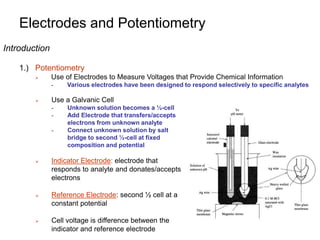
1.) Potentiometry
 Use of Electrodes to Measure Voltages that Provide Chemical Information
- Various electrodes have been designed to respond selectively to specific analytes
 Use a Galvanic Cell
- Unknown solution becomes a ½-cell
- Add Electrode that transfers/accepts
electrons from unknown analyte
- Connect unknown solution by salt
bridge to second ½-cell at fixed
composition and potential
 Indicator Electrode: electrode that
responds to analyte and donates/accepts
electrons
 Reference Electrode: second ½ cell at a
constant potential
 Cell voltage is difference between the
indicator and reference electrode
Binding generates
potential difference.
Electrodes and Potentiometry
Introduction
2.) Example
 A Heparin Sensor
- Voltage response is proportional to heparin concentration in blood
- Sensor is selective for heparin
Negatively charged heparin
binds selectively to positively
charged membrane.
heparin
Potential is
proportional to
[heparin]
Electrodes and Potentiometry
Reference Electrodes
1.) Overview
 Potential change only dependent on one ½ cell concentrations
 Reference electrode is fixed or saturated  doesn’t change!
Reference electrode,
[Cl-] is constant
Potential of the cell
only depends on
[Fe2+] & [Fe3+]
Pt wire is indicator
electrode whose
potential responds
to [Fe2+]/[Fe3+]
 
]
Cl
log[
.
.
]
Fe
[
]
Fe
[
log
.
.
Ecell
























 05916
0
222
0
1
05916
0
771
0
3
2
Unknown solution of
[Fe2+] & [Fe3+]
Electrodes and Potentiometry
Reference Electrodes
2.) Silver-Silver Chloride Reference Electrode
 Convenient
- Common problem is porous plug becomes clogged
Eo = +0.222 V
Activity of Cl- not 1E(sat,KCl) = +0.197 V
Electrodes and Potentiometry
Reference Electrodes
3.) Saturated Calomel Reference Electrode (S.C.E)
 Saturated KCl maintains constant [Cl-] even with
some evaporation
 Standard hydrogen electrodes are cumbersome
- Requires H2 gas and freshly prepared Pt surface
Eo = +0.268 V
Activity of Cl- not 1E(sat,KCl) = +0.241 V
Electrodes and Potentiometry
Reference Electrodes
4.) Observed Voltage is Reference Electrode Dependant
 The observed potential depends on the choice of reference electrode
- Silver-silver chloride and calomel have different potentials
 Use Reference Scale to convert between Reference Electrodes
Observed potential relative to SCE
Observed potential relative to Ag|AgCl
Observed potential relative to SHE
Electrodes and Potentiometry
Junction Potential
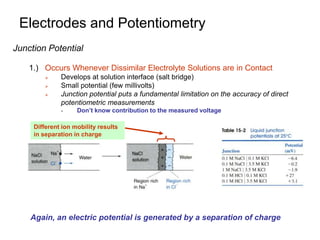
1.) Occurs Whenever Dissimilar Electrolyte Solutions are in Contact
 Develops at solution interface (salt bridge)
 Small potential (few millivolts)
 Junction potential puts a fundamental limitation on the accuracy of direct
potentiometric measurements
- Don’t know contribution to the measured voltage
Again, an electric potential is generated by a separation of charge
Different ion mobility results
in separation in charge
Electrodes and Potentiometry
Indicator Electrodes
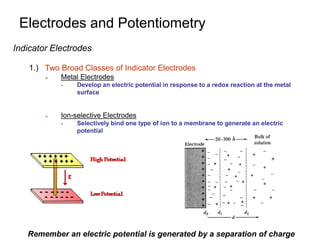
1.) Two Broad Classes of Indicator Electrodes
 Metal Electrodes
- Develop an electric potential in response to a redox reaction at the metal
surface
 Ion-selective Electrodes
- Selectively bind one type of ion to a membrane to generate an electric
potential
Remember an electric potential is generated by a separation of charge
Electrodes and Potentiometry
Indicator Electrodes
2.) Metal Electrodes
 Platinum
- Most common metal indicator electrode
- Inert: does not participate in many chemical reactions
- Simply used to transmit electrons
 Other electrodes include Gold and Carbon
 Metals (Ag, Cu, Zn, Cd, Hg) can be used to monitor their aqueous ions
- Most metals are not useable
- Equilibrium not readily established at the metal surface
E+
o = +799 V
E(sat,KCl) = +0.241 V
½ Reaction at Ag indicator electrode:
½ Reaction at Calomel reference electrode:
 
241
0
1
1
05916
0
799
0 .
]
Ag
[
log
.
.
E
E
Ecell 

























Potential of Ag
indicator electrode
Cell voltage changes as a function of [Ag+]
Example:
Cell Potential from Nernst Equation:
Electrodes and Potentiometry
Indicator Electrodes
3.) Example
 A 10.0 mL solution of 0.0500 M AgNO3 was titrated with 0.0250M NaBr in
the cell:
S.C.E. || titration solution | Ag(s)
Find the cell voltage for 10.0 mL of titrant
C+ diffuses across the membrane due to
concentration gradient resulting in charge
difference across membrane
Electrodes and Potentiometry
Indicator Electrodes
4.) Ion-Selective Electrodes
 Responds Selectively to one ion
- Contains a thin membrane
capable of only binding the
desired ion
 Does not involve a redox process
Membrane contains a ligand (L) that
specifically and tightly binds analyte
of interest (C+)
A difference in the concentration of C+
exists across the outer membrane.
The counter-ions (R-,A-) can’t cross the
membrane and/or have low solubility in
membrane or analyte solution
Remember an electric potential is generated by a separation of charge
Potential across outer membrane depends on
[C+] in analyte solution
Electrodes and Potentiometry
Indicator Electrodes
4.) Ion-Selective Electrodes
 Responds Selectively to one ion
- Contains a thin membrane
capable of only binding the
desired ion
 Does not involve a redox process
Remember an electric potential is generated by a separation of charge
Potential across inner membrane depends on [C+]
in filling solution, which is a known constant
C+ diffuses across the membrane due to
concentration gradient resulting in charge
difference across membrane
A difference in the concentration of C+
exists across the inner membrane.
inner
outer E
E
E 

Electrode potential is determined by the potential
difference between the inner and outer membranes:
where Einner is a constant and Eouter depends on the
concentration of C+ in analyte solution
]
[
constant 

 C
log
n
.
E
05916
0
Electrodes and Potentiometry
Indicator Electrodes
4.) Ion-Selective Electrodes
 Responds Selectively to one ion
- Contains a thin membrane
capable of only binding the
desired ion
 Does not involve a redox process
Electrode Potential is defined as:
where [C+] is actually the activity of the analyte and
n is the charge of the analyte
Electrodes and Potentiometry
pH Electrodes
1.) pH Measurement with a Glass Electrode
 Glass electrode is most common ion-selective electrode
 Combination electrode incorporates both glass and
reference electrode in one body
Ag(s)|AgCl(s)|Cl-(aq)||H+(aq,outside) H+(aq,inside),Cl-(aq)|AgCl(s)|Ag(s)
Outer reference
electrode
[H+] outside
(analyte solution)
[H+] inside Inner reference
electrode
Glass membrane
Selectively binds H+
Electric potential is generated by [H+] difference across glass membrane
Electrodes and Potentiometry
pH Electrodes
2.) Glass Membrane
 Irregular structure of silicate lattice
Cations (Na+) bind
oxygen in SiO4 structure
Electrodes and Potentiometry
pH Electrodes
2.) Glass Membrane
 Two surfaces of glass “swell” as they absorb water
- Surfaces are in contact with [H+]
Electrodes and Potentiometry
pH Electrodes
2.) Glass Membrane
 H+ diffuse into glass membrane and replace Na+ in hydrated gel region
- Ion-exchange equilibrium
- Selective for H+ because H+ is only ion that binds significantly to the
hydrated gel layer
H
(0.05916)
constant p
E 


Charge is slowly carried
by migration of Na+
across glass membrane
Potential is determined
by external [H+]
Constant and b are measured when electrode is calibrated with solution of known pH
Electrodes and Potentiometry
pH Electrodes
3.) Calibration
 A pH electrode should be calibrated with two or more standard buffers
before use.
 pH of the unknown should lie within the range of the standard buffers
Measured voltage is correlated
with a pH, which is then used to
measure an unknown.
Electrodes and Potentiometry
pH Electrodes
4.) Errors in pH Measurements
 Standards
- pH measurements cannot be more accurate than standards (±0.01)
 Junction potential
- If ionic strengths differ between analyte and standard buffer, junction potential
will differ resulting in an error of ±0.01
 Junction Potential Drift
- Caused by slow changes in [KCl] and [AgCl] re-calibrate!
 Sodium Error
- At very low [H+], electrode responds to Na+ and the apparent pH is lower than
the true pH
 Acid Error
- At high [H+], the measured pH is higher than actual pH, glass is saturated
 Equilibration Time
- Takes ~30s to minutes for electrode to equilibrate with solution
 Hydration of glass
- A dry electrode will not respond to H+ correctly
 Temperature
- Calibration needs to be done at same temperature of measurement
 Cleaning
- Contaminates on probe will cause reading to drift until properly cleaned or
equilibrated with analyte solution
Electrodes and Potentiometry
pH Electrodes
4.) Errors in pH Measurements
 pH measurements are accurate to ± 0.02 pH units
Larger errors occur at high
and low pH readings
Electrodes and Potentiometry
Other Ion-Selective Electrodes
1.) Solid-State Electrode
 Based on an inorganic crystal
- Fluoride electrode: LaF3 crystal doped with Eu2+
F- migrates across crystal by “jumping”
into crystal vacancies caused by Eu2+
Potential caused by charge imbalance from migrating ion across membrane


 F
(0.05916)
constant p
E 
Electrodes and Potentiometry
Other Ion-Selective Electrodes
2.) Liquid-Based Ion-Selective Electrodes
 Similar to solid-state electrode
- Hydrophobic membrane impregnated with hydrophobic ion exchanger
- Hydrophobic ion exchanger selective for analyte ion


 2
pCa
E )
2
0.05916
(
constant 
Binds Ca+2
Hydrophobic solvent
Hydrophobic counter-ion
Electrodes and Potentiometry
Other Ion-Selective Electrodes
2.) Liquid-Based Ion-Selective
Electrodes
Remember: ion-selective electrodes
create a potential from a charge
imbalance caused by analyte ion
migration across membrane
Electrodes and Potentiometry
Other Ion-Selective Electrodes
3.) Compound Electrodes
 Conventional electrode surrounded by a membrane that isolates or generates
the analyte to which the electrode responds
pH electrode surrounded by membrane
permeable to CO2.
As CO2 passes through membrane and
dissolves in solution, pH changes.
pH change is an indirect measure of CO2
concentration
Electrodes and Potentiometry
Other Ion-Selective Electrodes
4.) Standard Addition
 Corrects for analyte dissolved in complex or unknown matrix
- Blood, urine, biomass, etc
 Procedure:
1. Measure potential for unknown analyte solution
2. Add small (known) volume of a standard solution
3. Measure new potential
4. Repeat and graph data
s
s
S
/
k
x
o
S
/
k
S
/
E
s
o V
c
c
V
)
V
V
( 10
10
10 


y b m x
where:
Vo is the initial volume
Vs is the added volume
E is the measured potential
cx is the unknown concentration
cs is the standard concentration
s is a constant (RT/nF)ln10
Other Ion-Selective Electrodes
4.) Standard Addition
 Corrects for analyte dissolved in complex or unknown matrix
- Blood, urine, biomass, etc
 Procedure:
5. x-intercept yields the unknown (cx) concentration
Electrodes and Potentiometry
s
x
o
c
c
V
m
b
x 


 intercept
Only unknown

Electrodes and Potentiometry.ppt

  • 1.
  • 2.
    Electrodes and Potentiometry Introduction 1.)Potentiometry  Use of Electrodes to Measure Voltages that Provide Chemical Information - Various electrodes have been designed to respond selectively to specific analytes  Use a Galvanic Cell - Unknown solution becomes a ½-cell - Add Electrode that transfers/accepts electrons from unknown analyte - Connect unknown solution by salt bridge to second ½-cell at fixed composition and potential  Indicator Electrode: electrode that responds to analyte and donates/accepts electrons  Reference Electrode: second ½ cell at a constant potential  Cell voltage is difference between the indicator and reference electrode
  • 3.
    Binding generates potential difference. Electrodesand Potentiometry Introduction 2.) Example  A Heparin Sensor - Voltage response is proportional to heparin concentration in blood - Sensor is selective for heparin Negatively charged heparin binds selectively to positively charged membrane. heparin Potential is proportional to [heparin]
  • 4.
    Electrodes and Potentiometry ReferenceElectrodes 1.) Overview  Potential change only dependent on one ½ cell concentrations  Reference electrode is fixed or saturated  doesn’t change! Reference electrode, [Cl-] is constant Potential of the cell only depends on [Fe2+] & [Fe3+] Pt wire is indicator electrode whose potential responds to [Fe2+]/[Fe3+]   ] Cl log[ . . ] Fe [ ] Fe [ log . . Ecell                          05916 0 222 0 1 05916 0 771 0 3 2 Unknown solution of [Fe2+] & [Fe3+]
  • 5.
    Electrodes and Potentiometry ReferenceElectrodes 2.) Silver-Silver Chloride Reference Electrode  Convenient - Common problem is porous plug becomes clogged Eo = +0.222 V Activity of Cl- not 1E(sat,KCl) = +0.197 V
  • 6.
    Electrodes and Potentiometry ReferenceElectrodes 3.) Saturated Calomel Reference Electrode (S.C.E)  Saturated KCl maintains constant [Cl-] even with some evaporation  Standard hydrogen electrodes are cumbersome - Requires H2 gas and freshly prepared Pt surface Eo = +0.268 V Activity of Cl- not 1E(sat,KCl) = +0.241 V
  • 7.
    Electrodes and Potentiometry ReferenceElectrodes 4.) Observed Voltage is Reference Electrode Dependant  The observed potential depends on the choice of reference electrode - Silver-silver chloride and calomel have different potentials  Use Reference Scale to convert between Reference Electrodes Observed potential relative to SCE Observed potential relative to Ag|AgCl Observed potential relative to SHE
  • 8.
    Electrodes and Potentiometry JunctionPotential 1.) Occurs Whenever Dissimilar Electrolyte Solutions are in Contact  Develops at solution interface (salt bridge)  Small potential (few millivolts)  Junction potential puts a fundamental limitation on the accuracy of direct potentiometric measurements - Don’t know contribution to the measured voltage Again, an electric potential is generated by a separation of charge Different ion mobility results in separation in charge
  • 9.
    Electrodes and Potentiometry IndicatorElectrodes 1.) Two Broad Classes of Indicator Electrodes  Metal Electrodes - Develop an electric potential in response to a redox reaction at the metal surface  Ion-selective Electrodes - Selectively bind one type of ion to a membrane to generate an electric potential Remember an electric potential is generated by a separation of charge
  • 10.
    Electrodes and Potentiometry IndicatorElectrodes 2.) Metal Electrodes  Platinum - Most common metal indicator electrode - Inert: does not participate in many chemical reactions - Simply used to transmit electrons  Other electrodes include Gold and Carbon  Metals (Ag, Cu, Zn, Cd, Hg) can be used to monitor their aqueous ions - Most metals are not useable - Equilibrium not readily established at the metal surface E+ o = +799 V E(sat,KCl) = +0.241 V ½ Reaction at Ag indicator electrode: ½ Reaction at Calomel reference electrode:   241 0 1 1 05916 0 799 0 . ] Ag [ log . . E E Ecell                           Potential of Ag indicator electrode Cell voltage changes as a function of [Ag+] Example: Cell Potential from Nernst Equation:
  • 11.
    Electrodes and Potentiometry IndicatorElectrodes 3.) Example  A 10.0 mL solution of 0.0500 M AgNO3 was titrated with 0.0250M NaBr in the cell: S.C.E. || titration solution | Ag(s) Find the cell voltage for 10.0 mL of titrant
  • 12.
    C+ diffuses acrossthe membrane due to concentration gradient resulting in charge difference across membrane Electrodes and Potentiometry Indicator Electrodes 4.) Ion-Selective Electrodes  Responds Selectively to one ion - Contains a thin membrane capable of only binding the desired ion  Does not involve a redox process Membrane contains a ligand (L) that specifically and tightly binds analyte of interest (C+) A difference in the concentration of C+ exists across the outer membrane. The counter-ions (R-,A-) can’t cross the membrane and/or have low solubility in membrane or analyte solution Remember an electric potential is generated by a separation of charge Potential across outer membrane depends on [C+] in analyte solution
  • 13.
    Electrodes and Potentiometry IndicatorElectrodes 4.) Ion-Selective Electrodes  Responds Selectively to one ion - Contains a thin membrane capable of only binding the desired ion  Does not involve a redox process Remember an electric potential is generated by a separation of charge Potential across inner membrane depends on [C+] in filling solution, which is a known constant C+ diffuses across the membrane due to concentration gradient resulting in charge difference across membrane A difference in the concentration of C+ exists across the inner membrane. inner outer E E E   Electrode potential is determined by the potential difference between the inner and outer membranes: where Einner is a constant and Eouter depends on the concentration of C+ in analyte solution
  • 14.
    ] [ constant    C log n . E 05916 0 Electrodesand Potentiometry Indicator Electrodes 4.) Ion-Selective Electrodes  Responds Selectively to one ion - Contains a thin membrane capable of only binding the desired ion  Does not involve a redox process Electrode Potential is defined as: where [C+] is actually the activity of the analyte and n is the charge of the analyte
  • 15.
    Electrodes and Potentiometry pHElectrodes 1.) pH Measurement with a Glass Electrode  Glass electrode is most common ion-selective electrode  Combination electrode incorporates both glass and reference electrode in one body Ag(s)|AgCl(s)|Cl-(aq)||H+(aq,outside) H+(aq,inside),Cl-(aq)|AgCl(s)|Ag(s) Outer reference electrode [H+] outside (analyte solution) [H+] inside Inner reference electrode Glass membrane Selectively binds H+ Electric potential is generated by [H+] difference across glass membrane
  • 16.
    Electrodes and Potentiometry pHElectrodes 2.) Glass Membrane  Irregular structure of silicate lattice Cations (Na+) bind oxygen in SiO4 structure
  • 17.
    Electrodes and Potentiometry pHElectrodes 2.) Glass Membrane  Two surfaces of glass “swell” as they absorb water - Surfaces are in contact with [H+]
  • 18.
    Electrodes and Potentiometry pHElectrodes 2.) Glass Membrane  H+ diffuse into glass membrane and replace Na+ in hydrated gel region - Ion-exchange equilibrium - Selective for H+ because H+ is only ion that binds significantly to the hydrated gel layer H (0.05916) constant p E    Charge is slowly carried by migration of Na+ across glass membrane Potential is determined by external [H+] Constant and b are measured when electrode is calibrated with solution of known pH
  • 19.
    Electrodes and Potentiometry pHElectrodes 3.) Calibration  A pH electrode should be calibrated with two or more standard buffers before use.  pH of the unknown should lie within the range of the standard buffers Measured voltage is correlated with a pH, which is then used to measure an unknown.
  • 20.
    Electrodes and Potentiometry pHElectrodes 4.) Errors in pH Measurements  Standards - pH measurements cannot be more accurate than standards (±0.01)  Junction potential - If ionic strengths differ between analyte and standard buffer, junction potential will differ resulting in an error of ±0.01  Junction Potential Drift - Caused by slow changes in [KCl] and [AgCl] re-calibrate!  Sodium Error - At very low [H+], electrode responds to Na+ and the apparent pH is lower than the true pH  Acid Error - At high [H+], the measured pH is higher than actual pH, glass is saturated  Equilibration Time - Takes ~30s to minutes for electrode to equilibrate with solution  Hydration of glass - A dry electrode will not respond to H+ correctly  Temperature - Calibration needs to be done at same temperature of measurement  Cleaning - Contaminates on probe will cause reading to drift until properly cleaned or equilibrated with analyte solution
  • 21.
    Electrodes and Potentiometry pHElectrodes 4.) Errors in pH Measurements  pH measurements are accurate to ± 0.02 pH units Larger errors occur at high and low pH readings
  • 22.
    Electrodes and Potentiometry OtherIon-Selective Electrodes 1.) Solid-State Electrode  Based on an inorganic crystal - Fluoride electrode: LaF3 crystal doped with Eu2+ F- migrates across crystal by “jumping” into crystal vacancies caused by Eu2+ Potential caused by charge imbalance from migrating ion across membrane    F (0.05916) constant p E 
  • 23.
    Electrodes and Potentiometry OtherIon-Selective Electrodes 2.) Liquid-Based Ion-Selective Electrodes  Similar to solid-state electrode - Hydrophobic membrane impregnated with hydrophobic ion exchanger - Hydrophobic ion exchanger selective for analyte ion    2 pCa E ) 2 0.05916 ( constant  Binds Ca+2 Hydrophobic solvent Hydrophobic counter-ion
  • 24.
    Electrodes and Potentiometry OtherIon-Selective Electrodes 2.) Liquid-Based Ion-Selective Electrodes Remember: ion-selective electrodes create a potential from a charge imbalance caused by analyte ion migration across membrane
  • 25.
    Electrodes and Potentiometry OtherIon-Selective Electrodes 3.) Compound Electrodes  Conventional electrode surrounded by a membrane that isolates or generates the analyte to which the electrode responds pH electrode surrounded by membrane permeable to CO2. As CO2 passes through membrane and dissolves in solution, pH changes. pH change is an indirect measure of CO2 concentration
  • 26.
    Electrodes and Potentiometry OtherIon-Selective Electrodes 4.) Standard Addition  Corrects for analyte dissolved in complex or unknown matrix - Blood, urine, biomass, etc  Procedure: 1. Measure potential for unknown analyte solution 2. Add small (known) volume of a standard solution 3. Measure new potential 4. Repeat and graph data s s S / k x o S / k S / E s o V c c V ) V V ( 10 10 10    y b m x where: Vo is the initial volume Vs is the added volume E is the measured potential cx is the unknown concentration cs is the standard concentration s is a constant (RT/nF)ln10
  • 27.
    Other Ion-Selective Electrodes 4.)Standard Addition  Corrects for analyte dissolved in complex or unknown matrix - Blood, urine, biomass, etc  Procedure: 5. x-intercept yields the unknown (cx) concentration Electrodes and Potentiometry s x o c c V m b x     intercept Only unknown