Quantitative Analysis (CHEM 309)
Basic Information
Office: Temple 4429
Office hours: MTWR Morning(or by appt)
Instructor: Dr. Collinson
Email: mmcollinson@vcu.edu
Text: Harris, Quantitative Chemical Analysis, 8th ed.
Course Information: Located on Blackboard
Purchase and Register Clicker (Rf) via Blackboard
Quantitative Analysis
Basic Information
Grade
tests (5): 70% **No Make up tests*
final : 20%
homework: 10%
Bring clicker to class everyday and participate.
Attendance at each and every class is very important
Class Objectives
Students Should Learn
1. How to Solve Problems (Acid-Base Chemistry)
2. Apply chemical concepts to chemical analysis
3. Different Analytical Techniques and Methods
4. Appreciation for Analytical Measurements
5. Appreciation for error in chemical analysis
First Law of Reality:
Second Law of Reality:
What you put in determines what you get out!
“Learning is a choice – your choice!”
Keys to Success
•Attend and participate in EVERY class
•Do homework each night
•Read the book each night; outline chapters as needed
•Seek help when needed
Classroom Etiquette
Do not talk when the instructor is talking
Laptops can be used to take notes, not for surfing the web
Silence cell phones
Abide by the VCU Honor Code
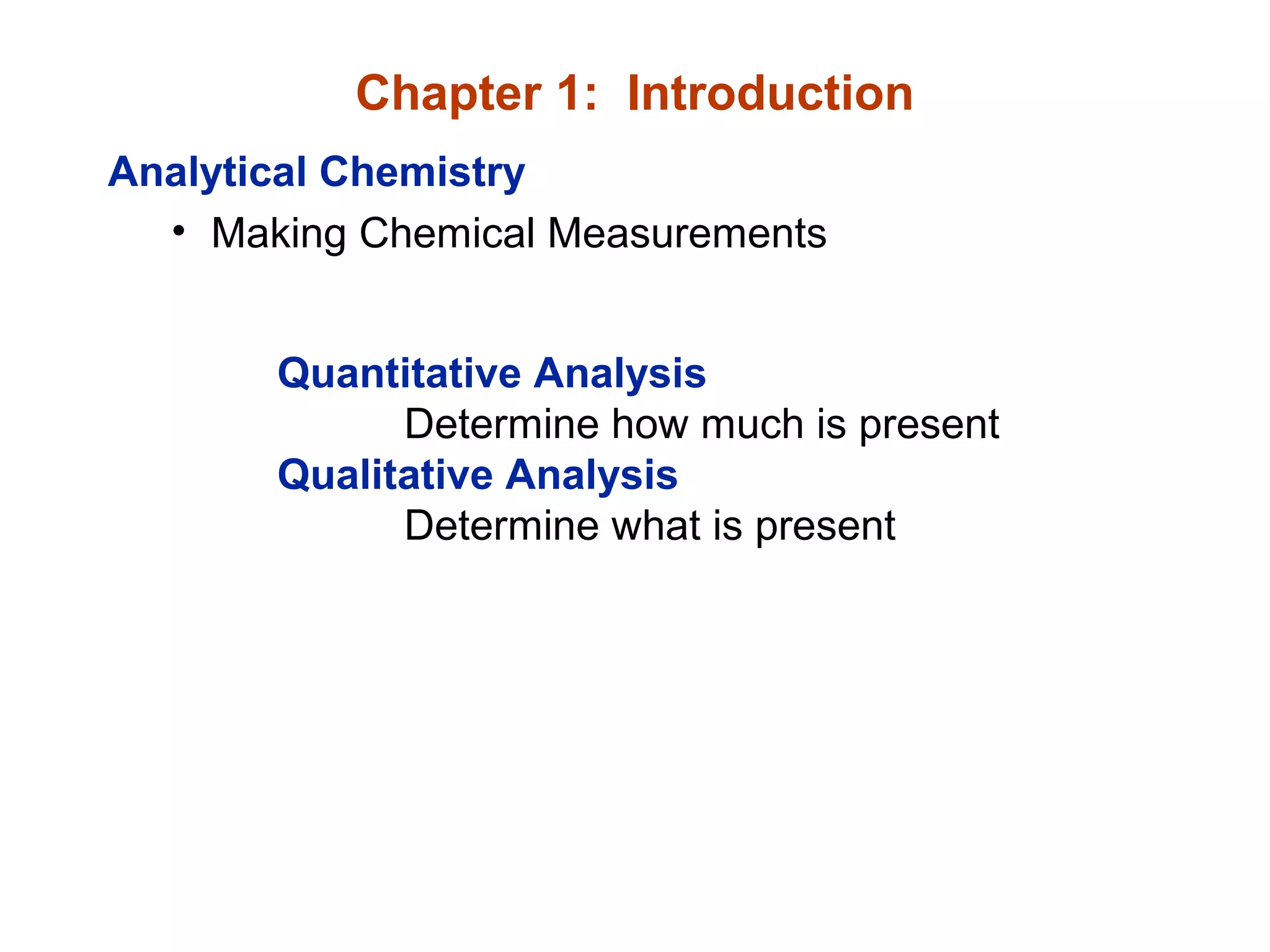
Chapter 1: Introduction
Analytical Chemistry
• Making Chemical Measurements
Quantitative Analysis
Determine how much is present
Qualitative Analysis
Determine what is present
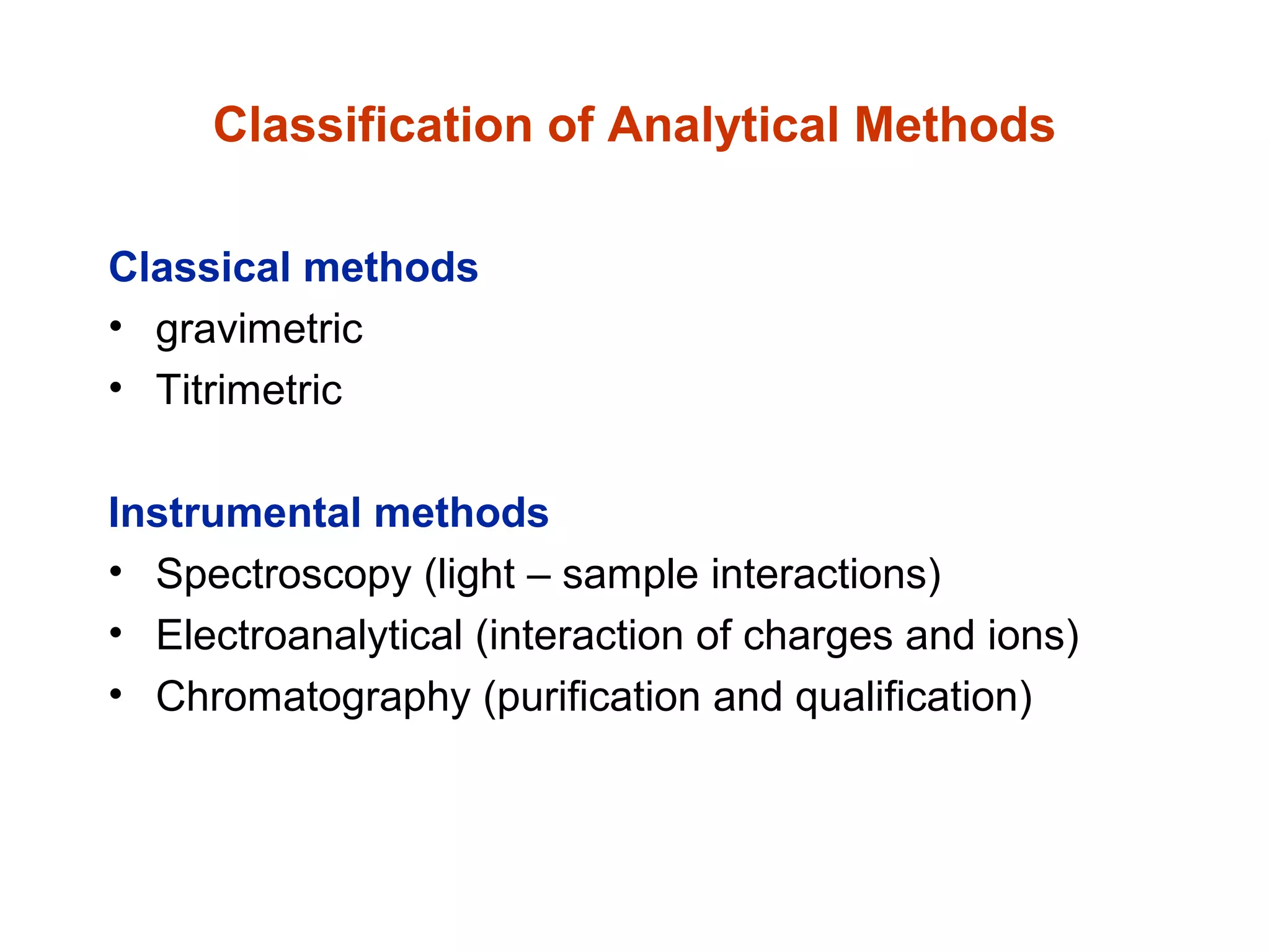
Classification of Analytical Methods
Classical methods
• gravimetric
• Titrimetric
Instrumental methods
• Spectroscopy (light – sample interactions)
• Electroanalytical (interaction of charges and ions)
• Chromatography (purification and qualification)
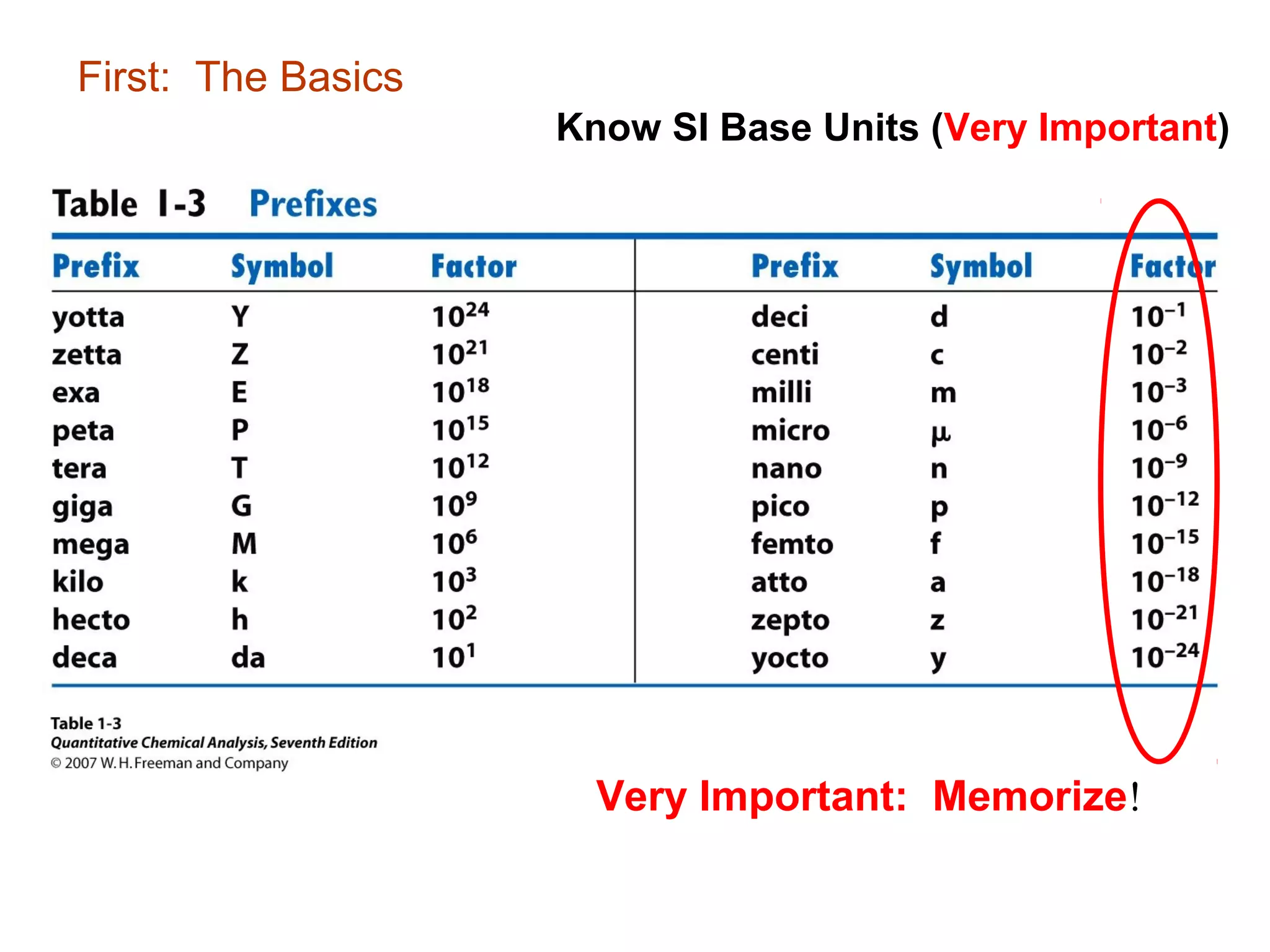
First: The Basics
Very Important: Memorize!
Know SI Base Units (Very Important)
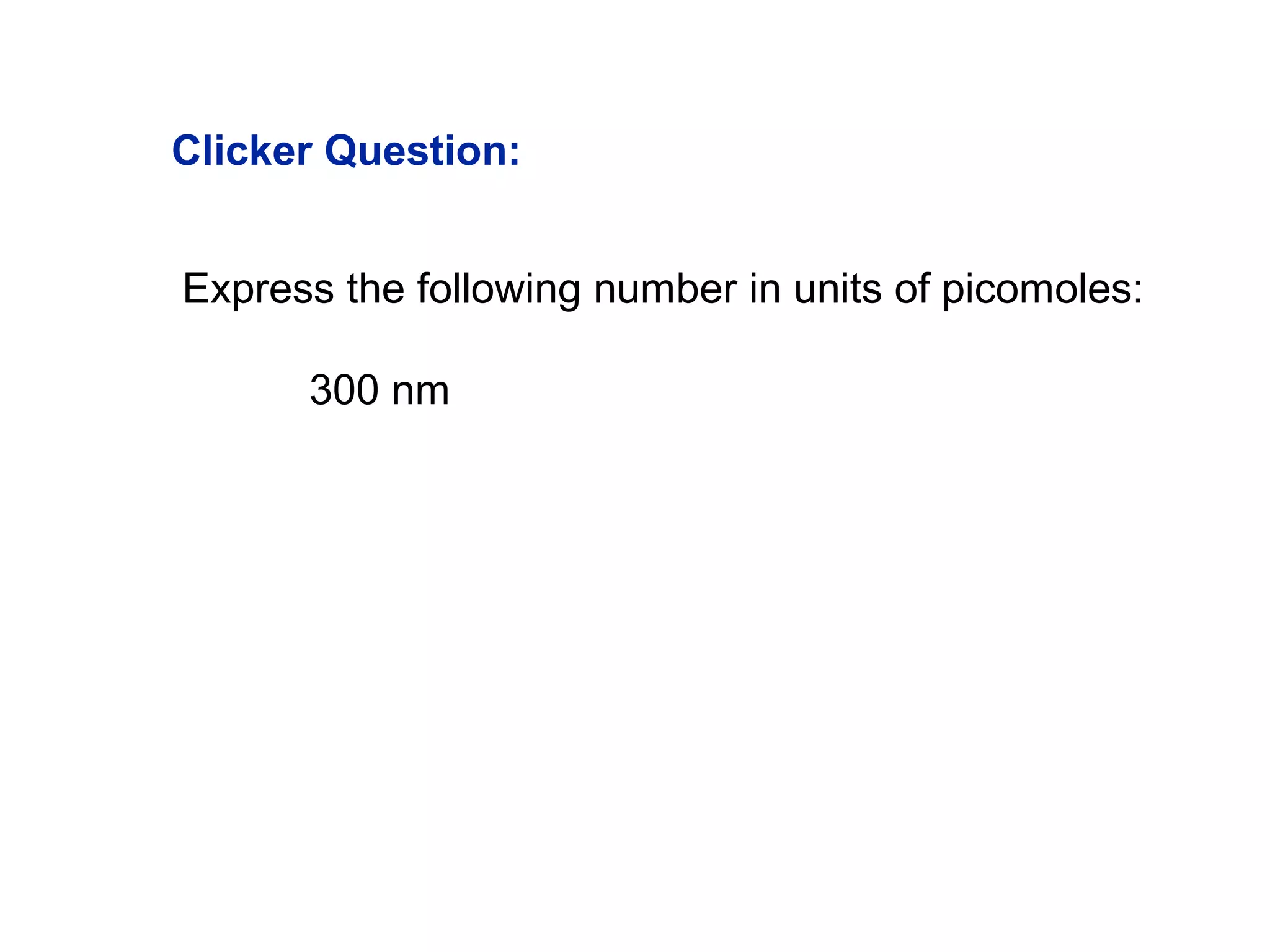
Clicker Question:
Express the following number in units of picomoles:
300 nm
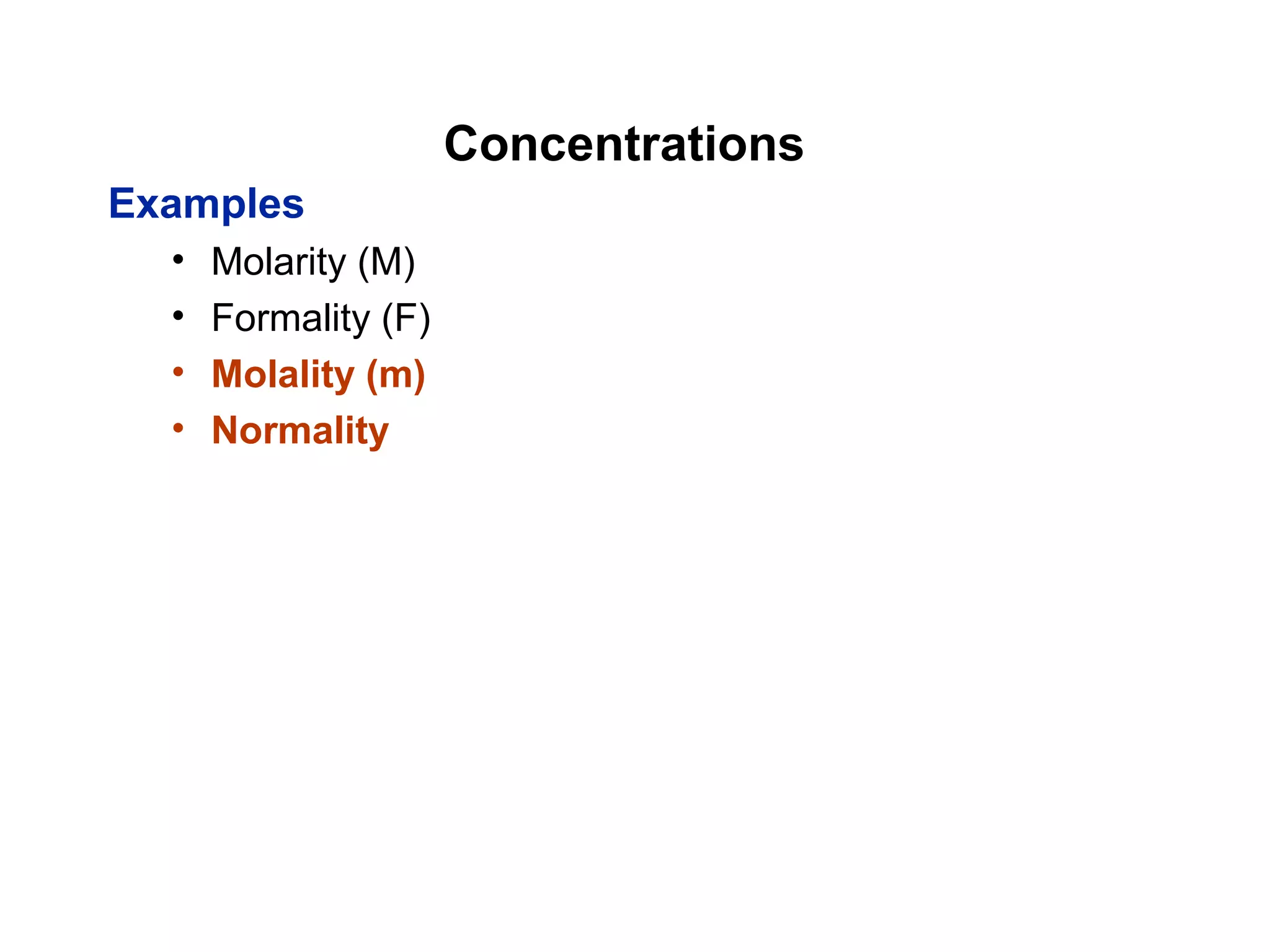
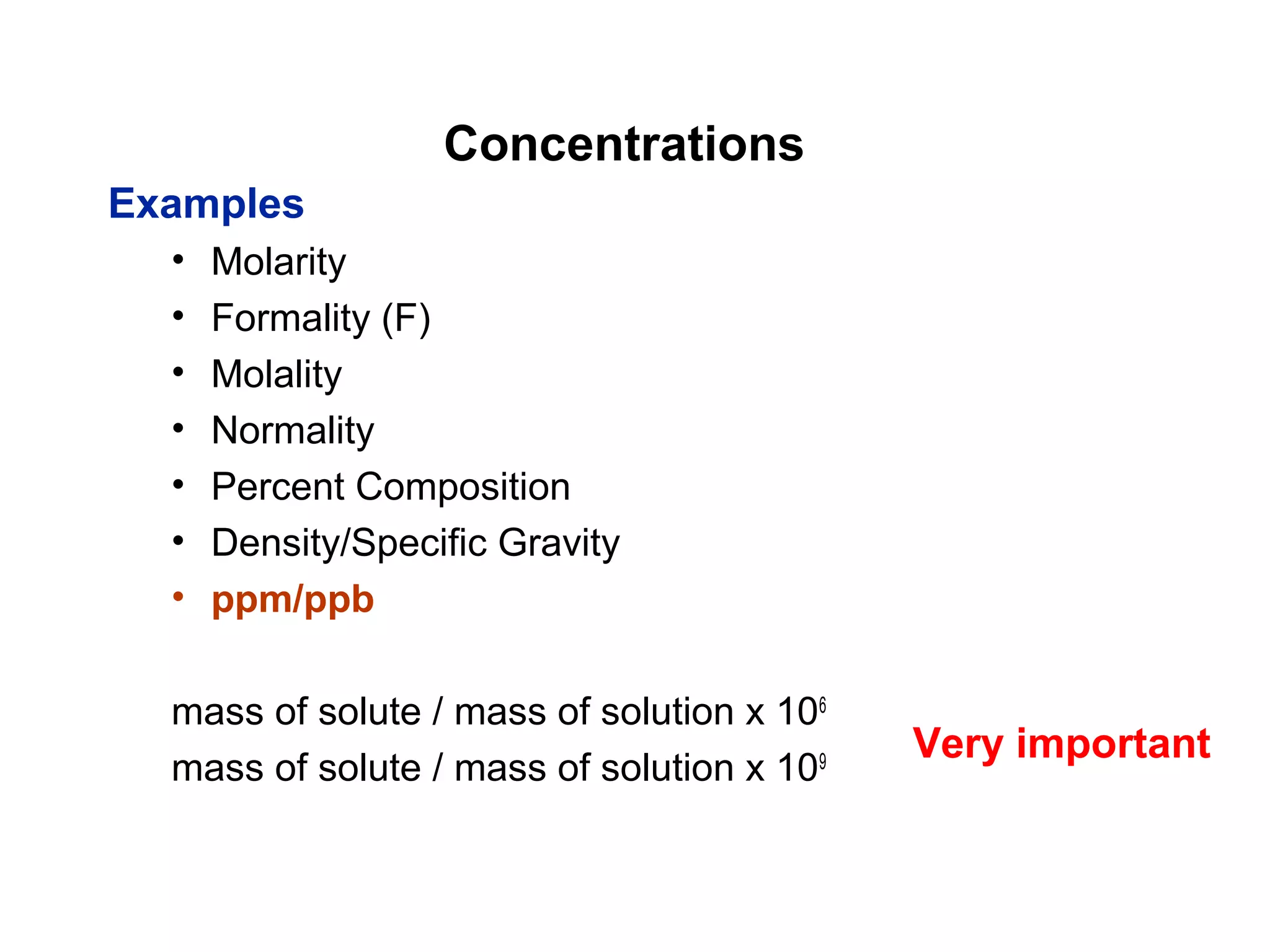
Concentrations
Examples
• Molarity (M)
• Formality (F)
• Molality (m)
• Normality (N)
• Percent Composition
• Density
• ppm/ppb
• p-functions
Concentrations
Examples
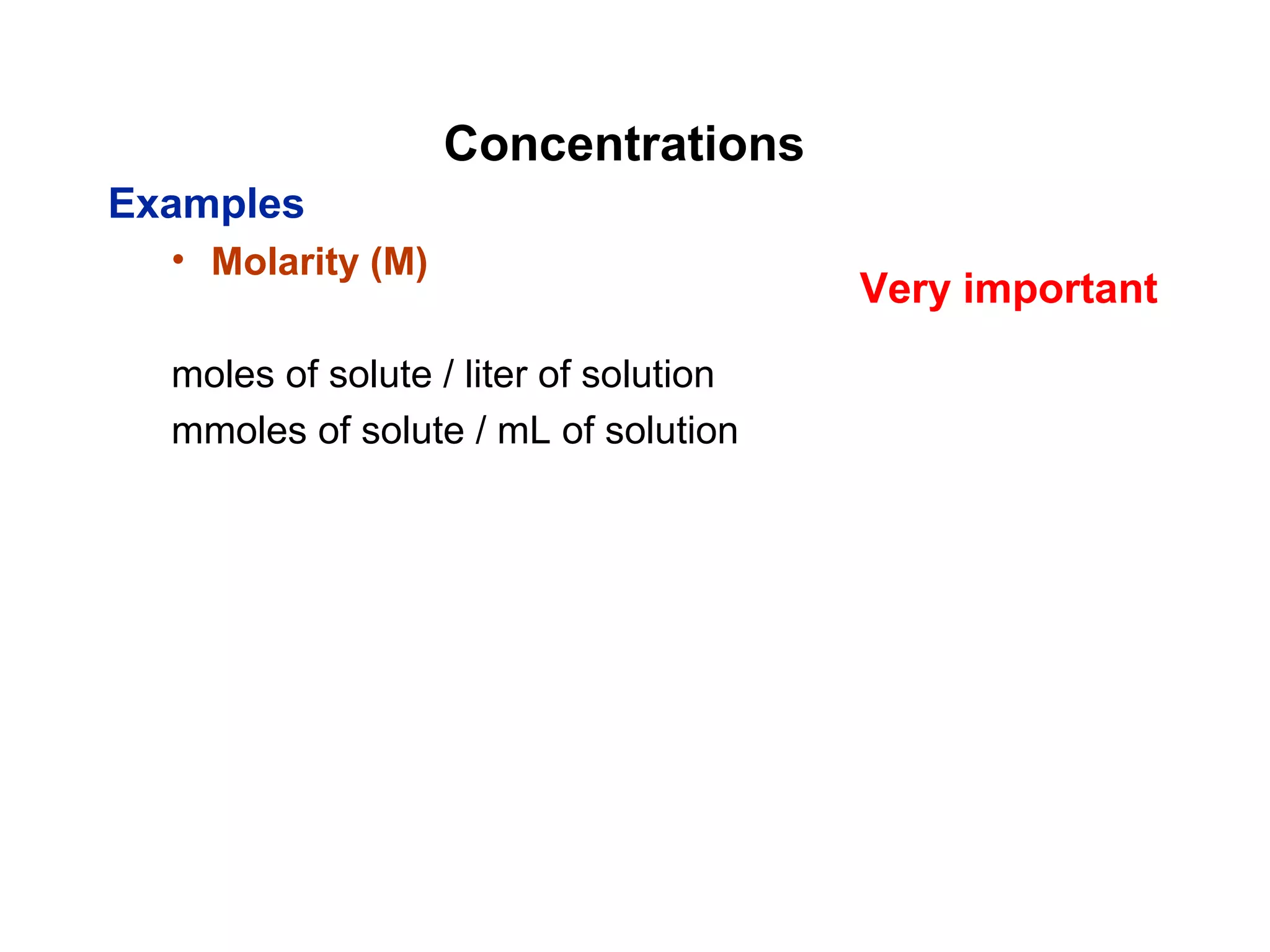
• Molarity (M)
moles of solute / liter of solution
mmoles of solute / mL of solution
Very important
Concentrations
Examples
• Molarity
• Formality (F)
ex. KCl
Your book loves using formality
Concentrations
Examples
• Molarity (M)
• Formality (F)
• Molality (m)
• Normality
Concentrations
Examples
• Molarity
• Formality (F)
• Molality
• Normality
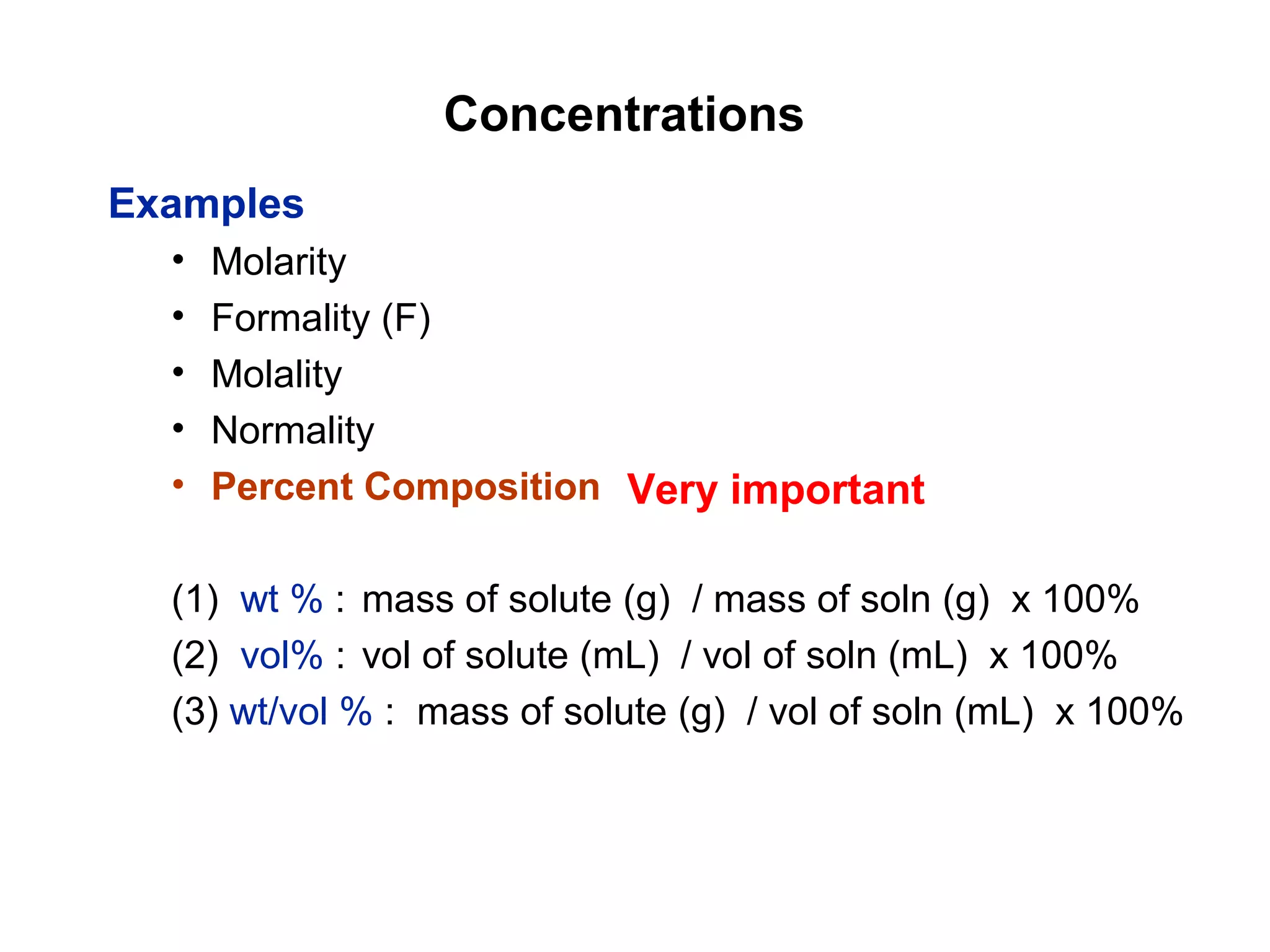
• Percent Composition
(1) wt % : mass of solute (g) / mass of soln (g) x 100%
(2) vol% : vol of solute (mL) / vol of soln (mL) x 100%
(3) wt/vol % : mass of solute (g) / vol of soln (mL) x 100%
Very important
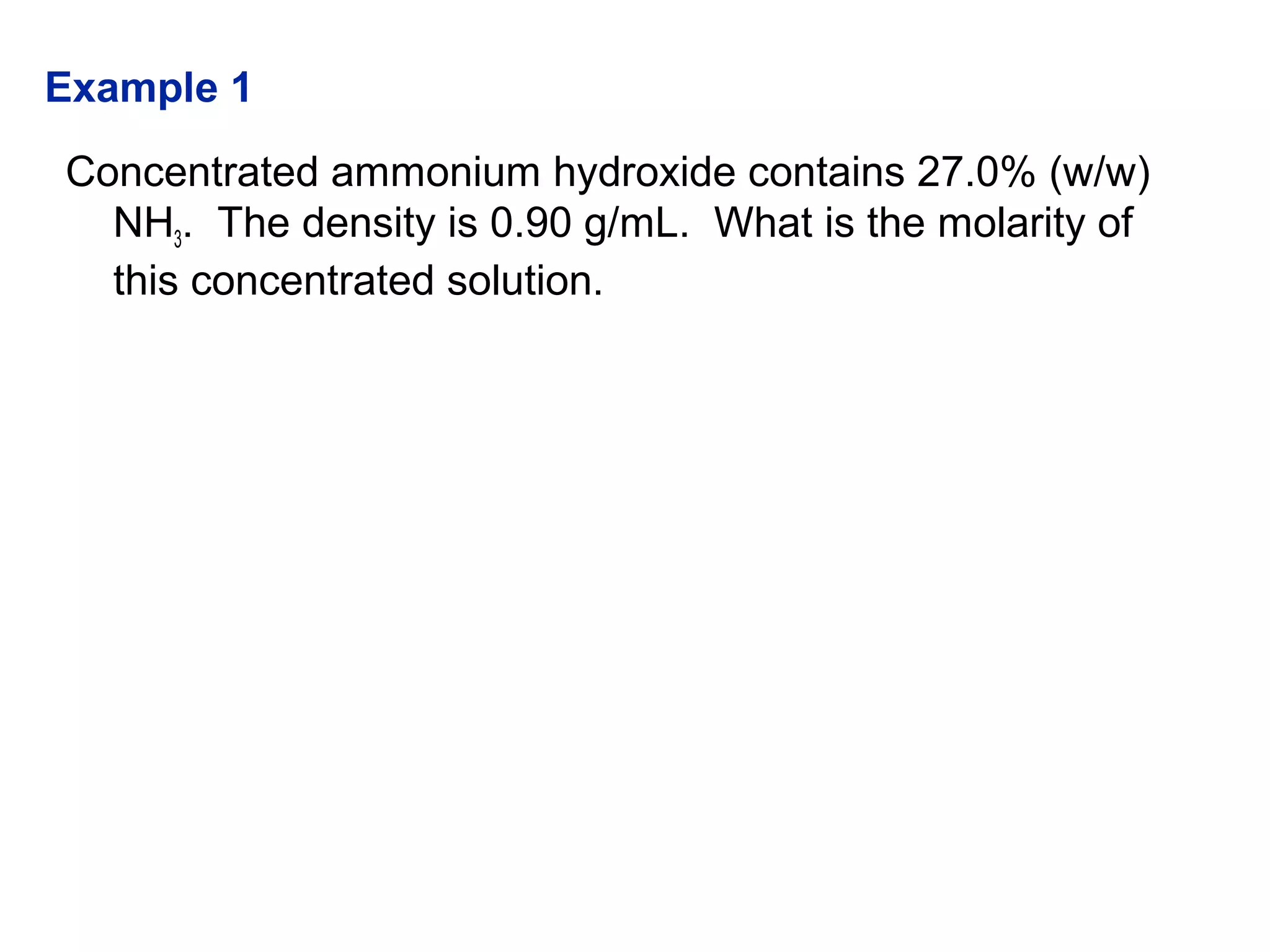
Concentrated ammonium hydroxide contains 27.0% (w/w)
NH3. The density is 0.90 g/mL. What is the molarity of
this concentrated solution.
Example 1
Concentrations
Examples
• Molarity
• Formality (F)
• Molality
• Normality
• Percent Composition
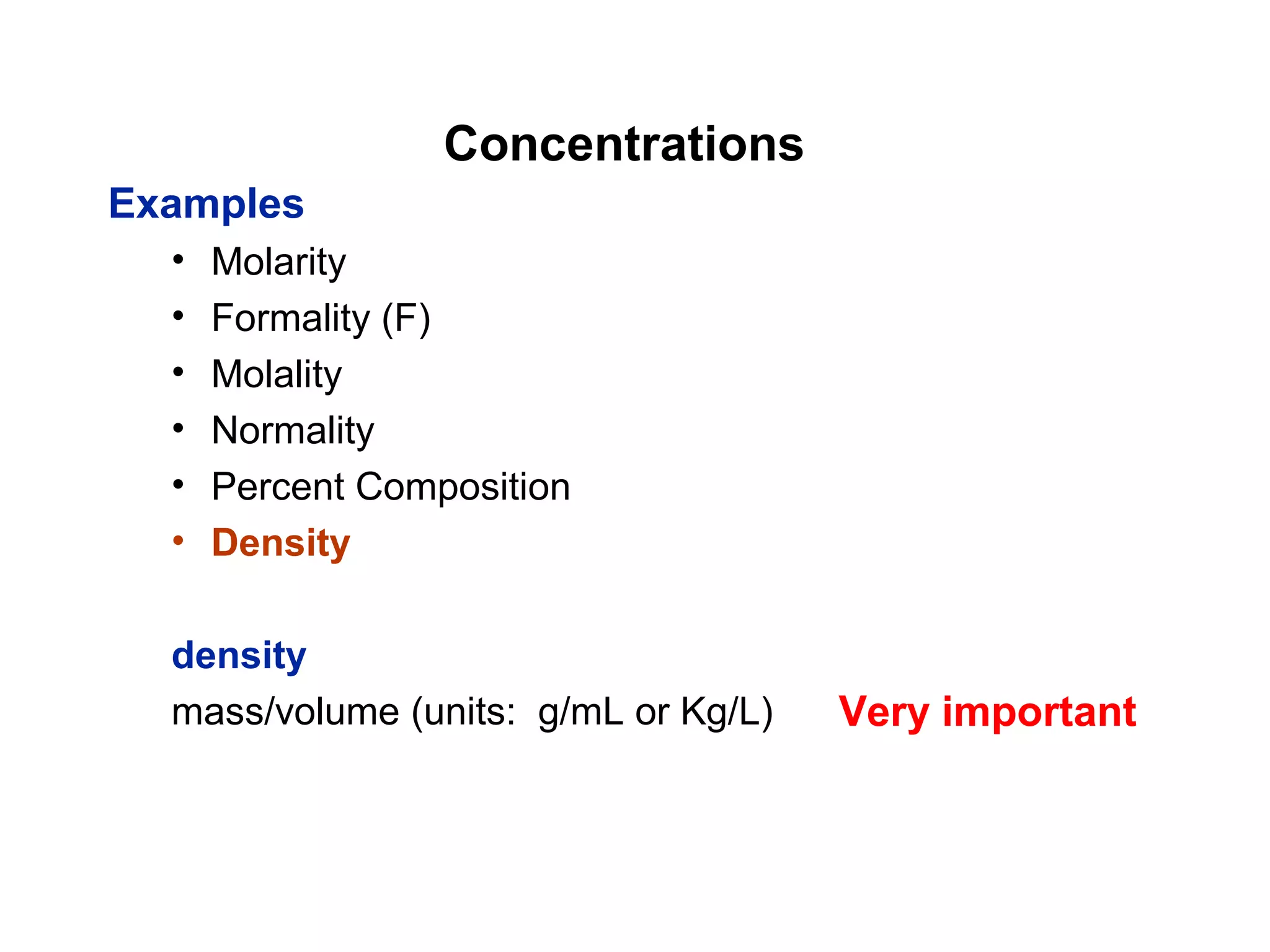
• Density
density
mass/volume (units: g/mL or Kg/L) Very important
Concentrations
Examples
• Molarity
• Formality (F)
• Molality
• Normality
• Percent Composition
• Density/Specific Gravity
• ppm/ppb
mass of solute / mass of solution x 106
mass of solute / mass of solution x 109
Very important
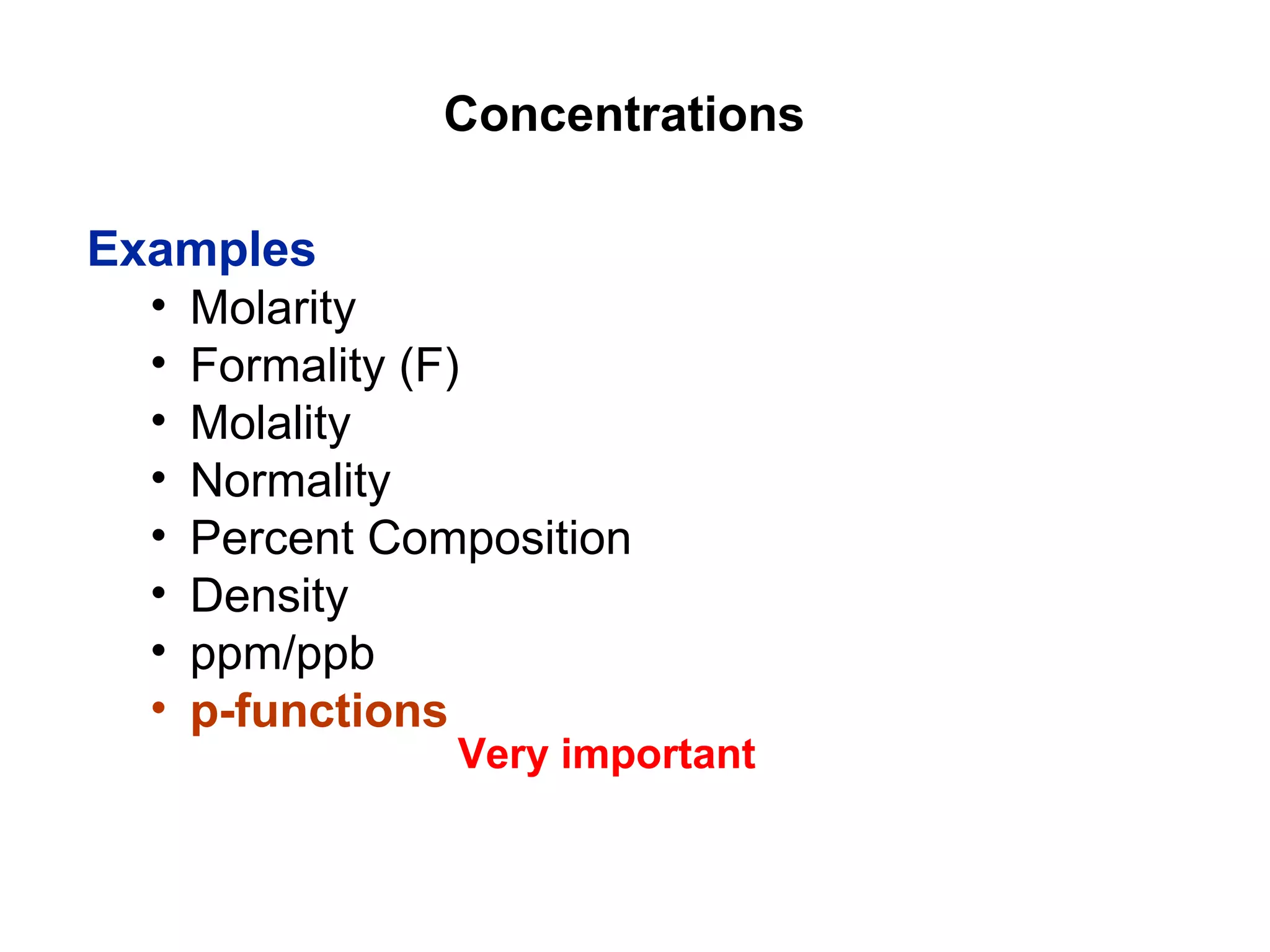
Concentrations
Examples
• Molarity
• Formality (F)
• Molality
• Normality
• Percent Composition
• Density
• ppm/ppb
• p-functions
Very important
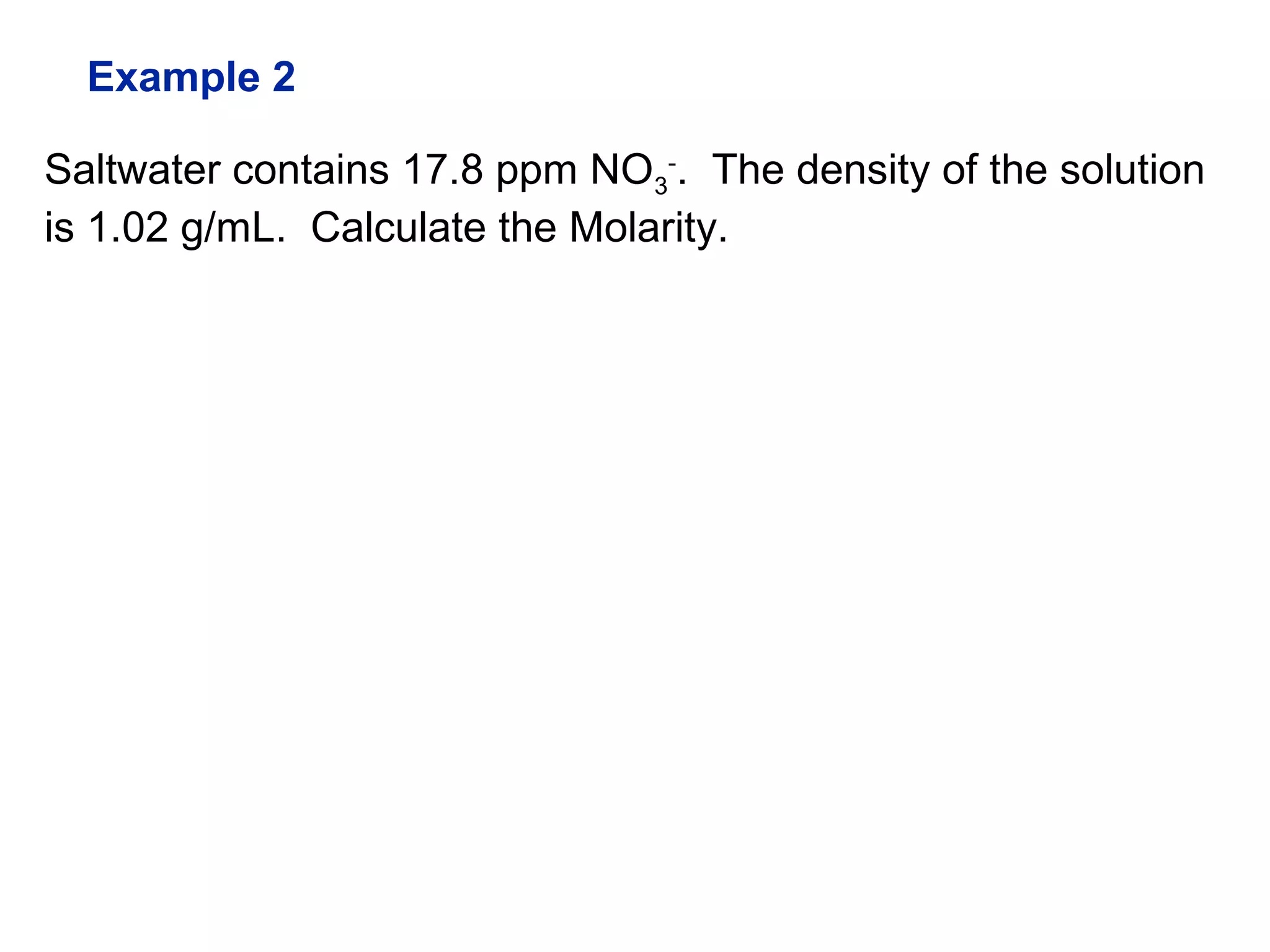
Saltwater contains 17.8 ppm NO3
-
. The density of the solution
is 1.02 g/mL. Calculate the Molarity.
Example 2
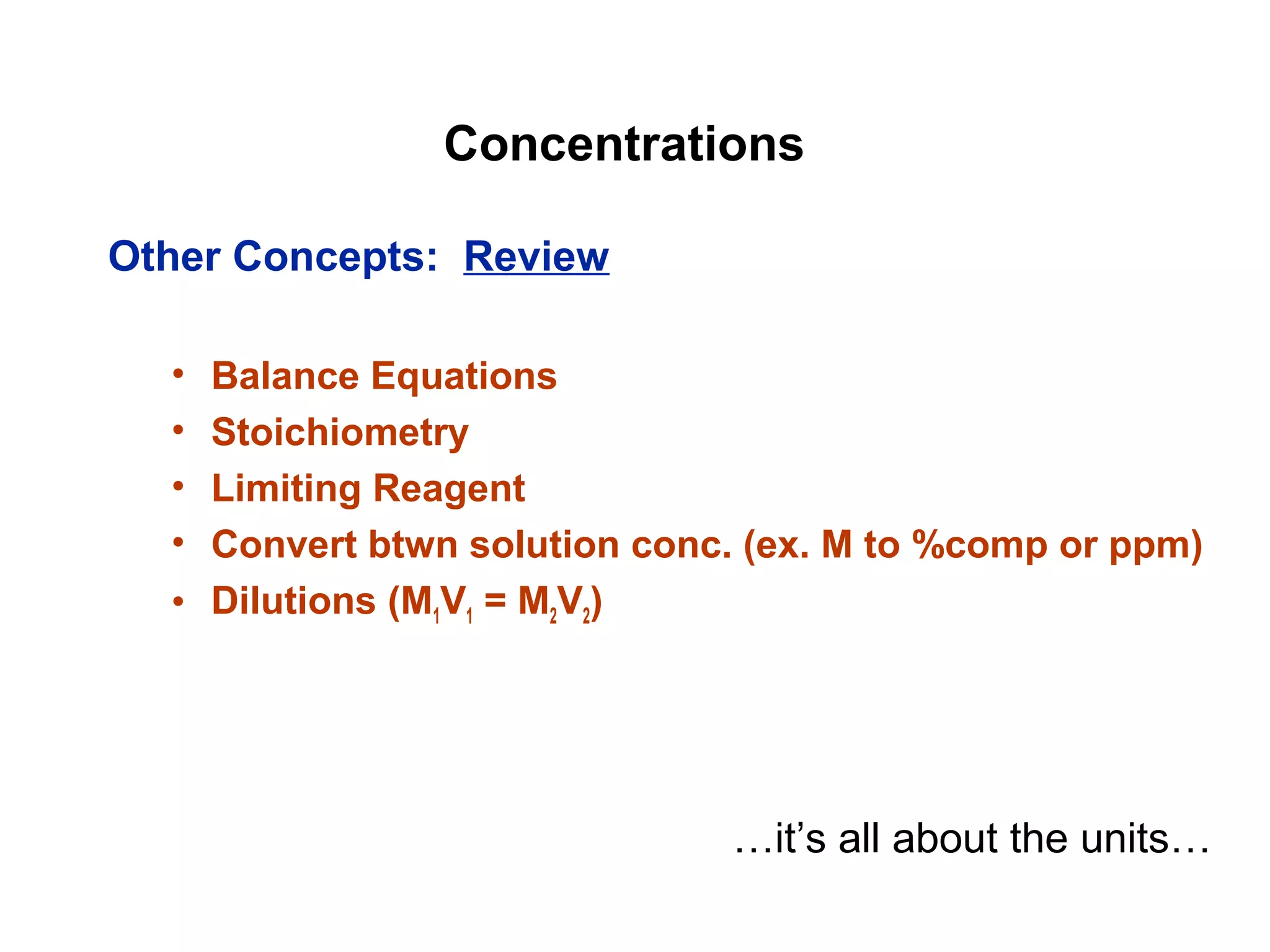
Concentrations
Other Concepts: Review
• Balance Equations
• Stoichiometry
• Limiting Reagent
• Convert btwn solution conc. (ex. M to %comp or ppm)
• Dilutions (M1V1 = M2V2)
…it’s all about the units…

Lecture 1 first day(1)