Atomic Spectroscopy (Chapter 21)
Used for qualitative and quantitative determinations
Widely used in industrial settings
Detection limits: ppm, ppb
Convert sample to atoms
Determine atom conc. by measuring A or I
A = kC I=kC
Three classes:
absorption
emission
fluorescence
Atomic Spectroscopy (Chapter 21)
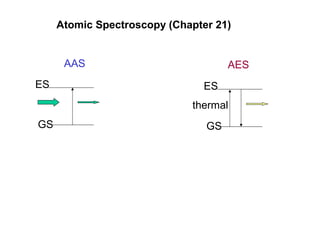
GS
ES
GS
ES
thermal
AAS AES
Atomic Spectroscopy (Chapter 21)
Step 1: Atomization
Volatilize, decomp. to form atomic gas
1. Convert solution to a mist
2. Carry into source
CaCl2(soln) → CaCl2(gas) → Ca0
(gas) + 2Cl0
(gas)
Excitation: Ca0
(gas) → Ca*
(gas)
Emission: Ca*
(gas) → Ca0
(gas)
AA: measure ground state
AE: measure excited state
3. Evaporate solvent
4. Vaporize
5. Decompose to atoms
Why are spectra
so narrow?
Atomic Spectroscopy (Chapter 21)
Atomization Sources
1. Flame (AA, AE)
2. Furnace (AA)
3. Plasma (AE)
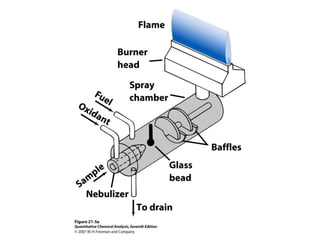
A. Flame
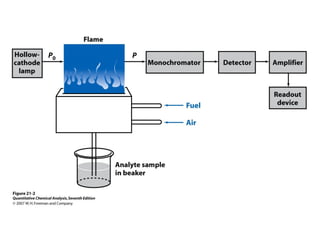
pneumatic nebulizer
burner
flame temperature is impt (1700 – 3100 C)
T ~ 2500 K
Smaller volume (µL)
Greater sensitivity
Longer residence times
Less reproducible, more complicated
why?
Very high Temperature (6000 - 10,000K)
Large ES population
Reduced interference
C. Plasma
ICP
why?
Atomic Spectroscopy (Chapter 21)
Temperature
very important
degree at which sample breaks down
determine the percent of atoms in GS, ES, or ionized
N*
/ No = g*
/ go exp (-∆E/kT)
If T = 2500 K (λ = 500 nm) N*
/No = 10-5
If T = 6000 K N*
/No = 10-2
AE: I depends of ES population
change T by 10 K, change N*
by 4%
AA: A depends of GS population
Change T by 10K, little change in N
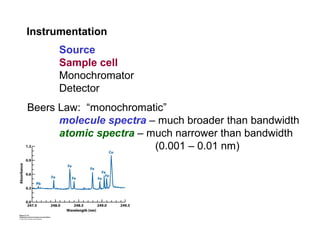
Instrumentation
Source
Sample cell
Monochromator
Detector
Beers Law: “monochromatic”
molecule spectra – much broader than bandwidth
atomic spectra – much narrower than bandwidth
(0.001 – 0.01 nm)
1. Need a special source: Hollow cathode lamp
element specific
why?
2. Background Subtraction Methods
remove flame signal from atom
Interferences
spectral
chemical
ionization
Spectra
overlap of analyte signal with other signals
(molec – element); chose another λ, change T
Chemical
chemical reactions decrease conc of of analyte
example: Ca2+
in presence of SO4
2-
add a releasing agent (EDTA) or change temp
Ionization
ionization of atoms decrease conc. of neutral atoms
ex. Kg → K+
+ 1e-
Add an ionization supressor (Csg → Cs+
+ e-
)
Detection Limits
Depends on element and method
Element ICP Flame E Flame A Furnace
Ca 0.02 0.1 1 0.02
Fe 0.3 30 5 0.005
Na 0.20 0.1 2 0.0002
units: ng/mL
What is better, big number or small number?

Atomic spectroscopy ch 20

  • 1.
    Atomic Spectroscopy (Chapter21) Used for qualitative and quantitative determinations Widely used in industrial settings Detection limits: ppm, ppb Convert sample to atoms Determine atom conc. by measuring A or I A = kC I=kC Three classes: absorption emission fluorescence
  • 2.
    Atomic Spectroscopy (Chapter21) GS ES GS ES thermal AAS AES
  • 4.
    Atomic Spectroscopy (Chapter21) Step 1: Atomization Volatilize, decomp. to form atomic gas 1. Convert solution to a mist 2. Carry into source CaCl2(soln) → CaCl2(gas) → Ca0 (gas) + 2Cl0 (gas) Excitation: Ca0 (gas) → Ca* (gas) Emission: Ca* (gas) → Ca0 (gas) AA: measure ground state AE: measure excited state 3. Evaporate solvent 4. Vaporize 5. Decompose to atoms
  • 5.
  • 6.
    Atomic Spectroscopy (Chapter21) Atomization Sources 1. Flame (AA, AE) 2. Furnace (AA) 3. Plasma (AE) A. Flame pneumatic nebulizer burner flame temperature is impt (1700 – 3100 C)
  • 10.
    T ~ 2500K Smaller volume (µL) Greater sensitivity Longer residence times Less reproducible, more complicated why?
  • 12.
    Very high Temperature(6000 - 10,000K) Large ES population Reduced interference C. Plasma ICP why?
  • 13.
    Atomic Spectroscopy (Chapter21) Temperature very important degree at which sample breaks down determine the percent of atoms in GS, ES, or ionized N* / No = g* / go exp (-∆E/kT) If T = 2500 K (λ = 500 nm) N* /No = 10-5 If T = 6000 K N* /No = 10-2 AE: I depends of ES population change T by 10 K, change N* by 4% AA: A depends of GS population Change T by 10K, little change in N
  • 14.
    Instrumentation Source Sample cell Monochromator Detector Beers Law:“monochromatic” molecule spectra – much broader than bandwidth atomic spectra – much narrower than bandwidth (0.001 – 0.01 nm)
  • 15.
    1. Need aspecial source: Hollow cathode lamp element specific why?
  • 16.
    2. Background SubtractionMethods remove flame signal from atom
  • 17.
    Interferences spectral chemical ionization Spectra overlap of analytesignal with other signals (molec – element); chose another λ, change T Chemical chemical reactions decrease conc of of analyte example: Ca2+ in presence of SO4 2- add a releasing agent (EDTA) or change temp Ionization ionization of atoms decrease conc. of neutral atoms ex. Kg → K+ + 1e- Add an ionization supressor (Csg → Cs+ + e- )
  • 18.
    Detection Limits Depends onelement and method Element ICP Flame E Flame A Furnace Ca 0.02 0.1 1 0.02 Fe 0.3 30 5 0.005 Na 0.20 0.1 2 0.0002 units: ng/mL What is better, big number or small number?