Arpit Rajaram Suralkar
M Pharmacy ( Quality Assurance)
AMPEROMETRY
CONTENT :
 Introduction
 Principle
 Condition for performing amperometric titraton
 Appratus used for amperometric titration
 Types of amperometric titration
 Advantages of amperometric titraton
 Application of amperometric titration
Disadvantages of amperometric titration
INTRODUCTION :
• Amperometry is one of the electrochemical method.
• It is concerned with the measurement of current under
constant applied voltage.
• It is a form of quantitative analysis.
• When indicator method is not suitable we use
amperometric method for determinaton of end point.
• Amperometric titration are otherwise called as
polarographic titration because of similarity in
principle.
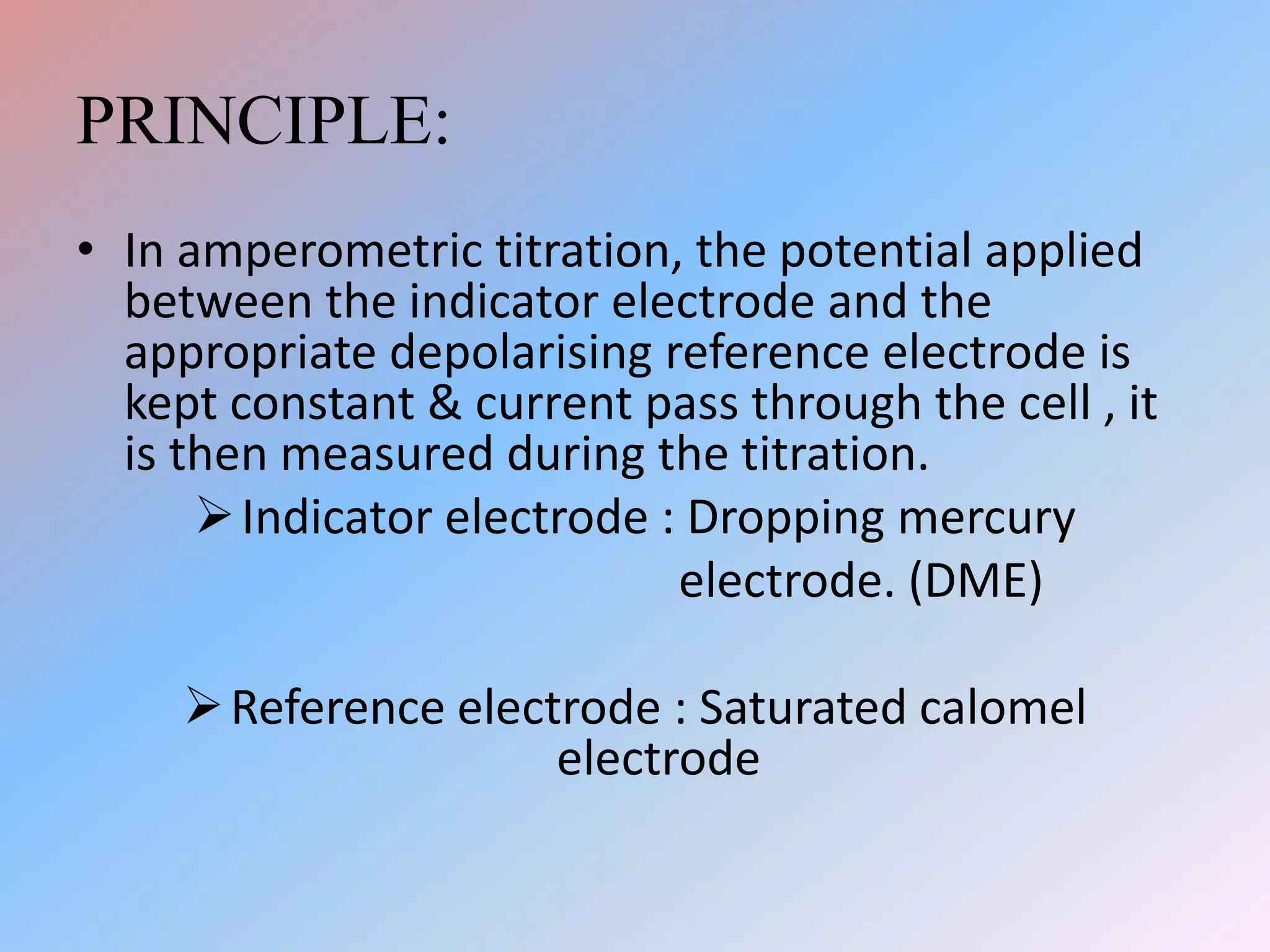
PRINCIPLE:
• In amperometric titration, the potential applied
between the indicator electrode and the
appropriate depolarising reference electrode is
kept constant & current pass through the cell , it
is then measured during the titration.
Indicator electrode : Dropping mercury
electrode. (DME)
Reference electrode : Saturated calomel
electrode
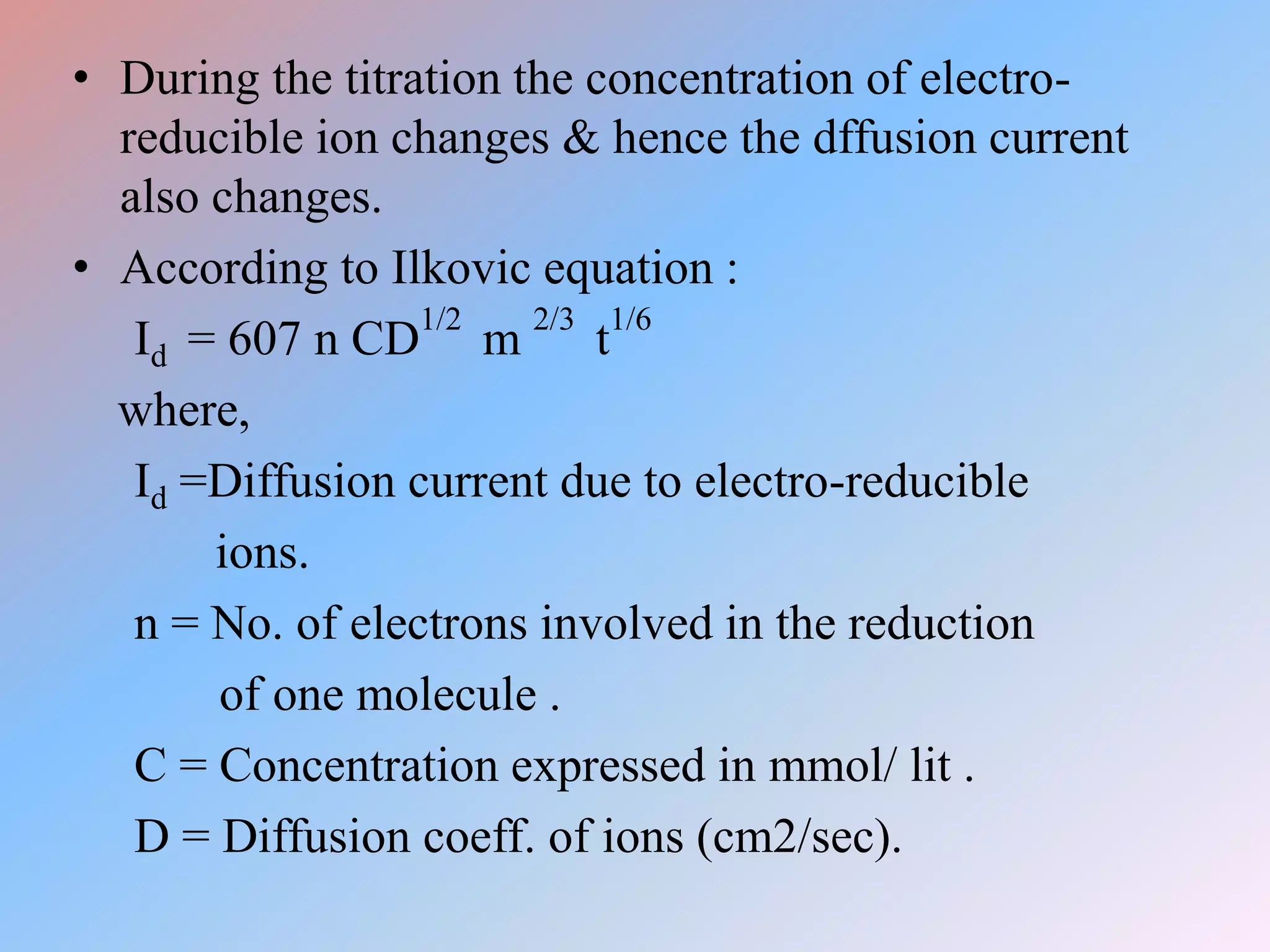
• During the titration the concentration of electro-
reducible ion changes & hence the dffusion current
also changes.
• According to Ilkovic equation :
Id = 607 n CD
1/2
m
2/3
t
1/6
where,
Id =Diffusion current due to electro-reducible
ions.
n = No. of electrons involved in the reduction
of one molecule .
C = Concentration expressed in mmol/ lit .
D = Diffusion coeff. of ions (cm2/sec).
m= Wt. of mercury flowing through capillary
(mg/sec)
t = Drop time in second.
CONDITION FOR PERFORMING
AMPEROMETRIC TITRATION:
 Both should be reducible .
 the potential applied should limiting current.
APPRATUS USED FOR AMPEROMETRIC
TITRATION :
• Dropping mercury
electrode :
 Capillary tube about 10 -
15 cm.
 Internal diameter of
capillary 0.05mm.
 A vertical distance being
maintained between DME
& the solution.
 Drop time : 1-5 se
 Drop diameter – 0.5 mm Hg drop
Hg
reservoir
Glass capillary
Fig. Dropping Mercury Electrode
 It consist of a glass rod
with a bent platinum wire
at about 600 rpm .
 Wire contacts are made
through a mercury
reservoir at the top so the
potential can be applied &
the current is produced
• Rotating Platinum Micro-electrode :
Fig. Rotating Platinum Micro-Electrode
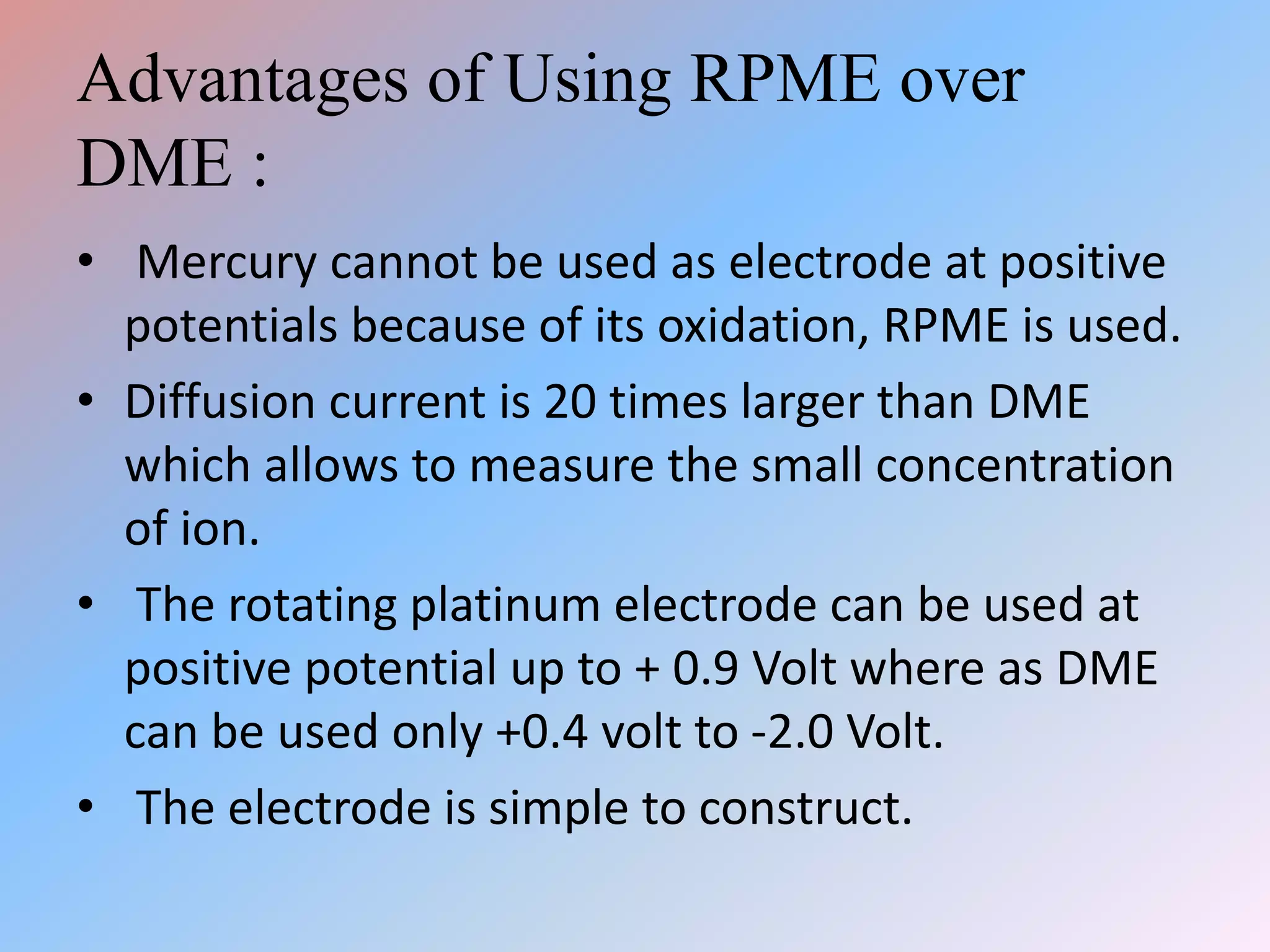
Advantages of Using RPME over
DME :
• Mercury cannot be used as electrode at positive
potentials because of its oxidation, RPME is used.
• Diffusion current is 20 times larger than DME
which allows to measure the small concentration
of ion.
• The rotating platinum electrode can be used at
positive potential up to + 0.9 Volt where as DME
can be used only +0.4 volt to -2.0 Volt.
• The electrode is simple to construct.
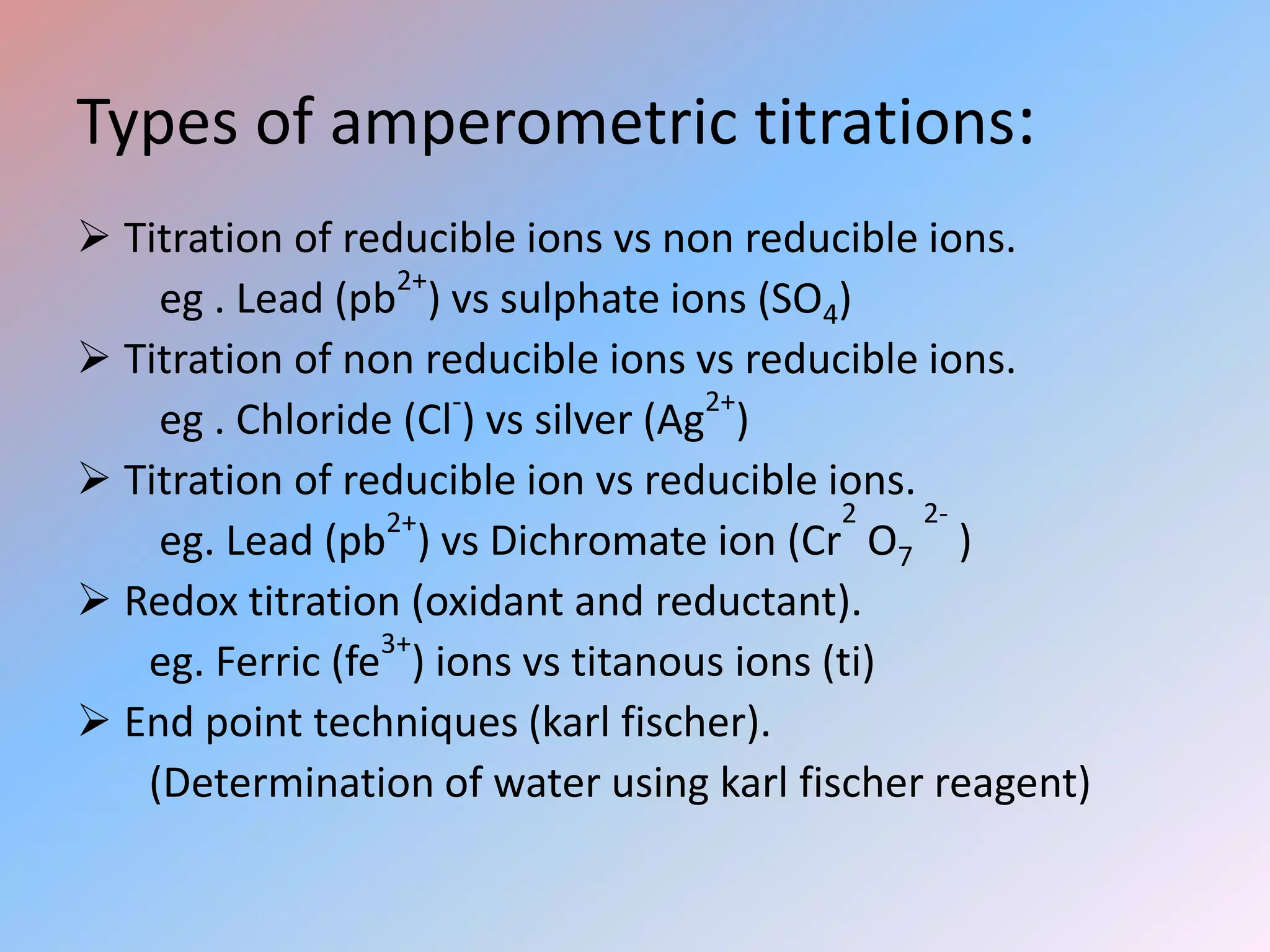
Types of amperometric titrations:
 Titration of reducible ions vs non reducible ions.
eg . Lead (pb2+
) vs sulphate ions (SO4)
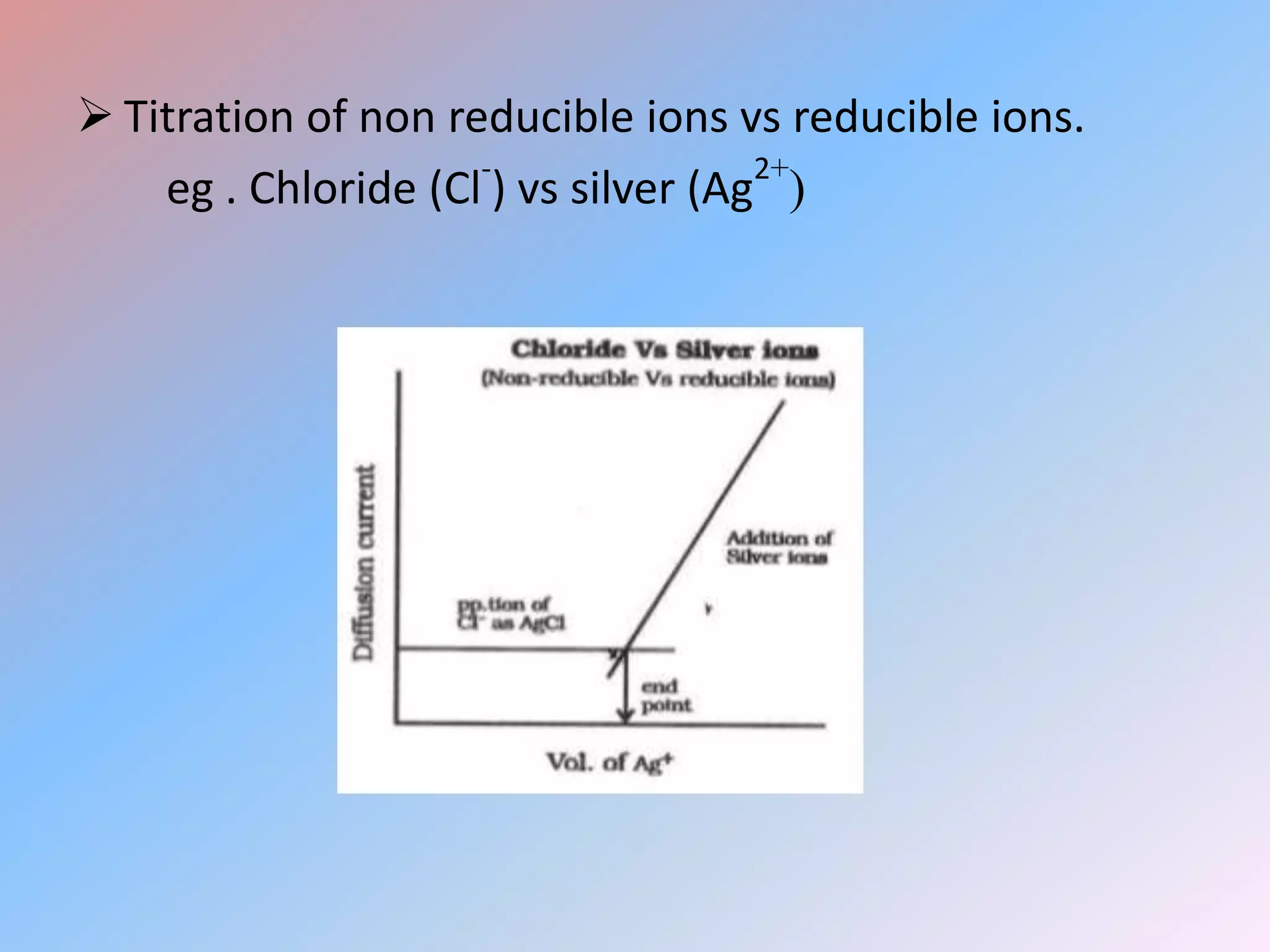
 Titration of non reducible ions vs reducible ions.
eg . Chloride (Cl-
) vs silver (Ag2+
)
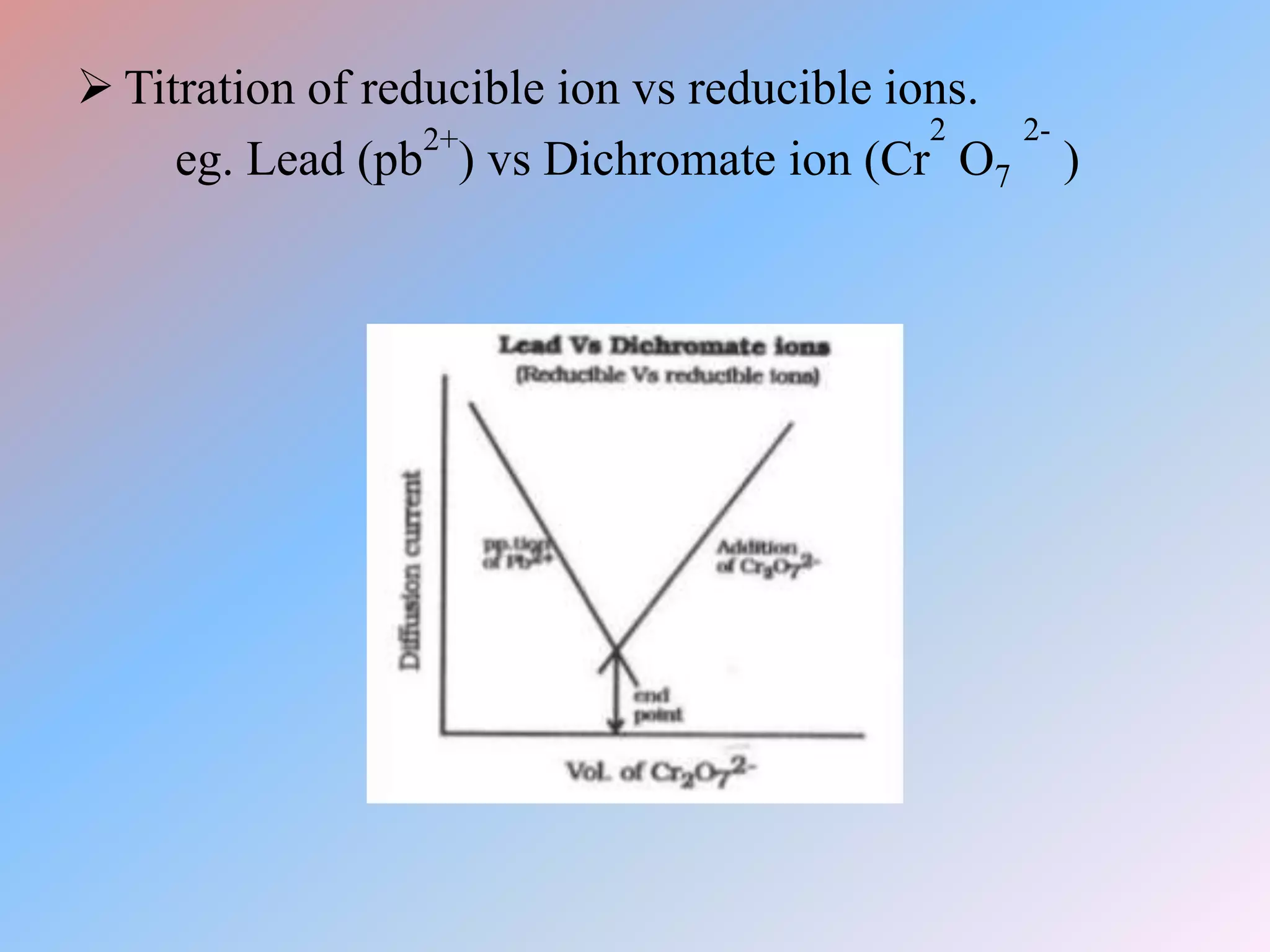
 Titration of reducible ion vs reducible ions.
eg. Lead (pb2+
) vs Dichromate ion (Cr
2
O7
2-
)
 Redox titration (oxidant and reductant).
eg. Ferric (fe3+
) ions vs titanous ions (ti)
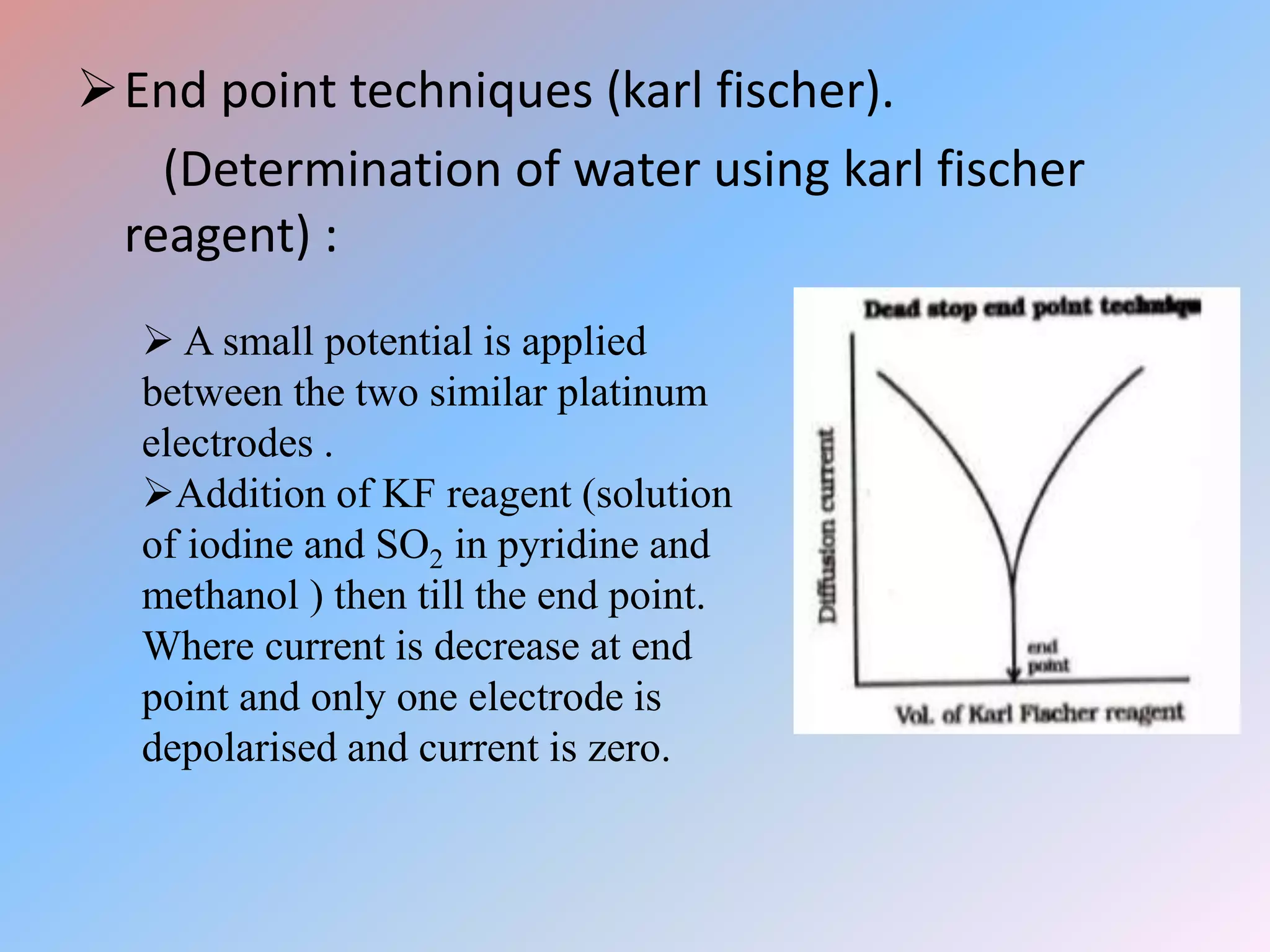
 End point techniques (karl fischer).
(Determination of water using karl fischer reagent)
 Titration of reducible ions vs non reducible ions.
eg . Lead (pb
2+
) vs sulphate ions (SO4
2-
)
 Titration of non reducible ions vs reducible ions.
eg . Chloride (Cl
-
) vs silver (Ag
2+
)
 Titration of reducible ion vs reducible ions.
eg. Lead (pb
2+
) vs Dichromate ion (Cr
2
O7
2-
)
 Redox titration (oxidant and reductant).
eg. Ferric (fe
3+
) ions vs titanous ions (ti)
End point techniques (karl fischer).
(Determination of water using karl fischer
reagent) :
 A small potential is applied
between the two similar platinum
electrodes .
Addition of KF reagent (solution
of iodine and SO2 in pyridine and
methanol ) then till the end point.
Where current is decrease at end
point and only one electrode is
depolarised and current is zero.
Advantages of Amperometric titration:
• Both reducible as well as non- reducible ions
groups can be determine.
• Dilute solution can be analysed.
• The reaction carryout can be reducible or
irreversible.
• The appratus is simple and temprerature
need not be provided constants.
Application of Amperometric titration :
• Amperometric titration :
 quantitative in nature.
 used and determine the end point.
• Determination of water by using karl fischer reagent.
• Amperometric dectector - (HPLC)Amperometric
dectector can detect very low conc. of reducible ions
& they can easily determine.
• Quantification of ion or mixture of ions.
Disadvantages of amperometric
titration
• Inaccurate result are sometime obtained.
• The foreign substance should not be present in a
larger concentrations than the substance to be
titrated.
Reference :
• Textbook of pharmaceutical analysis , 4
th
edition by
Dr. Ravi Sankar.
• Instrumental method of chemical analysis by G. R.
Chatwal & Sham K. Anand , hmalaya publishing
house.
THANK YOU

Amperometry

  • 1.
    Arpit Rajaram Suralkar MPharmacy ( Quality Assurance) AMPEROMETRY
  • 2.
    CONTENT :  Introduction Principle  Condition for performing amperometric titraton  Appratus used for amperometric titration  Types of amperometric titration  Advantages of amperometric titraton  Application of amperometric titration Disadvantages of amperometric titration
  • 3.
    INTRODUCTION : • Amperometryis one of the electrochemical method. • It is concerned with the measurement of current under constant applied voltage. • It is a form of quantitative analysis. • When indicator method is not suitable we use amperometric method for determinaton of end point. • Amperometric titration are otherwise called as polarographic titration because of similarity in principle.
  • 4.
    PRINCIPLE: • In amperometrictitration, the potential applied between the indicator electrode and the appropriate depolarising reference electrode is kept constant & current pass through the cell , it is then measured during the titration. Indicator electrode : Dropping mercury electrode. (DME) Reference electrode : Saturated calomel electrode
  • 5.
    • During thetitration the concentration of electro- reducible ion changes & hence the dffusion current also changes. • According to Ilkovic equation : Id = 607 n CD 1/2 m 2/3 t 1/6 where, Id =Diffusion current due to electro-reducible ions. n = No. of electrons involved in the reduction of one molecule . C = Concentration expressed in mmol/ lit . D = Diffusion coeff. of ions (cm2/sec).
  • 6.
    m= Wt. ofmercury flowing through capillary (mg/sec) t = Drop time in second. CONDITION FOR PERFORMING AMPEROMETRIC TITRATION:  Both should be reducible .  the potential applied should limiting current.
  • 7.
    APPRATUS USED FORAMPEROMETRIC TITRATION : • Dropping mercury electrode :  Capillary tube about 10 - 15 cm.  Internal diameter of capillary 0.05mm.  A vertical distance being maintained between DME & the solution.  Drop time : 1-5 se  Drop diameter – 0.5 mm Hg drop Hg reservoir Glass capillary Fig. Dropping Mercury Electrode
  • 8.
     It consistof a glass rod with a bent platinum wire at about 600 rpm .  Wire contacts are made through a mercury reservoir at the top so the potential can be applied & the current is produced • Rotating Platinum Micro-electrode : Fig. Rotating Platinum Micro-Electrode
  • 9.
    Advantages of UsingRPME over DME : • Mercury cannot be used as electrode at positive potentials because of its oxidation, RPME is used. • Diffusion current is 20 times larger than DME which allows to measure the small concentration of ion. • The rotating platinum electrode can be used at positive potential up to + 0.9 Volt where as DME can be used only +0.4 volt to -2.0 Volt. • The electrode is simple to construct.
  • 10.
    Types of amperometrictitrations:  Titration of reducible ions vs non reducible ions. eg . Lead (pb2+ ) vs sulphate ions (SO4)  Titration of non reducible ions vs reducible ions. eg . Chloride (Cl- ) vs silver (Ag2+ )  Titration of reducible ion vs reducible ions. eg. Lead (pb2+ ) vs Dichromate ion (Cr 2 O7 2- )  Redox titration (oxidant and reductant). eg. Ferric (fe3+ ) ions vs titanous ions (ti)  End point techniques (karl fischer). (Determination of water using karl fischer reagent)
  • 11.
     Titration ofreducible ions vs non reducible ions. eg . Lead (pb 2+ ) vs sulphate ions (SO4 2- )
  • 12.
     Titration ofnon reducible ions vs reducible ions. eg . Chloride (Cl - ) vs silver (Ag 2+ )
  • 13.
     Titration ofreducible ion vs reducible ions. eg. Lead (pb 2+ ) vs Dichromate ion (Cr 2 O7 2- )
  • 14.
     Redox titration(oxidant and reductant). eg. Ferric (fe 3+ ) ions vs titanous ions (ti)
  • 15.
    End point techniques(karl fischer). (Determination of water using karl fischer reagent) :  A small potential is applied between the two similar platinum electrodes . Addition of KF reagent (solution of iodine and SO2 in pyridine and methanol ) then till the end point. Where current is decrease at end point and only one electrode is depolarised and current is zero.
  • 16.
    Advantages of Amperometrictitration: • Both reducible as well as non- reducible ions groups can be determine. • Dilute solution can be analysed. • The reaction carryout can be reducible or irreversible. • The appratus is simple and temprerature need not be provided constants.
  • 17.
    Application of Amperometrictitration : • Amperometric titration :  quantitative in nature.  used and determine the end point. • Determination of water by using karl fischer reagent. • Amperometric dectector - (HPLC)Amperometric dectector can detect very low conc. of reducible ions & they can easily determine. • Quantification of ion or mixture of ions.
  • 18.
    Disadvantages of amperometric titration •Inaccurate result are sometime obtained. • The foreign substance should not be present in a larger concentrations than the substance to be titrated.
  • 19.
    Reference : • Textbookof pharmaceutical analysis , 4 th edition by Dr. Ravi Sankar. • Instrumental method of chemical analysis by G. R. Chatwal & Sham K. Anand , hmalaya publishing house.
  • 20.