Electrochemistry
(Electrode Potential)
Dr.S.SURESH
Assistant Professor
Email:avitsureshindia@gmail.com
Electrode potential
• The tendency of a metal to get oxidised or reduced when it
is placed in a solution of its own salt is called electrode
potential.
• When a metal [M] is placed in a solution containing its own
ions [Mn+
], then the metal may undergo either oxidation or
reduction. If the metal undergoes oxidation, then the
positive metal ions may pass into the solution
M Mn+
+ ne‒
• If the metal undergoes reduction, then the negative ions
may get deposited over the metal.
Mn+
+ ne‒
M
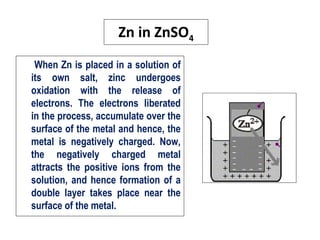
Zn in ZnSO4
When Zn is placed in a solution of
its own salt, zinc undergoes
oxidation with the release of
electrons. The electrons liberated
in the process, accumulate over the
surface of the metal and hence, the
metal is negatively charged. Now,
the negatively charged metal
attracts the positive ions from the
solution, and hence formation of a
double layer takes place near the
surface of the metal.
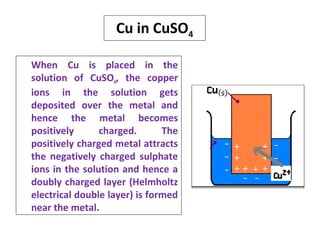
Cu in CuSO4
When Cu is placed in the
solution of CuSO4, the copper
ions in the solution gets
deposited over the metal and
hence the metal becomes
positively charged. The
positively charged metal attracts
the negatively charged sulphate
ions in the solution and hence a
doubly charged layer (Helmholtz
electrical double layer) is formed
near the metal.
Single Electrode Potential:
It is a measure of tendency of a metallic
electrode to lose or gain electrons when it is in
contact with a solution of its own salt.
Standard Electrode Potential:
It is a measure of tendency of a metallic
electrode to lose or gain electrons, when it is
in contact with a solution of its own salt of 1
Molar concentration at 25°C.
Primary Reference
Electrodes
The electrode potential is found out by coupling
the electrode with a primary reference electrode,
the potential of which is arbitrarily fixed as zero.
The important primary reference electrode used
is a standard hydrogen electrode,
Standard hydrogen electrode(SHE)
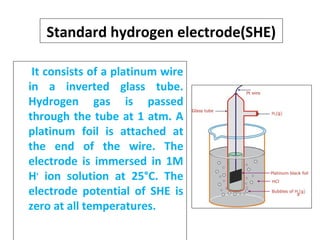
It consists of a platinum wire
in a inverted glass tube.
Hydrogen gas is passed
through the tube at 1 atm. A
platinum foil is attached at
the end of the wire. The
electrode is immersed in 1M
H+
ion solution at 25°C. The
electrode potential of SHE is
zero at all temperatures.
Standard hydrogen electrode(SHE)
It is represented as
Pt, H2(1atm)/H+
(1M)
In a cell when the standard hydrogen electrode acts as
anode, the electrode reaction can be written as
H2(g) 2 H+
+ 2 e‒
When the standard hydrogen electrode acts as cathode,
the electrode reaction can be written as
2H+
+ 2e‒
H2(g)
Based on the electrode potential obtained with reference
to hydrogen, electrochemical series is obtained.
Secondary Reference Electrode:
(Saturated calomel electrode)
Need for Secondary Reference Electrode
• The use of SHE is difficult, because it is difficult to
maintain 1M H+
ion concentration and the pressure
of the gas at one atmosphere. Also, the electrode
will easily get poisoned in case of traces of
impurities in the gas and hence, other reference
electrodes are used.
Example: Saturated calomel electrode (Saturated
KCl)
Saturated calomel electrode
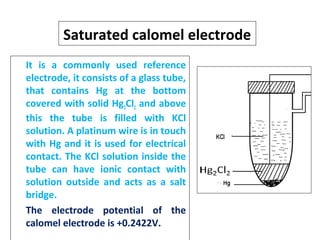
It is a commonly used reference
electrode, it consists of a glass tube,
that contains Hg at the bottom
covered with solid Hg2Cl2 and above
this the tube is filled with KCl
solution. A platinum wire is in touch
with Hg and it is used for electrical
contact. The KCl solution inside the
tube can have ionic contact with
solution outside and acts as a salt
bridge.
The electrode potential of the
calomel electrode is +0.2422V.
Determination of standard electrode potential of Silver using
Saturated Calomel Electrode
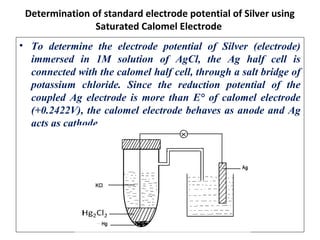
• To determine the electrode potential of Silver (electrode)
immersed in 1M solution of AgCl, the Ag half cell is
connected with the calomel half cell, through a salt bridge of
potassium chloride. Since the reduction potential of the
coupled Ag electrode is more than E° of calomel electrode
(+0.2422V), the calomel electrode behaves as anode and Ag
acts as cathode
Determination of standard electrode
potential of Zinc
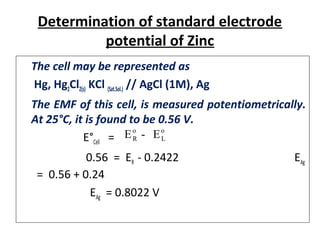
The cell may be represented as
Hg, Hg2Cl2(s) KCl (Sat.Sol.) // AgCl (1M), Ag
The EMF of this cell, is measured potentiometrically.
At 25°C, it is found to be 0.56 V.
E°Cell =
0.56 = ER - 0.2422 EAg
= 0.56 + 0.24
EAg = 0.8022 V
ο
L
ο
R E-E
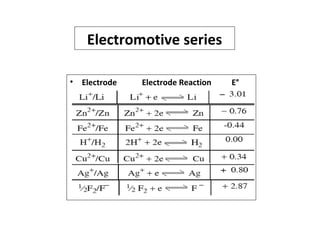
Electromotive series
Definition:
When the metals (electrodes) are arranged in
the order of their increasing values of
standard reduction potential on the
hydrogen scale, then the arrangement is
called electromotive series.
Electromotive series
• Electrode Electrode Reaction E°
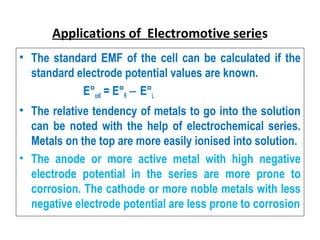
Applications of Electromotive series
• The standard EMF of the cell can be calculated if the
standard electrode potential values are known.
E°cell = E°R E°‒ L
• The relative tendency of metals to go into the solution
can be noted with the help of electrochemical series.
Metals on the top are more easily ionised into solution.
• The anode or more active metal with high negative
electrode potential in the series are more prone to
corrosion. The cathode or more noble metals with less
negative electrode potential are less prone to corrosion
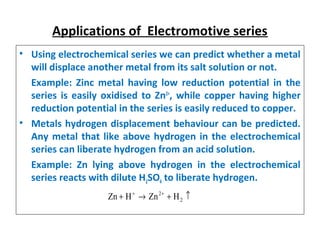
Applications of Electromotive series
• Using electrochemical series we can predict whether a metal
will displace another metal from its salt solution or not.
Example: Zinc metal having low reduction potential in the
series is easily oxidised to Zn2+
, while copper having higher
reduction potential in the series is easily reduced to copper.
• Metals hydrogen displacement behaviour can be predicted.
Any metal that like above hydrogen in the electrochemical
series can liberate hydrogen from an acid solution.
Example: Zn lying above hydrogen in the electrochemical
series reacts with dilute H2SO4 to liberate hydrogen.
↑+→+ ++
2
2
HZnHZn
Electrochemical cell (or) Galvanic cell
A galvanic cell is an electrochemical cell in which
the electrons are transferred due to redox reaction
to get electrical energy. In a galvanic cell, two
different electrodes are kept immersed in their
respective salt solutions and connected by means
of a salt bridge
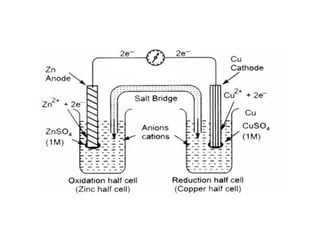
Example: Daniel cell
Daniel Cell
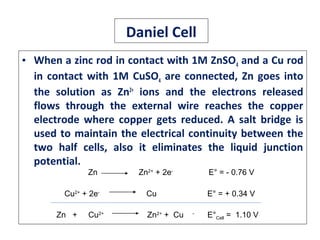
• When a zinc rod in contact with 1M ZnSO4 and a Cu rod
in contact with 1M CuSO4 are connected, Zn goes into
the solution as Zn2+
ions and the electrons released
flows through the external wire reaches the copper
electrode where copper gets reduced. A salt bridge is
used to maintain the electrical continuity between the
two half cells, also it eliminates the liquid junction
potential.
Zn Zn2+
+ 2e-
E° = - 0.76 V
Cu2+
+ 2e-
Cu E° = + 0.34 V
Zn + Cu2+
Zn2+
+ Cu -
E°Cell = 1.10 V
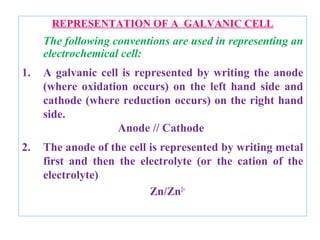
REPRESENTATION OF A GALVANIC CELL
The following conventions are used in representing an
electrochemical cell:
1. A galvanic cell is represented by writing the anode
(where oxidation occurs) on the left hand side and
cathode (where reduction occurs) on the right hand
side.
Anode // Cathode
2. The anode of the cell is represented by writing metal
first and then the electrolyte (or the cation of the
electrolyte)
Zn/Zn2+
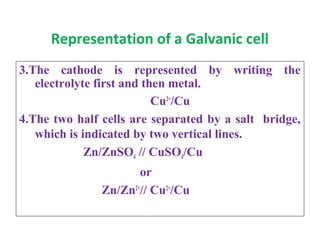
Representation of a Galvanic cell
3.The cathode is represented by writing the
electrolyte first and then metal.
Cu2+
/Cu
4.The two half cells are separated by a salt bridge,
which is indicated by two vertical lines.
Zn/ZnSO4 // CuSO4/Cu
or
Zn/Zn2+
// Cu2+
/Cu

Electrode potential

  • 1.
  • 2.
    Electrode potential • Thetendency of a metal to get oxidised or reduced when it is placed in a solution of its own salt is called electrode potential. • When a metal [M] is placed in a solution containing its own ions [Mn+ ], then the metal may undergo either oxidation or reduction. If the metal undergoes oxidation, then the positive metal ions may pass into the solution M Mn+ + ne‒ • If the metal undergoes reduction, then the negative ions may get deposited over the metal. Mn+ + ne‒ M
  • 3.
    Zn in ZnSO4 WhenZn is placed in a solution of its own salt, zinc undergoes oxidation with the release of electrons. The electrons liberated in the process, accumulate over the surface of the metal and hence, the metal is negatively charged. Now, the negatively charged metal attracts the positive ions from the solution, and hence formation of a double layer takes place near the surface of the metal.
  • 4.
    Cu in CuSO4 WhenCu is placed in the solution of CuSO4, the copper ions in the solution gets deposited over the metal and hence the metal becomes positively charged. The positively charged metal attracts the negatively charged sulphate ions in the solution and hence a doubly charged layer (Helmholtz electrical double layer) is formed near the metal.
  • 5.
    Single Electrode Potential: Itis a measure of tendency of a metallic electrode to lose or gain electrons when it is in contact with a solution of its own salt. Standard Electrode Potential: It is a measure of tendency of a metallic electrode to lose or gain electrons, when it is in contact with a solution of its own salt of 1 Molar concentration at 25°C.
  • 6.
    Primary Reference Electrodes The electrodepotential is found out by coupling the electrode with a primary reference electrode, the potential of which is arbitrarily fixed as zero. The important primary reference electrode used is a standard hydrogen electrode,
  • 7.
    Standard hydrogen electrode(SHE) Itconsists of a platinum wire in a inverted glass tube. Hydrogen gas is passed through the tube at 1 atm. A platinum foil is attached at the end of the wire. The electrode is immersed in 1M H+ ion solution at 25°C. The electrode potential of SHE is zero at all temperatures.
  • 8.
    Standard hydrogen electrode(SHE) Itis represented as Pt, H2(1atm)/H+ (1M) In a cell when the standard hydrogen electrode acts as anode, the electrode reaction can be written as H2(g) 2 H+ + 2 e‒ When the standard hydrogen electrode acts as cathode, the electrode reaction can be written as 2H+ + 2e‒ H2(g) Based on the electrode potential obtained with reference to hydrogen, electrochemical series is obtained.
  • 9.
  • 10.
    Need for SecondaryReference Electrode • The use of SHE is difficult, because it is difficult to maintain 1M H+ ion concentration and the pressure of the gas at one atmosphere. Also, the electrode will easily get poisoned in case of traces of impurities in the gas and hence, other reference electrodes are used. Example: Saturated calomel electrode (Saturated KCl)
  • 11.
    Saturated calomel electrode Itis a commonly used reference electrode, it consists of a glass tube, that contains Hg at the bottom covered with solid Hg2Cl2 and above this the tube is filled with KCl solution. A platinum wire is in touch with Hg and it is used for electrical contact. The KCl solution inside the tube can have ionic contact with solution outside and acts as a salt bridge. The electrode potential of the calomel electrode is +0.2422V.
  • 12.
    Determination of standardelectrode potential of Silver using Saturated Calomel Electrode • To determine the electrode potential of Silver (electrode) immersed in 1M solution of AgCl, the Ag half cell is connected with the calomel half cell, through a salt bridge of potassium chloride. Since the reduction potential of the coupled Ag electrode is more than E° of calomel electrode (+0.2422V), the calomel electrode behaves as anode and Ag acts as cathode
  • 13.
    Determination of standardelectrode potential of Zinc The cell may be represented as Hg, Hg2Cl2(s) KCl (Sat.Sol.) // AgCl (1M), Ag The EMF of this cell, is measured potentiometrically. At 25°C, it is found to be 0.56 V. E°Cell = 0.56 = ER - 0.2422 EAg = 0.56 + 0.24 EAg = 0.8022 V ο L ο R E-E
  • 14.
    Electromotive series Definition: When themetals (electrodes) are arranged in the order of their increasing values of standard reduction potential on the hydrogen scale, then the arrangement is called electromotive series.
  • 15.
    Electromotive series • ElectrodeElectrode Reaction E°
  • 16.
    Applications of Electromotiveseries • The standard EMF of the cell can be calculated if the standard electrode potential values are known. E°cell = E°R E°‒ L • The relative tendency of metals to go into the solution can be noted with the help of electrochemical series. Metals on the top are more easily ionised into solution. • The anode or more active metal with high negative electrode potential in the series are more prone to corrosion. The cathode or more noble metals with less negative electrode potential are less prone to corrosion
  • 17.
    Applications of Electromotiveseries • Using electrochemical series we can predict whether a metal will displace another metal from its salt solution or not. Example: Zinc metal having low reduction potential in the series is easily oxidised to Zn2+ , while copper having higher reduction potential in the series is easily reduced to copper. • Metals hydrogen displacement behaviour can be predicted. Any metal that like above hydrogen in the electrochemical series can liberate hydrogen from an acid solution. Example: Zn lying above hydrogen in the electrochemical series reacts with dilute H2SO4 to liberate hydrogen. ↑+→+ ++ 2 2 HZnHZn
  • 18.
    Electrochemical cell (or)Galvanic cell A galvanic cell is an electrochemical cell in which the electrons are transferred due to redox reaction to get electrical energy. In a galvanic cell, two different electrodes are kept immersed in their respective salt solutions and connected by means of a salt bridge Example: Daniel cell
  • 20.
    Daniel Cell • Whena zinc rod in contact with 1M ZnSO4 and a Cu rod in contact with 1M CuSO4 are connected, Zn goes into the solution as Zn2+ ions and the electrons released flows through the external wire reaches the copper electrode where copper gets reduced. A salt bridge is used to maintain the electrical continuity between the two half cells, also it eliminates the liquid junction potential. Zn Zn2+ + 2e- E° = - 0.76 V Cu2+ + 2e- Cu E° = + 0.34 V Zn + Cu2+ Zn2+ + Cu - E°Cell = 1.10 V
  • 21.
    REPRESENTATION OF AGALVANIC CELL The following conventions are used in representing an electrochemical cell: 1. A galvanic cell is represented by writing the anode (where oxidation occurs) on the left hand side and cathode (where reduction occurs) on the right hand side. Anode // Cathode 2. The anode of the cell is represented by writing metal first and then the electrolyte (or the cation of the electrolyte) Zn/Zn2+
  • 22.
    Representation of aGalvanic cell 3.The cathode is represented by writing the electrolyte first and then metal. Cu2+ /Cu 4.The two half cells are separated by a salt bridge, which is indicated by two vertical lines. Zn/ZnSO4 // CuSO4/Cu or Zn/Zn2+ // Cu2+ /Cu