Mrs Vandana Sharma
Assistant Professor
 Principle
 Ilkovic equation
 Construction and working of dropping mercury electrode and
rotating platinum electrode
 Applications
 Give any 2 applications of polarography. 2
 Write ilkovic equation used in polarography. 2
 Explain the construction and working of dropping mercury
electrode. 5
 Give principle, instrumentation and applications of a)
Conductometry b) Polarography 10
 Give the ilkovic equation of polarography. 2
 Draw a labeled diagram of polarography and explain it.
 Explain the construction and working of dropping mercury
electrode. 5
 Give principle, instrumentation and applications of
a)Conductometry b) Polarography 10
 Explain the construction and working of dropping mercury
electrode. 5
 Discuss the principle and application of the ilkovic equation. 5
 Polarography is a voltammetric technique in which chemical
species (ions or molecules) undergo oxidation (lose electrons) or
reduction (gain electrons) at the surface of a dropping mercury
electrode (DME) at an applied potential. Polarography only applies
to the DME.
Objective of polarography
Polarography is an electroanalytical technique that measures the
current flowing between two electrodes in the solution (in the
presence of gradually increasing applied voltage) to determine the
concentration of solute and its nature respectively
 Polarography is based upon the principle that gradually
increasing voltage is applied between two electrodes, one of
which is polarisable (dropping mercury electrode) and other is
non-polarisable and current flowing between the two electrodes
is recorded.
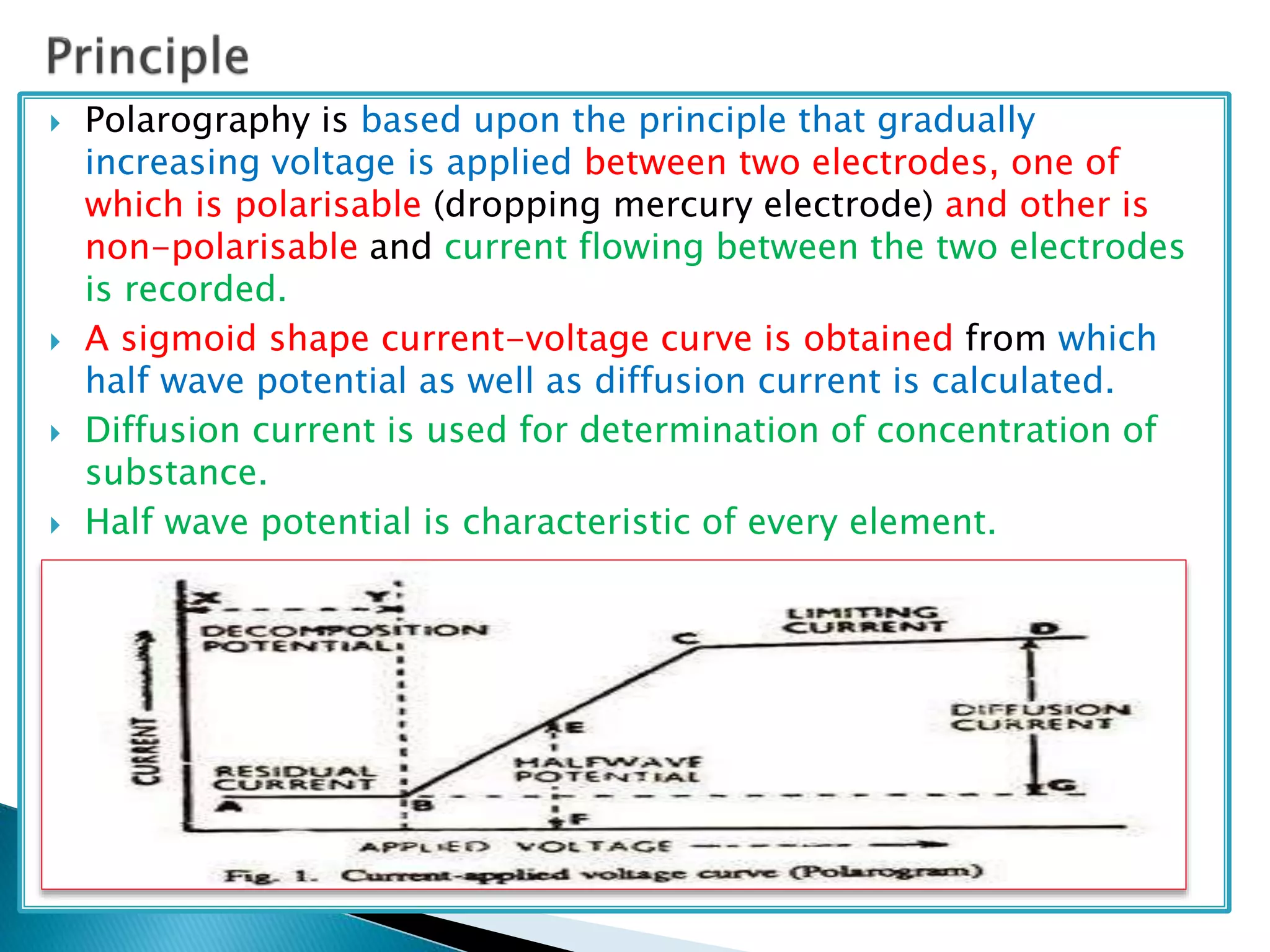
 A sigmoid shape current-voltage curve is obtained from which
half wave potential as well as diffusion current is calculated.
 Diffusion current is used for determination of concentration of
substance.
 Half wave potential is characteristic of every element.
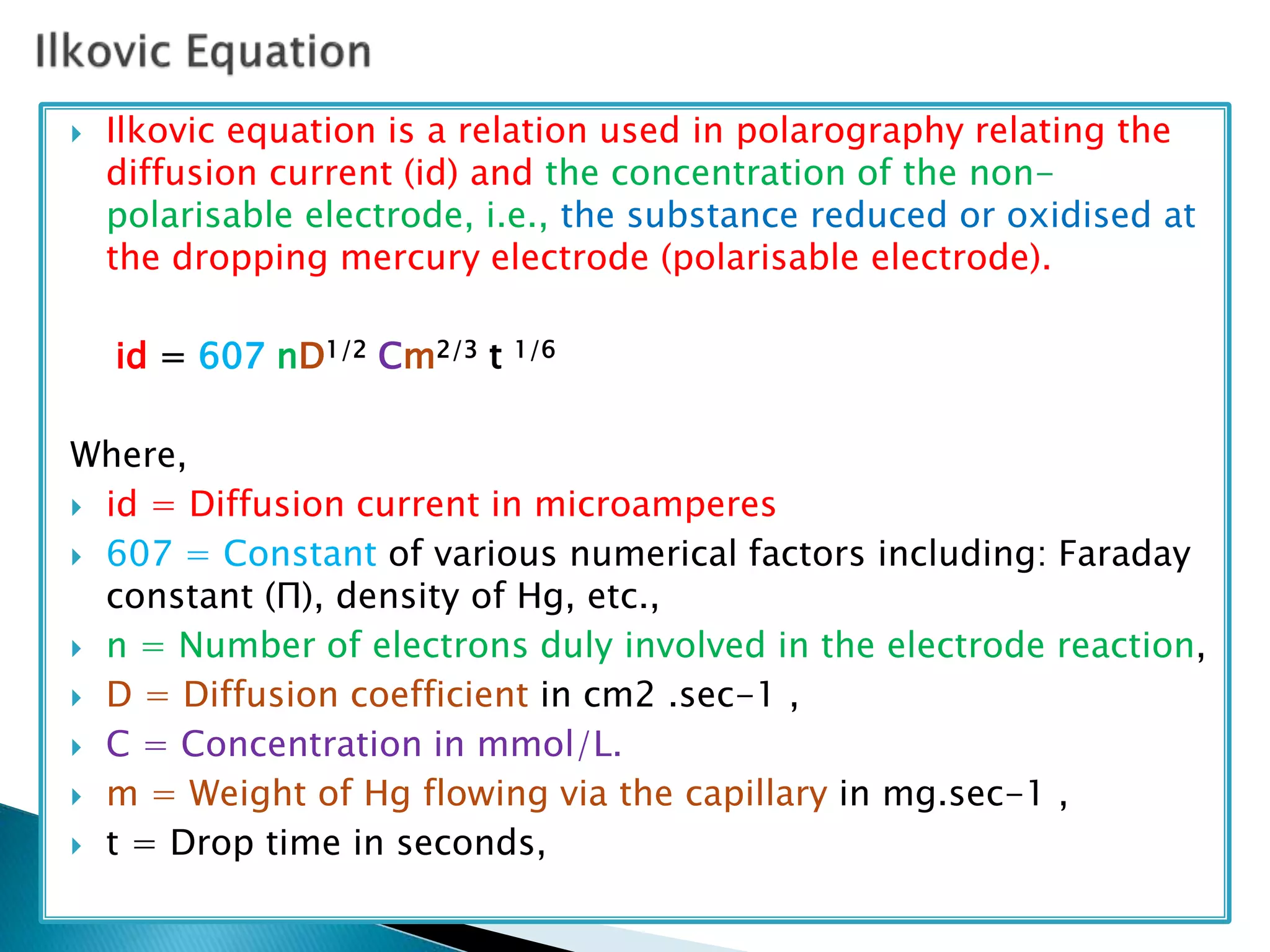
 Ilkovic equation is a relation used in polarography relating the
diffusion current (id) and the concentration of the non-
polarisable electrode, i.e., the substance reduced or oxidised at
the dropping mercury electrode (polarisable electrode).
id = 607 nD1/2 Cm2/3 t 1/6
Where,
 id = Diffusion current in microamperes
 607 = Constant of various numerical factors including: Faraday
constant (П), density of Hg, etc.,
 n = Number of electrons duly involved in the electrode reaction,
 D = Diffusion coefficient in cm2 .sec-1 ,
 C = Concentration in mmol/L.
 m = Weight of Hg flowing via the capillary in mg.sec-1 ,
 t = Drop time in seconds,
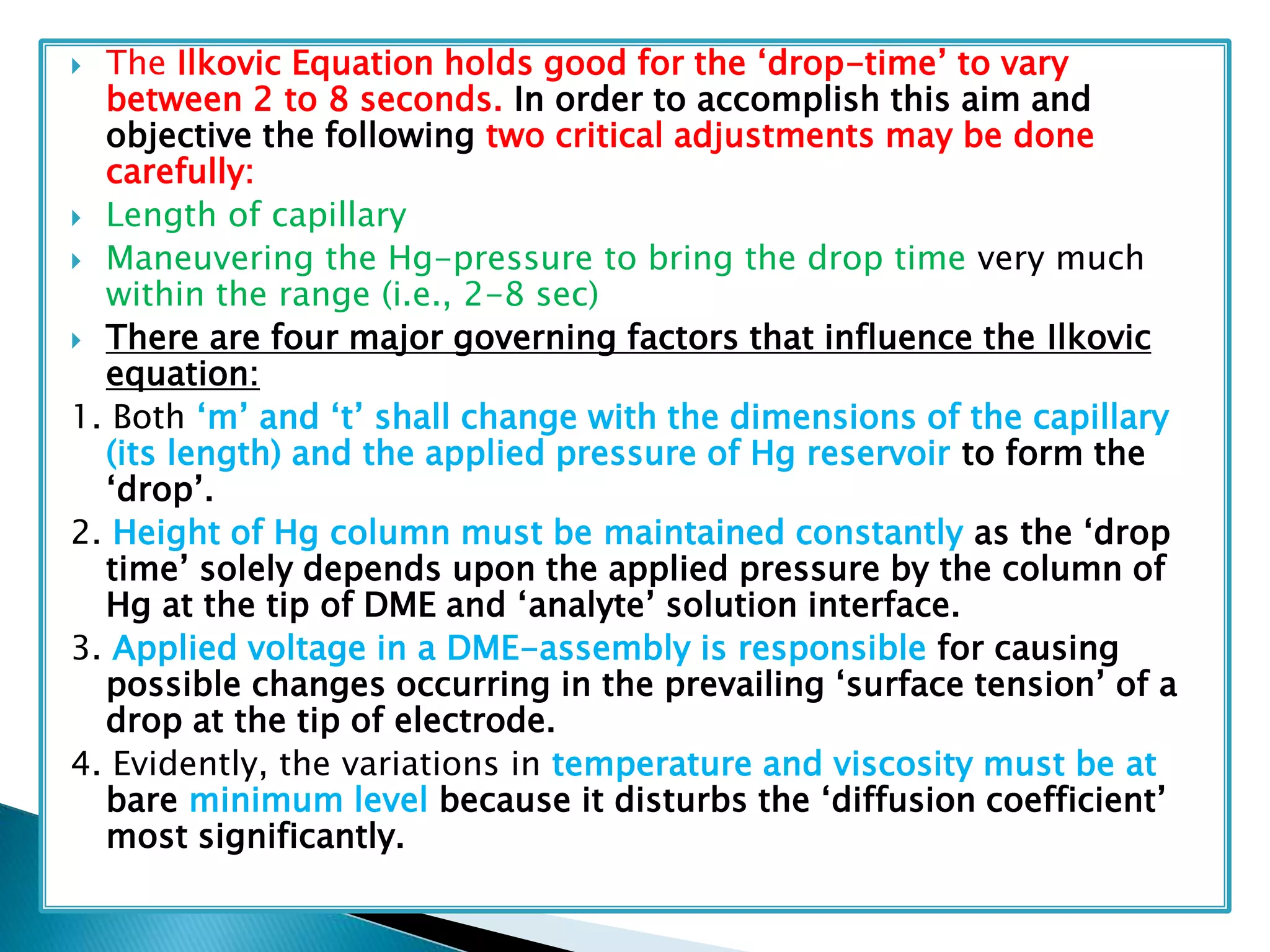
 The Ilkovic Equation holds good for the ‘drop-time’ to vary
between 2 to 8 seconds. In order to accomplish this aim and
objective the following two critical adjustments may be done
carefully:
 Length of capillary
 Maneuvering the Hg-pressure to bring the drop time very much
within the range (i.e., 2-8 sec)
 There are four major governing factors that influence the Ilkovic
equation:
1. Both ‘m’ and ‘t’ shall change with the dimensions of the capillary
(its length) and the applied pressure of Hg reservoir to form the
‘drop’.
2. Height of Hg column must be maintained constantly as the ‘drop
time’ solely depends upon the applied pressure by the column of
Hg at the tip of DME and ‘analyte’ solution interface.
3. Applied voltage in a DME-assembly is responsible for causing
possible changes occurring in the prevailing ‘surface tension’ of a
drop at the tip of electrode.
4. Evidently, the variations in temperature and viscosity must be at
bare minimum level because it disturbs the ‘diffusion coefficient’
most significantly.
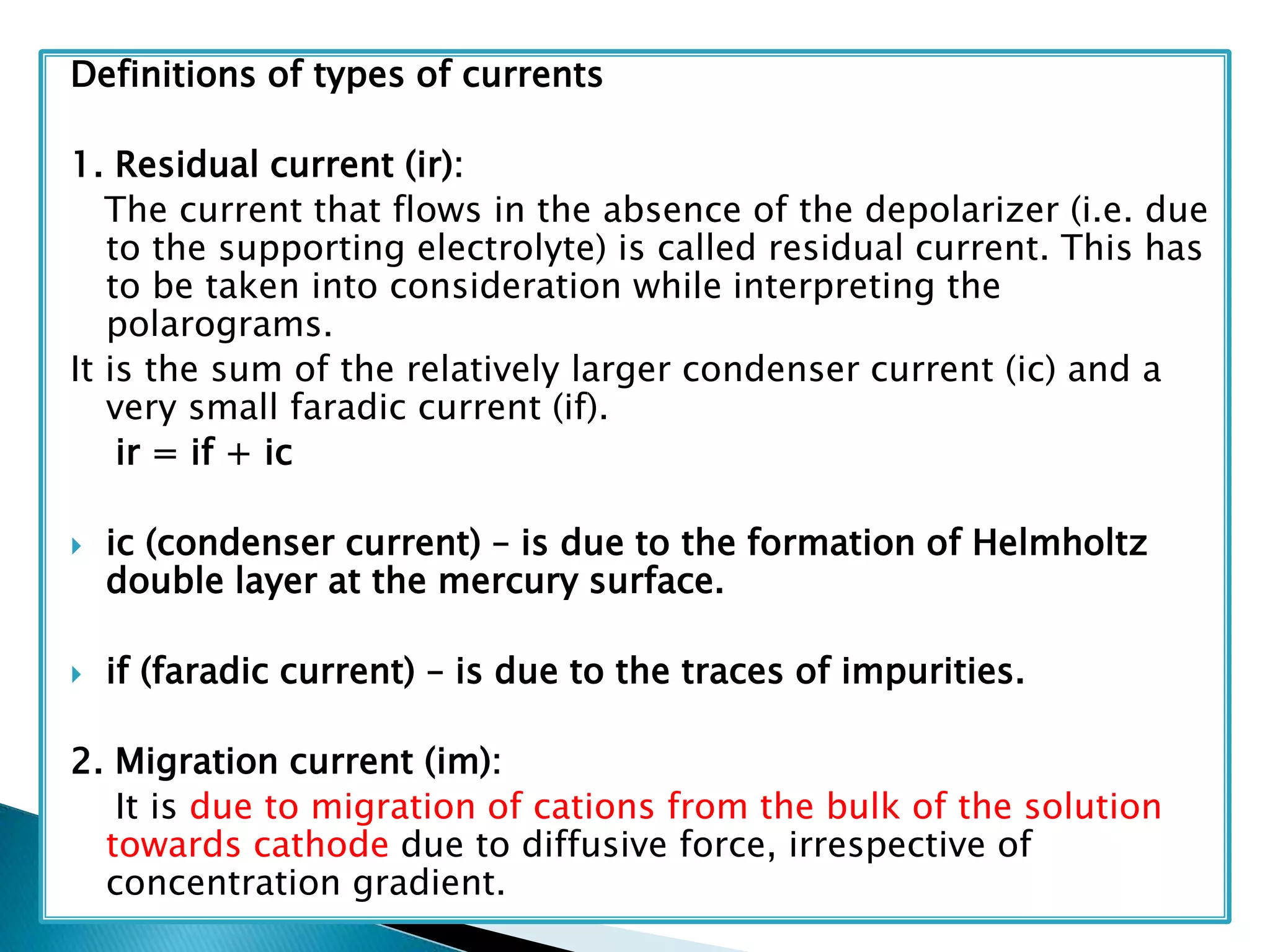
Definitions of types of currents
1. Residual current (ir):
The current that flows in the absence of the depolarizer (i.e. due
to the supporting electrolyte) is called residual current. This has
to be taken into consideration while interpreting the
polarograms.
It is the sum of the relatively larger condenser current (ic) and a
very small faradic current (if).
ir = if + ic
 ic (condenser current) – is due to the formation of Helmholtz
double layer at the mercury surface.
 if (faradic current) – is due to the traces of impurities.
2. Migration current (im):
It is due to migration of cations from the bulk of the solution
towards cathode due to diffusive force, irrespective of
concentration gradient.
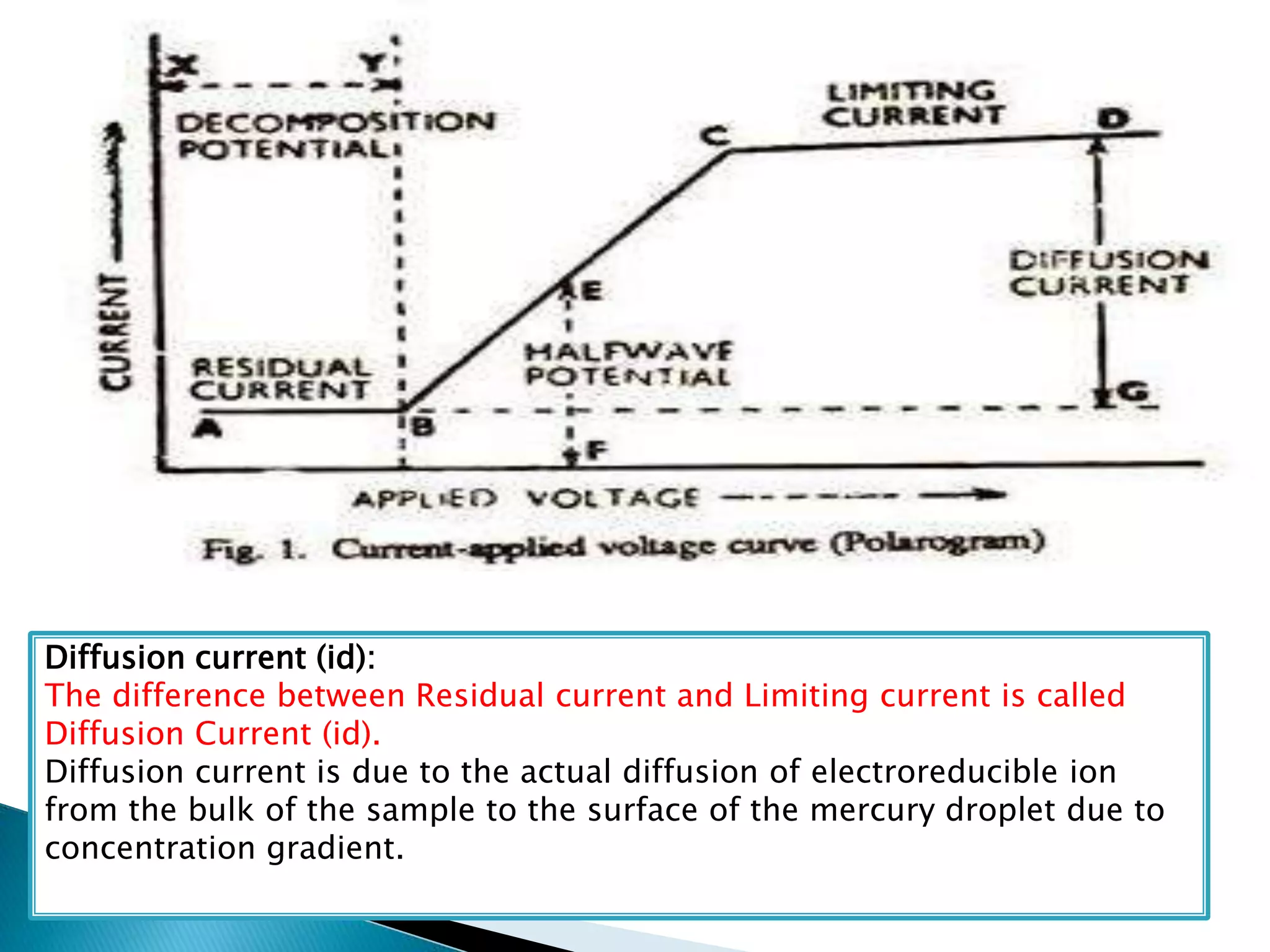
Diffusion current (id):
The difference between Residual current and Limiting current is called
Diffusion Current (id).
Diffusion current is due to the actual diffusion of electroreducible ion
from the bulk of the sample to the surface of the mercury droplet due to
concentration gradient.
6.Half wave potential
Half wave potential is the potential at which the concentration
of oxidised and reduced forms at electrode surface is equal. i.e.,
50% of oxidised and 50% of reduced forms are present.
5. Limiting current (il):
Beyond a certain potential, the current reaches a steady state
value called as the limiting current. At this point, the rate of the
diffusion of ions is equal to the rate of reduction of ions, and
the state of electrode is said to be concentration polarised.
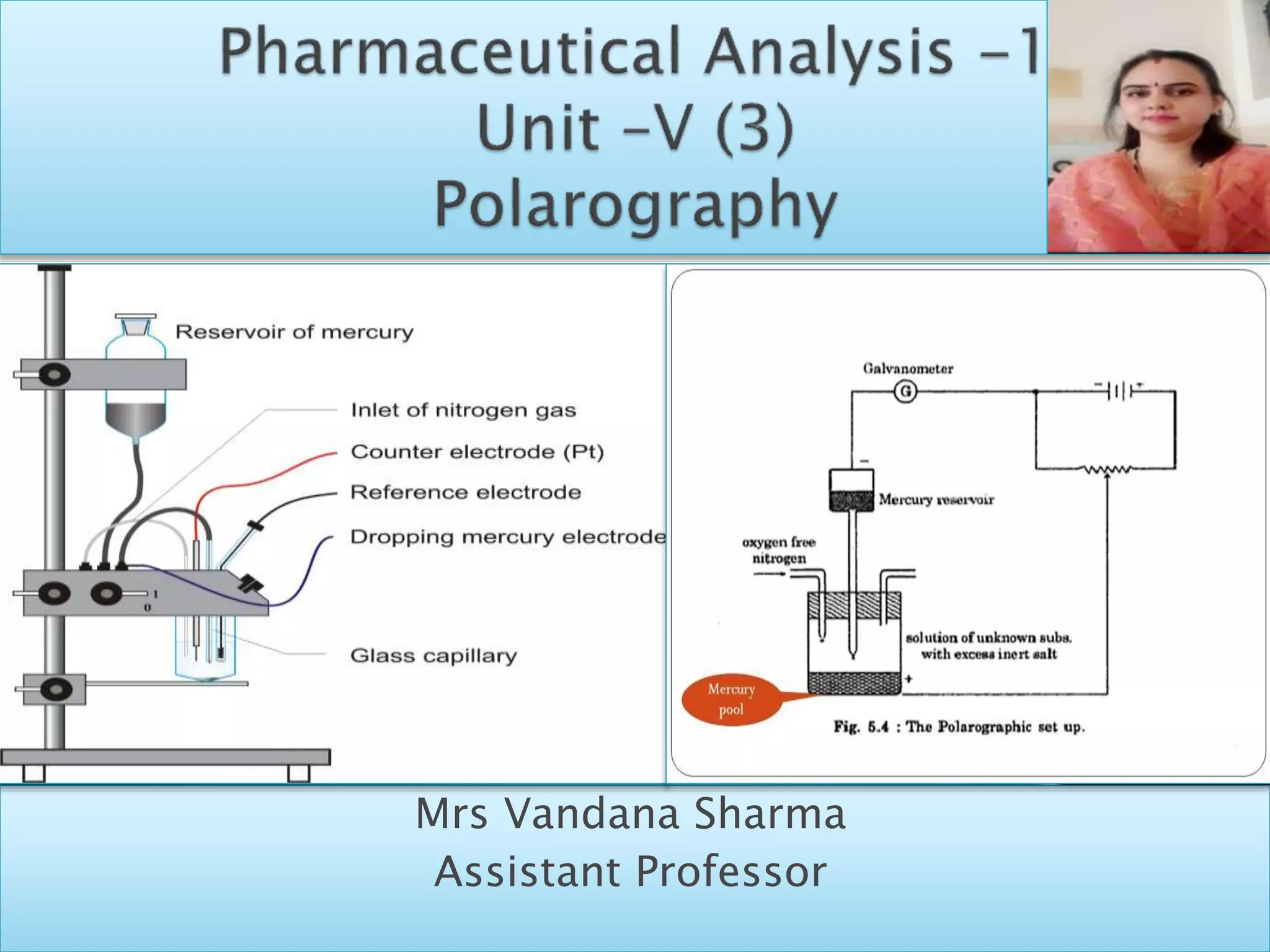
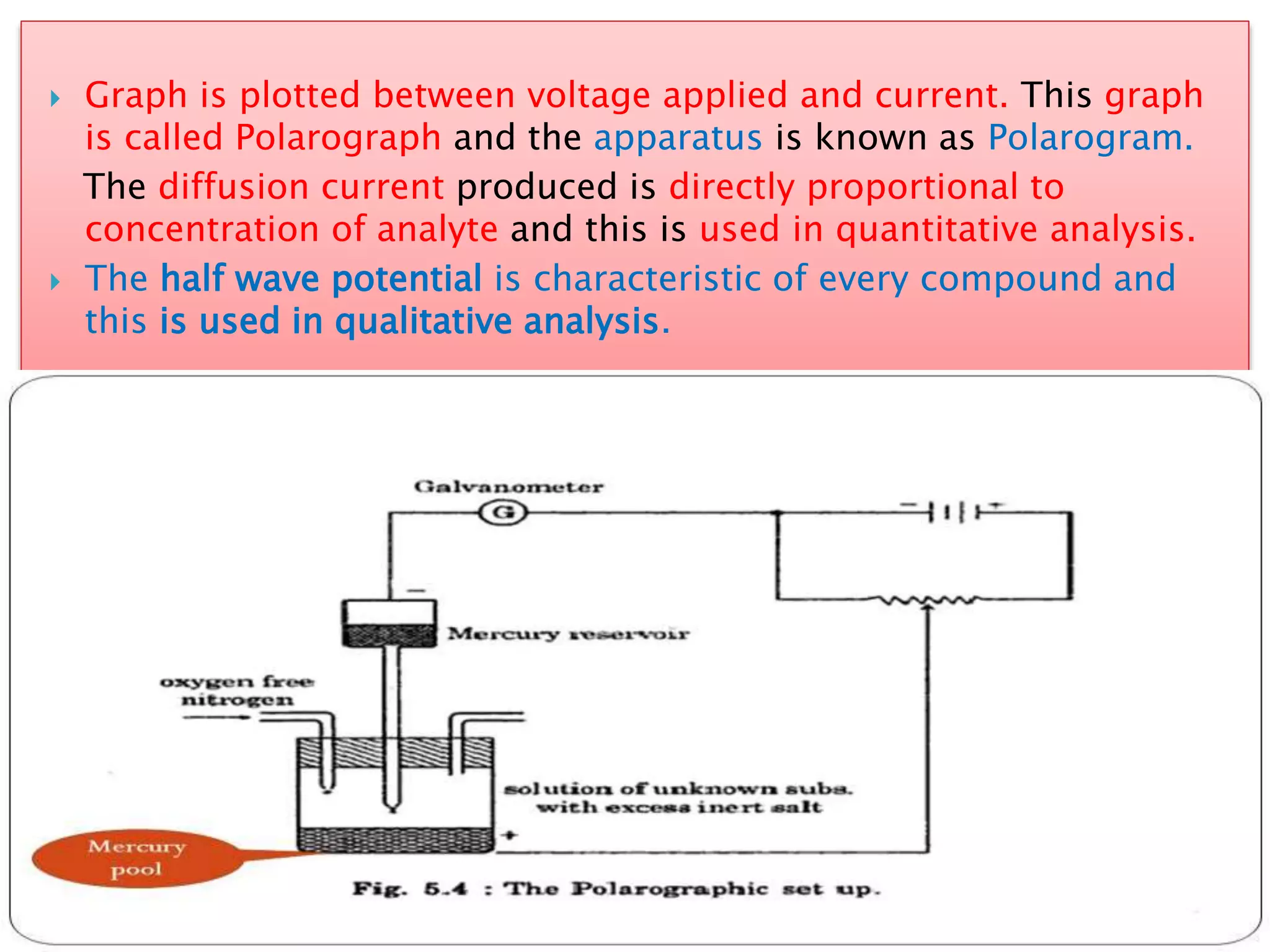
Construction
 Dropping mercury electrode (DMF) is consist of a mercury
reservoir from which mercury drops come down as small drops
through a capillary. It is generally act as cathode (-). It is known
as indicator electrode or micro electrode.
 The height of mercury reservoir is adjusted to set the drop time
i.e. 1 to 5 seconds
 Drop time is the time required to form every fresh drop of
mercury from capillary.
 Inside the tubing wire contact is made where mercury flows
through.
 The Anode—consist of mercury pool at the bottom of reservoir
which act as the reference electrode and its area is large, so that
is not polarize.
 Both anode and cathode are connected across the appropriate
end of battery.
 The applied voltage can be changed by adjusting the sliding
contact along the potentiometer wire EF.
Mercury
pool-
Anode
Dropping
mercury
electrode
Mercury
Drop
Solution
(Analyte)
i.e Cd+2
Supporting
analyte
Cd+2 + 2e Cd
Working-
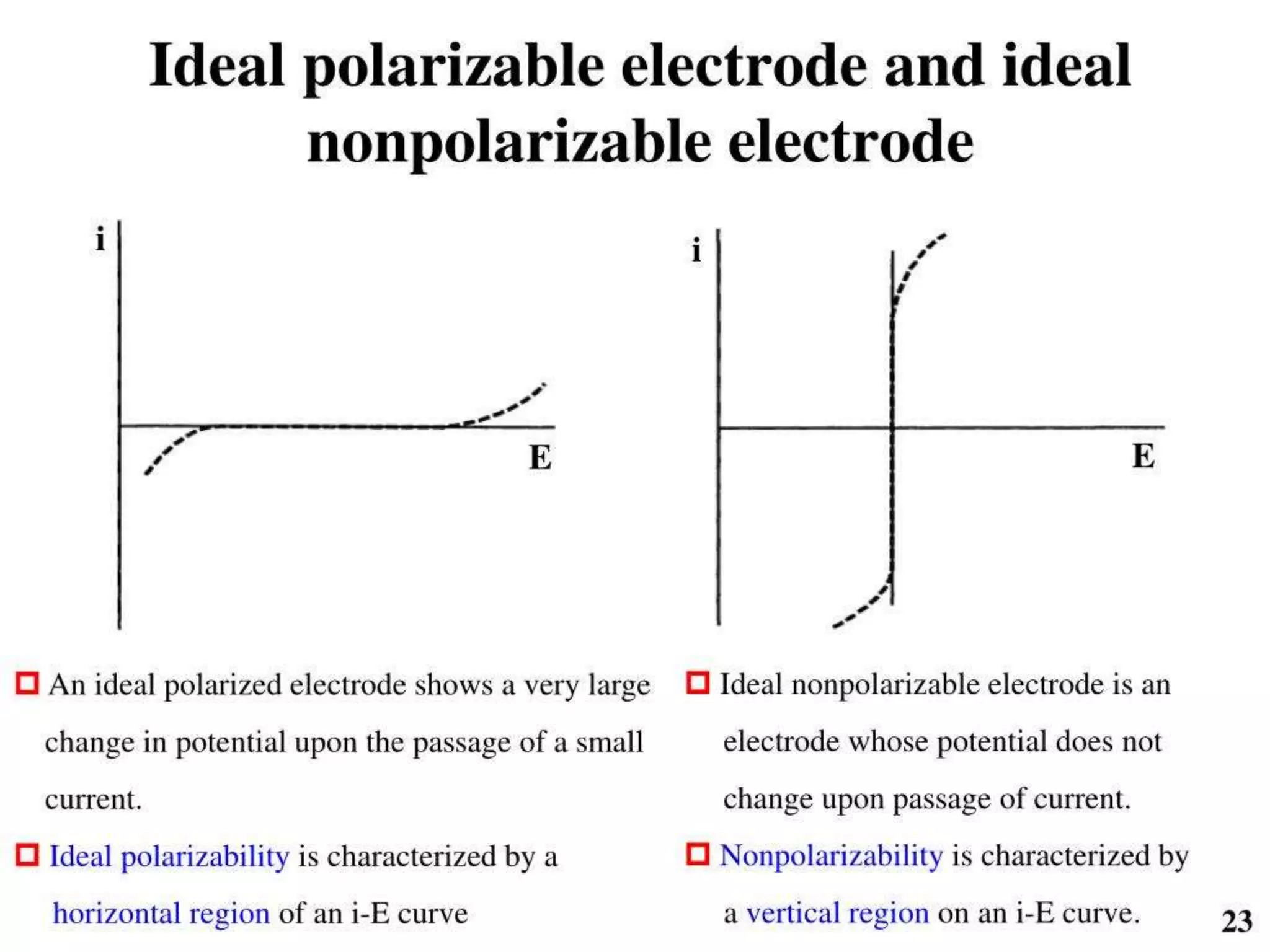
1. Dropping mercury electrode is polarisable electrode {A very
large change in potential (The change in potential energy equals
the gain in kinetic energy, which can then be used to find the
speed) upon passages of a small current}.
2. Can be act as both anode (+) and cathode (-). But generally
used as cathode (-).
3. The pool of mercury act as counter electrode i.e. anode (+) if
DMF is Cathode (-).
4. Note- a pool of mercury due to large surface area has low
current density and is non- polarisable therefore has constant
potential.
5. Example- Consider the polerography cell containing a solution
of cadmium chloride, to which external EMF is applied.
5. To the analyte solution (i.e. Cadmium) supporting electrolyte
like KCl is added i.e. 50-100 times of sample concentration to
eliminate the migration current (Additional current produced
by electrostatic attraction of cations to the surface of a
dropping electrode; an unpredictable and undesirable effect
to be avoided during analytical voltammeter.)
6. Pure nitrogen or hydrogen gas is bubbled to expel out the
dissolved oxygen.
7. The positively charged ions ( Cd+2 ) present in solution will
attract to the dropping mercury electrode (-) by an electrical
force and by diffusive force resulting from the concentration
gradient formed at the surface of the electrode.
8. Thus total current flowing through the cell may be regarded
as the sum of electrical and diffusive forces.
9. When applied voltage is increased and current is recorded , a
graph will be obtained
Easy step of working
Dropping mercury electrode (DME) is a polarisable electrode and
can act as both anode and cathode.
 The pool of mercury acts as counter electrode,
i.e., anode if DME is cathode or
cathode if DME is anode.
 The counter electrode is a non-polarisable electrode.
 To the analyte solution, electrolyte like KCl is added i.e., 50-100
times of sample concentration.
 Pure nitrogen or hydrogen gas is bubbled through the solution,
to expel (remove) out oxygen.
Eg: If the analyte solution contains cadmium ions, then cadmium
ions are discharged at cathode (-)
Cd2+ + 2e- → Cd
 Then, gradually increasing voltage is applied to the polarographic
cell and current is recorded.
 Graph is plotted between voltage applied and current. This graph
is called Polarograph and the apparatus is known as Polarogram.
The diffusion current produced is directly proportional to
concentration of analyte and this is used in quantitative analysis.
 The half wave potential is characteristic of every compound and
this is used in qualitative analysis.
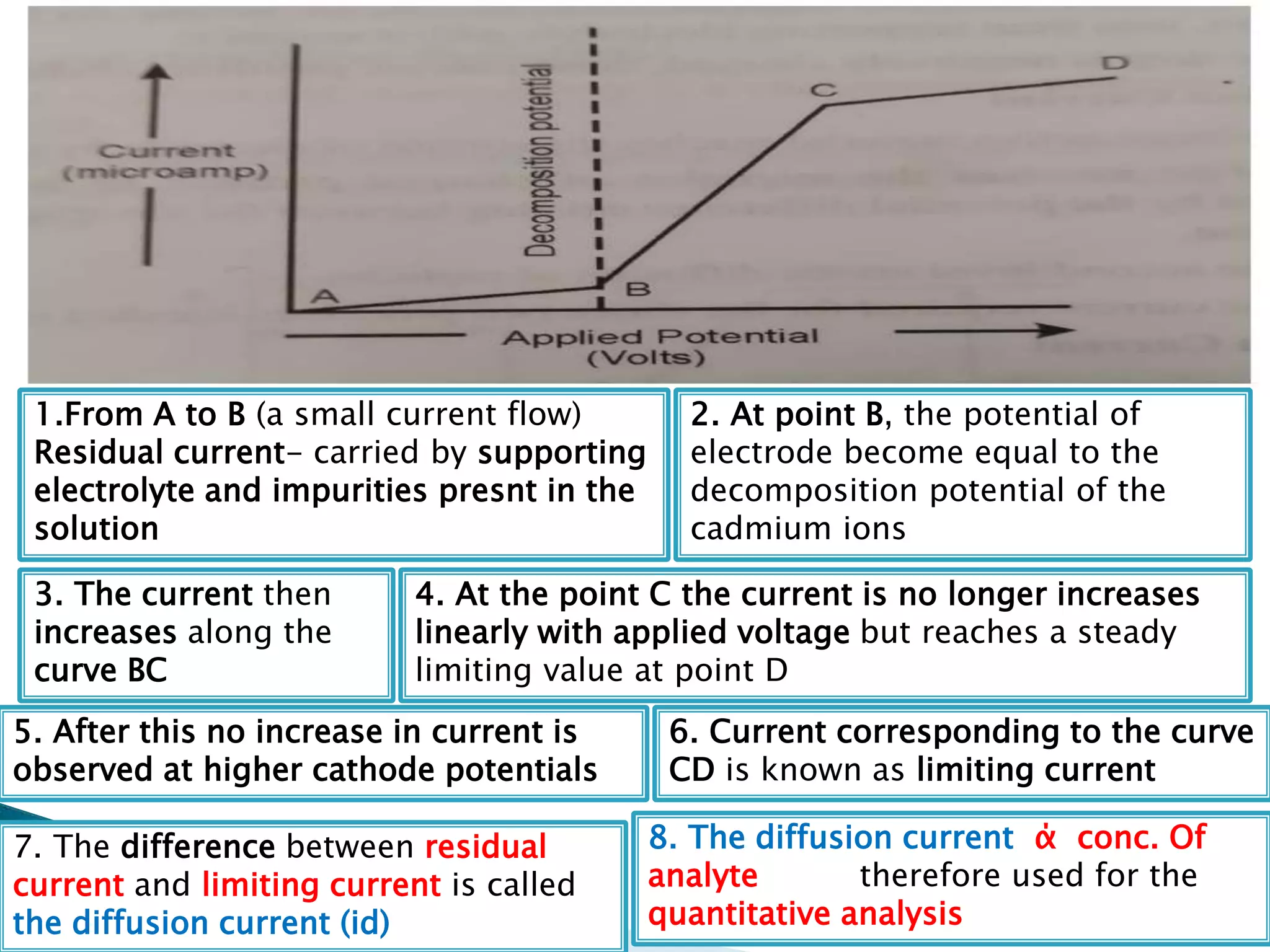
1.From A to B (a small current flow)
Residual current- carried by supporting
electrolyte and impurities presnt in the
solution
2. At point B, the potential of
electrode become equal to the
decomposition potential of the
cadmium ions
3. The current then
increases along the
curve BC
4. At the point C the current is no longer increases
linearly with applied voltage but reaches a steady
limiting value at point D
5. After this no increase in current is
observed at higher cathode potentials
6. Current corresponding to the curve
CD is known as limiting current
7. The difference between residual
current and limiting current is called
the diffusion current (id)
8. The diffusion current ά conc. Of
analyte therefore used for the
quantitative analysis
Advantage
 Surface area is reproducible with a given capillary
 It provides a smooth, fresh surface for the reaction.
 Each drop remains unaffected and does not become
contaminated by the deposited metal.
 Diffusion equilibrium is readily established at mercury-solution
interface.
 Surface area of a drop is can be calculated from the weight of
drop
 Mercury forms amalgam (Solid solution) with most of the metals
Limitations
 It is poisonous so care should be taken in its handling.
 Surface area of a drop of mercury is never constant.
 Applied voltage produces changes in surface tension and hence
change in drop size.
 Mercury has limited applications in analysis
 Capillary is very small and thus can be easily blocked.
 It cannot be used at higher positive potential due to oxidation of
mercury.
 DME has disadvantage that it cannot be used at high potential
due to oxidation of mercury. Therefore, platinum electrode is
used in such cases.
 Why the platinum electrode is rotated?
 If the platinum electrode is stationary then diffusion current will
be slowly attained, so to overcome this problem platinum
electrode rotated at constant speed, which results in increasing
sensitivity and rate of attaining steady diffusion current.
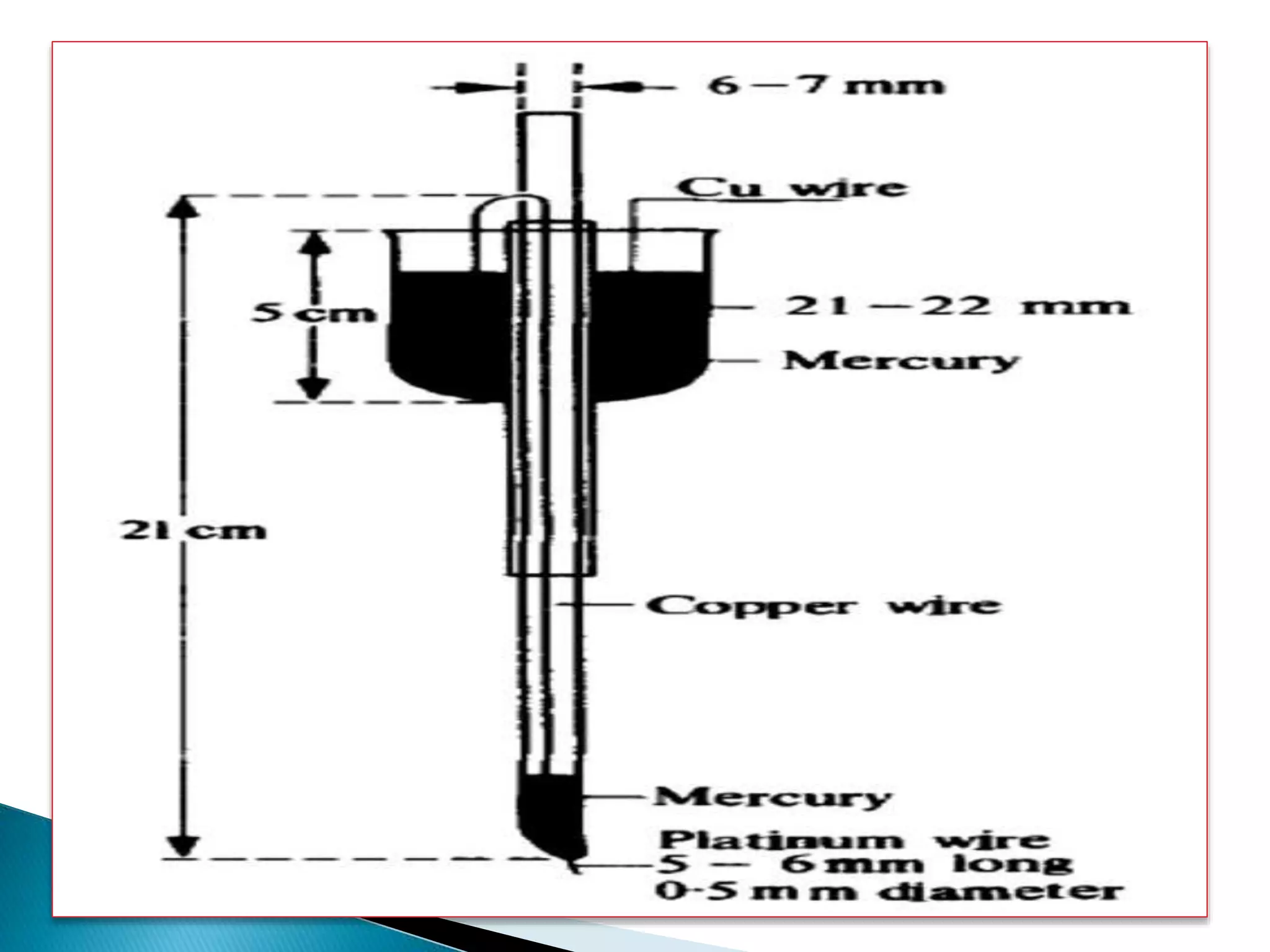
 Construction:
 The construction of the rotating platinum electrode is evident
from the figure.
 The electrode is constructed from a standard ‘mercury seal’.
 It consists of about 5mm platinum wire having 0.5mm diameter
below standard mercury seal by passing through small hole.
 A wire from mercury seal is connected to the source that applies
voltage.
 The tubing forms the stem of the electrode which is rotated at a
constant speed of 600 rpm.
Working
 Rotating platinum electrode is used as an indicator electrode. To
the analyte solution supporting electrolyte like KCl is added i.e.,
50-100 times of sample concentration.
 Pure nitrogen gas is bubbled through the solution to expel out
the dissolved oxygen.
 Potential is applied across the electrodes and titration is started.
 A graph is plotted between the volume of solution added v/s
diffusion current and end point is detected.
Applications of Polarography:
1. Qualitative analysis: It helps in characterization of organic matter
and various metal interactions from half wave potential of the
current v/s voltage graph.
2. Qualitative analysis: Polarography is used in the determination of
concentration of drugs, metal ions etc. in the given sample.
3. Determination of inorganic compounds: Polarography is used in
determination of cations and anions in the presence of interfering
ions.
4. Determination of organic compounds: Polarography is used in
determination of structure, quantitative analysis of mixture of
organic compounds.
5. Estimation of dissolved oxygen: Amount of oxygen dissolved in
aqueous solution or organic solvent can be calculated with the help
of Polarography.
6. Pharmaceutical applications: Tetracycline antibiotics,
sulphonamides can be analysed by Polarography
Polarography has been used extensively to determine trace metals in
pharmaceutical products and to estimate drugs that contain metals
as a constituent. The metals examined include antimony, arsenic,
cadmium, copper, iron, lead, magnesium, mercury, vanadium and
zinc.
The change in potential energy equals the gain in kinetic energy, which
can then be used to find the speed.

Polarography Principle, instrumentation, Applications.pptx

  • 1.
  • 2.
     Principle  Ilkovicequation  Construction and working of dropping mercury electrode and rotating platinum electrode  Applications  Give any 2 applications of polarography. 2  Write ilkovic equation used in polarography. 2  Explain the construction and working of dropping mercury electrode. 5  Give principle, instrumentation and applications of a) Conductometry b) Polarography 10  Give the ilkovic equation of polarography. 2  Draw a labeled diagram of polarography and explain it.  Explain the construction and working of dropping mercury electrode. 5
  • 3.
     Give principle,instrumentation and applications of a)Conductometry b) Polarography 10  Explain the construction and working of dropping mercury electrode. 5  Discuss the principle and application of the ilkovic equation. 5  Polarography is a voltammetric technique in which chemical species (ions or molecules) undergo oxidation (lose electrons) or reduction (gain electrons) at the surface of a dropping mercury electrode (DME) at an applied potential. Polarography only applies to the DME. Objective of polarography Polarography is an electroanalytical technique that measures the current flowing between two electrodes in the solution (in the presence of gradually increasing applied voltage) to determine the concentration of solute and its nature respectively
  • 4.
     Polarography isbased upon the principle that gradually increasing voltage is applied between two electrodes, one of which is polarisable (dropping mercury electrode) and other is non-polarisable and current flowing between the two electrodes is recorded.  A sigmoid shape current-voltage curve is obtained from which half wave potential as well as diffusion current is calculated.  Diffusion current is used for determination of concentration of substance.  Half wave potential is characteristic of every element.
  • 5.
     Ilkovic equationis a relation used in polarography relating the diffusion current (id) and the concentration of the non- polarisable electrode, i.e., the substance reduced or oxidised at the dropping mercury electrode (polarisable electrode). id = 607 nD1/2 Cm2/3 t 1/6 Where,  id = Diffusion current in microamperes  607 = Constant of various numerical factors including: Faraday constant (П), density of Hg, etc.,  n = Number of electrons duly involved in the electrode reaction,  D = Diffusion coefficient in cm2 .sec-1 ,  C = Concentration in mmol/L.  m = Weight of Hg flowing via the capillary in mg.sec-1 ,  t = Drop time in seconds,
  • 6.
     The IlkovicEquation holds good for the ‘drop-time’ to vary between 2 to 8 seconds. In order to accomplish this aim and objective the following two critical adjustments may be done carefully:  Length of capillary  Maneuvering the Hg-pressure to bring the drop time very much within the range (i.e., 2-8 sec)  There are four major governing factors that influence the Ilkovic equation: 1. Both ‘m’ and ‘t’ shall change with the dimensions of the capillary (its length) and the applied pressure of Hg reservoir to form the ‘drop’. 2. Height of Hg column must be maintained constantly as the ‘drop time’ solely depends upon the applied pressure by the column of Hg at the tip of DME and ‘analyte’ solution interface. 3. Applied voltage in a DME-assembly is responsible for causing possible changes occurring in the prevailing ‘surface tension’ of a drop at the tip of electrode. 4. Evidently, the variations in temperature and viscosity must be at bare minimum level because it disturbs the ‘diffusion coefficient’ most significantly.
  • 7.
    Definitions of typesof currents 1. Residual current (ir): The current that flows in the absence of the depolarizer (i.e. due to the supporting electrolyte) is called residual current. This has to be taken into consideration while interpreting the polarograms. It is the sum of the relatively larger condenser current (ic) and a very small faradic current (if). ir = if + ic  ic (condenser current) – is due to the formation of Helmholtz double layer at the mercury surface.  if (faradic current) – is due to the traces of impurities. 2. Migration current (im): It is due to migration of cations from the bulk of the solution towards cathode due to diffusive force, irrespective of concentration gradient.
  • 8.
    Diffusion current (id): Thedifference between Residual current and Limiting current is called Diffusion Current (id). Diffusion current is due to the actual diffusion of electroreducible ion from the bulk of the sample to the surface of the mercury droplet due to concentration gradient.
  • 9.
    6.Half wave potential Halfwave potential is the potential at which the concentration of oxidised and reduced forms at electrode surface is equal. i.e., 50% of oxidised and 50% of reduced forms are present. 5. Limiting current (il): Beyond a certain potential, the current reaches a steady state value called as the limiting current. At this point, the rate of the diffusion of ions is equal to the rate of reduction of ions, and the state of electrode is said to be concentration polarised.
  • 10.
    Construction  Dropping mercuryelectrode (DMF) is consist of a mercury reservoir from which mercury drops come down as small drops through a capillary. It is generally act as cathode (-). It is known as indicator electrode or micro electrode.  The height of mercury reservoir is adjusted to set the drop time i.e. 1 to 5 seconds  Drop time is the time required to form every fresh drop of mercury from capillary.  Inside the tubing wire contact is made where mercury flows through.  The Anode—consist of mercury pool at the bottom of reservoir which act as the reference electrode and its area is large, so that is not polarize.  Both anode and cathode are connected across the appropriate end of battery.  The applied voltage can be changed by adjusting the sliding contact along the potentiometer wire EF.
  • 11.
  • 12.
    Working- 1. Dropping mercuryelectrode is polarisable electrode {A very large change in potential (The change in potential energy equals the gain in kinetic energy, which can then be used to find the speed) upon passages of a small current}. 2. Can be act as both anode (+) and cathode (-). But generally used as cathode (-). 3. The pool of mercury act as counter electrode i.e. anode (+) if DMF is Cathode (-). 4. Note- a pool of mercury due to large surface area has low current density and is non- polarisable therefore has constant potential. 5. Example- Consider the polerography cell containing a solution of cadmium chloride, to which external EMF is applied.
  • 13.
    5. To theanalyte solution (i.e. Cadmium) supporting electrolyte like KCl is added i.e. 50-100 times of sample concentration to eliminate the migration current (Additional current produced by electrostatic attraction of cations to the surface of a dropping electrode; an unpredictable and undesirable effect to be avoided during analytical voltammeter.) 6. Pure nitrogen or hydrogen gas is bubbled to expel out the dissolved oxygen. 7. The positively charged ions ( Cd+2 ) present in solution will attract to the dropping mercury electrode (-) by an electrical force and by diffusive force resulting from the concentration gradient formed at the surface of the electrode. 8. Thus total current flowing through the cell may be regarded as the sum of electrical and diffusive forces. 9. When applied voltage is increased and current is recorded , a graph will be obtained
  • 14.
    Easy step ofworking Dropping mercury electrode (DME) is a polarisable electrode and can act as both anode and cathode.  The pool of mercury acts as counter electrode, i.e., anode if DME is cathode or cathode if DME is anode.  The counter electrode is a non-polarisable electrode.  To the analyte solution, electrolyte like KCl is added i.e., 50-100 times of sample concentration.  Pure nitrogen or hydrogen gas is bubbled through the solution, to expel (remove) out oxygen. Eg: If the analyte solution contains cadmium ions, then cadmium ions are discharged at cathode (-) Cd2+ + 2e- → Cd  Then, gradually increasing voltage is applied to the polarographic cell and current is recorded.
  • 15.
     Graph isplotted between voltage applied and current. This graph is called Polarograph and the apparatus is known as Polarogram. The diffusion current produced is directly proportional to concentration of analyte and this is used in quantitative analysis.  The half wave potential is characteristic of every compound and this is used in qualitative analysis.
  • 16.
    1.From A toB (a small current flow) Residual current- carried by supporting electrolyte and impurities presnt in the solution 2. At point B, the potential of electrode become equal to the decomposition potential of the cadmium ions 3. The current then increases along the curve BC 4. At the point C the current is no longer increases linearly with applied voltage but reaches a steady limiting value at point D 5. After this no increase in current is observed at higher cathode potentials 6. Current corresponding to the curve CD is known as limiting current 7. The difference between residual current and limiting current is called the diffusion current (id) 8. The diffusion current ά conc. Of analyte therefore used for the quantitative analysis
  • 17.
    Advantage  Surface areais reproducible with a given capillary  It provides a smooth, fresh surface for the reaction.  Each drop remains unaffected and does not become contaminated by the deposited metal.  Diffusion equilibrium is readily established at mercury-solution interface.  Surface area of a drop is can be calculated from the weight of drop  Mercury forms amalgam (Solid solution) with most of the metals Limitations  It is poisonous so care should be taken in its handling.  Surface area of a drop of mercury is never constant.  Applied voltage produces changes in surface tension and hence change in drop size.  Mercury has limited applications in analysis  Capillary is very small and thus can be easily blocked.  It cannot be used at higher positive potential due to oxidation of mercury.
  • 18.
     DME hasdisadvantage that it cannot be used at high potential due to oxidation of mercury. Therefore, platinum electrode is used in such cases.  Why the platinum electrode is rotated?  If the platinum electrode is stationary then diffusion current will be slowly attained, so to overcome this problem platinum electrode rotated at constant speed, which results in increasing sensitivity and rate of attaining steady diffusion current.  Construction:  The construction of the rotating platinum electrode is evident from the figure.  The electrode is constructed from a standard ‘mercury seal’.  It consists of about 5mm platinum wire having 0.5mm diameter below standard mercury seal by passing through small hole.
  • 20.
     A wirefrom mercury seal is connected to the source that applies voltage.  The tubing forms the stem of the electrode which is rotated at a constant speed of 600 rpm. Working  Rotating platinum electrode is used as an indicator electrode. To the analyte solution supporting electrolyte like KCl is added i.e., 50-100 times of sample concentration.  Pure nitrogen gas is bubbled through the solution to expel out the dissolved oxygen.  Potential is applied across the electrodes and titration is started.  A graph is plotted between the volume of solution added v/s diffusion current and end point is detected.
  • 21.
    Applications of Polarography: 1.Qualitative analysis: It helps in characterization of organic matter and various metal interactions from half wave potential of the current v/s voltage graph. 2. Qualitative analysis: Polarography is used in the determination of concentration of drugs, metal ions etc. in the given sample. 3. Determination of inorganic compounds: Polarography is used in determination of cations and anions in the presence of interfering ions. 4. Determination of organic compounds: Polarography is used in determination of structure, quantitative analysis of mixture of organic compounds. 5. Estimation of dissolved oxygen: Amount of oxygen dissolved in aqueous solution or organic solvent can be calculated with the help of Polarography. 6. Pharmaceutical applications: Tetracycline antibiotics, sulphonamides can be analysed by Polarography Polarography has been used extensively to determine trace metals in pharmaceutical products and to estimate drugs that contain metals as a constituent. The metals examined include antimony, arsenic, cadmium, copper, iron, lead, magnesium, mercury, vanadium and zinc.
  • 23.
    The change inpotential energy equals the gain in kinetic energy, which can then be used to find the speed.