Voltammetry
and
polarography
1. NORMAL PULSE VOLTAMMETRY
2. DIFFERENTIAL PULSE VOLTAMMETRY
By
Shobana.N.S
Queen Mary’s College, Chennai
Voltammetry
 It is an Electro- analytical technique.
 It gives information about the analyte.
 We can even measure the amount of current by varying the
voltage.
 The change in current with the varying voltage gives the
plot and is known as uoltammogram
 There is a minimum potential required to initiate an
oxidation or reduction reaction at an electrode.
Instrumentation
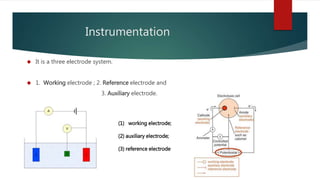
 It is a three electrode system.
 1. Working electrode ; 2. Reference electrode and
3. Auxiliary electrode.
(1) working electrode;
(2) auxiliary electrode;
(3) reference electrode
Working Electrode
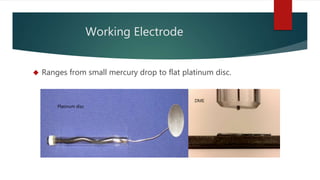
 Ranges from small mercury drop to flat platinum disc.
Platinum disc
DME
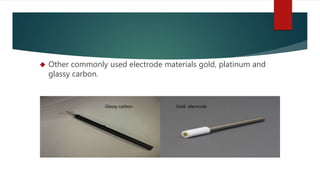
 Other commonly used electrode materials gold, platinum and
glassy carbon.
Glassy carbon Gold electrode
 Depending on the choice of working electrode, the type of voltammetry is
decided.
 Example :
We use Dropping Mercury Electrode (DME) in Polarography technique
We use Platinum electrode in Cyclic Voltammetry
We use Glassy Carbon as electrode in Linear Sweep Voltammetry.
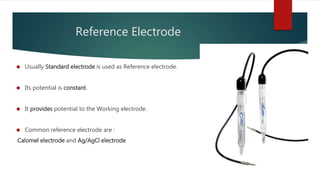
Reference Electrode
 Usually Standard electrode is used as Reference electrode.
 Its potential is constant.
 It provides potential to the Working electrode.
 Common reference electrode are :
Calomel electrode and Ag/AgCl electrode
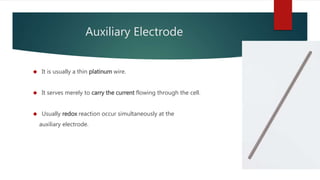
Auxiliary Electrode
 It is usually a thin platinum wire.
 It serves merely to carry the current flowing through the cell.
 Usually redox reaction occur simultaneously at the
auxiliary electrode.
Type of Voltammetry
 LINEAR SWEEP VOLTAMMETRY
 STAIRCASE VOLTAMMETRY
 CYCLIC VOLTAMMETRY
 SQUAREWAVE VOLTAMMETRY
 ANODIC STRIPPING VOLTAMMETRY
 CATHODIC STRIPPING VOLTAMMETRY
 ABSORPTIVE STRIPPING VOLTAMMETRY
 ALTERNATING CURRENT VOLTAMMETRY
 POLAROGRAPHY
 ROTATED ELECTRODE VOLTAMMETRY
 NORMAL PULSE VOLTAMMETRY
 DIFFERENTIAL PULSE VOLTAMMETRY
 CHRONOAMPEROMETRY.
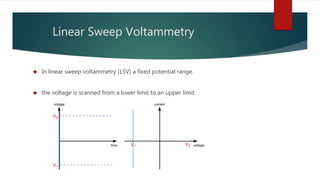
Linear Sweep Voltammetry
 In linear sweep voltammetry (LSV) a fixed potential range.
 the voltage is scanned from a lower limit to an upper limit.
 In LSV measurements the current response is plotted as a function of voltage
rather than time.
 The scan begins from the left hand side of the current/voltage plot where no
current flows.
 As the voltage is swept further to the right (to more reductive values) a current
begins to flow and eventually reaches a peak before dropping
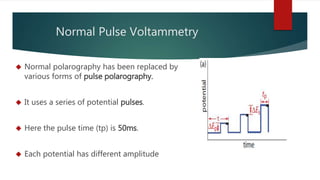
Normal Pulse Voltammetry
 Normal polarography has been replaced by
various forms of pulse polarography.
 It uses a series of potential pulses.
 Here the pulse time (tp) is 50ms.
 Each potential has different amplitude
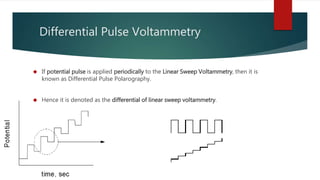
Differential Pulse Voltammetry
 If potential pulse is applied periodically to the Linear Sweep Voltammetry, then it is
known as Differential Pulse Polarography.
 Hence it is denoted as the differential of linear sweep voltammetry.
 The current is measured twice per cycle.
 Here the pulse time (tp) is 17ms.
 The difference in the two currents gives rise to the peak-shaped voltammogram.
 consistent enhancement of the signal is achieved.
 Detection limit is as low as 10-8 M
 Each potential step has the same amplitude
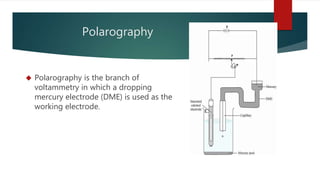
Polarography
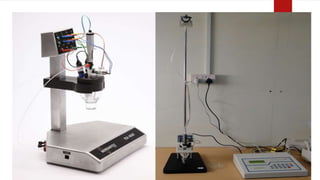
 Polarography is the branch of
voltammetry in which a dropping
mercury electrode (DME) is used as the
working electrode.
 Conventional DC
 Wide cathodic potential range and a renewable surface
 Hence widely used for the determination of many reducible species
 Reduction begins at sufficiently negative potential
 voltage applied to the polarisable electrode is increased over the range of 0-2V
 It is known as incomplete electrolysis.
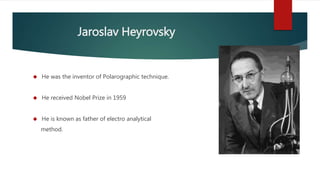
Jaroslav Heyrovsky
 He was the inventor of Polarographic technique.
 He received Nobel Prize in 1959
 He is known as father of electro analytical
method.
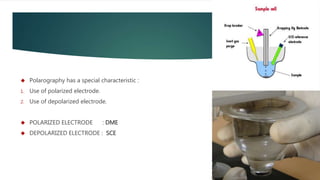
 Polarography has a special characteristic :
1. Use of polarized electrode.
2. Use of depolarized electrode.
 POLARIZED ELECTRODE : DME
 DEPOLARIZED ELECTRODE : SCE
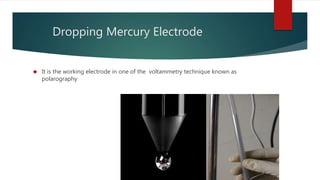
Dropping Mercury Electrode
 It is the working electrode in one of the voltammetry technique known as
polarography
Advantages of DME
 Clean Surface generated
 Rapid constant current achievement
 Even metal with high negative standard voltage systems can be studied without
hydrogen.
 Amalgam formation more favourable.
THANK YOU !!