23.2 Half-cells and Cell Potentials
Electrode potentials A measure of how willing a species is to gain or lose electrons. Standard potentials Potential of a cell acting as a cathode compared to a standard hydrogen  electrode. Values also require other standard  conditions.
Standard hydrogen electrode Hydrogen electrode (SHE) The ultimate reference electrode. H 2  is constantly bubbled into a 1 M HCl solution E o  = 0.000 000 V All other standard potentials are then reported relative to SHE. H 2 1 M HCl Pt black plate
Electrode potentials Standard potentials are defined using specific concentrations. All soluble species are at 1 M Slightly soluble species must be at saturation. Any gas is constantly introduced at 1 atm Any metal must be in electrical contact Other solids must also be present and in contact.
Electrode potentials The standard potential for: Cu 2+  + 2e -   Cu  (s)   is +0.337V. This means that: If a sample of copper metal is placed in a 1 M Cu 2+  solution, we’ll measure a value of 0.337V if compared to: 2H +  + 2e -   H 2  (g)   (1 M)  (1atm)
Half reactions A common approach for listing species that undergo REDOX is as half-reactions. For  2Fe 3+  + Zn o (s)   =  2Fe 2+  + Zn 2+ Fe 3+  + e -     Fe 2+ (reduction) Zn o (s)     Zn 2+  + 2e -   (oxidation) You’ll find this approach useful for a number of reasons.
Half reactions Tables are available which list half reactions as either oxidations or reductions.( Pg 688) Will provide Standard  E o  values  to help predict reactions and equilibria. Other species that participate in the reaction. Show the relative ability to gain or loss electrons.
Cell potentials One thing that we would like to know is the spontaneous direction for a reaction. This requires that we determine the  E cell . Since our standard potentials ( E  o ) are commonly listed as reductions, we’ll base our definitions on that. E cell  =  E half-cell of reduction  -  E half-cell of oxidation E o cell  =  E o half-cell of reduction  -  E o half-cell of oxidation
Cell potentials You know that both an oxidation and a reduction must occur.  One of your half reactions must be reversed. The spontaneous or galvanic direction for a reaction is the one where  E cell  is a positive value. The half reaction with the largest  E  value will proceed as a reduction. The other will be reversed -  oxidation.
Cell potentials For our copper - zinc cell at standard conditions:   Cu 2+  + 2e -   Cu  (s) +0.34 V   Zn 2+  + 2e -   Zn  (s)   -0.763 V E cell   1.03 V Spontaneous reaction at standard conditions: Cu 2+  + Zn  (s)   Cu  (s)   +   Zn 2+
Concentration dependency of  E E o  values are based on standard conditions. The  E  value will vary if any of the concentrations vary from standard conditions. This effect can be experimentally determined by measuring E versus a standard (indicator) electrode. Theoretically, the electrode potential can be determined by the  Nernst equation .
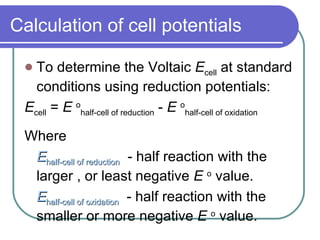
Calculation of cell potentials To determine the Voltaic  E cell  at standard conditions using reduction potentials: E cell  =  E  o half-cell of reduction  -  E  o half-cell of oxidation Where  E half-cell of reduction   - half reaction with the larger , or least negative  E  o  value. E half-cell of oxidation   - half reaction with the smaller or more negative  E  o  value.
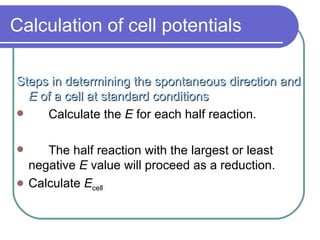
Calculation of cell potentials Steps in determining the spontaneous direction and  E  of a cell at standard conditions Calculate the  E  for each half reaction. The half reaction with the largest or least negative  E  value will proceed as a reduction. Calculate  E cell
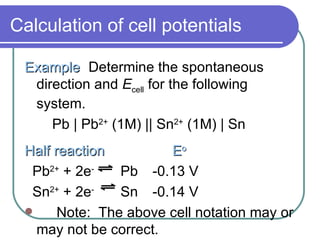
Calculation of cell potentials Example Determine the spontaneous direction and  E cell  for the following system. Pb | Pb 2+  (1M) || Sn 2+  (1M) | Sn Half reaction   E o Pb 2+  + 2e -   Pb -0.13 V Sn 2+  + 2e -   Sn -0.14 V Note:  The above cell notation may or may not be correct.
Calculation of cell potentials anode: Pb 2+  + 2e -   Pb  -0.13 V cathode:Sn 2+  + 2e -   Sn  -0.14 V E cell  =  E  o half-cell of reduction  -  E  o half-cell of oxidation (-0.14)  – (-0.13)= -0.1 V so not spontaneous
Calculation of cell potentials Calculate the E 0 cell  to determine if the following cell is spontaneous as written Ni (s)  + Fe 2+ (aq)  -----Ni 2+ (aq)  + Fe (s)
Calculation of cell potentials Write each half reaction and look up the reduction cell potential Oxidation: Ni----Ni 2+  + 2e -  -0.25 V Reduction:Fe 2+  +2e - ------Fe  -0.44 V E 0 cell = (-0.44)-(-0.25)=  -0.19V Because the potential is negative, it is not spontaneous
Calculation of cell potentials A voltaic cell is constructed using the following half-reactions: Ag +  + 1e - -----Ag  +0.80 Cu 2+ +2e - -----Cu  +0.34 Determine the cell reaction and the standard cell potential
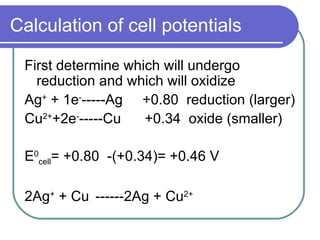
Calculation of cell potentials First determine which will undergo reduction and which will oxidize Ag +  + 1e - -----Ag  +0.80  reduction (larger) Cu 2+ +2e - -----Cu  +0.34  oxide (smaller) E 0 cell = +0.80  -(+0.34)= +0.46 V  2Ag +  + Cu  ------2Ag + Cu 2+

23sec2

  • 1.
    23.2 Half-cells andCell Potentials
  • 2.
    Electrode potentials Ameasure of how willing a species is to gain or lose electrons. Standard potentials Potential of a cell acting as a cathode compared to a standard hydrogen electrode. Values also require other standard conditions.
  • 3.
    Standard hydrogen electrodeHydrogen electrode (SHE) The ultimate reference electrode. H 2 is constantly bubbled into a 1 M HCl solution E o = 0.000 000 V All other standard potentials are then reported relative to SHE. H 2 1 M HCl Pt black plate
  • 4.
    Electrode potentials Standardpotentials are defined using specific concentrations. All soluble species are at 1 M Slightly soluble species must be at saturation. Any gas is constantly introduced at 1 atm Any metal must be in electrical contact Other solids must also be present and in contact.
  • 5.
    Electrode potentials Thestandard potential for: Cu 2+ + 2e - Cu (s) is +0.337V. This means that: If a sample of copper metal is placed in a 1 M Cu 2+ solution, we’ll measure a value of 0.337V if compared to: 2H + + 2e - H 2 (g) (1 M) (1atm)
  • 6.
    Half reactions Acommon approach for listing species that undergo REDOX is as half-reactions. For 2Fe 3+ + Zn o (s) = 2Fe 2+ + Zn 2+ Fe 3+ + e - Fe 2+ (reduction) Zn o (s) Zn 2+ + 2e - (oxidation) You’ll find this approach useful for a number of reasons.
  • 7.
    Half reactions Tablesare available which list half reactions as either oxidations or reductions.( Pg 688) Will provide Standard E o values to help predict reactions and equilibria. Other species that participate in the reaction. Show the relative ability to gain or loss electrons.
  • 8.
    Cell potentials Onething that we would like to know is the spontaneous direction for a reaction. This requires that we determine the E cell . Since our standard potentials ( E o ) are commonly listed as reductions, we’ll base our definitions on that. E cell = E half-cell of reduction - E half-cell of oxidation E o cell = E o half-cell of reduction - E o half-cell of oxidation
  • 9.
    Cell potentials Youknow that both an oxidation and a reduction must occur. One of your half reactions must be reversed. The spontaneous or galvanic direction for a reaction is the one where E cell is a positive value. The half reaction with the largest E value will proceed as a reduction. The other will be reversed - oxidation.
  • 10.
    Cell potentials Forour copper - zinc cell at standard conditions: Cu 2+ + 2e - Cu (s) +0.34 V Zn 2+ + 2e - Zn (s) -0.763 V E cell 1.03 V Spontaneous reaction at standard conditions: Cu 2+ + Zn (s) Cu (s) + Zn 2+
  • 11.
    Concentration dependency of E E o values are based on standard conditions. The E value will vary if any of the concentrations vary from standard conditions. This effect can be experimentally determined by measuring E versus a standard (indicator) electrode. Theoretically, the electrode potential can be determined by the Nernst equation .
  • 12.
    Calculation of cellpotentials To determine the Voltaic E cell at standard conditions using reduction potentials: E cell = E o half-cell of reduction - E o half-cell of oxidation Where E half-cell of reduction - half reaction with the larger , or least negative E o value. E half-cell of oxidation - half reaction with the smaller or more negative E o value.
  • 13.
    Calculation of cellpotentials Steps in determining the spontaneous direction and E of a cell at standard conditions Calculate the E for each half reaction. The half reaction with the largest or least negative E value will proceed as a reduction. Calculate E cell
  • 14.
    Calculation of cellpotentials Example Determine the spontaneous direction and E cell for the following system. Pb | Pb 2+ (1M) || Sn 2+ (1M) | Sn Half reaction E o Pb 2+ + 2e - Pb -0.13 V Sn 2+ + 2e - Sn -0.14 V Note: The above cell notation may or may not be correct.
  • 15.
    Calculation of cellpotentials anode: Pb 2+ + 2e - Pb -0.13 V cathode:Sn 2+ + 2e - Sn -0.14 V E cell = E o half-cell of reduction - E o half-cell of oxidation (-0.14) – (-0.13)= -0.1 V so not spontaneous
  • 16.
    Calculation of cellpotentials Calculate the E 0 cell to determine if the following cell is spontaneous as written Ni (s) + Fe 2+ (aq) -----Ni 2+ (aq) + Fe (s)
  • 17.
    Calculation of cellpotentials Write each half reaction and look up the reduction cell potential Oxidation: Ni----Ni 2+ + 2e - -0.25 V Reduction:Fe 2+ +2e - ------Fe -0.44 V E 0 cell = (-0.44)-(-0.25)= -0.19V Because the potential is negative, it is not spontaneous
  • 18.
    Calculation of cellpotentials A voltaic cell is constructed using the following half-reactions: Ag + + 1e - -----Ag +0.80 Cu 2+ +2e - -----Cu +0.34 Determine the cell reaction and the standard cell potential
  • 19.
    Calculation of cellpotentials First determine which will undergo reduction and which will oxidize Ag + + 1e - -----Ag +0.80 reduction (larger) Cu 2+ +2e - -----Cu +0.34 oxide (smaller) E 0 cell = +0.80 -(+0.34)= +0.46 V 2Ag + + Cu ------2Ag + Cu 2+