Plant Tissues: Overview Meristems, Simple Tissues, & Complex Tissues Many of the figures found in this presentation are from the internet site  http://botit.botany.wisc.edu/images/130/  and a CD entitled “Plant Anatomy” by Richard Crang & Andrey Vassilyev published by McGraw Hill.
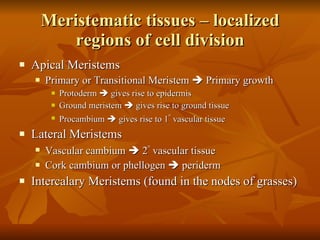
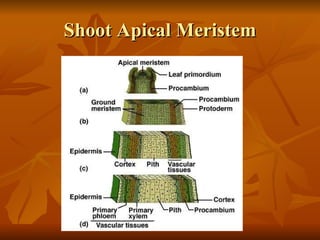
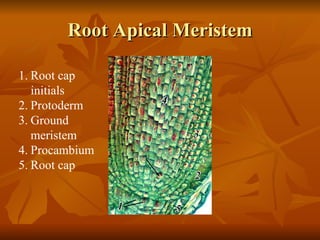
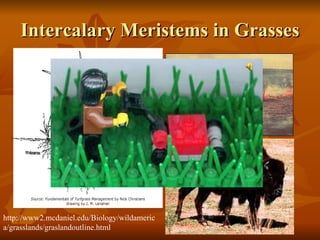
Meristematic tissues – localized regions of cell division Apical Meristems Primary or Transitional Meristem    Primary growth Protoderm    gives rise to epidermis Ground meristem    gives rise to ground tissue Procambium    gives rise to 1 o  vascular tissue Lateral Meristems Vascular cambium    2 o  vascular tissue Cork cambium or phellogen    periderm Intercalary Meristems (found in the nodes of grasses)
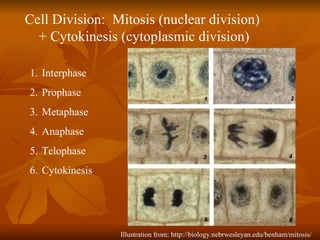
Illustration from: http://biology.nebrwesleyan.edu/benham/mitosis/   Interphase Prophase Metaphase Anaphase Telophase Cytokinesis Cell Division:  Mitosis (nuclear division)  + Cytokinesis (cytoplasmic division)
Shoot Apical Meristem
Root Apical Meristem Root cap initials Protoderm Ground meristem Procambium Root cap
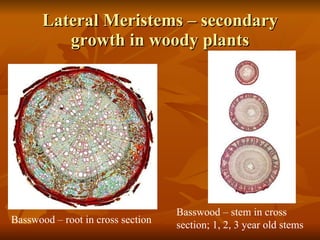
Lateral Meristems – secondary growth in woody plants Basswood – root in cross section Basswood – stem in cross section; 1, 2, 3 year old stems
Intercalary Meristems in Grasses http://www2.mcdaniel.edu/Biology/wildamerica/grasslands/graslandoutline.html
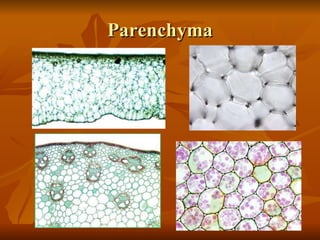
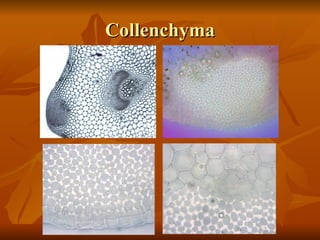
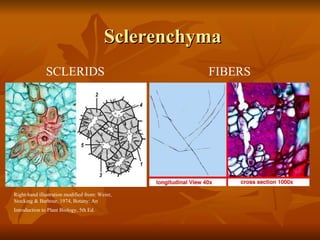
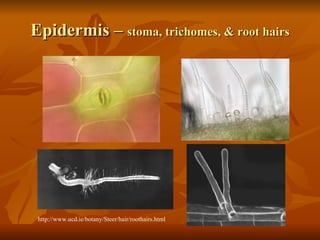
Simple Tissues – consisting of one cell type Parenchyma –  thin walled & alive at maturity; often multifaceted. Collenchyma –  thick walled & alive at maturity Sclerenchyma –  thick walled and dead at maturity Sclerids or stone cells –  cells as long as they are wide Fibers –  cells longer than they are wide Epidermis – alive at maturity Trichomes – “pubescence” or hairs on epidermis Root Hairs – tubular extensions of epidermal cells
Parenchyma
Collenchyma
Sclerenchyma Right-hand illustration modified from: Weier, Stocking & Barbour, 1974, Botany: An Introduction to Plant Biology, 5th Ed.   SCLERIDS FIBERS
Epidermis –  stoma, trichomes, & root hairs http://www.ucd.ie/botany/Steer/hair/roothairs.html
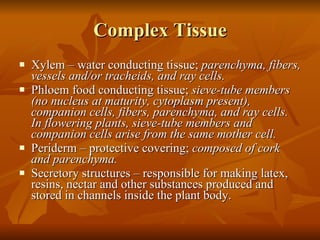
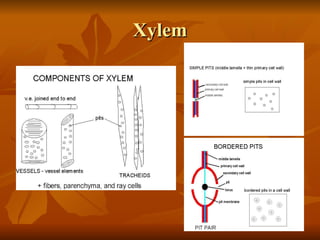
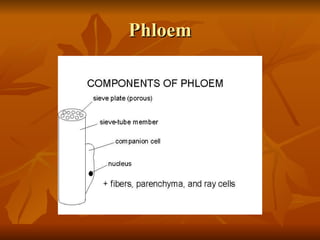
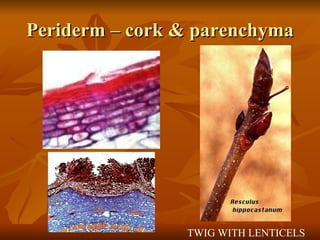
Complex Tissue Xylem – water conducting tissue;  parenchyma, fibers, vessels and/or tracheids, and ray cells.   Phloem food conducting tissue;  sieve-tube members (no nucleus at maturity, cytoplasm present), companion cells, fibers, parenchyma, and ray cells.  In flowering plants, sieve-tube members and companion cells arise from the same mother cell.  Periderm – protective covering;  composed of cork and parenchyma. Secretory structures  –  responsible for making latex, resins, nectar and other substances produced and stored in channels inside the plant body.
Xylem
Phloem
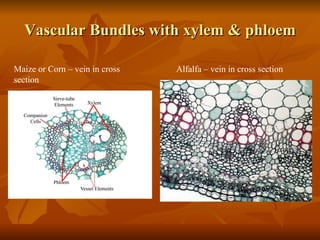
Vascular Bundles with xylem & phloem Maize or Corn – vein in cross section Alfalfa – vein in cross section
Periderm – cork & parenchyma TWIG WITH LENTICELS
Secretory Structures nectar (flowers) from nectaries  oils (peanuts, oranges, citrus) from accumulation of glands and elaioplasts.  resins (conifers) from resin canals  lacticifers (e.g., latex - milkweed, rubber plants, opium poppy)  hydathodes (openings for secretion of water)  digestive glands of carnivorous plants (enzymes)  salt glands that shed salt (especial in plants adapted to environments laden with salt).

Plant tissues

  • 1.
    Plant Tissues: OverviewMeristems, Simple Tissues, & Complex Tissues Many of the figures found in this presentation are from the internet site http://botit.botany.wisc.edu/images/130/ and a CD entitled “Plant Anatomy” by Richard Crang & Andrey Vassilyev published by McGraw Hill.
  • 2.
    Meristematic tissues –localized regions of cell division Apical Meristems Primary or Transitional Meristem  Primary growth Protoderm  gives rise to epidermis Ground meristem  gives rise to ground tissue Procambium  gives rise to 1 o vascular tissue Lateral Meristems Vascular cambium  2 o vascular tissue Cork cambium or phellogen  periderm Intercalary Meristems (found in the nodes of grasses)
  • 3.
    Illustration from: http://biology.nebrwesleyan.edu/benham/mitosis/ Interphase Prophase Metaphase Anaphase Telophase Cytokinesis Cell Division: Mitosis (nuclear division) + Cytokinesis (cytoplasmic division)
  • 4.
  • 5.
    Root Apical MeristemRoot cap initials Protoderm Ground meristem Procambium Root cap
  • 6.
    Lateral Meristems –secondary growth in woody plants Basswood – root in cross section Basswood – stem in cross section; 1, 2, 3 year old stems
  • 7.
    Intercalary Meristems inGrasses http://www2.mcdaniel.edu/Biology/wildamerica/grasslands/graslandoutline.html
  • 8.
    Simple Tissues –consisting of one cell type Parenchyma – thin walled & alive at maturity; often multifaceted. Collenchyma – thick walled & alive at maturity Sclerenchyma – thick walled and dead at maturity Sclerids or stone cells – cells as long as they are wide Fibers – cells longer than they are wide Epidermis – alive at maturity Trichomes – “pubescence” or hairs on epidermis Root Hairs – tubular extensions of epidermal cells
  • 9.
  • 10.
  • 11.
    Sclerenchyma Right-hand illustrationmodified from: Weier, Stocking & Barbour, 1974, Botany: An Introduction to Plant Biology, 5th Ed. SCLERIDS FIBERS
  • 12.
    Epidermis – stoma, trichomes, & root hairs http://www.ucd.ie/botany/Steer/hair/roothairs.html
  • 13.
    Complex Tissue Xylem– water conducting tissue; parenchyma, fibers, vessels and/or tracheids, and ray cells. Phloem food conducting tissue; sieve-tube members (no nucleus at maturity, cytoplasm present), companion cells, fibers, parenchyma, and ray cells.  In flowering plants, sieve-tube members and companion cells arise from the same mother cell.  Periderm – protective covering; composed of cork and parenchyma. Secretory structures – responsible for making latex, resins, nectar and other substances produced and stored in channels inside the plant body.
  • 14.
  • 15.
  • 16.
    Vascular Bundles withxylem & phloem Maize or Corn – vein in cross section Alfalfa – vein in cross section
  • 17.
    Periderm – cork& parenchyma TWIG WITH LENTICELS
  • 18.
    Secretory Structures nectar(flowers) from nectaries oils (peanuts, oranges, citrus) from accumulation of glands and elaioplasts. resins (conifers) from resin canals lacticifers (e.g., latex - milkweed, rubber plants, opium poppy) hydathodes (openings for secretion of water) digestive glands of carnivorous plants (enzymes) salt glands that shed salt (especial in plants adapted to environments laden with salt).