Plant Tissue
Lecture-3 Root Apical Meristem
By: Dr. Sunita Sangwan
Assistant Prof.
Deptt. of Botany
MNSGC Bhiwani
Root Apical Meristem
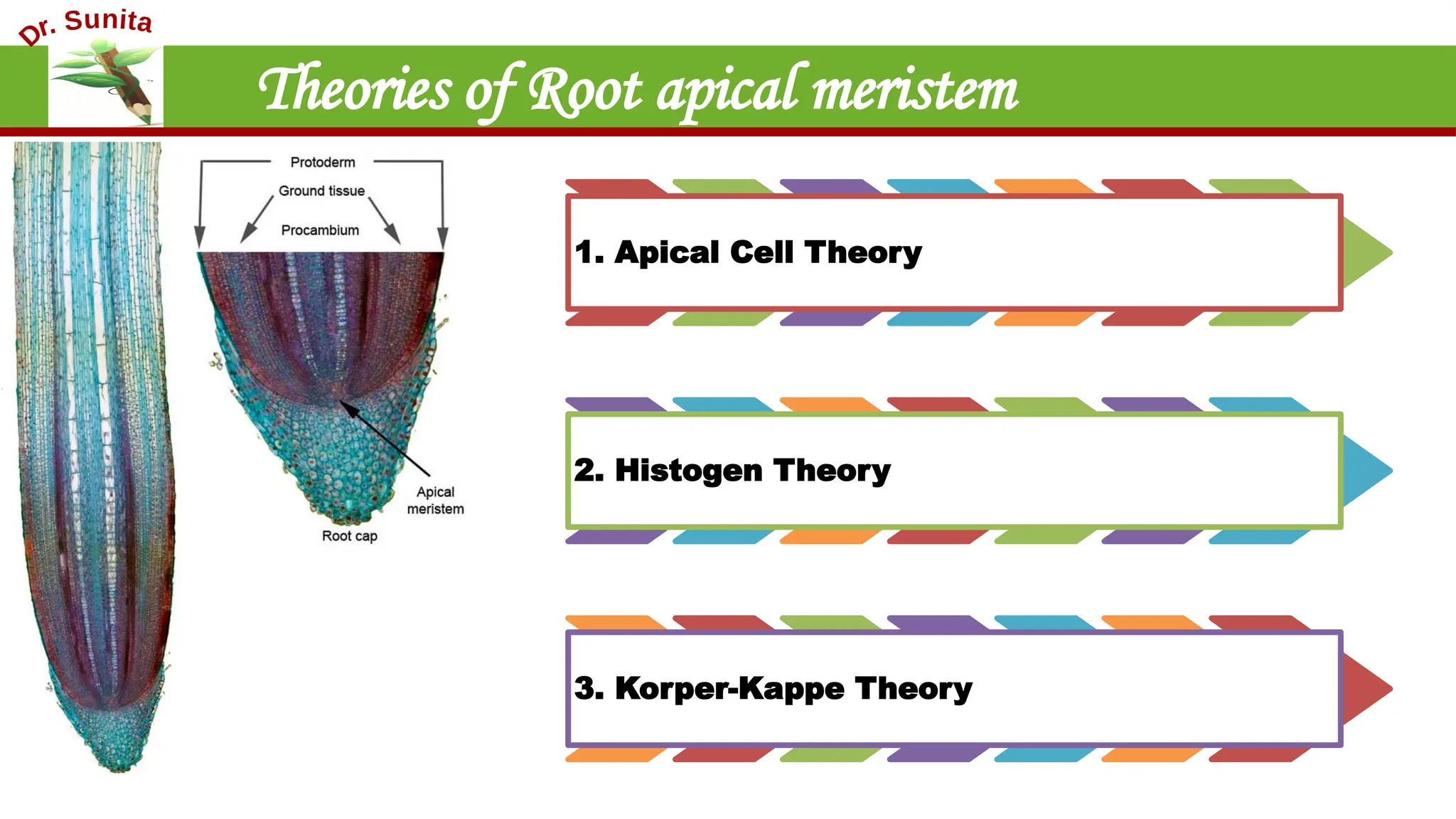
Root apical meristem
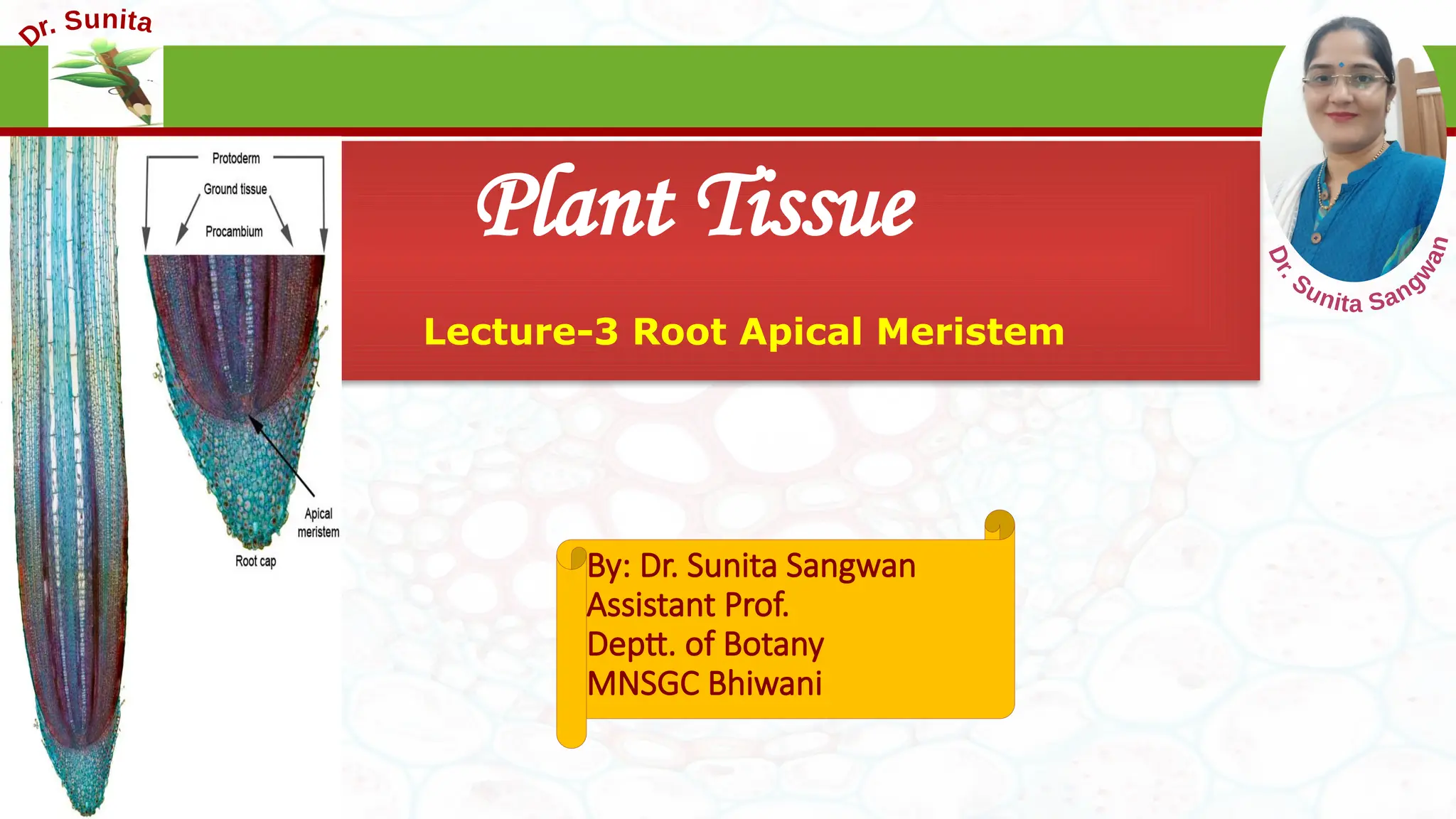
The cells of the apical meristem of primary root have dense
cytoplasm, large nuclei and divide actively.
This meristem differentiates into embryonic radicle.
All the permanent tissues of the root are originated from the
root apical meristem.
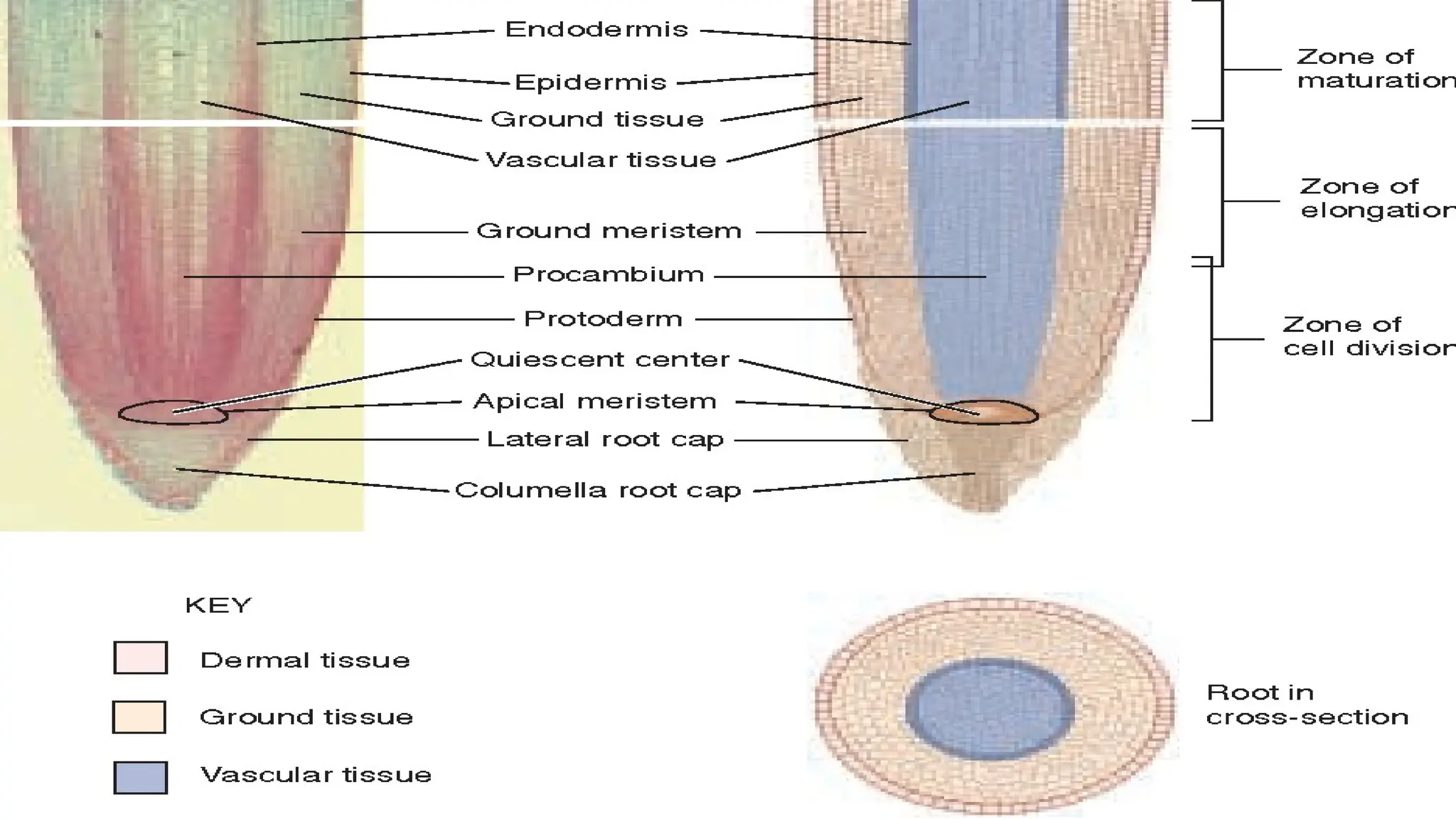
The root apical meristem is sub-terminal in position as terminal
position is occupied by a root-cap.
The meristem that develop root cap is termed as calyptrogen.
1. Apical Cell Theory
2. Histogen Theory
3. Korper-Kappe Theory
Theories of Root apical meristem
Apical Cell Theory
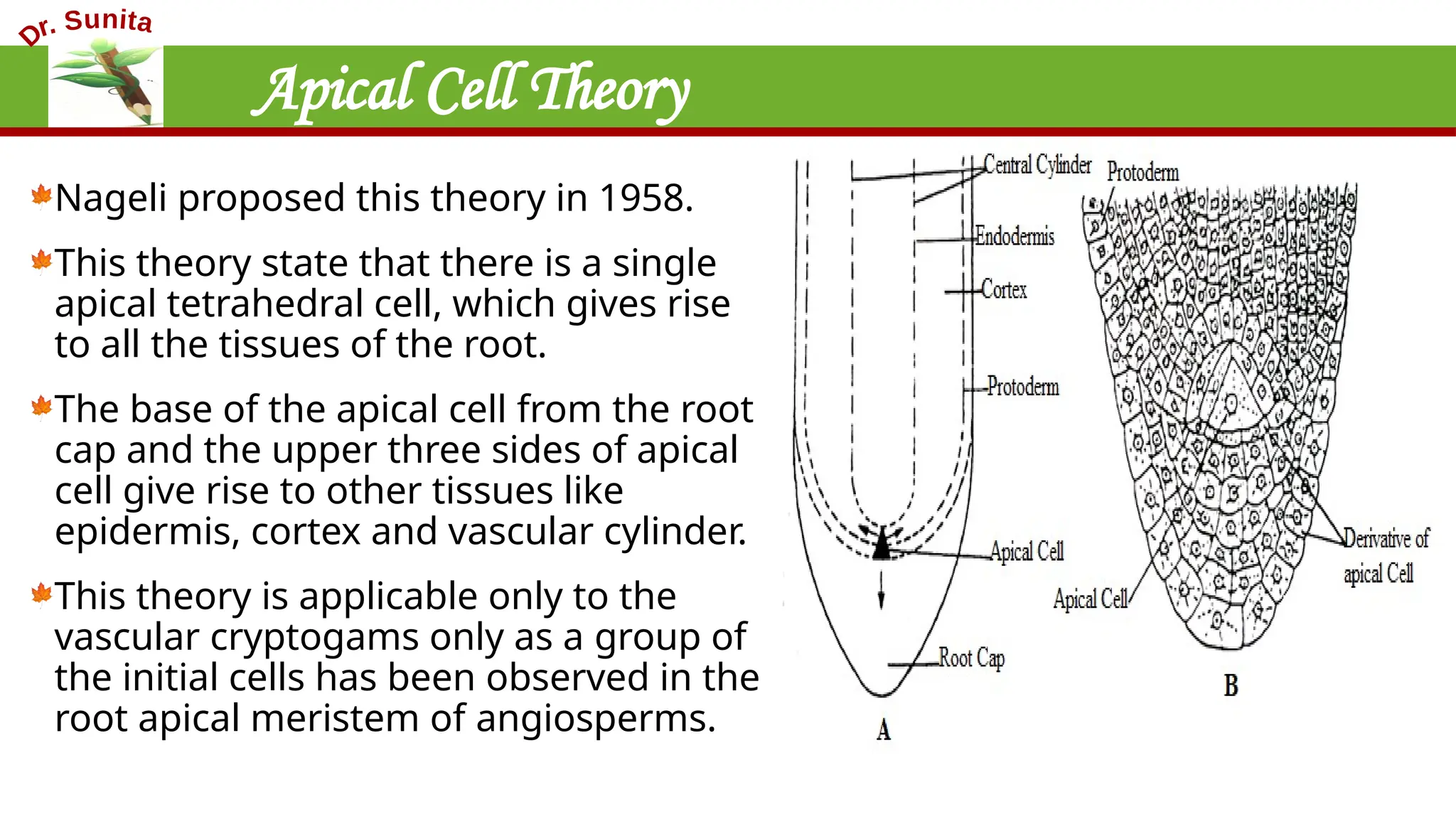
Nageli proposed this theory in 1958.
This theory state that there is a single
apical tetrahedral cell, which gives rise
to all the tissues of the root.
The base of the apical cell from the root
cap and the upper three sides of apical
cell give rise to other tissues like
epidermis, cortex and vascular cylinder.
This theory is applicable only to the
vascular cryptogams only as a group of
the initial cells has been observed in the
root apical meristem of angiosperms.
Histogen Theory
Hanstein postulated this theory in 1868.
He proposed that there are three distinct meristematic zones termed as
histogens.
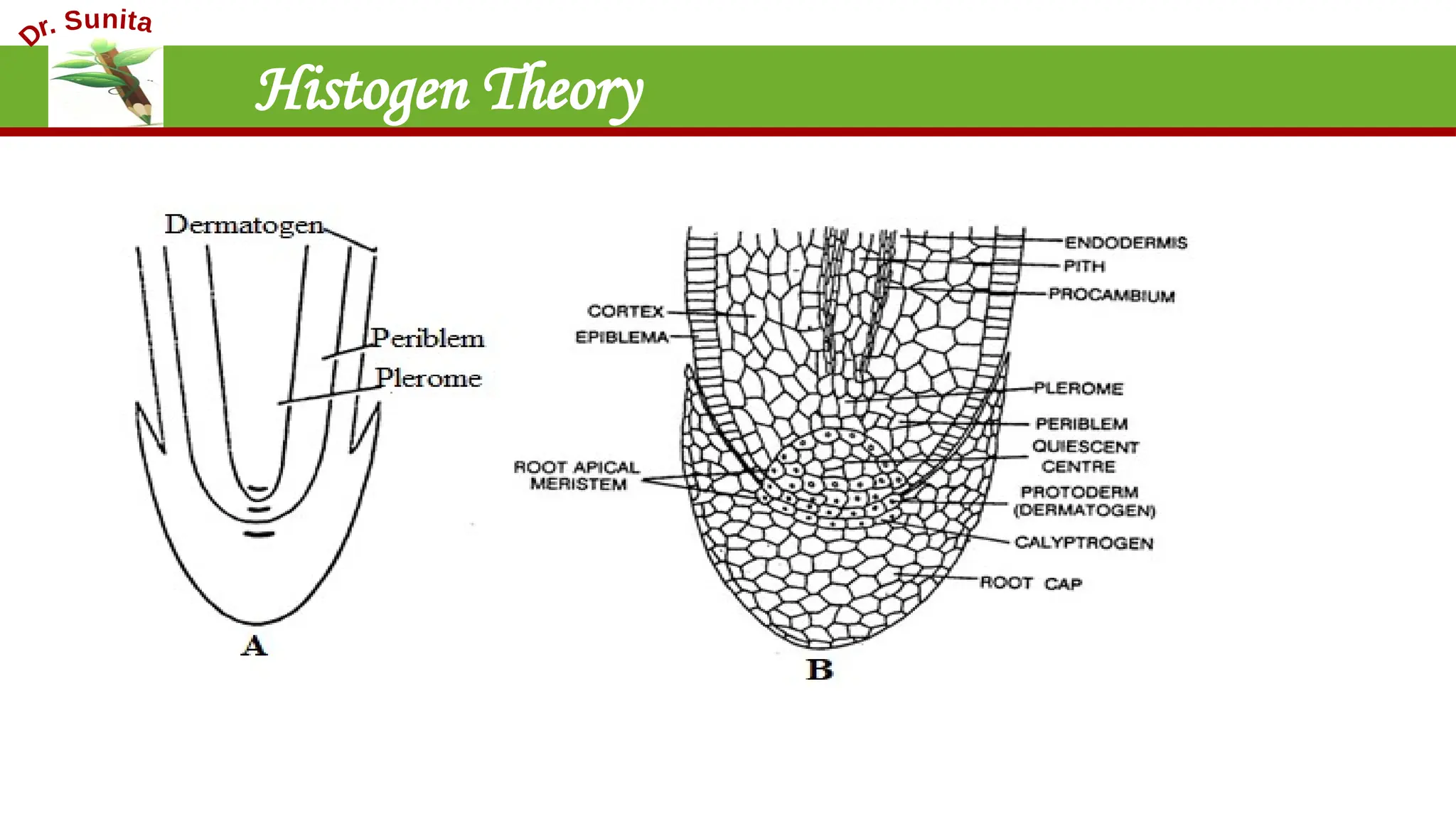
These three zones are dermatogen, periblem and plerome. Each zone has
its specific function.
Dermatogen form epidermis, periblem give rise to cortex and vascular
cylinder are originated from plerome.
Later on calyptrogen was defined as the fourth histogen that played a role
in formation of root cap.
Haberlandt proposed the name protoderm, ground meristem and
procambium for these three histogens dermatogen, periblem and plerome
respectively.
Histogen Theory
Histogen Theory
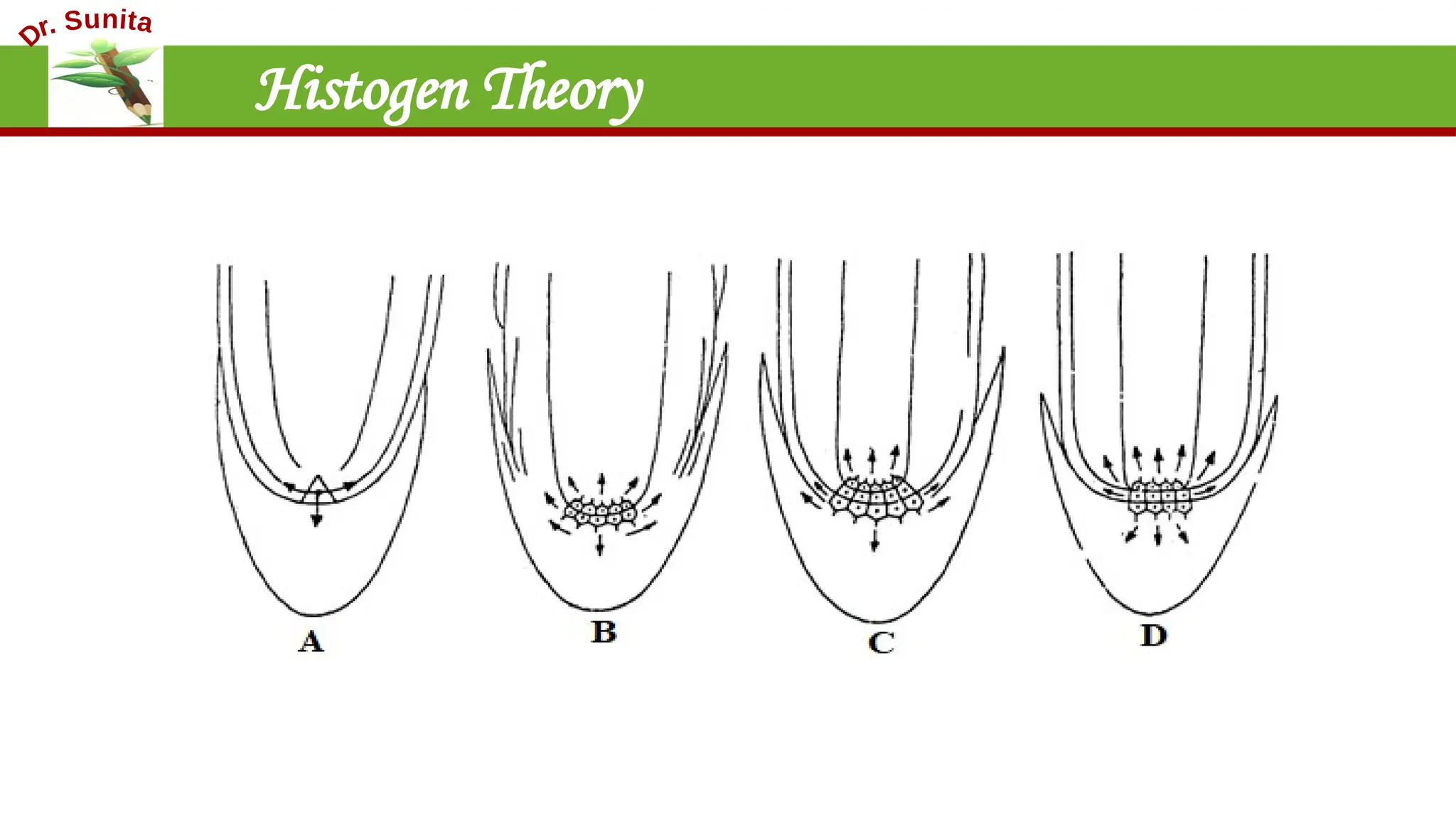
Based on cellular configuration, Schuepp in 1926 divided the root apical meristem into four
types.
Type A: All the permanent tissues of root are originated from a single apical cell. It is found
in all vascular cryptogams.
Type B: There are two separate groups of initials. One give rise to the vascular cylinder and
other tissues like epidermis, cortex and root cap derived from second group. It is most
commonly observed in gymnosperms.
Type C: There are poorly organized initials that develop into root cap, cortex and vascular
cylinder and it is found in dicotyledons.
Type D: There are three separate groups of initials. One group forms root cap; other group
give rise to epidermis and cortex while vascular cylinder derived from separate group. This
type is commonly found in monocotyledons.
Histogen Theory
Korper-Kappe Theory
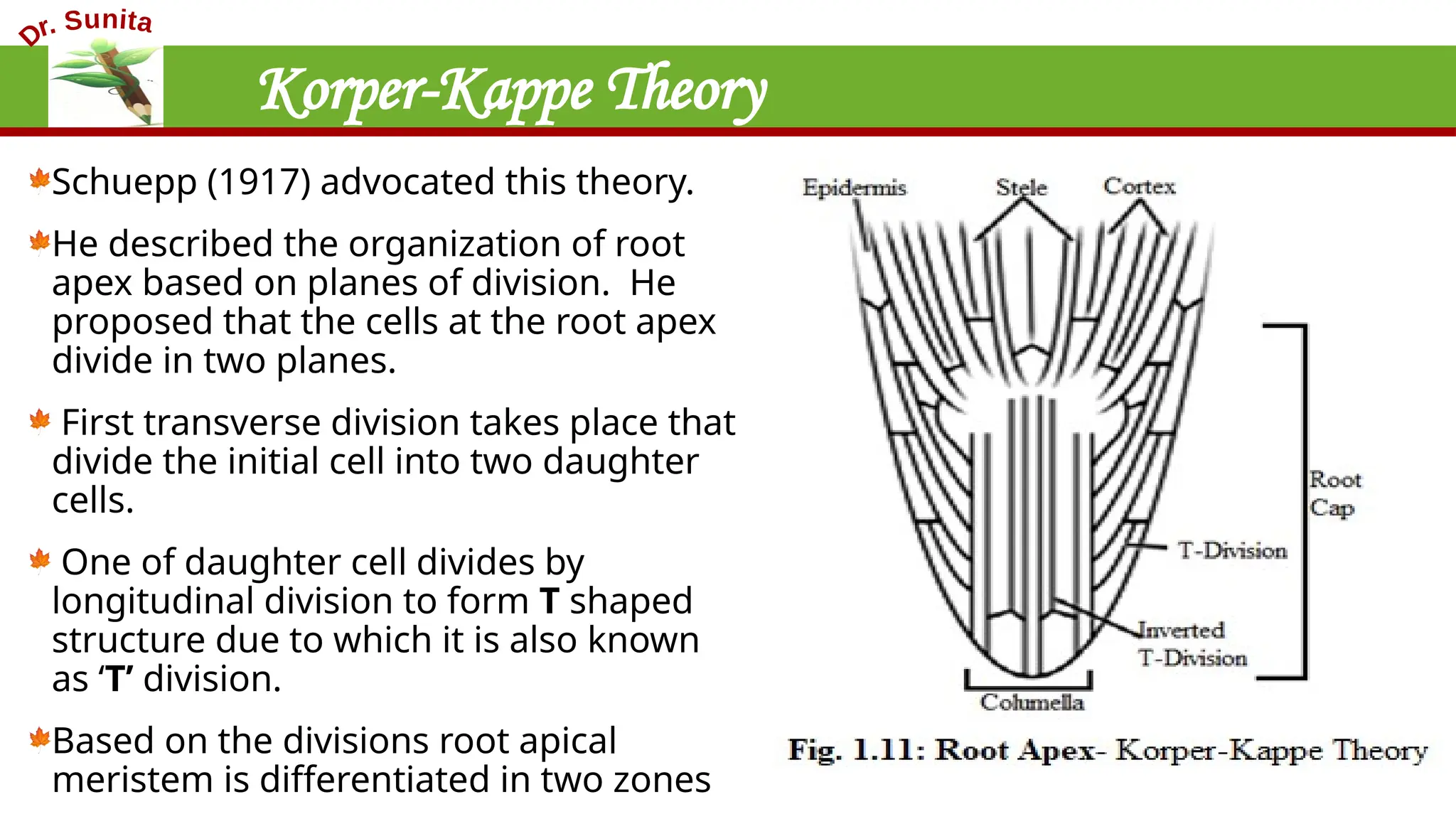
Schuepp (1917) advocated this theory.
He described the organization of root
apex based on planes of division. He
proposed that the cells at the root apex
divide in two planes.
First transverse division takes place that
divide the initial cell into two daughter
cells.
One of daughter cell divides by
longitudinal division to form T shaped
structure due to which it is also known
as ‘T’ division.
Based on the divisions root apical
meristem is differentiated in two zones
Korper (Cap) and Kappe (body)
In the inner region, inverted T shaped structure is formed
because of the upper daughter second division in cell and it is
known as Korper (cap).
In the outer region, the second division occurs in lower
daughter cell and form straight T shaped structure termed as
Kappe (body).
These Korper and Kappe are clearly differentiated in
monocotyledons.
Korper-Kappe Theory
The central region of root cap the cells are arranged in
longitudinal files is called columella and cells of this region
divide rarely.
Like the korper-kappe theory of root apex, tunica-corpus theory
of shoot apical meristem also based on the plane of cell division
so these two theories shows similarity in organization of apical
meristem.
Quiescent Centre
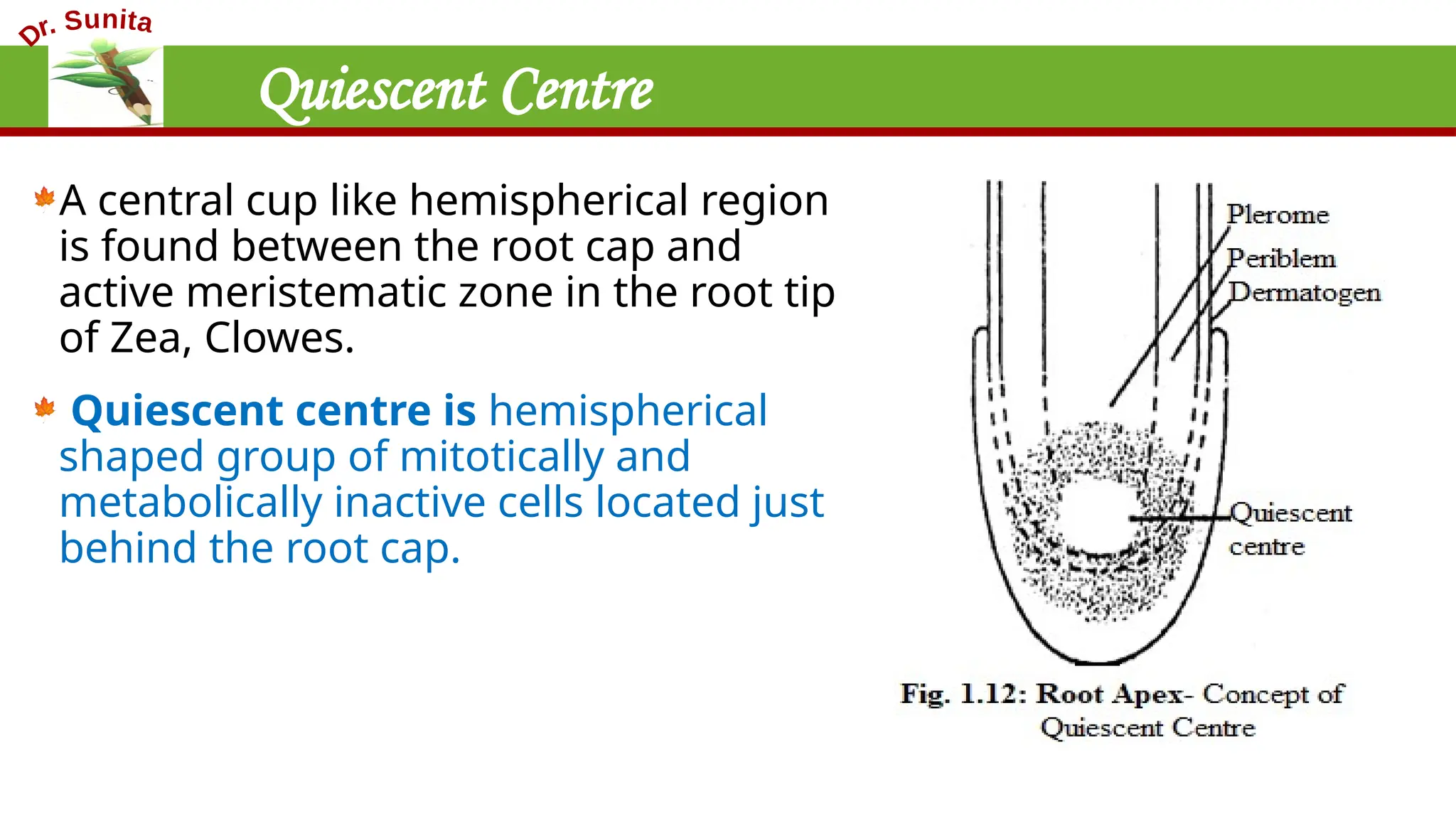
A central cup like hemispherical region
is found between the root cap and
active meristematic zone in the root tip
of Zea, Clowes.
Quiescent centre is hemispherical
shaped group of mitotically and
metabolically inactive cells located just
behind the root cap.
Characteristics of Quiescent center cells
The amount of DNA, RNA and protein is less in these cells.
These cells also have low mitotic activity.
The cell organelles like mitochondria, endoplasmic reticulum,
dictyosomes are also less in numbers.
Later on, quiescent zone found in the root tips of many plants.
Quiescent Centre
When the cells of this region are exposed to X-rays, the
meristematic cells stop dividing and the cells of quiescent centre
become active because the cells of quiescent centre are more
resistant to the radiations than meristematic cells.
Therefore, quiescent centre is considered as central mother cells
that form promeristem of the apex. It act as a reservoir of
diploid cells when the root tip is damaged.
Thanks

3. Root Apical Meristem and theories of root apical meristem

  • 1.
    Plant Tissue Lecture-3 RootApical Meristem By: Dr. Sunita Sangwan Assistant Prof. Deptt. of Botany MNSGC Bhiwani
  • 2.
  • 3.
    Root apical meristem Thecells of the apical meristem of primary root have dense cytoplasm, large nuclei and divide actively. This meristem differentiates into embryonic radicle. All the permanent tissues of the root are originated from the root apical meristem. The root apical meristem is sub-terminal in position as terminal position is occupied by a root-cap. The meristem that develop root cap is termed as calyptrogen.
  • 5.
    1. Apical CellTheory 2. Histogen Theory 3. Korper-Kappe Theory Theories of Root apical meristem
  • 6.
    Apical Cell Theory Nageliproposed this theory in 1958. This theory state that there is a single apical tetrahedral cell, which gives rise to all the tissues of the root. The base of the apical cell from the root cap and the upper three sides of apical cell give rise to other tissues like epidermis, cortex and vascular cylinder. This theory is applicable only to the vascular cryptogams only as a group of the initial cells has been observed in the root apical meristem of angiosperms.
  • 7.
    Histogen Theory Hanstein postulatedthis theory in 1868. He proposed that there are three distinct meristematic zones termed as histogens. These three zones are dermatogen, periblem and plerome. Each zone has its specific function. Dermatogen form epidermis, periblem give rise to cortex and vascular cylinder are originated from plerome. Later on calyptrogen was defined as the fourth histogen that played a role in formation of root cap. Haberlandt proposed the name protoderm, ground meristem and procambium for these three histogens dermatogen, periblem and plerome respectively.
  • 8.
  • 9.
    Histogen Theory Based oncellular configuration, Schuepp in 1926 divided the root apical meristem into four types. Type A: All the permanent tissues of root are originated from a single apical cell. It is found in all vascular cryptogams. Type B: There are two separate groups of initials. One give rise to the vascular cylinder and other tissues like epidermis, cortex and root cap derived from second group. It is most commonly observed in gymnosperms. Type C: There are poorly organized initials that develop into root cap, cortex and vascular cylinder and it is found in dicotyledons. Type D: There are three separate groups of initials. One group forms root cap; other group give rise to epidermis and cortex while vascular cylinder derived from separate group. This type is commonly found in monocotyledons.
  • 10.
  • 11.
    Korper-Kappe Theory Schuepp (1917)advocated this theory. He described the organization of root apex based on planes of division. He proposed that the cells at the root apex divide in two planes. First transverse division takes place that divide the initial cell into two daughter cells. One of daughter cell divides by longitudinal division to form T shaped structure due to which it is also known as ‘T’ division. Based on the divisions root apical meristem is differentiated in two zones
  • 12.
    Korper (Cap) andKappe (body) In the inner region, inverted T shaped structure is formed because of the upper daughter second division in cell and it is known as Korper (cap). In the outer region, the second division occurs in lower daughter cell and form straight T shaped structure termed as Kappe (body). These Korper and Kappe are clearly differentiated in monocotyledons.
  • 13.
    Korper-Kappe Theory The centralregion of root cap the cells are arranged in longitudinal files is called columella and cells of this region divide rarely. Like the korper-kappe theory of root apex, tunica-corpus theory of shoot apical meristem also based on the plane of cell division so these two theories shows similarity in organization of apical meristem.
  • 14.
    Quiescent Centre A centralcup like hemispherical region is found between the root cap and active meristematic zone in the root tip of Zea, Clowes. Quiescent centre is hemispherical shaped group of mitotically and metabolically inactive cells located just behind the root cap.
  • 15.
    Characteristics of Quiescentcenter cells The amount of DNA, RNA and protein is less in these cells. These cells also have low mitotic activity. The cell organelles like mitochondria, endoplasmic reticulum, dictyosomes are also less in numbers. Later on, quiescent zone found in the root tips of many plants.
  • 16.
    Quiescent Centre When thecells of this region are exposed to X-rays, the meristematic cells stop dividing and the cells of quiescent centre become active because the cells of quiescent centre are more resistant to the radiations than meristematic cells. Therefore, quiescent centre is considered as central mother cells that form promeristem of the apex. It act as a reservoir of diploid cells when the root tip is damaged.
  • 17.