

















PLANT TISSUE CULTURE
BY SREEREMYA
Types of Tissue Culture
• The types of tissue culture can be grouped by
the structures formed in culture.
• Plantlets
• Seedlings
• Callus
• Somatic Embryogenesis
• Plantlet formation
• 1. Axillary shoot formation Meristem culture
Shoot culture
• 2. Adventitious shoot formation Diploid plant
regeneration Haploid and triploid
regeneration
• Axillary shoots form directly from existing
meristems. The initial explant is a shoot tip or
stem pieces.
• Adventitious shoots form indirectly after the
initiation of new meristems. The initial explant
is an internodal stem piece, leaf, root or other
tissue without a pre-existing meristem
• Indirect adventitious shoots may also form
after an intermediate callus step.
• Plantlet formation - Meristem cultures
• Uses a shoot tip that is less than 1 mm in size.
Can be used for micropropagation. Mostly
used for virus elimination
Plantlet formation - Shoot cultures
• This is the most common form of
micropropagation. Uses a portion of the stem
with one to several nodes.
• Plantlet formation - Shoot cultures
• Axillary branching 2. Nodal cultures 3. Stool
shoots 4. Pseudocorms 5. Minitubers 6.
Micrografting
• Plantlet formation - Shoot cultures
• Axillary branching
• The initial explant contains several nodes on a
single stem.
• Lateral shoots are stimulated to form a dense
clump of shoots.
• Plantlet formation - Shoot cultures
• Nodal cultures
• Used with species with strong apical
dominance. Long shoots are cut into single
nodes and placed vertically in the medium.
The new shoot elongates and the process is
repeated.
• Stool shoots
• A shoot with several nodes is layered
horizontally on the medium. A thicket of
stems emerge. Clumps are separated and
subcultured.
• Pseudocorms
• Pseudocorms are the structures initiated after
seed germination in orchids.
• Minitubers
• Minitubers can be produced in plants that
naturally form tubers like potato and yam.
Each minituber can be used as a propagule.
• Micrografting - an alternative to meristem
culture
• Production of disease-free plants. Virus
indexing. Micropropagation. Rejuvenation by
serial micrografting. Send germplasm
between countries.
• Plantlet formation
• 1. Axillary shoot formation Meristem culture
Shoot culture 2. Adventitious shoot formation
Diploid plant regeneration Haploid and
triploid regeneration
antlet formation - Adventitious shoots
• Diploid plant regeneration Explants include:
Leaf pieces
• Plantlet formation - Adventitious shoots
• Diploid plant regeneration Explants include:
Leaf pieces, petioles
• Plantlet formation - Adventitious shoots
• Diploid plant regeneration Explants include:
Leaf pieces, petioles, bulb scales, stem
internodes, roots and callus.
• Haploid plant regeneration
• Anther culture is a procedure for obtaining
haploid (half the chromosome number) plants
from normally diploid plants. The discovery
that pollen grains could develop into embryos
was made by accident with Datura by Guha
and Masheshwari in 1964.
• Techniques used to regenerate plants
• 1. Plantlet formation 2. Seedling formation 3.
Callus formation 4. Somatic embryo formation
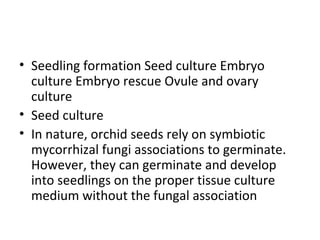
• Seedling formation Seed culture Embryo
culture Embryo rescue Ovule and ovary
culture
• Seed culture
• In nature, orchid seeds rely on symbiotic
mycorrhizal fungi associations to germinate.
However, they can germinate and develop
into seedlings on the proper tissue culture
medium without the fungal association
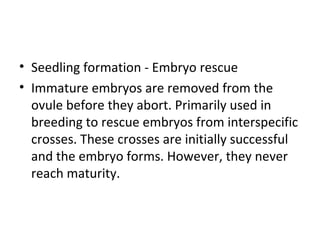
• Seedling formation - Embryo rescue
• Immature embryos are removed from the
ovule before they abort. Primarily used in
breeding to rescue embryos from interspecific
crosses. These crosses are initially successful
and the embryo forms. However, they never
reach maturity.
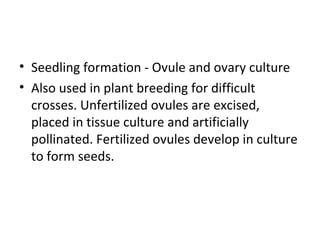
• Seedling formation - Ovule and ovary culture
• Also used in plant breeding for difficult
crosses. Unfertilized ovules are excised,
placed in tissue culture and artificially
pollinated. Fertilized ovules develop in culture
to form seeds.
Plant tissue culture march 2

Plant tissue culture march 2

  • 1.
  • 2.
    Types of TissueCulture • The types of tissue culture can be grouped by the structures formed in culture. • Plantlets • Seedlings • Callus • Somatic Embryogenesis
  • 3.
    • Plantlet formation •1. Axillary shoot formation Meristem culture Shoot culture • 2. Adventitious shoot formation Diploid plant regeneration Haploid and triploid regeneration
  • 4.
    • Axillary shootsform directly from existing meristems. The initial explant is a shoot tip or stem pieces.
  • 5.
    • Adventitious shootsform indirectly after the initiation of new meristems. The initial explant is an internodal stem piece, leaf, root or other tissue without a pre-existing meristem
  • 6.
    • Indirect adventitiousshoots may also form after an intermediate callus step.
  • 7.
    • Plantlet formation- Meristem cultures • Uses a shoot tip that is less than 1 mm in size. Can be used for micropropagation. Mostly used for virus elimination
  • 8.
    Plantlet formation -Shoot cultures • This is the most common form of micropropagation. Uses a portion of the stem with one to several nodes.
  • 9.
    • Plantlet formation- Shoot cultures • Axillary branching 2. Nodal cultures 3. Stool shoots 4. Pseudocorms 5. Minitubers 6. Micrografting
  • 10.
    • Plantlet formation- Shoot cultures • Axillary branching • The initial explant contains several nodes on a single stem. • Lateral shoots are stimulated to form a dense clump of shoots.
  • 11.
    • Plantlet formation- Shoot cultures • Nodal cultures • Used with species with strong apical dominance. Long shoots are cut into single nodes and placed vertically in the medium. The new shoot elongates and the process is repeated.
  • 12.
    • Stool shoots •A shoot with several nodes is layered horizontally on the medium. A thicket of stems emerge. Clumps are separated and subcultured.
  • 13.
    • Pseudocorms • Pseudocormsare the structures initiated after seed germination in orchids.
  • 14.
    • Minitubers • Minituberscan be produced in plants that naturally form tubers like potato and yam. Each minituber can be used as a propagule.
  • 15.
    • Micrografting -an alternative to meristem culture • Production of disease-free plants. Virus indexing. Micropropagation. Rejuvenation by serial micrografting. Send germplasm between countries.
  • 16.
    • Plantlet formation •1. Axillary shoot formation Meristem culture Shoot culture 2. Adventitious shoot formation Diploid plant regeneration Haploid and triploid regeneration
  • 17.
    antlet formation -Adventitious shoots • Diploid plant regeneration Explants include: Leaf pieces • Plantlet formation - Adventitious shoots • Diploid plant regeneration Explants include: Leaf pieces, petioles
  • 18.
    • Plantlet formation- Adventitious shoots • Diploid plant regeneration Explants include: Leaf pieces, petioles, bulb scales, stem internodes, roots and callus.
  • 19.
    • Haploid plantregeneration • Anther culture is a procedure for obtaining haploid (half the chromosome number) plants from normally diploid plants. The discovery that pollen grains could develop into embryos was made by accident with Datura by Guha and Masheshwari in 1964.
  • 20.
    • Techniques usedto regenerate plants • 1. Plantlet formation 2. Seedling formation 3. Callus formation 4. Somatic embryo formation
  • 21.
    • Seedling formationSeed culture Embryo culture Embryo rescue Ovule and ovary culture • Seed culture • In nature, orchid seeds rely on symbiotic mycorrhizal fungi associations to germinate. However, they can germinate and develop into seedlings on the proper tissue culture medium without the fungal association
  • 22.
    • Seedling formation- Embryo rescue • Immature embryos are removed from the ovule before they abort. Primarily used in breeding to rescue embryos from interspecific crosses. These crosses are initially successful and the embryo forms. However, they never reach maturity.
  • 23.
    • Seedling formation- Ovule and ovary culture • Also used in plant breeding for difficult crosses. Unfertilized ovules are excised, placed in tissue culture and artificially pollinated. Fertilized ovules develop in culture to form seeds.