Plant tissues
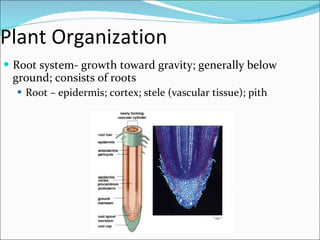
Plant Organization Root system- growth toward gravity; generally below ground; consists of roots Root – epidermis; cortex; stele (vascular tissue); pith
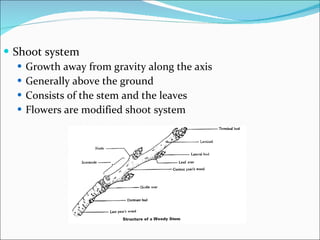
Shoot system Growth away from gravity along the axis Generally above the ground Consists of the stem and the leaves Flowers are modified shoot system
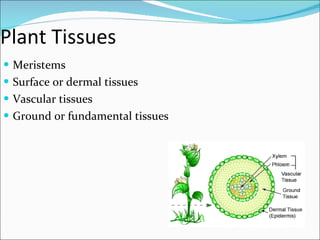
Plant Tissues Meristems Surface or dermal tissues Vascular tissues Ground or fundamental tissues
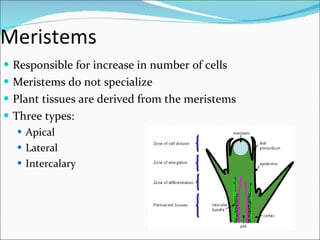
Meristems  Responsible for increase in number of cells Meristems do not specialize Plant tissues are derived from the meristems Three types: Apical Lateral Intercalary
 
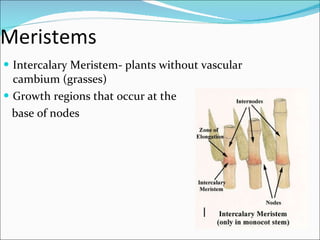
Meristems Intercalary Meristem- plants without vascular cambium (grasses) Growth regions that occur at the base of nodes
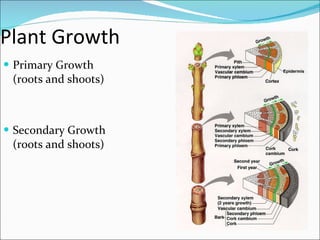
Growth  Primary growth Inc in length of plants (apical meristem) Secondary growth Inc in plant girth (lateral meristem) Select plants only (woody plants such as dicot and gymnosperms) Product: wood and cork
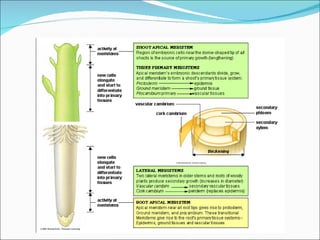
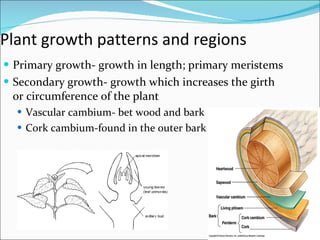
Plant growth patterns and regions Primary growth- growth in length; primary meristems Secondary growth- growth which increases the girth or circumference of the plant Vascular cambium- bet wood and bark Cork cambium-found in the outer bark
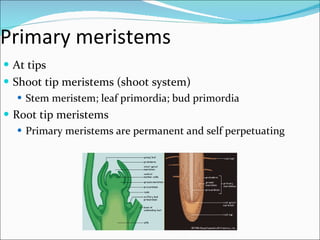
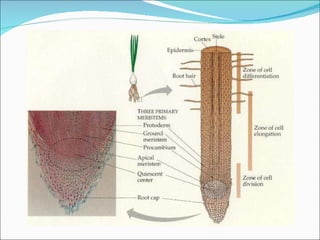
Primary meristems At tips Shoot tip meristems (shoot system) Stem meristem; leaf primordia; bud primordia Root tip meristems Primary meristems are permanent and self perpetuating
 
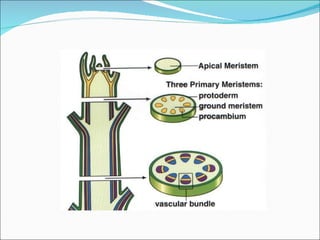
Derivative meristems Produced when meristem cells divide; forms the tissue systems of the plant Protoderm- develops into surface or dermal tissues Procambium- develops into vascular tissue Ground meristem- fundamental /ground tissues Secondary meristems Vascular cambium- produces wood (strength); produces part of bark (protection) Cork cambium- produces protective layer of bark called cork
Plant Growth Primary Growth (roots and shoots) Secondary Growth (roots and shoots)
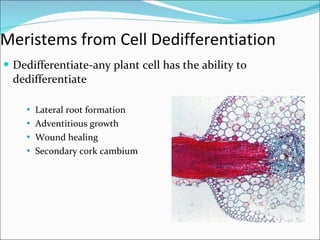
Meristems from Cell Dedifferentiation Dedifferentiate-any plant cell has the ability to dedifferentiate Lateral root formation Adventitious growth Wound healing Secondary cork cambium
Primary Growth of Roots Root cap  protects the delicate meristems as the root elongates through the abrasive soil secretes mucous that lubricates the soil 3 Zones of cells at successive station Zone of cell division Zone of cell elongation Zone of cell differentiation
Simple Tissues
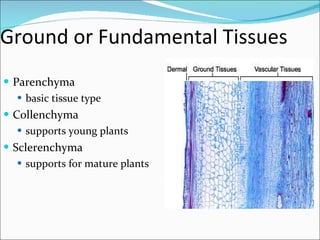
Ground or fundamental tissues Fibers- for support Photosynthetic cells Storage cells Fill in the spaces cells
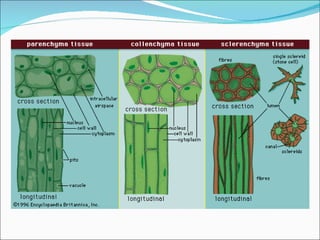
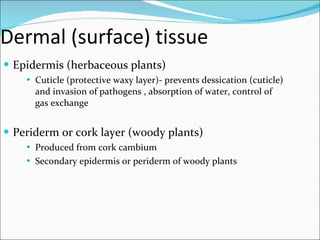
Ground or Fundamental Tissues Parenchyma  basic tissue type Collenchyma supports young plants Sclerenchyma supports for mature plants
 
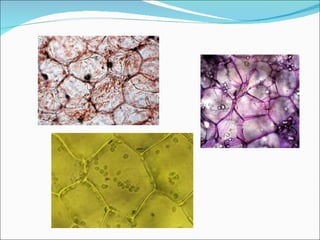
Parenchyma Definition : a simple tissue composed of spherical-shaped  cells; most common type of tissue Have thin primary walls Living, metabolizing tissue E.g. Chlorenchyma, Aerenchyma Functions: Photosynthesis & Respiration Storage (starch, oil droplets, air, water, and salts) Wound healing & regeneration
 
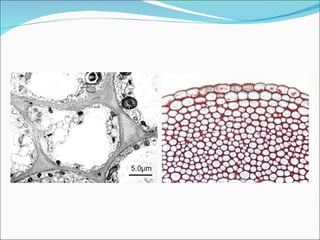
Collenchyma Definition : a simple tissue found beneath the epidermis in young stems and in large veins of leaves (“strings” in celery). Provides a flexible support system (like our skeletal system). Found uniformly throughout the plant. Elongated cells that have unevenly thickened cell walls (especially in the corners) Alive at maturity
 
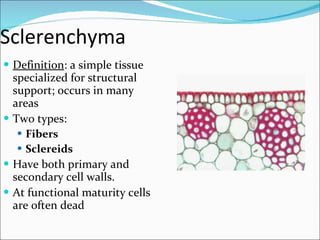
Sclerenchyma Definition : a simple tissue specialized for structural support; occurs in many areas Two types: Fibers   Sclereids  Have both primary and secondary cell walls. At functional maturity cells are often dead
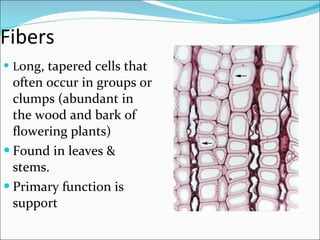
Fibers L ong, tapered cells that often occur in groups or clumps (abundant in the wood and bark of flowering plants) Found in leaves & stems. Primary function is support
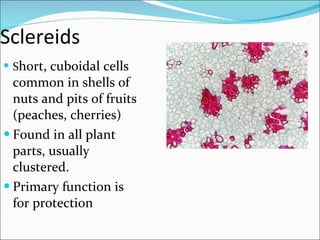
Sclereids S hort, cuboidal cells common in shells of nuts and pits of fruits (peaches, cherries) Found in all plant parts, usually clustered. Primary function is for protection
Complex tissues Vascular Tissue System
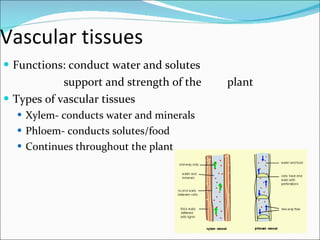
Vascular tissues Functions: conduct water and solutes support and strength of the  plant Types of vascular tissues Xylem- conducts water and minerals Phloem- conducts solutes/food Continues throughout the plant
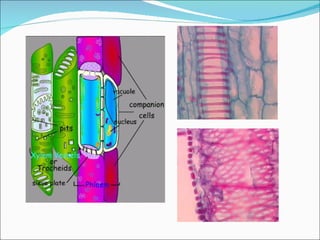
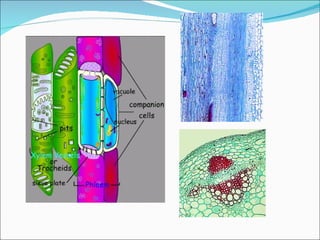
Xylem Conduction of H 2 O from roots to leaves Made up the wood Composed of: Vessel Elements- elongated cells with secondary walls  Dead at functional maturity; perforated Large diameter Tracheids – elongated, narrow cells with secondary walls; dead at functional maturity; pitted Xylem fibers Xylem parenchyma Xylem rays Parenchyma cells and Fibers
 
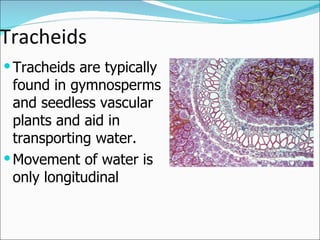
Tracheids Tracheids are typically found in gymnosperms and seedless vascular plants and aid in transporting water. Movement of water is only longitudinal
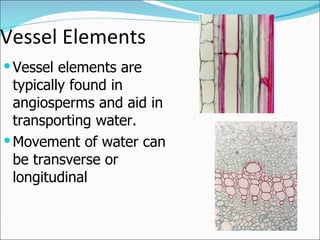
Vessel Elements Vessel elements are  typically found in angiosperms and aid in transporting water. Movement of water can be transverse or longitudinal
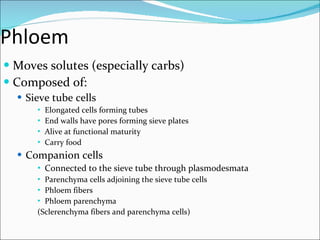
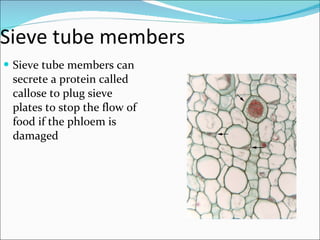
Phloem  Moves solutes (especially carbs) Composed of: Sieve tube cells Elongated cells forming tubes End walls have pores forming sieve plates Alive at functional maturity Carry food Companion cells Connected to the sieve tube through plasmodesmata Parenchyma cells adjoining the sieve tube cells Phloem fibers Phloem parenchyma (Sclerenchyma fibers and parenchyma cells)
 
Sieve tube members Sieve tube members can secrete a protein called callose to plug sieve plates to stop the flow of food if the phloem is damaged
Complex tissues Dermal Tissues
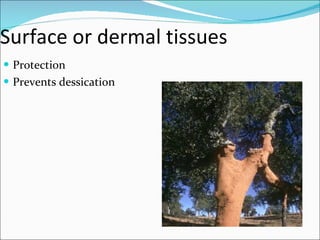
Surface or dermal tissues Protection Prevents dessication
Dermal (surface) tissue Epidermis (herbaceous plants) Cuticle (protective waxy layer)- prevents dessication (cuticle) and invasion of pathogens , absorption of water, control of gas exchange Periderm or cork layer (woody plants) Produced from cork cambium  Secondary epidermis or periderm of woody plants
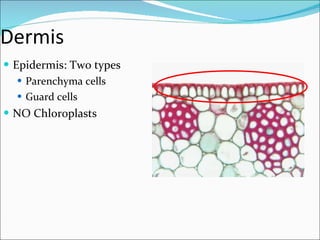
Dermis Epidermis: Two types Parenchyma cells Guard cells NO Chloroplasts
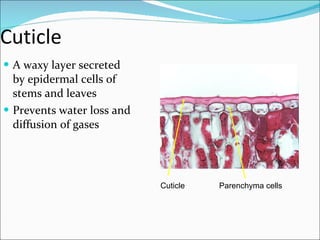
Cuticle A waxy layer secreted by epidermal cells of stems and leaves Prevents water loss and diffusion of gases Cuticle Parenchyma cells
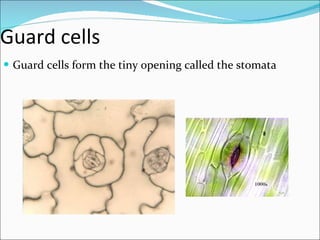
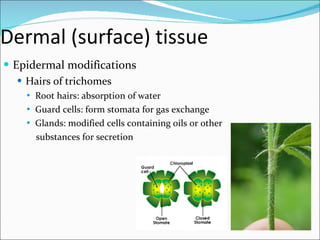
Guard cells Guard cells form the tiny opening called the stomata
Peridermis Woody plants  initially produce an epidermis that splits as the plant grows.  These plants also have periderm, which is several cells thick and forms under the epidermis. Periderm  composes the outer bark Composed of two types of cells Cork cells- secrete suberin Cork parenchyma
Dermal (surface) tissue Epidermal modifications Hairs of trichomes Root hairs: absorption of water Guard cells: form stomata for gas exchange  Glands: modified cells containing oils or other  substances for secretion
 
Transport in Plants Cellular level transport Lateral transport Long-distance transport
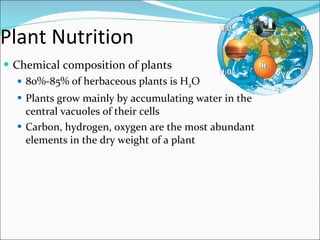
Plant Nutrition Chemical composition of plants 80%-85% of herbaceous plants is H 2 O Plants grow mainly by accumulating water in the central vacuoles of their cells Carbon, hydrogen, oxygen are the most abundant elements in the dry weight of a plant
Essential Nutrients Hydroponic structure- used to determine which of the mineral elements are actually essential nutrients Macronutrients- elements required by plants in relatively large amounts Micronutrients- elements needed by plants in small amounts

Final botany powerpoint2.1

  • 1.
  • 2.
    Plant Organization Rootsystem- growth toward gravity; generally below ground; consists of roots Root – epidermis; cortex; stele (vascular tissue); pith
  • 3.
    Shoot system Growthaway from gravity along the axis Generally above the ground Consists of the stem and the leaves Flowers are modified shoot system
  • 4.
    Plant Tissues MeristemsSurface or dermal tissues Vascular tissues Ground or fundamental tissues
  • 5.
    Meristems Responsiblefor increase in number of cells Meristems do not specialize Plant tissues are derived from the meristems Three types: Apical Lateral Intercalary
  • 6.
  • 7.
    Meristems Intercalary Meristem-plants without vascular cambium (grasses) Growth regions that occur at the base of nodes
  • 8.
    Growth Primarygrowth Inc in length of plants (apical meristem) Secondary growth Inc in plant girth (lateral meristem) Select plants only (woody plants such as dicot and gymnosperms) Product: wood and cork
  • 9.
    Plant growth patternsand regions Primary growth- growth in length; primary meristems Secondary growth- growth which increases the girth or circumference of the plant Vascular cambium- bet wood and bark Cork cambium-found in the outer bark
  • 10.
    Primary meristems Attips Shoot tip meristems (shoot system) Stem meristem; leaf primordia; bud primordia Root tip meristems Primary meristems are permanent and self perpetuating
  • 11.
  • 12.
    Derivative meristems Producedwhen meristem cells divide; forms the tissue systems of the plant Protoderm- develops into surface or dermal tissues Procambium- develops into vascular tissue Ground meristem- fundamental /ground tissues Secondary meristems Vascular cambium- produces wood (strength); produces part of bark (protection) Cork cambium- produces protective layer of bark called cork
  • 13.
    Plant Growth PrimaryGrowth (roots and shoots) Secondary Growth (roots and shoots)
  • 14.
    Meristems from CellDedifferentiation Dedifferentiate-any plant cell has the ability to dedifferentiate Lateral root formation Adventitious growth Wound healing Secondary cork cambium
  • 15.
    Primary Growth ofRoots Root cap protects the delicate meristems as the root elongates through the abrasive soil secretes mucous that lubricates the soil 3 Zones of cells at successive station Zone of cell division Zone of cell elongation Zone of cell differentiation
  • 16.
  • 17.
    Ground or fundamentaltissues Fibers- for support Photosynthetic cells Storage cells Fill in the spaces cells
  • 18.
    Ground or FundamentalTissues Parenchyma basic tissue type Collenchyma supports young plants Sclerenchyma supports for mature plants
  • 19.
  • 20.
    Parenchyma Definition :a simple tissue composed of spherical-shaped cells; most common type of tissue Have thin primary walls Living, metabolizing tissue E.g. Chlorenchyma, Aerenchyma Functions: Photosynthesis & Respiration Storage (starch, oil droplets, air, water, and salts) Wound healing & regeneration
  • 21.
  • 22.
    Collenchyma Definition :a simple tissue found beneath the epidermis in young stems and in large veins of leaves (“strings” in celery). Provides a flexible support system (like our skeletal system). Found uniformly throughout the plant. Elongated cells that have unevenly thickened cell walls (especially in the corners) Alive at maturity
  • 23.
  • 24.
    Sclerenchyma Definition :a simple tissue specialized for structural support; occurs in many areas Two types: Fibers Sclereids Have both primary and secondary cell walls. At functional maturity cells are often dead
  • 25.
    Fibers L ong,tapered cells that often occur in groups or clumps (abundant in the wood and bark of flowering plants) Found in leaves & stems. Primary function is support
  • 26.
    Sclereids S hort,cuboidal cells common in shells of nuts and pits of fruits (peaches, cherries) Found in all plant parts, usually clustered. Primary function is for protection
  • 27.
  • 28.
    Vascular tissues Functions:conduct water and solutes support and strength of the plant Types of vascular tissues Xylem- conducts water and minerals Phloem- conducts solutes/food Continues throughout the plant
  • 29.
    Xylem Conduction ofH 2 O from roots to leaves Made up the wood Composed of: Vessel Elements- elongated cells with secondary walls Dead at functional maturity; perforated Large diameter Tracheids – elongated, narrow cells with secondary walls; dead at functional maturity; pitted Xylem fibers Xylem parenchyma Xylem rays Parenchyma cells and Fibers
  • 30.
  • 31.
    Tracheids Tracheids aretypically found in gymnosperms and seedless vascular plants and aid in transporting water. Movement of water is only longitudinal
  • 32.
    Vessel Elements Vesselelements are typically found in angiosperms and aid in transporting water. Movement of water can be transverse or longitudinal
  • 33.
    Phloem Movessolutes (especially carbs) Composed of: Sieve tube cells Elongated cells forming tubes End walls have pores forming sieve plates Alive at functional maturity Carry food Companion cells Connected to the sieve tube through plasmodesmata Parenchyma cells adjoining the sieve tube cells Phloem fibers Phloem parenchyma (Sclerenchyma fibers and parenchyma cells)
  • 34.
  • 35.
    Sieve tube membersSieve tube members can secrete a protein called callose to plug sieve plates to stop the flow of food if the phloem is damaged
  • 36.
  • 37.
    Surface or dermaltissues Protection Prevents dessication
  • 38.
    Dermal (surface) tissueEpidermis (herbaceous plants) Cuticle (protective waxy layer)- prevents dessication (cuticle) and invasion of pathogens , absorption of water, control of gas exchange Periderm or cork layer (woody plants) Produced from cork cambium Secondary epidermis or periderm of woody plants
  • 39.
    Dermis Epidermis: Twotypes Parenchyma cells Guard cells NO Chloroplasts
  • 40.
    Cuticle A waxylayer secreted by epidermal cells of stems and leaves Prevents water loss and diffusion of gases Cuticle Parenchyma cells
  • 41.
    Guard cells Guardcells form the tiny opening called the stomata
  • 42.
    Peridermis Woody plants initially produce an epidermis that splits as the plant grows. These plants also have periderm, which is several cells thick and forms under the epidermis. Periderm composes the outer bark Composed of two types of cells Cork cells- secrete suberin Cork parenchyma
  • 43.
    Dermal (surface) tissueEpidermal modifications Hairs of trichomes Root hairs: absorption of water Guard cells: form stomata for gas exchange Glands: modified cells containing oils or other substances for secretion
  • 44.
  • 45.
    Transport in PlantsCellular level transport Lateral transport Long-distance transport
  • 46.
    Plant Nutrition Chemicalcomposition of plants 80%-85% of herbaceous plants is H 2 O Plants grow mainly by accumulating water in the central vacuoles of their cells Carbon, hydrogen, oxygen are the most abundant elements in the dry weight of a plant
  • 47.
    Essential Nutrients Hydroponicstructure- used to determine which of the mineral elements are actually essential nutrients Macronutrients- elements required by plants in relatively large amounts Micronutrients- elements needed by plants in small amounts