This document provides an overview of the classification of gymnosperms by different researchers over time. It discusses the key characteristics of modern gymnosperms and describes the four orders that living gymnosperms are commonly grouped into: Cycadales, Ginkgoales, Coniferales, and Gnetales. For each order, it highlights some representative genera and provides details on morphological features. The classification schemes of various scientists who studied gymnosperms, such as Bentham and Hooker, Engler, Coulter and Chamberlain, are summarized. Diagrams of their classification systems are also included.
In this document
Powered by AI
Introduction to gymnosperms, their characteristics, and reproductive structures.
Historical classification of gymnosperms by various botanists, including major groups and orders.
Updates on the classification of gymnosperms, including modern divisions and taxonomic families.
Overview of living gymnosperms: Cycadales, Ginkgoales, Coniferales, Gnetales.
Characteristics of conifer trees, including structures, families, and notable species.
Detailed discussion of various families within conifers, including their distinctive features.
Characteristics of Cycadophyta, their historical significance, and reproductive processes.
Attributes of Ginkgo biloba including its unique reproductive structures and fossil history.
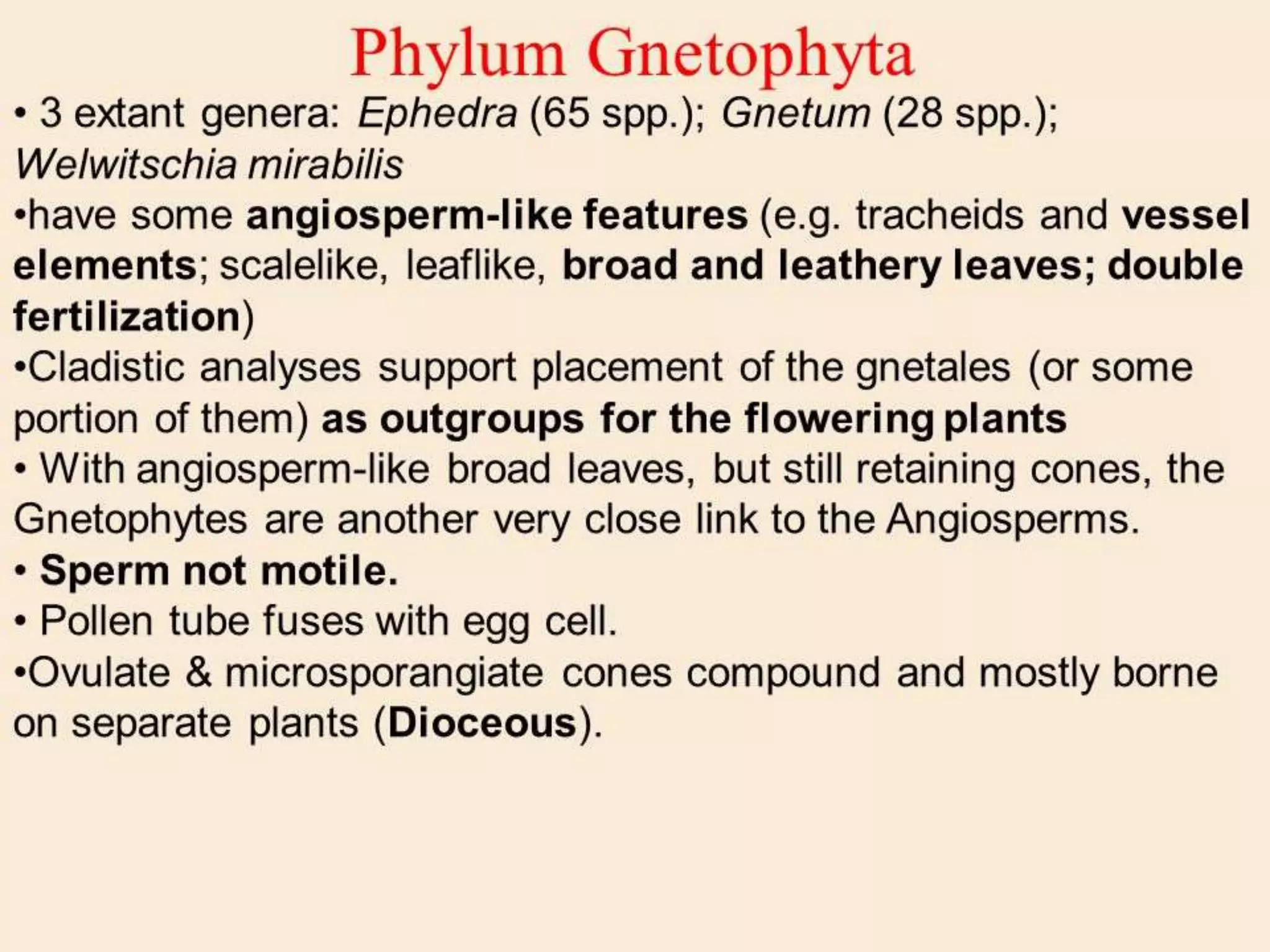
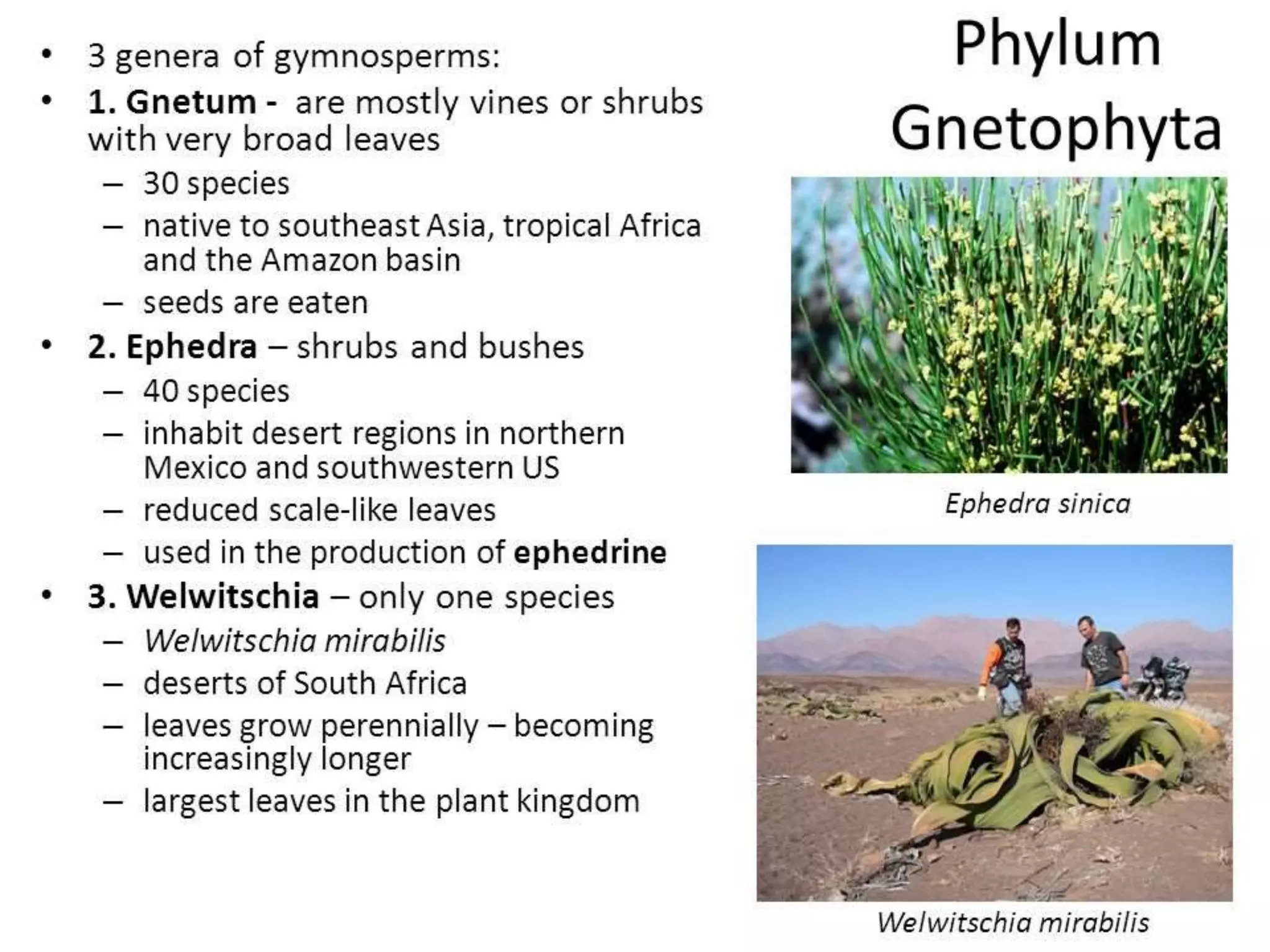
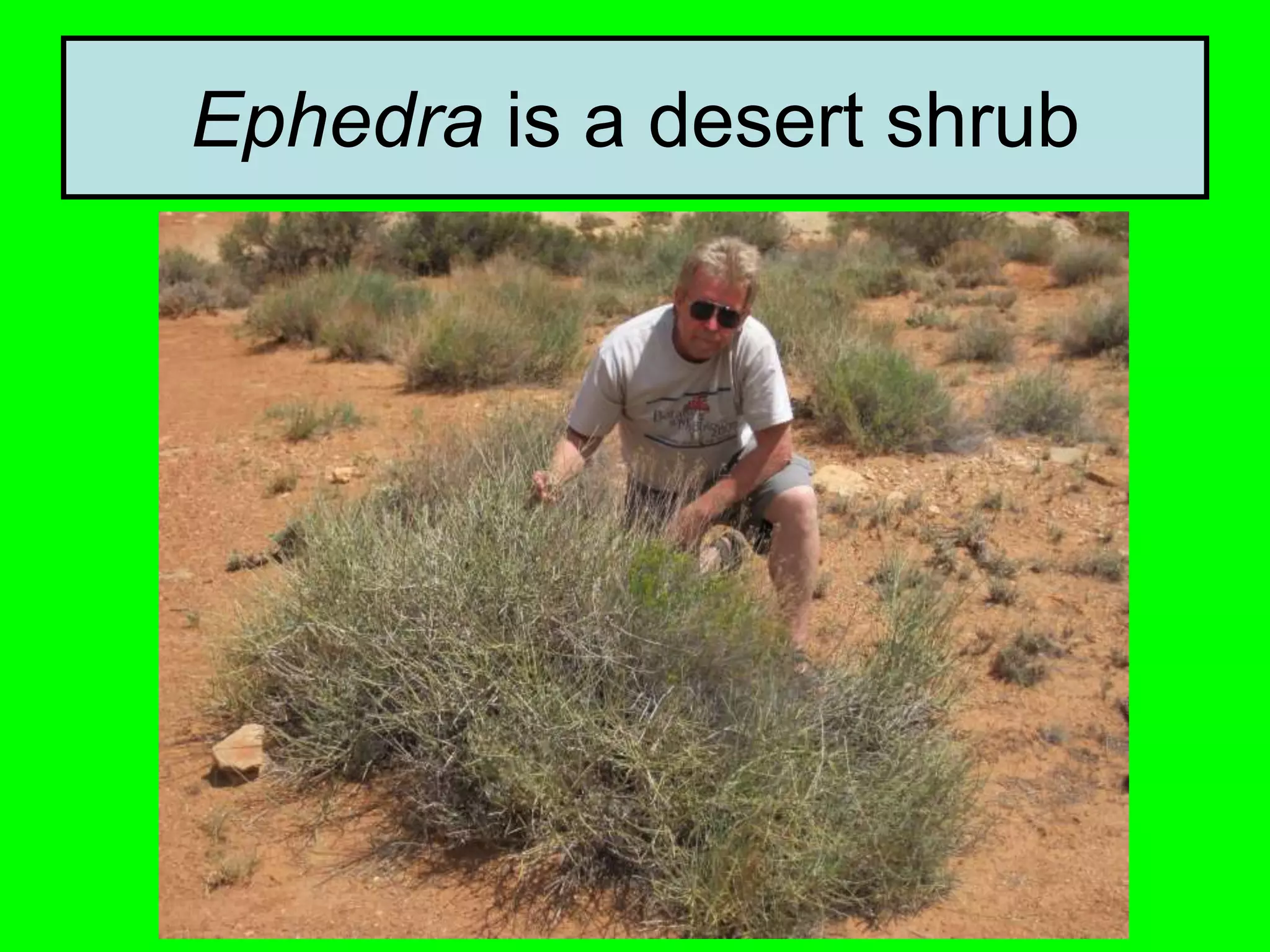
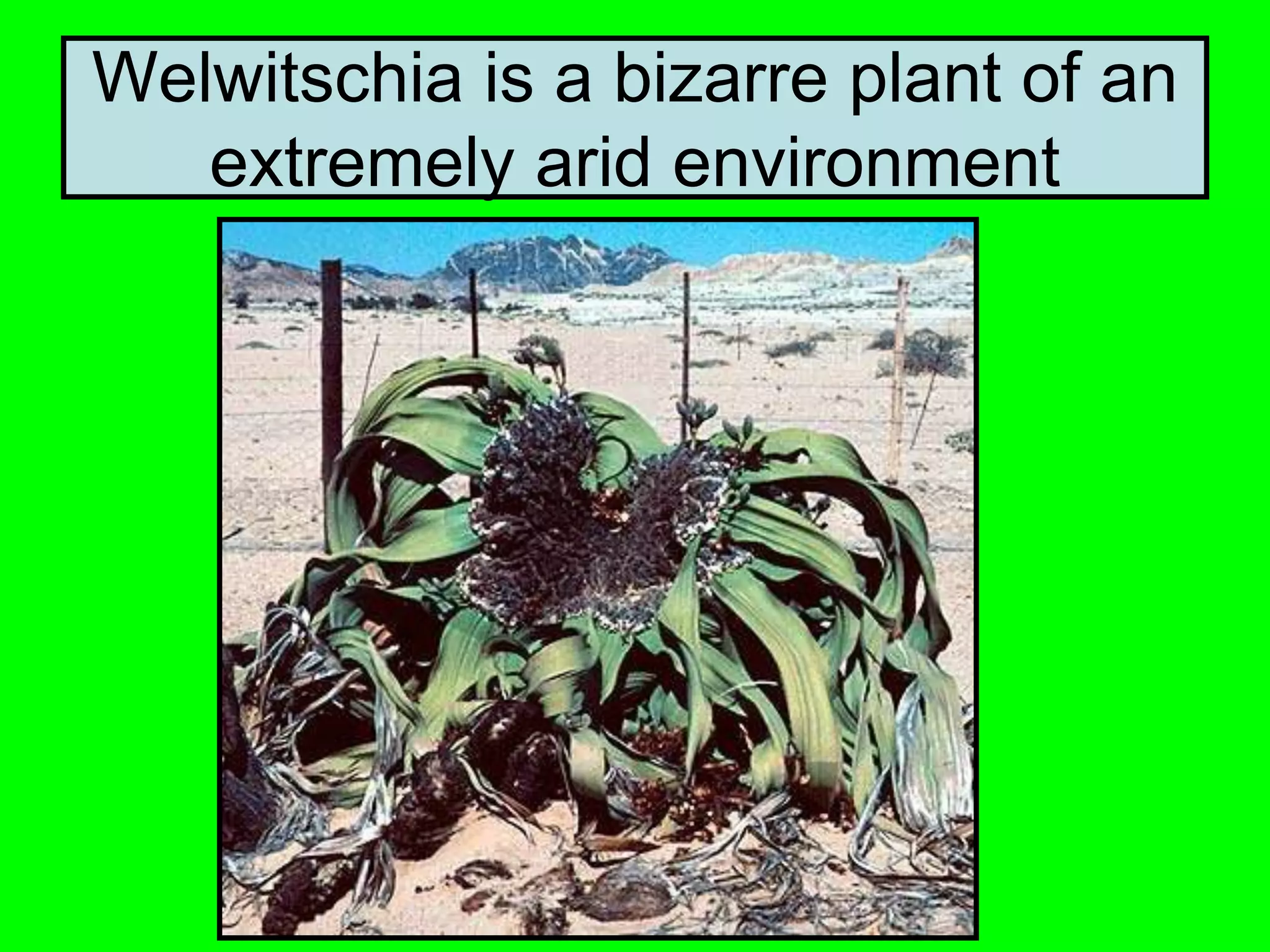
Details about gnetophytes like Ephedra, Gnetum, and Welwitschia, including their habitats.
Introduction
• Gymnosperms arewoody seed-bearing plants differing
from the other group of seed plants.
• The term "gymnosperm" comes from word
gymnospermos, meaning "naked seeds", after the
unenclosed condition of theirseeds (called ovules in their
unfertilized state).
• There are between 700 and 900 extant* or currently
living species of Gymnosperms.
• They grow in xerophytic conditions and posses
xerophytic adaptations.
• Gymnosperms are heterosporous which means that
they produce different male and female spores. The
microspores develop into pollen grainsand the
megasporesare in an ovule
4.
• .
• Maleand female reproductive structures are borne on
sporophylls, scales, or comparable structures
• Most of them are trees and some are shrubs. There are
no herbs..
• They have monopodial growth represented by one main
axis. As the axis grows taller it increases in diameter due
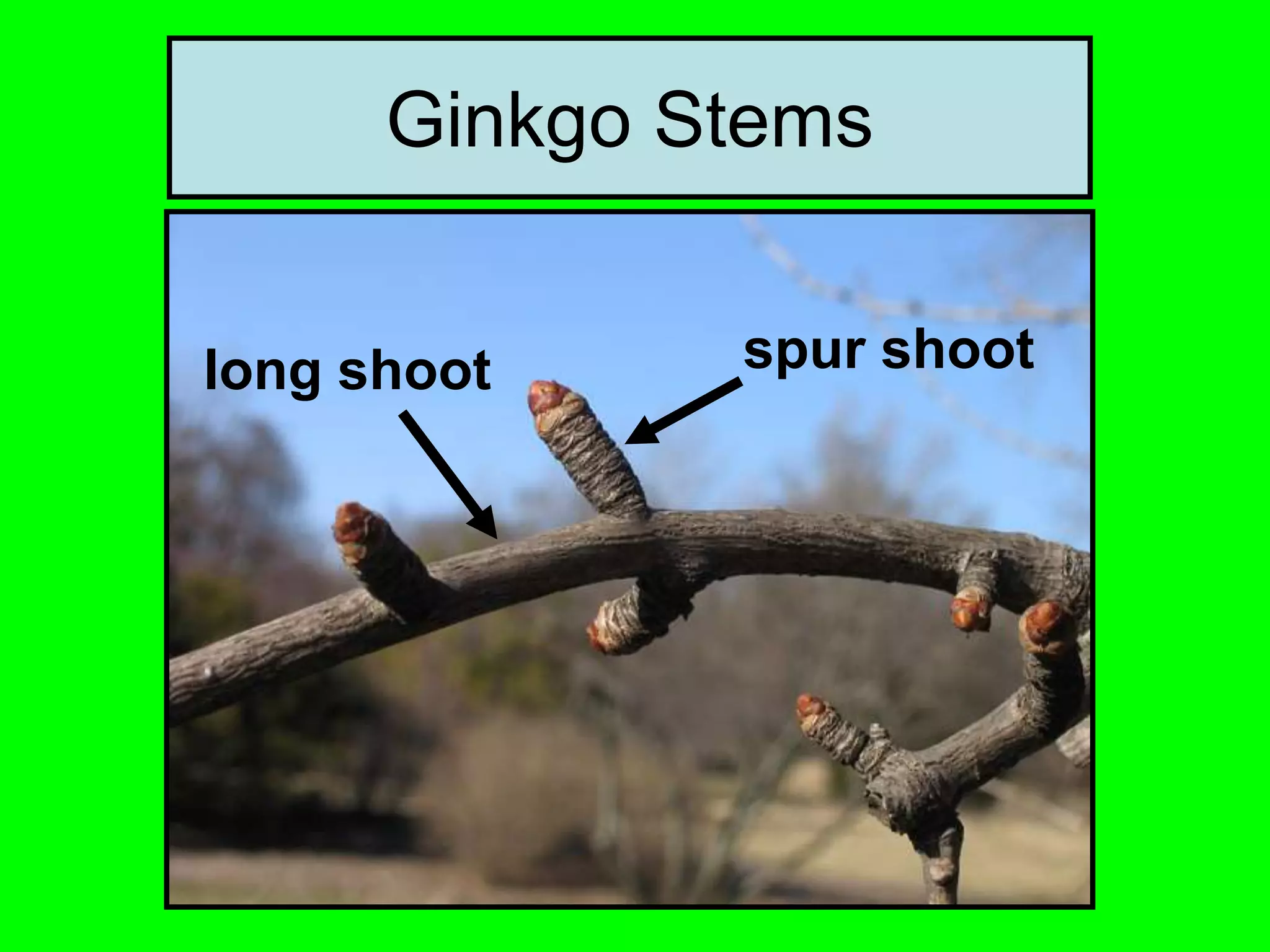
to secondary growth. Stem branches are of two types: 1.
Long shoots or branchesof unlimited growth. 2. Dwarf
shoots or branchesof limited growth.
• The plants possess well-developed tap root system. In
some cases the roots are symbiotically associated with
algae (coralloid roots of Cycas) or with fungi (mycorrhizal
roots of Pinus).
5.
Classification
• Gymnosperms includea number of fossil and living
forms. They include the primitive members of the
Spermophyta (seed- bearing plants) and form a link
between the Pteridophyta on the one hand and the
angiosperms on the other. Various attempts have been
made by different workers to classify the Gymnosperms.
• One of the earliest attempts was made by Bentham and
Hooker (1866-1883), when they divided seed bearing
plants into Dicots, Gymnosperms and Monocots.
Gymnosperms were further divided into Cycadaceae,
Gnetaceae and Coniferae. Engler (1885) divided
Gymnosperms into seven groups as follows: 1.
Cycadofilicales 2. Cycadales 3. Bennittitales 4.
Cordaitales 5. Ginkgoales 6. Coniferales 7. Gnetales
6.
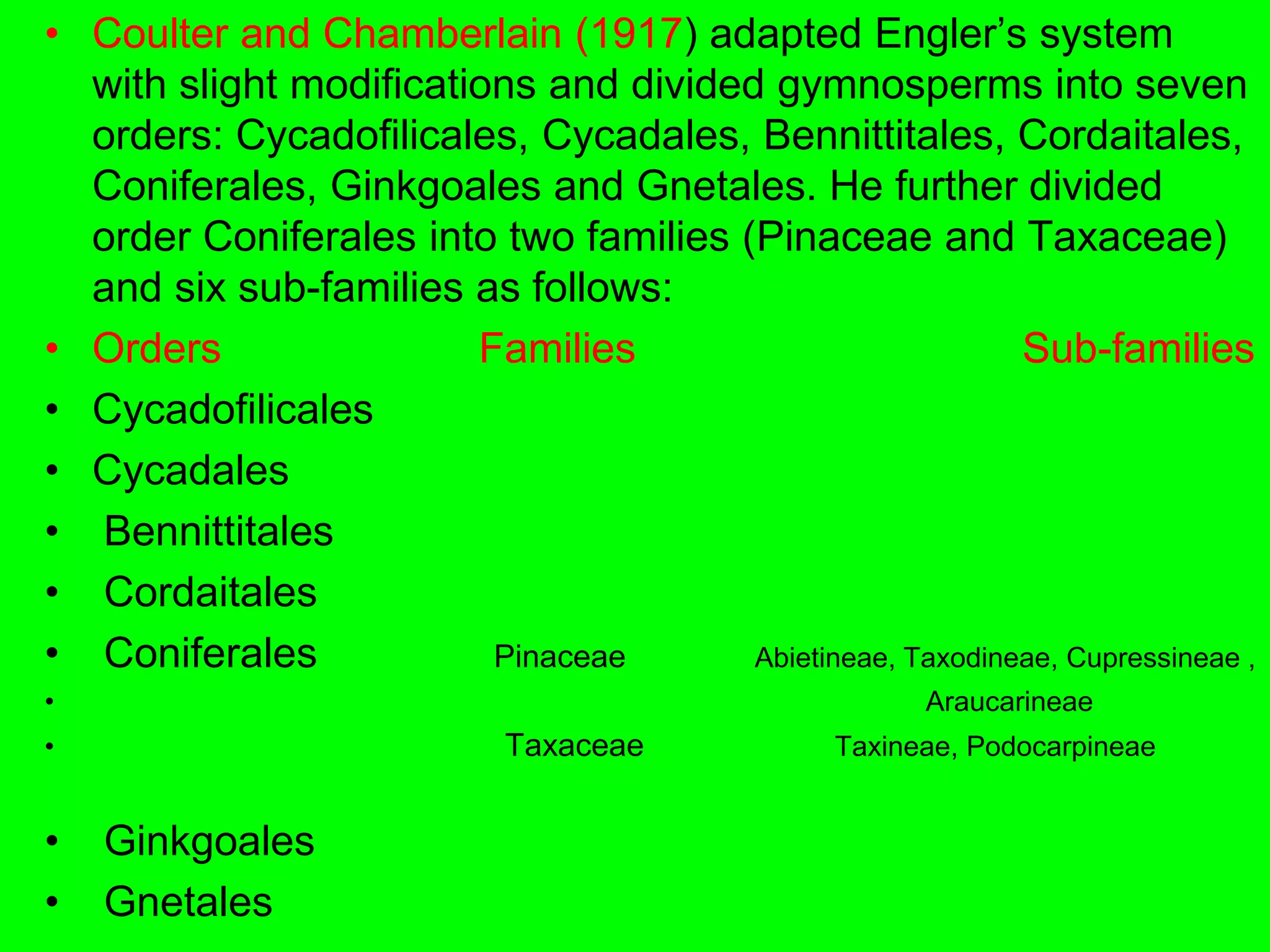
• Coulter andChamberlain (1917) adapted Engler’s system
with slight modifications and divided gymnosperms into seven
orders: Cycadofilicales, Cycadales, Bennittitales, Cordaitales,
Coniferales, Ginkgoales and Gnetales. He further divided
order Coniferales into two families (Pinaceae and Taxaceae)
and six sub-families as follows:
• Orders Families Sub-families
• Cycadofilicales
• Cycadales
• Bennittitales
• Cordaitales
• Coniferales Pinaceae Abietineae, Taxodineae, Cupressineae ,
• Araucarineae
• Taxaceae Taxineae, Podocarpineae
• Ginkgoales
• Gnetales
7.
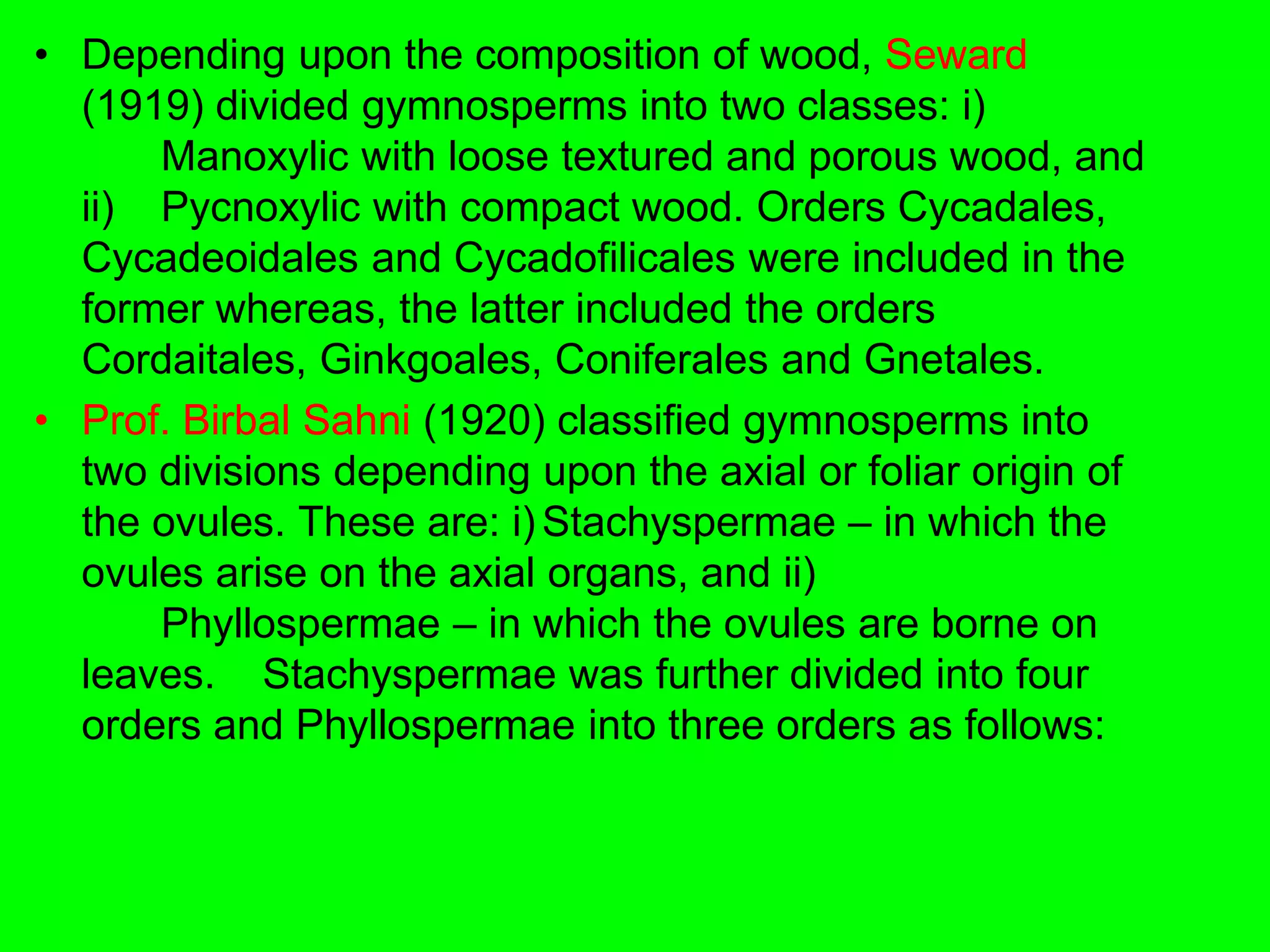
• Depending uponthe composition of wood, Seward
(1919) divided gymnosperms into two classes: i)
Manoxylic with loose textured and porous wood, and
ii) Pycnoxylic with compact wood. Orders Cycadales,
Cycadeoidales and Cycadofilicales were included in the
former whereas, the latter included the orders
Cordaitales, Ginkgoales, Coniferales and Gnetales.
• Prof. Birbal Sahni (1920) classified gymnosperms into
two divisions depending upon the axial or foliar origin of
the ovules. These are: i) Stachyspermae – in which the
ovules arise on the axial organs, and ii)
Phyllospermae – in which the ovules are borne on
leaves. Stachyspermae was further divided into four
orders and Phyllospermae into three orders as follows:
8.
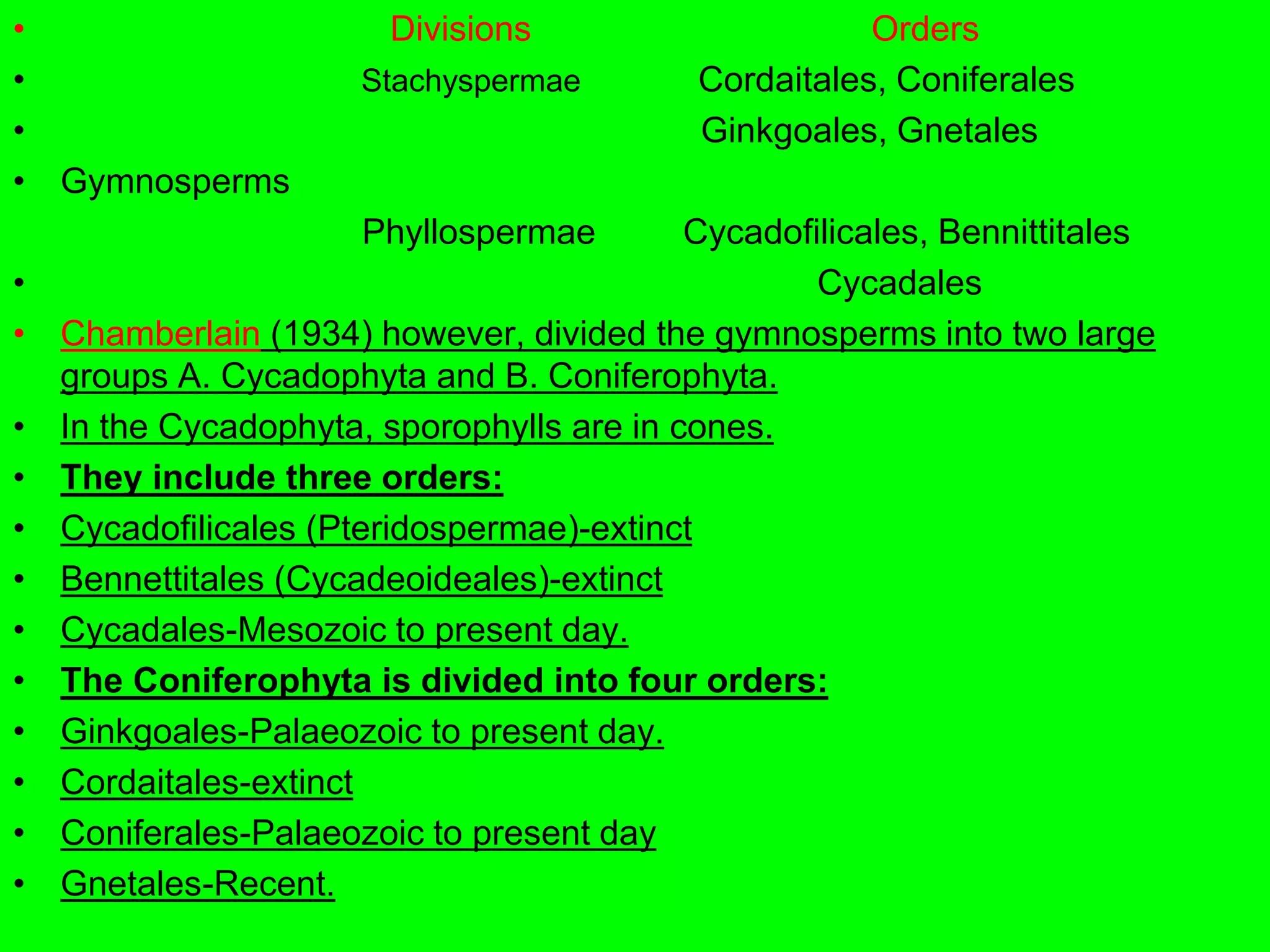
• Divisions Orders
•Stachyspermae Cordaitales, Coniferales
• Ginkgoales, Gnetales
• Gymnosperms
Phyllospermae Cycadofilicales, Bennittitales
• Cycadales
• Chamberlain (1934) however, divided the gymnosperms into two large
groups A. Cycadophyta and B. Coniferophyta.
• In the Cycadophyta, sporophylls are in cones.
• They include three orders:
• Cycadofilicales (Pteridospermae)-extinct
• Bennettitales (Cycadeoideales)-extinct
• Cycadales-Mesozoic to present day.
• The Coniferophyta is divided into four orders:
• Ginkgoales-Palaeozoic to present day.
• Cordaitales-extinct
• Coniferales-Palaeozoic to present day
• Gnetales-Recent.
9.
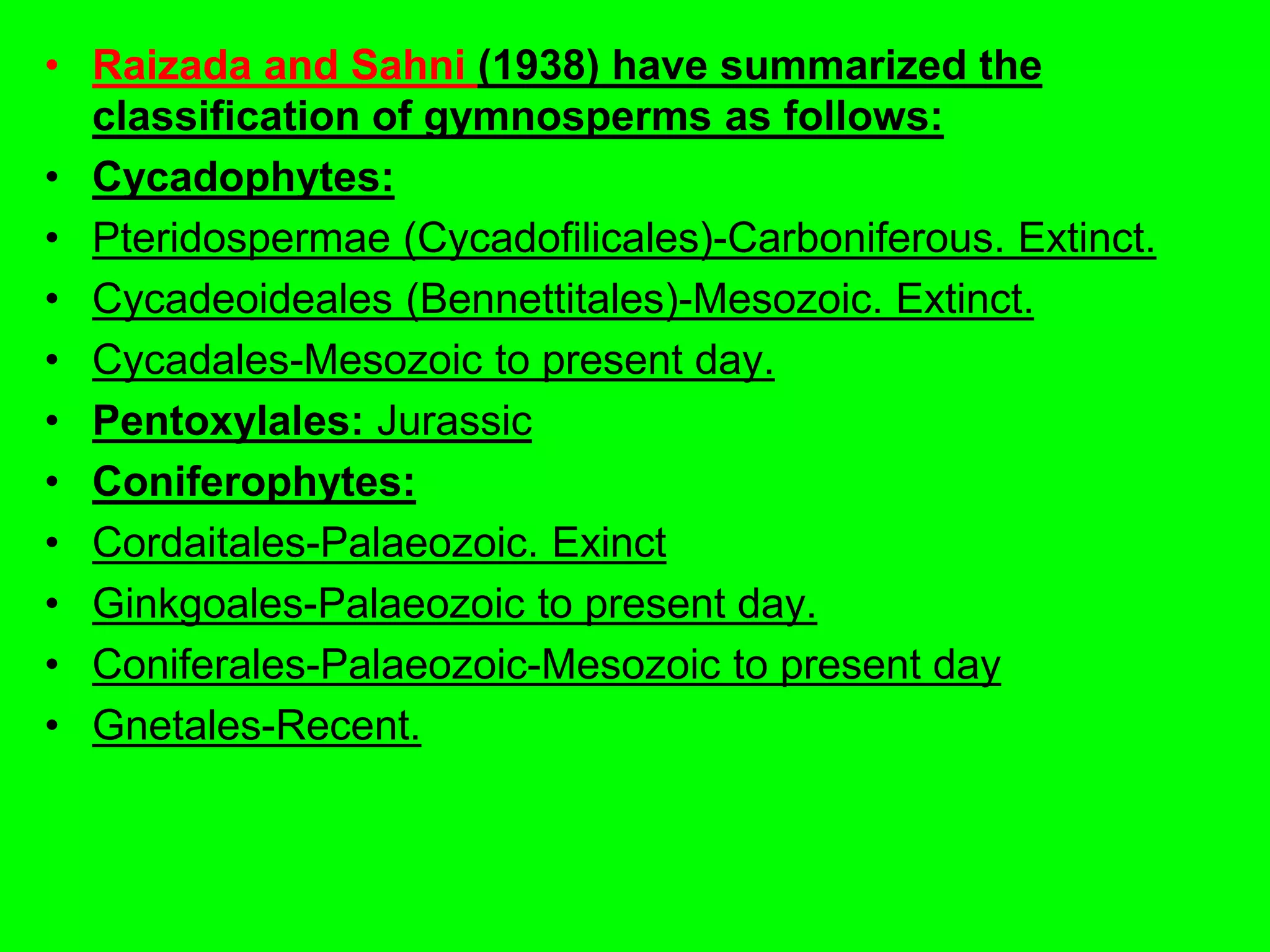
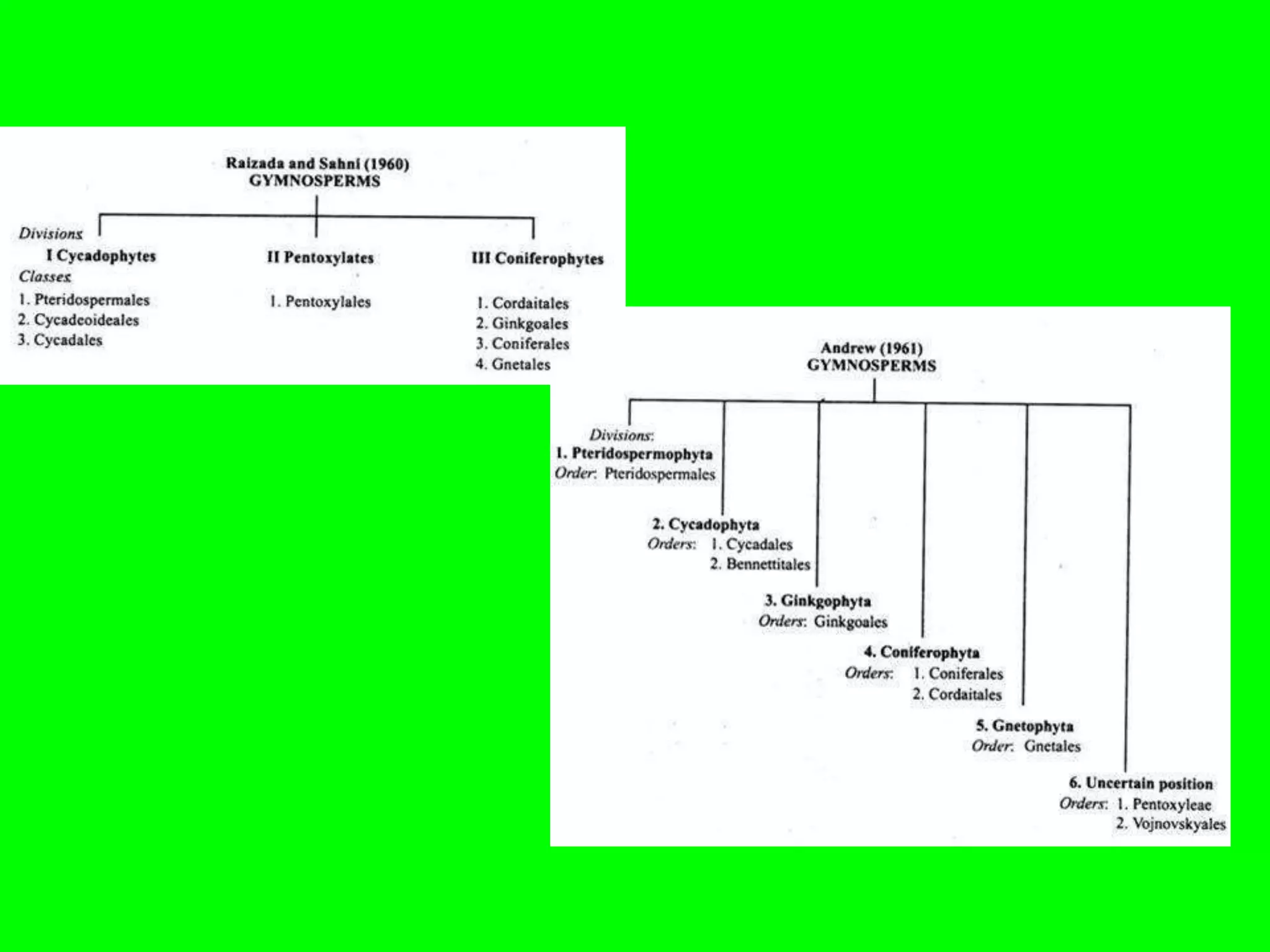
• Raizada andSahni (1938) have summarized the
classification of gymnosperms as follows:
• Cycadophytes:
• Pteridospermae (Cycadofilicales)-Carboniferous. Extinct.
• Cycadeoideales (Bennettitales)-Mesozoic. Extinct.
• Cycadales-Mesozoic to present day.
• Pentoxylales: Jurassic
• Coniferophytes:
• Cordaitales-Palaeozoic. Exinct
• Ginkgoales-Palaeozoic to present day.
• Coniferales-Palaeozoic-Mesozoic to present day
• Gnetales-Recent.
10.
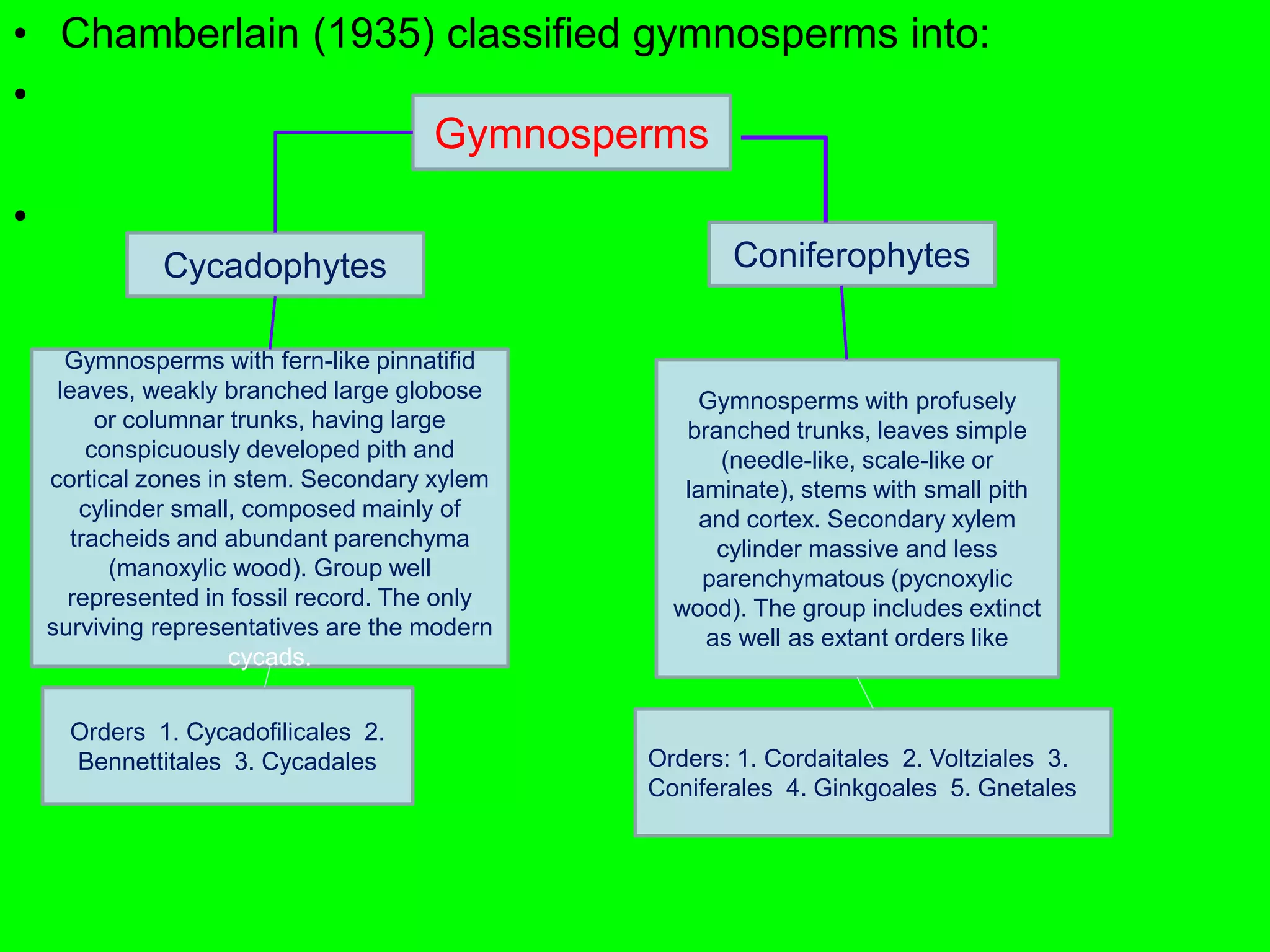
• Chamberlain (1935)classified gymnosperms into:
•
•
Gymnosperms with profusely
branched trunks, leaves simple
(needle-like, scale-like or
laminate), stems with small pith
and cortex. Secondary xylem
cylinder massive and less
parenchymatous (pycnoxylic
wood). The group includes extinct
as well as extant orders like
Gymnosperms with fern-like pinnatifid
leaves, weakly branched large globose
or columnar trunks, having large
conspicuously developed pith and
cortical zones in stem. Secondary xylem
cylinder small, composed mainly of
tracheids and abundant parenchyma
(manoxylic wood). Group well
represented in fossil record. The only
surviving representatives are the modern
cycads.
Orders 1. Cycadofilicales 2.
Bennettitales 3. Cycadales Orders: 1. Cordaitales 2. Voltziales 3.
Coniferales 4. Ginkgoales 5. Gnetales
ConiferophytesCycadophytes
Gymnosperms
11.
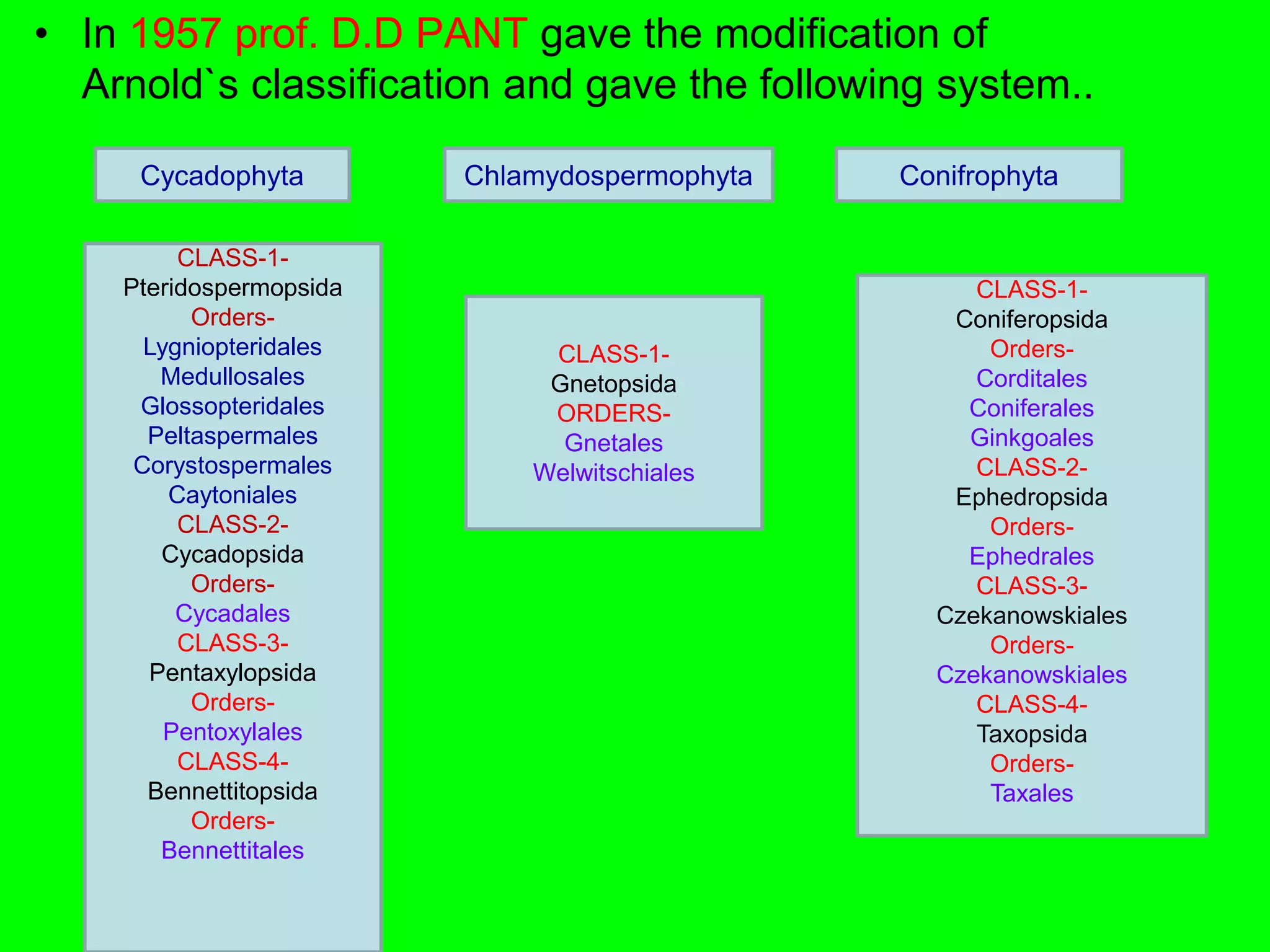
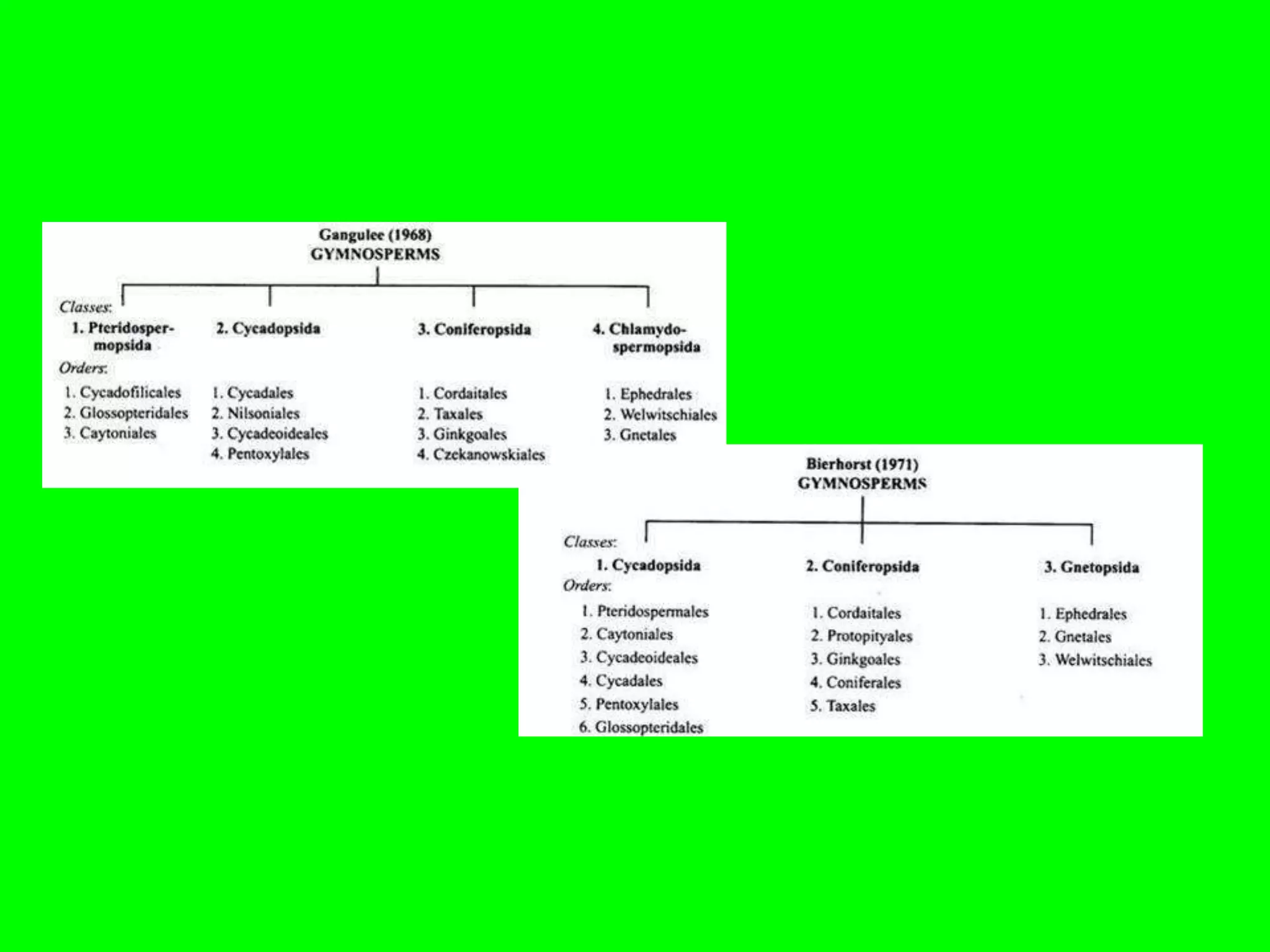
• In 1957prof. D.D PANT gave the modification of
Arnold`s classification and gave the following system..
Cycadophyta Chlamydospermophyta Conifrophyta
CLASS-1-
Pteridospermopsida
Orders-
Lygniopteridales
Medullosales
Glossopteridales
Peltaspermales
Corystospermales
Caytoniales
CLASS-2-
Cycadopsida
Orders-
Cycadales
CLASS-3-
Pentaxylopsida
Orders-
Pentoxylales
CLASS-4-
Bennettitopsida
Orders-
Bennettitales
CLASS-1-
Gnetopsida
ORDERS-
Gnetales
Welwitschiales
CLASS-1-
Coniferopsida
Orders-
Corditales
Coniferales
Ginkgoales
CLASS-2-
Ephedropsida
Orders-
Ephedrales
CLASS-3-
Czekanowskiales
Orders-
Czekanowskiales
CLASS-4-
Taxopsida
Orders-
Taxales
12.
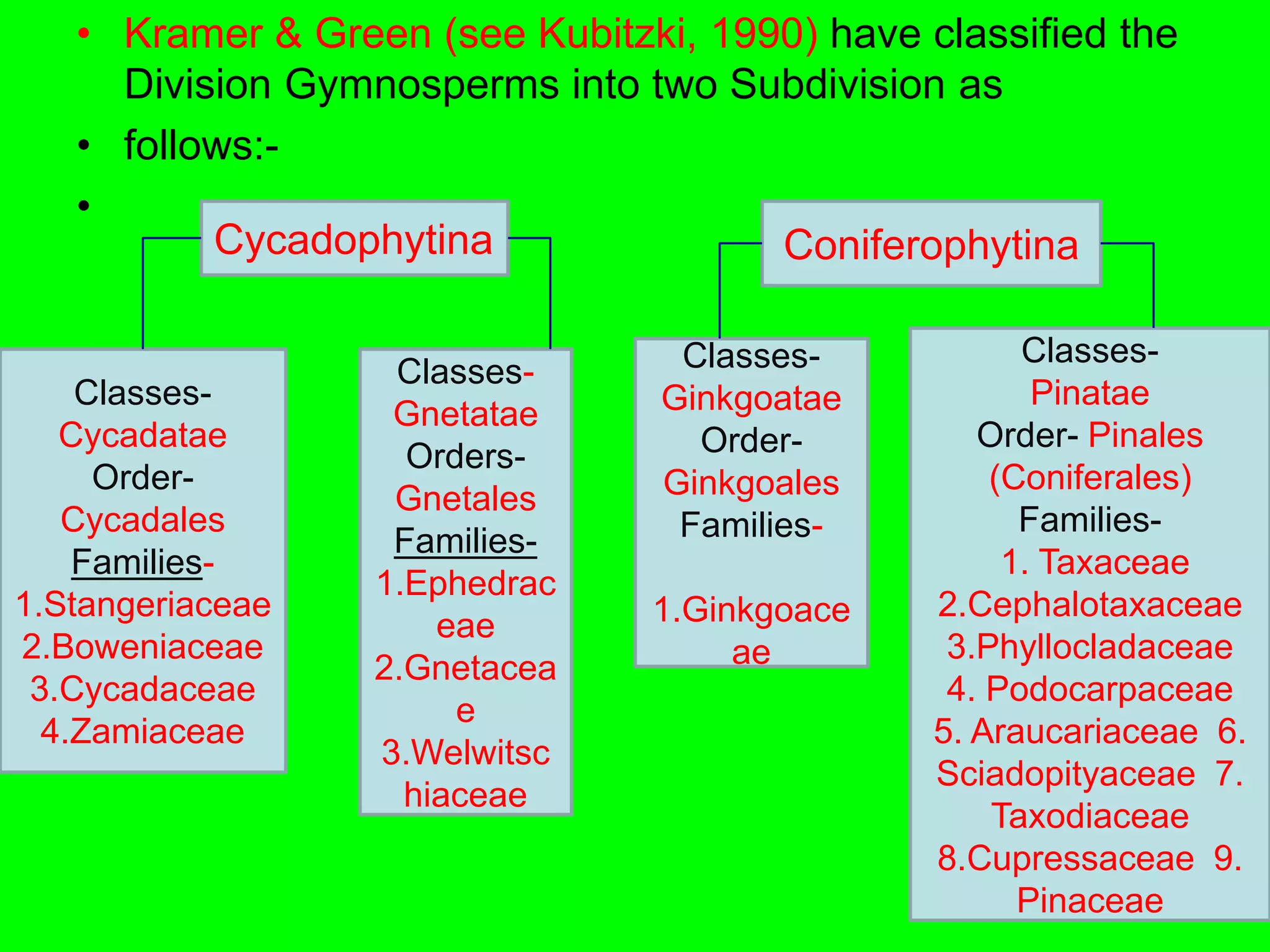
• Kramer &Green (see Kubitzki, 1990) have classified the
Division Gymnosperms into two Subdivision as
• follows:-
•
Cycadophytina Coniferophytina
Classes-
Cycadatae
Order-
Cycadales
Families-
1.Stangeriaceae
2.Boweniaceae
3.Cycadaceae
4.Zamiaceae
Classes-
Gnetatae
Orders-
Gnetales
Families-
1.Ephedrac
eae
2.Gnetacea
e
3.Welwitsc
hiaceae
Classes-
Ginkgoatae
Order-
Ginkgoales
Families-
1.Ginkgoace
ae
Classes-
Pinatae
Order- Pinales
(Coniferales)
Families-
1. Taxaceae
2.Cephalotaxaceae
3.Phyllocladaceae
4. Podocarpaceae
5. Araucariaceae 6.
Sciadopityaceae 7.
Taxodiaceae
8.Cupressaceae 9.
Pinaceae
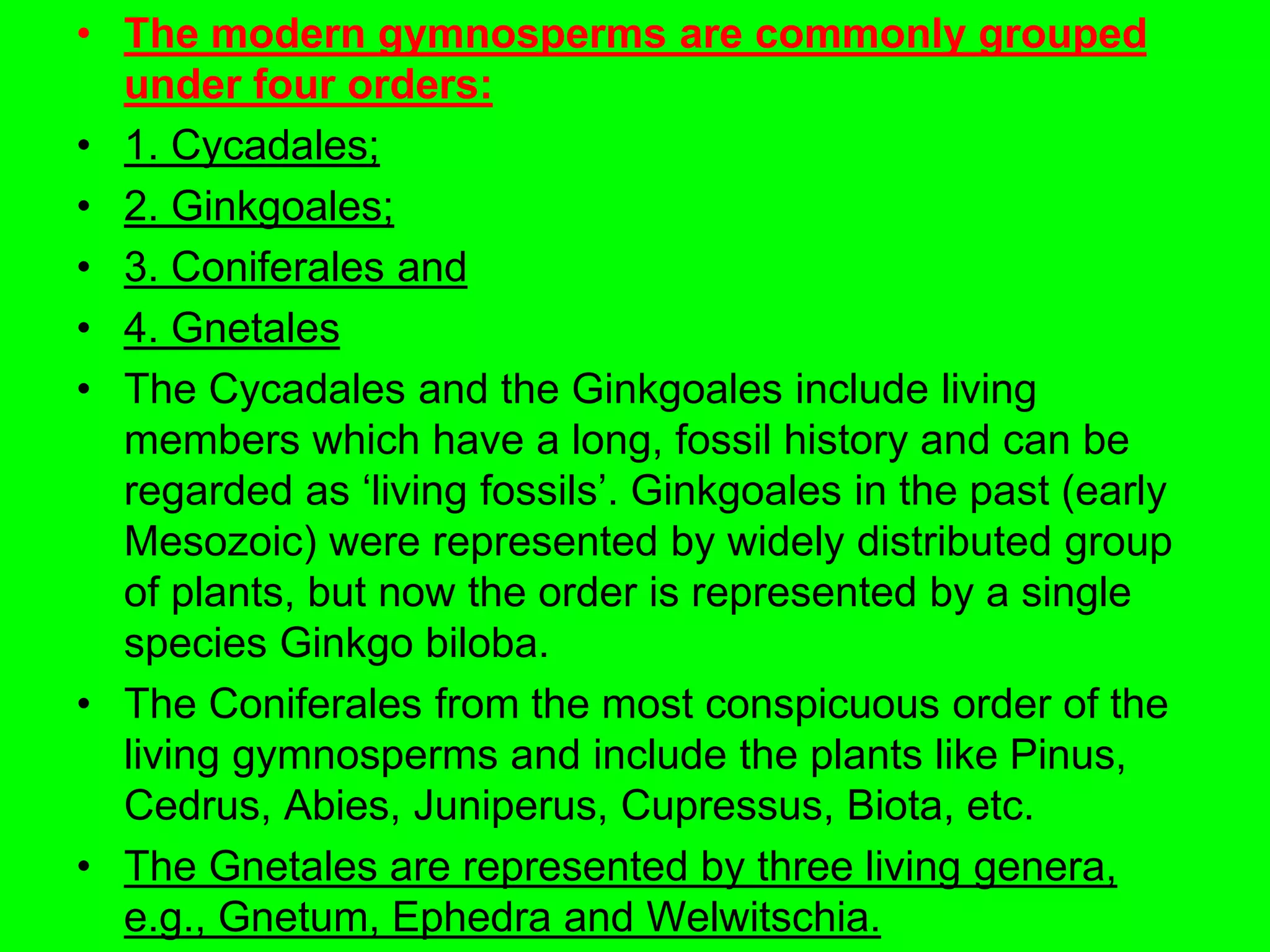
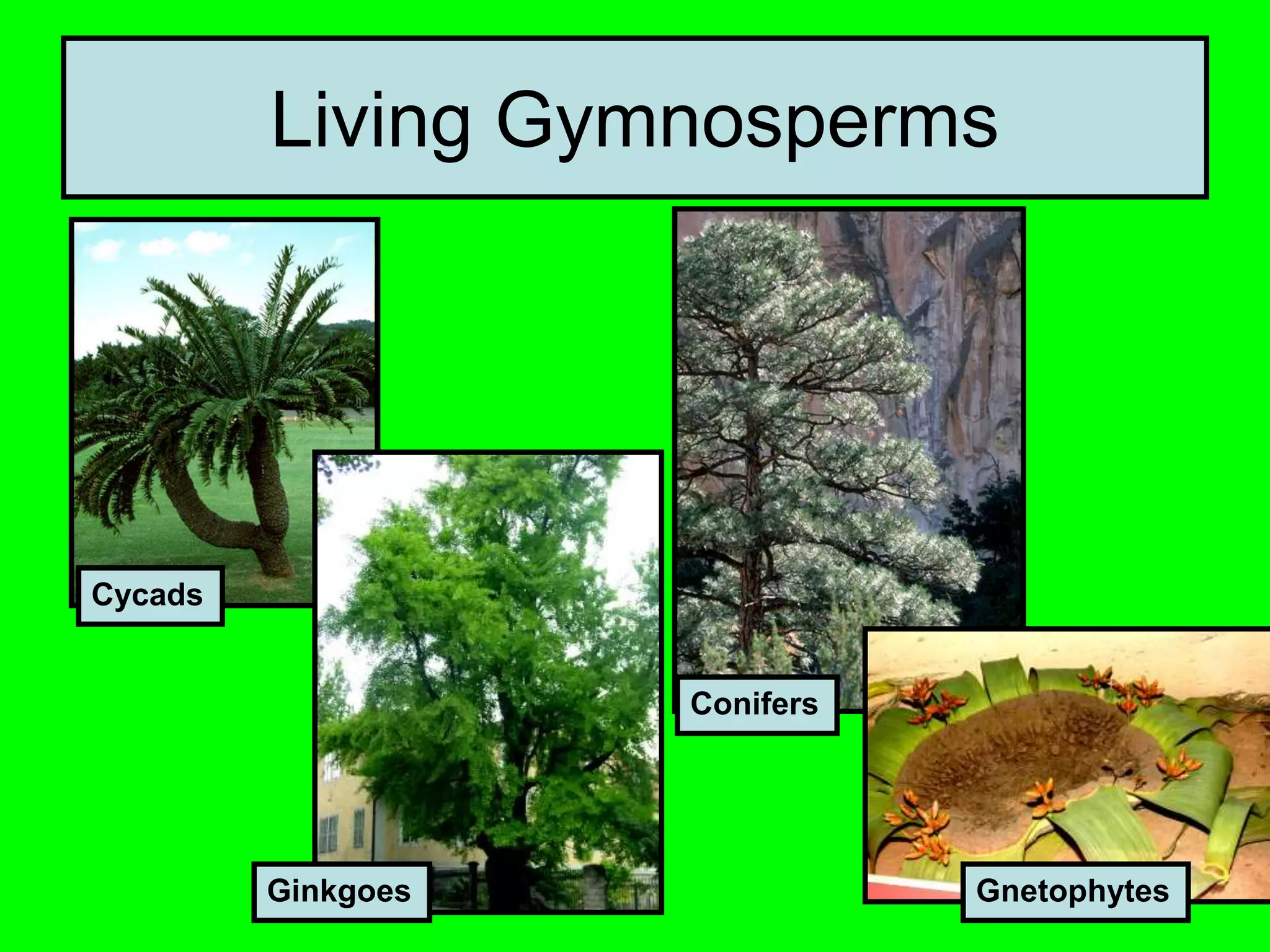
• The moderngymnosperms are commonly grouped
under four orders:
• 1. Cycadales;
• 2. Ginkgoales;
• 3. Coniferales and
• 4. Gnetales
• The Cycadales and the Ginkgoales include living
members which have a long, fossil history and can be
regarded as ‘living fossils’. Ginkgoales in the past (early
Mesozoic) were represented by widely distributed group
of plants, but now the order is represented by a single
species Ginkgo biloba.
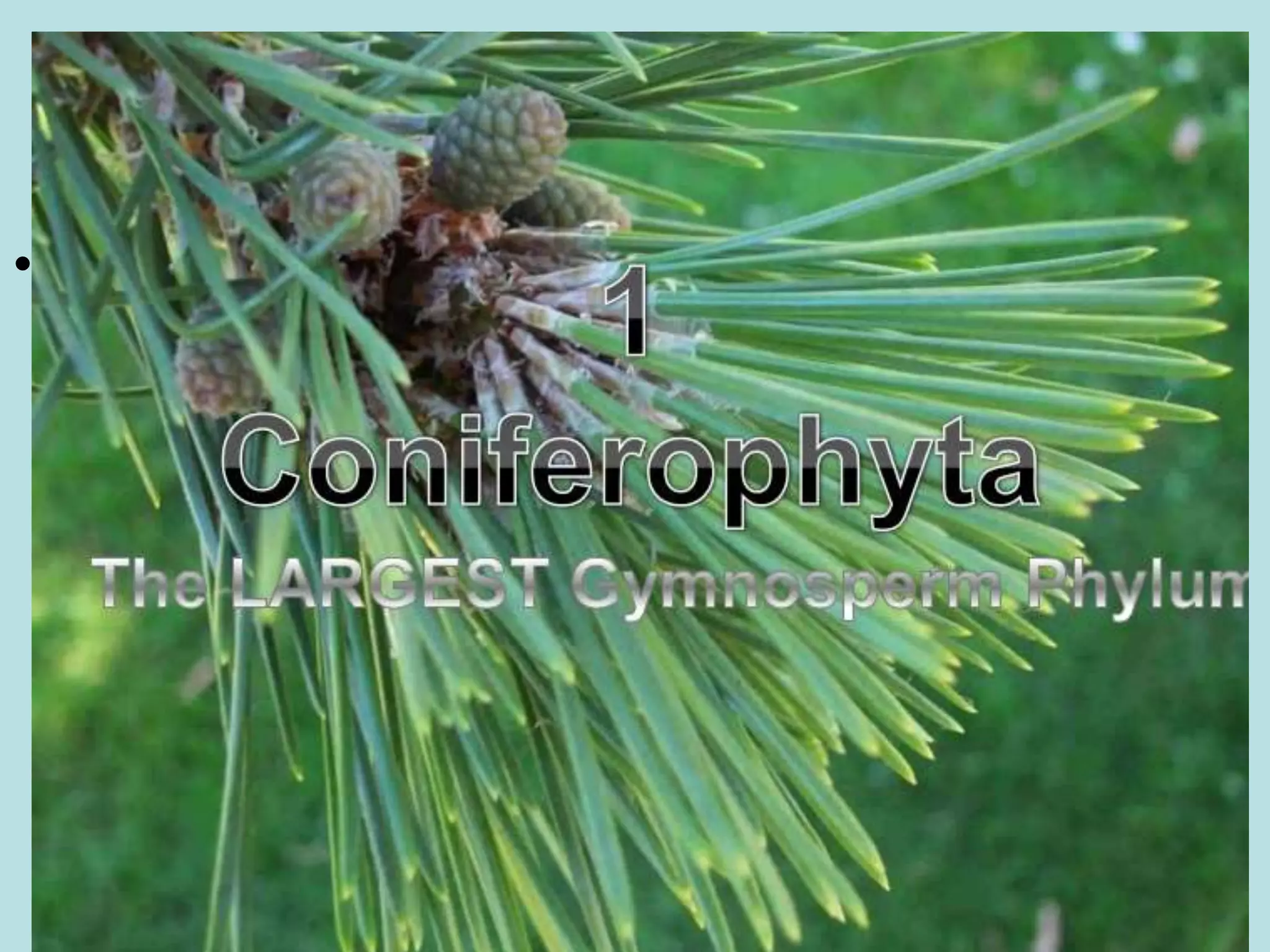
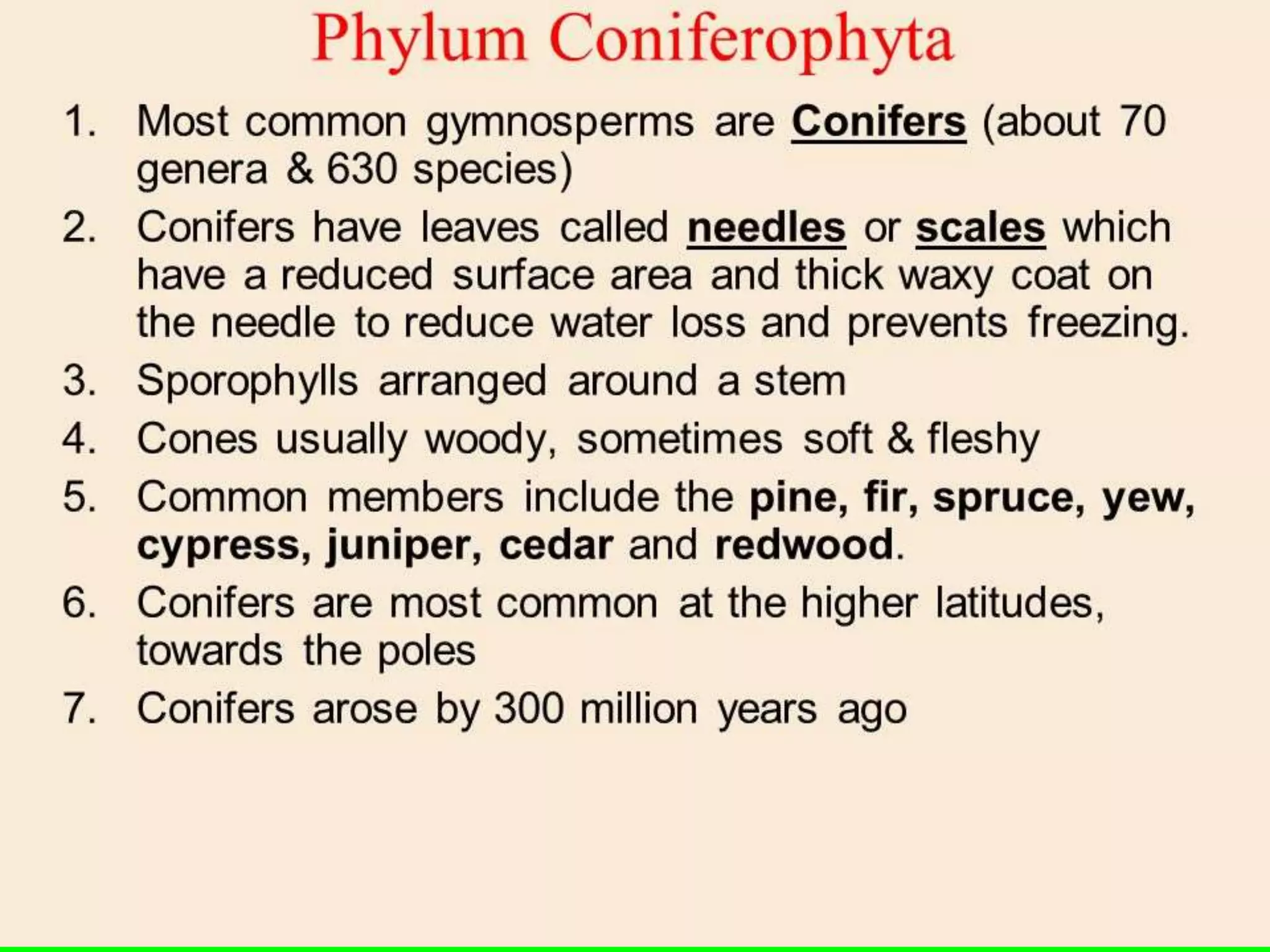
• The Coniferales from the most conspicuous order of the
living gymnosperms and include the plants like Pinus,
Cedrus, Abies, Juniperus, Cupressus, Biota, etc.
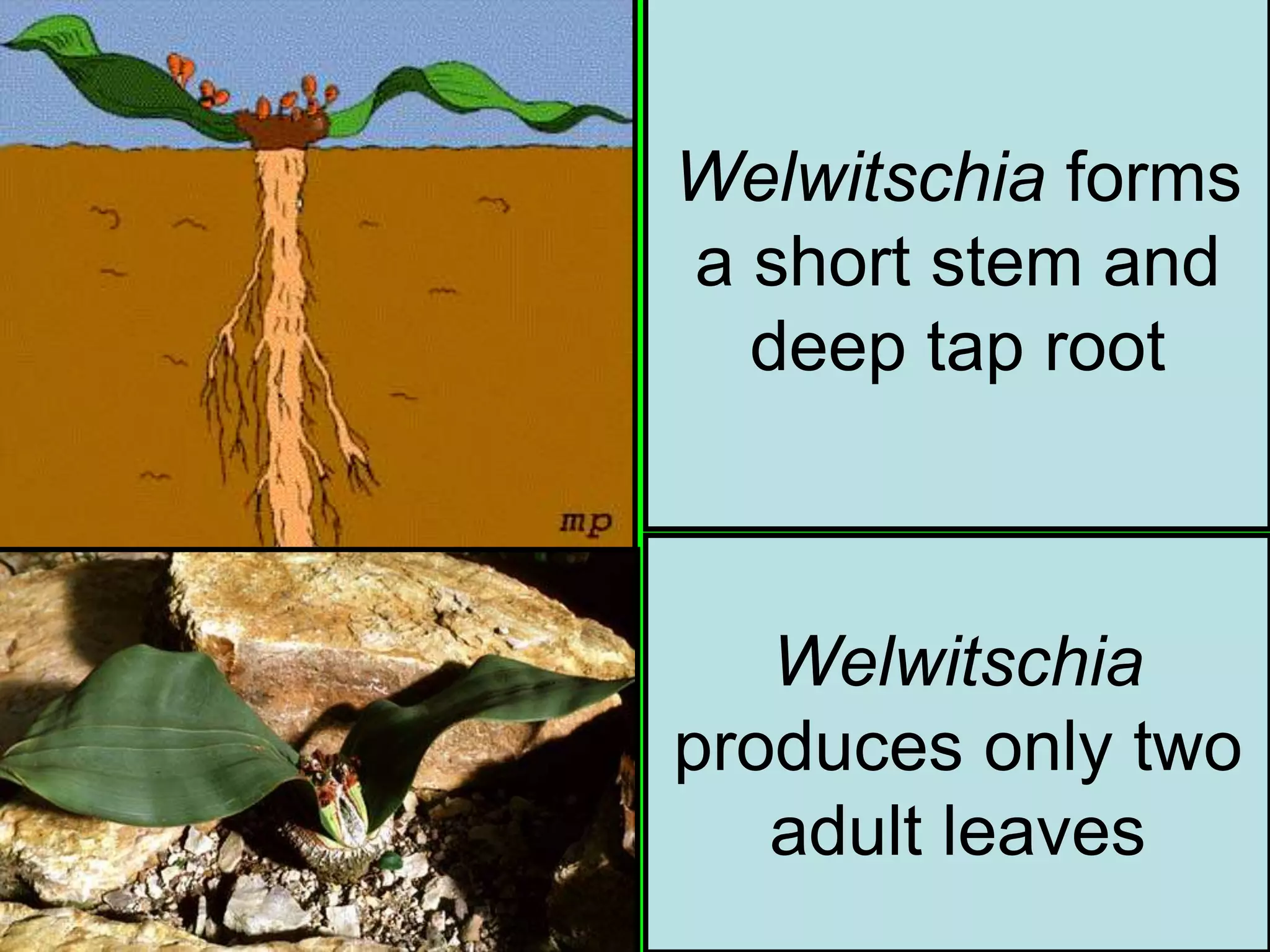
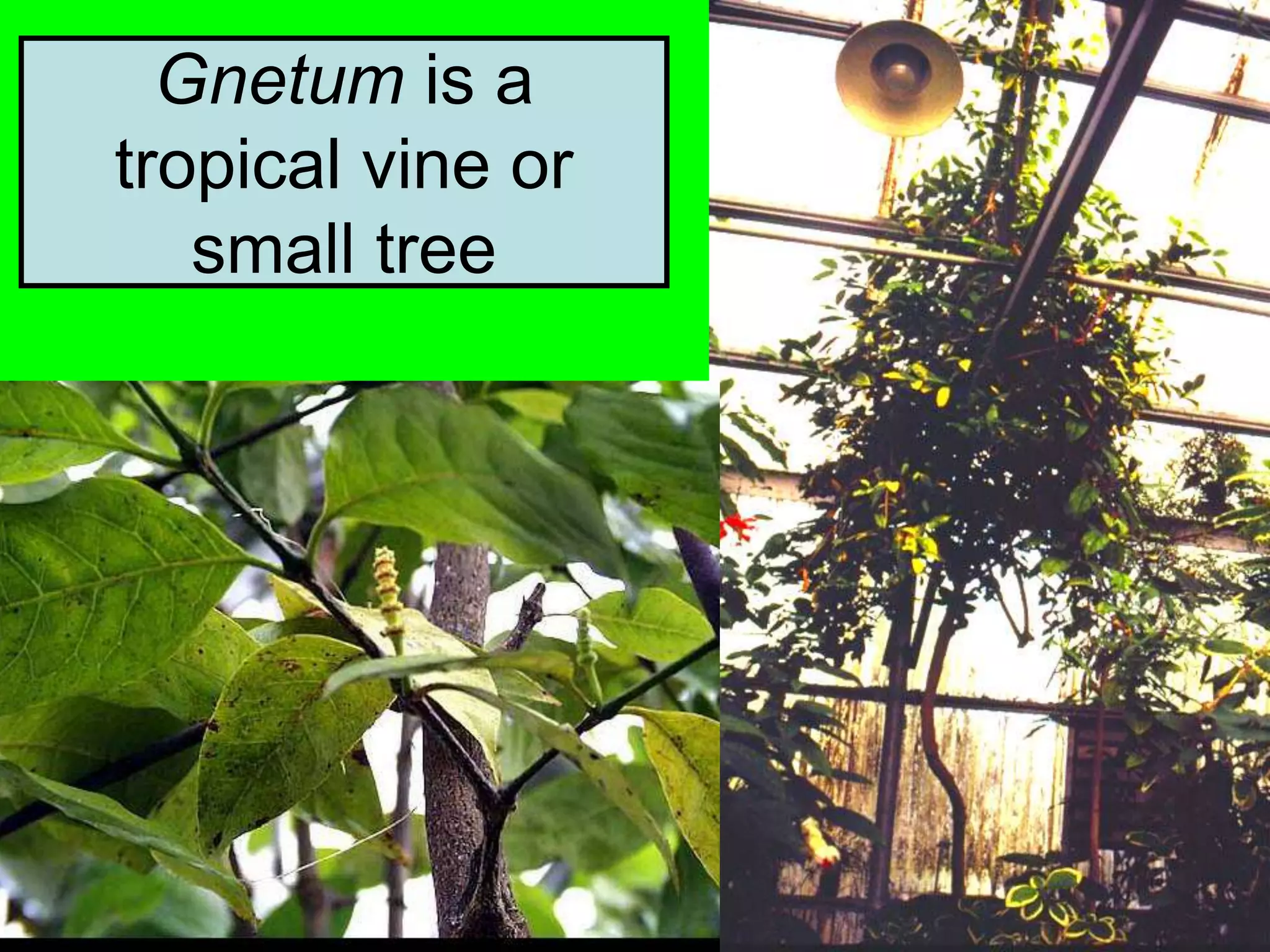
• The Gnetales are represented by three living genera,
e.g., Gnetum, Ephedra and Welwitschia.
• The treesare branched,woody and perennial.
• The leaves are dimorphic scaly and foliar.
• Tap root system mostly associated with fungi
[mycorrhizal association]
• Reproductive structures are formed on leaves which
arrange to form cones male and female cones are
formed sepratly.
• Pollen grains are wind spread and embryo formed is di
to polycotylednous
21.
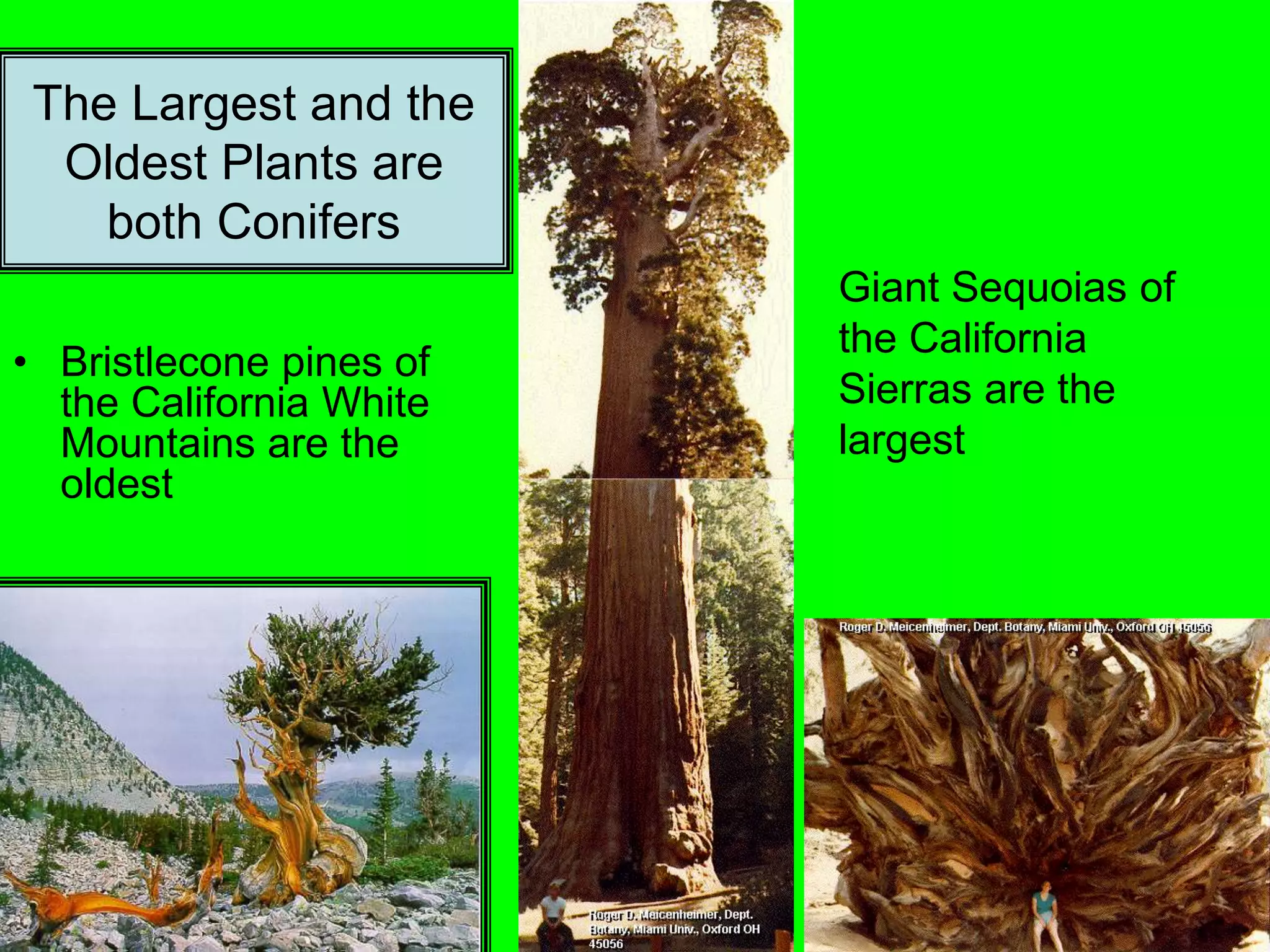
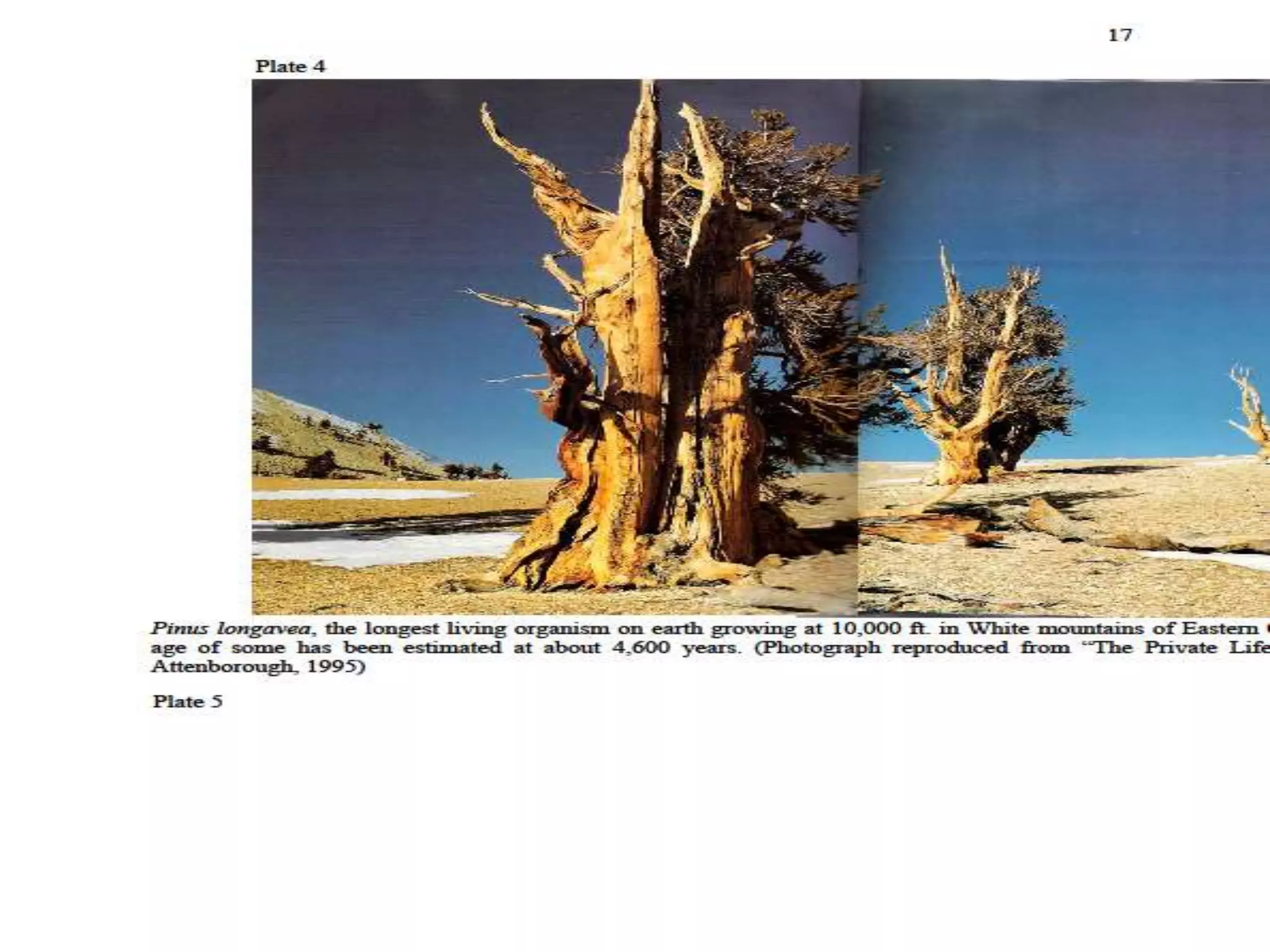
The Largest andthe
Oldest Plants are
both Conifers
• Bristlecone pines of
the California White
Mountains are the
oldest
Giant Sequoias of
the California
Sierras are the
largest
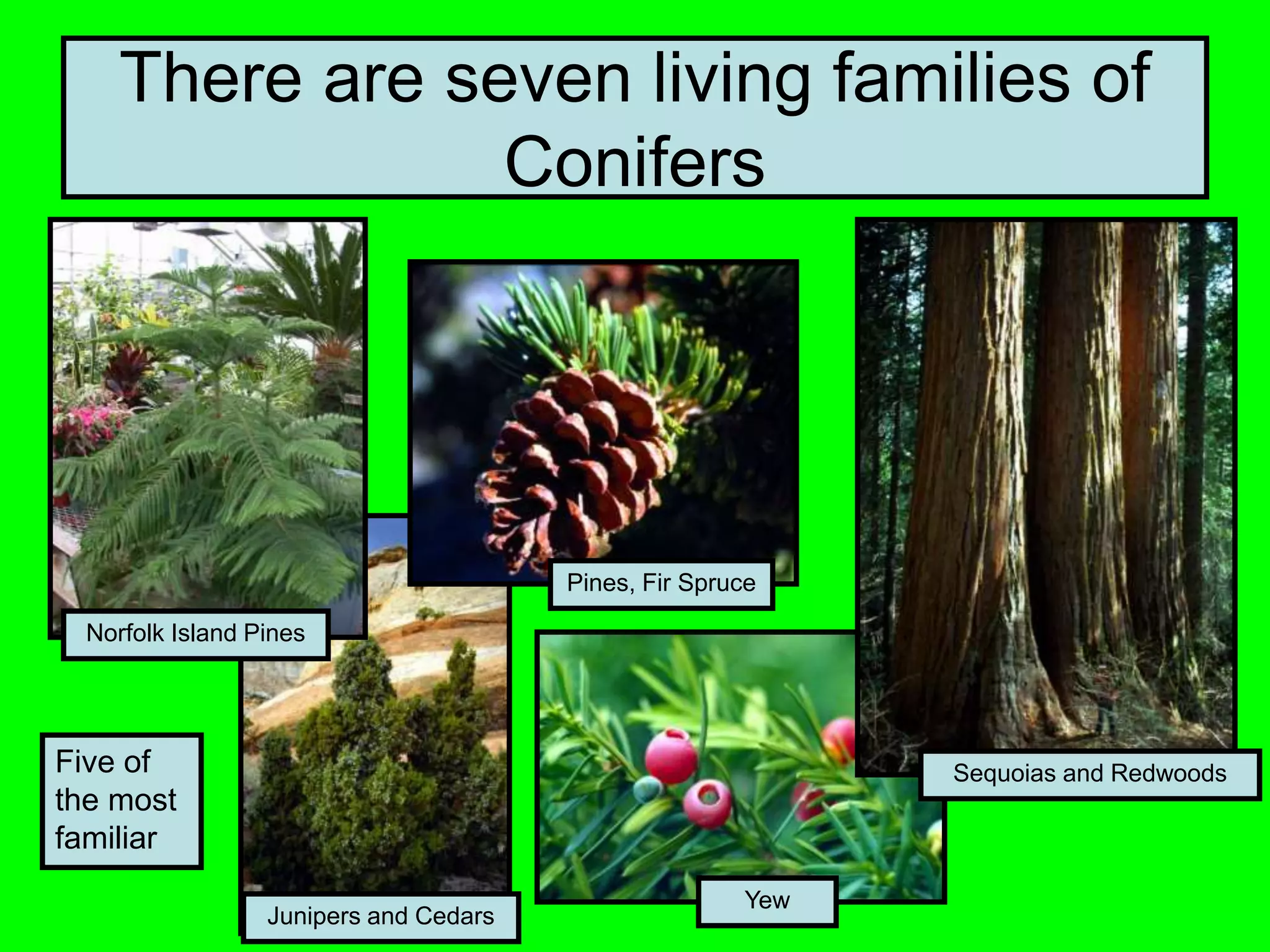
There are sevenliving families of
Conifers
Norfolk Island Pines
Junipers and Cedars
Yew
Sequoias and Redwoods
Pines, Fir Spruce
Five of
the most
familiar
24.
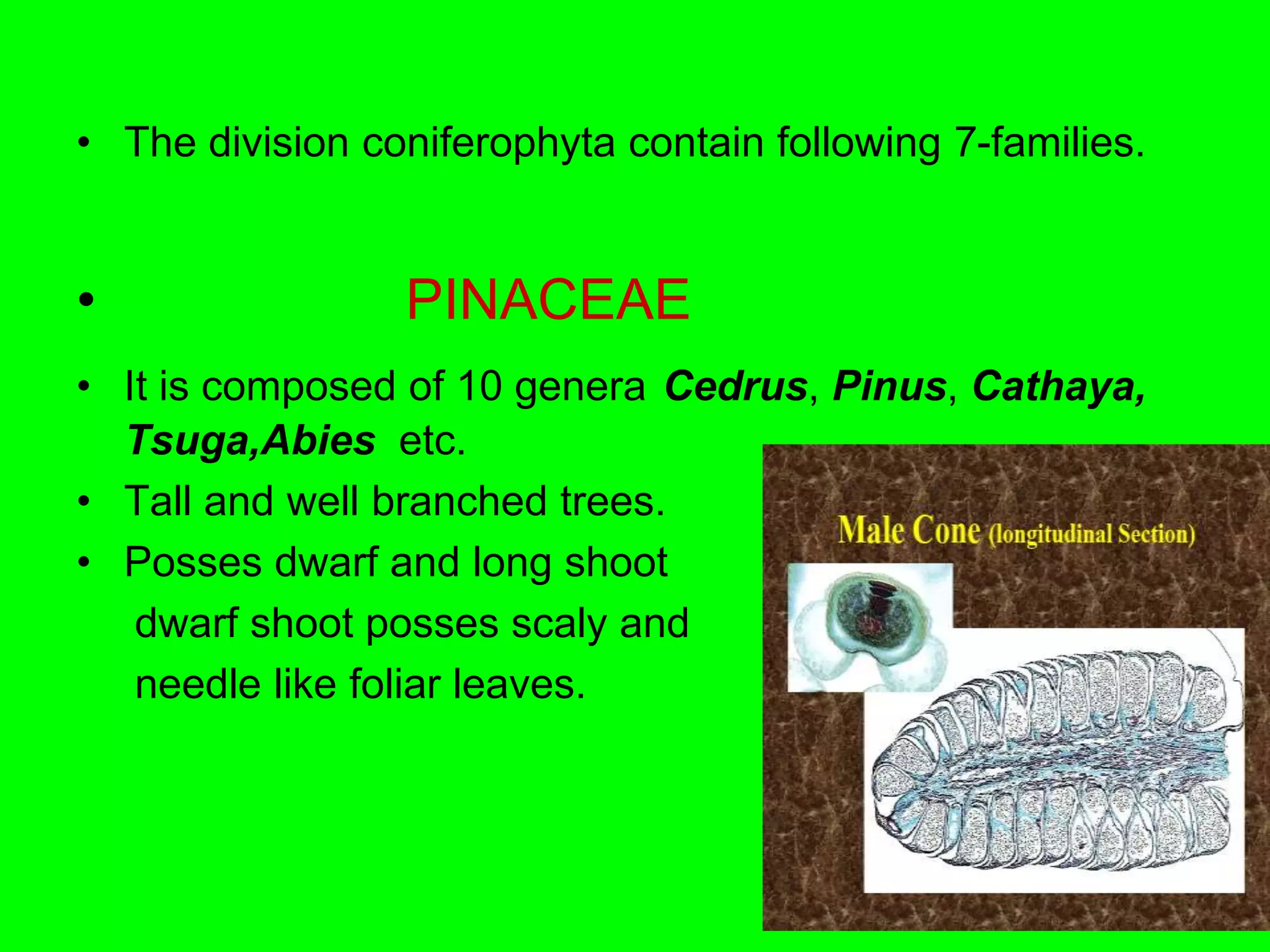
• The divisionconiferophyta contain following 7-families.
• PINACEAE
• It is composed of 10 genera Cedrus, Pinus, Cathaya,
Tsuga,Abies etc.
• Tall and well branched trees.
• Posses dwarf and long shoot
dwarf shoot posses scaly and
needle like foliar leaves.
26.
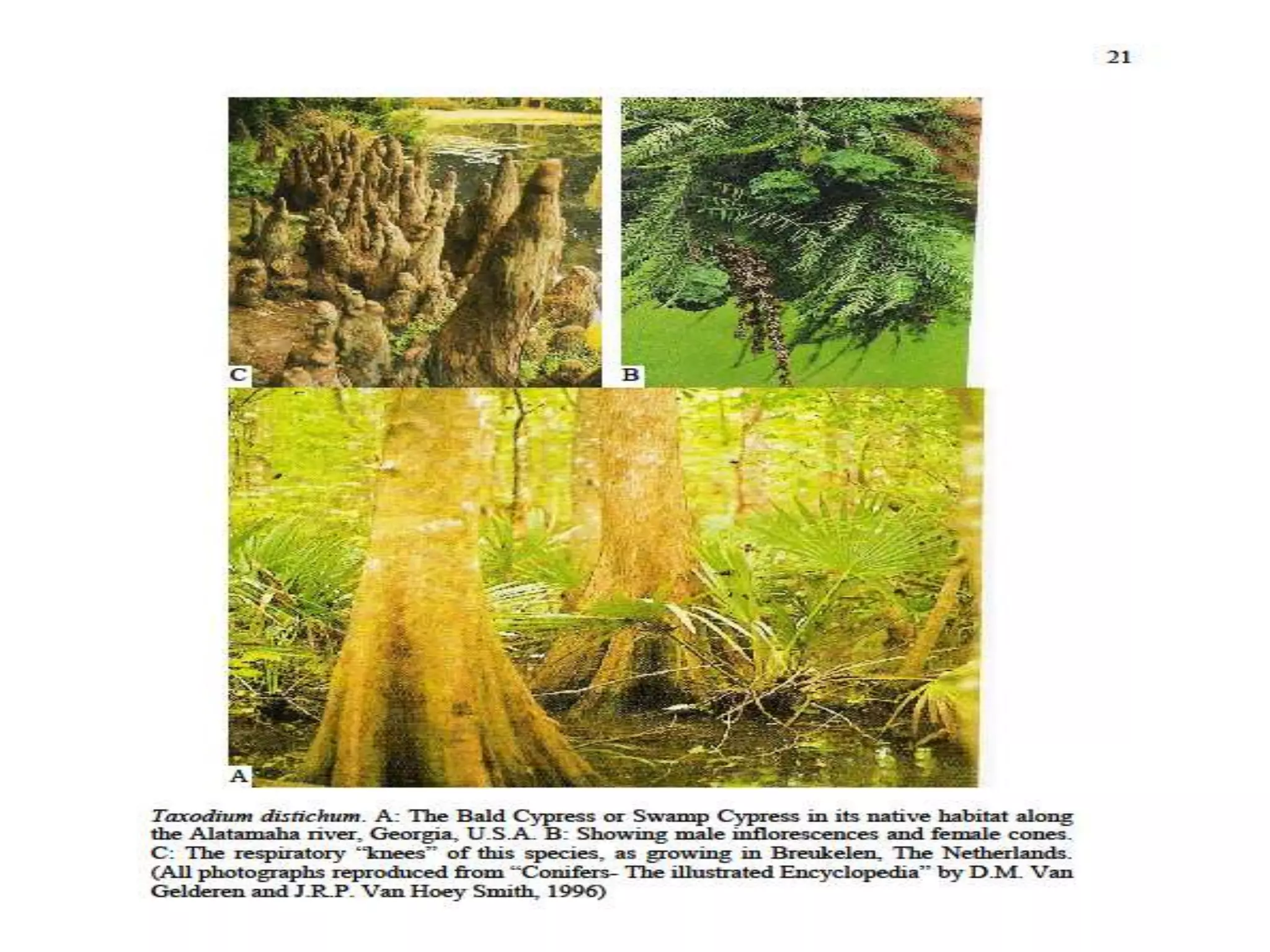
Taxodiaceae
• Comparises evergreenor deciduous trees and plant
parts are mostly spirally arranged.
• Both male and female cones are arranged on same
plants.
• Contain ovuliferous scales with 2 to 9 ovules on each.
• Pollen grains are wingless and lack prothalial cells.
• Seeds may be winged or wingless or irregular in shape.
• Consist of…. Taxodium, Sequoia,
Sequoiadendron, Taiwania, Cunninghamia
etc.
28.
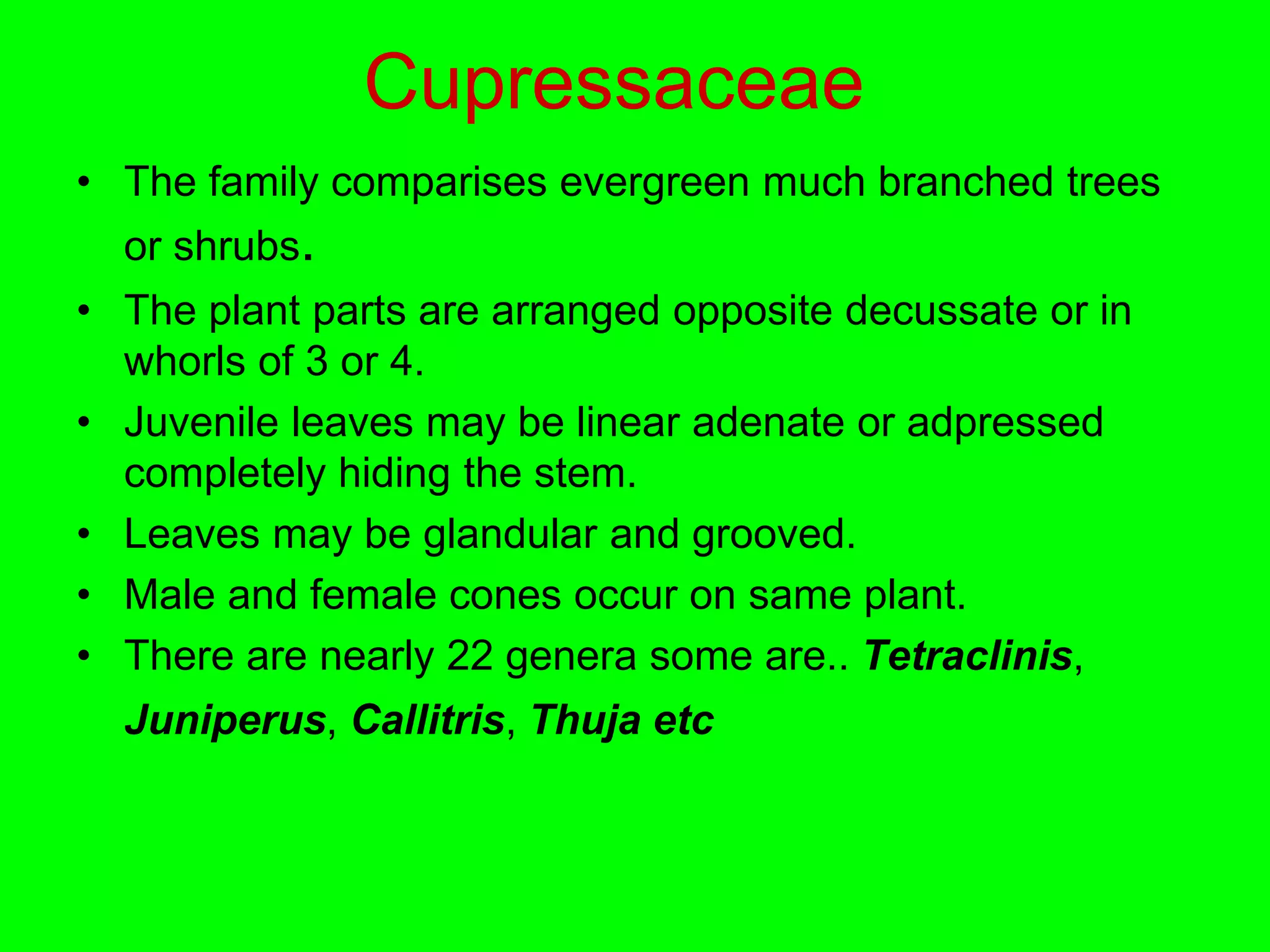
Cupressaceae
• The familycomparises evergreen much branched trees
or shrubs.
• The plant parts are arranged opposite decussate or in
whorls of 3 or 4.
• Juvenile leaves may be linear adenate or adpressed
completely hiding the stem.
• Leaves may be glandular and grooved.
• Male and female cones occur on same plant.
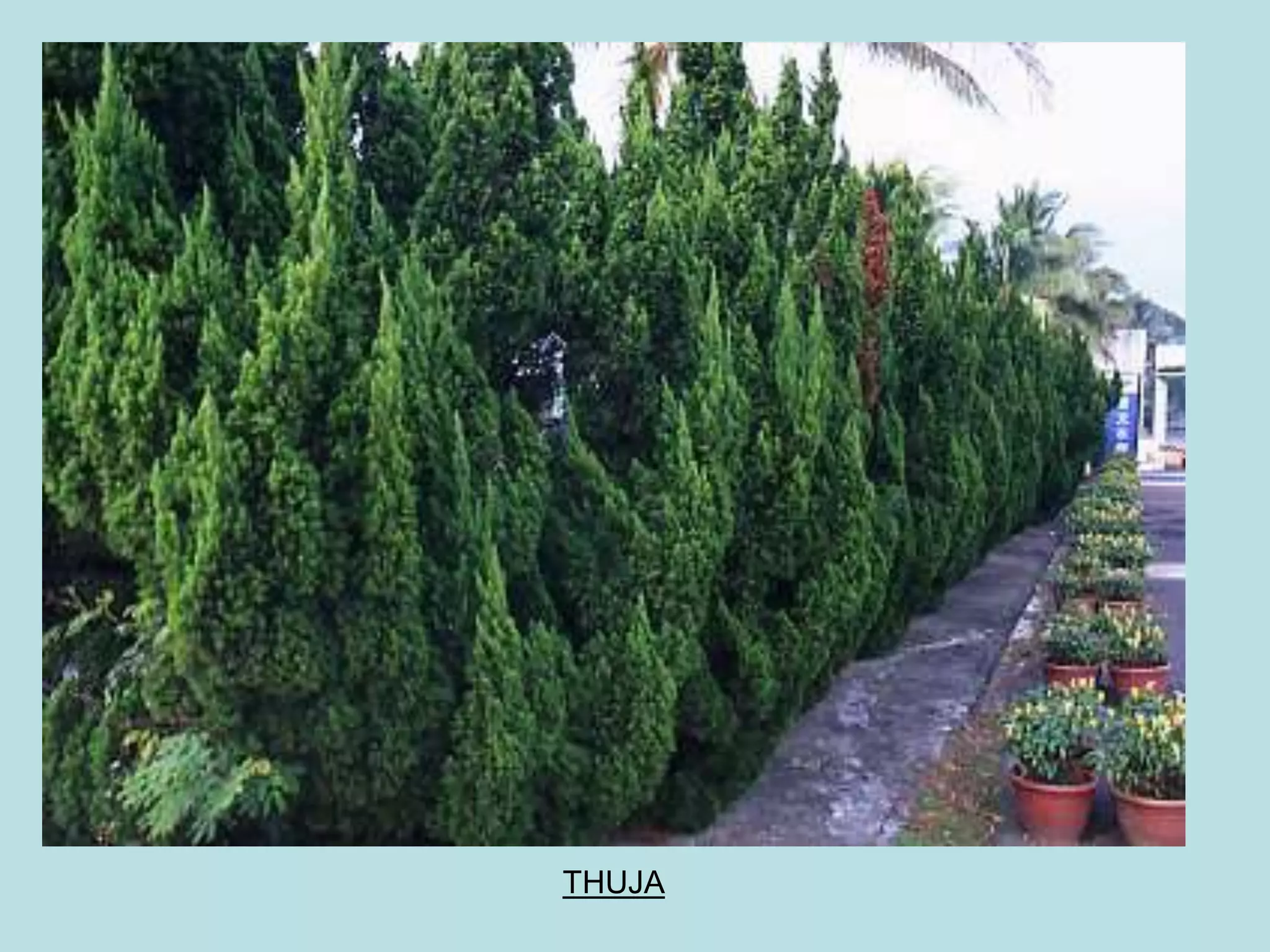
• There are nearly 22 genera some are.. Tetraclinis,
Juniperus, Callitris, Thuja etc
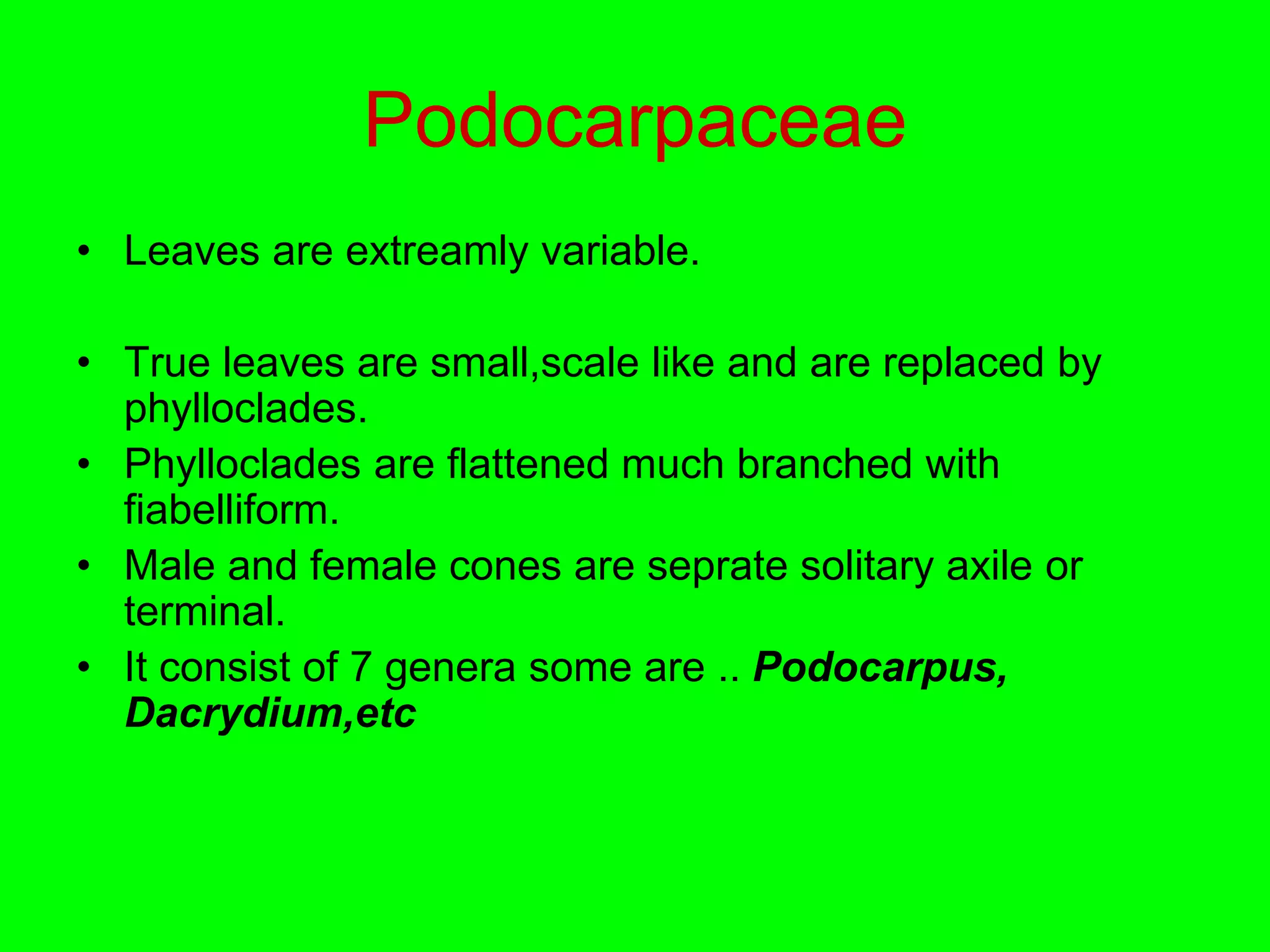
Podocarpaceae
• Leaves areextreamly variable.
• True leaves are small,scale like and are replaced by
phylloclades.
• Phylloclades are flattened much branched with
fiabelliform.
• Male and female cones are seprate solitary axile or
terminal.
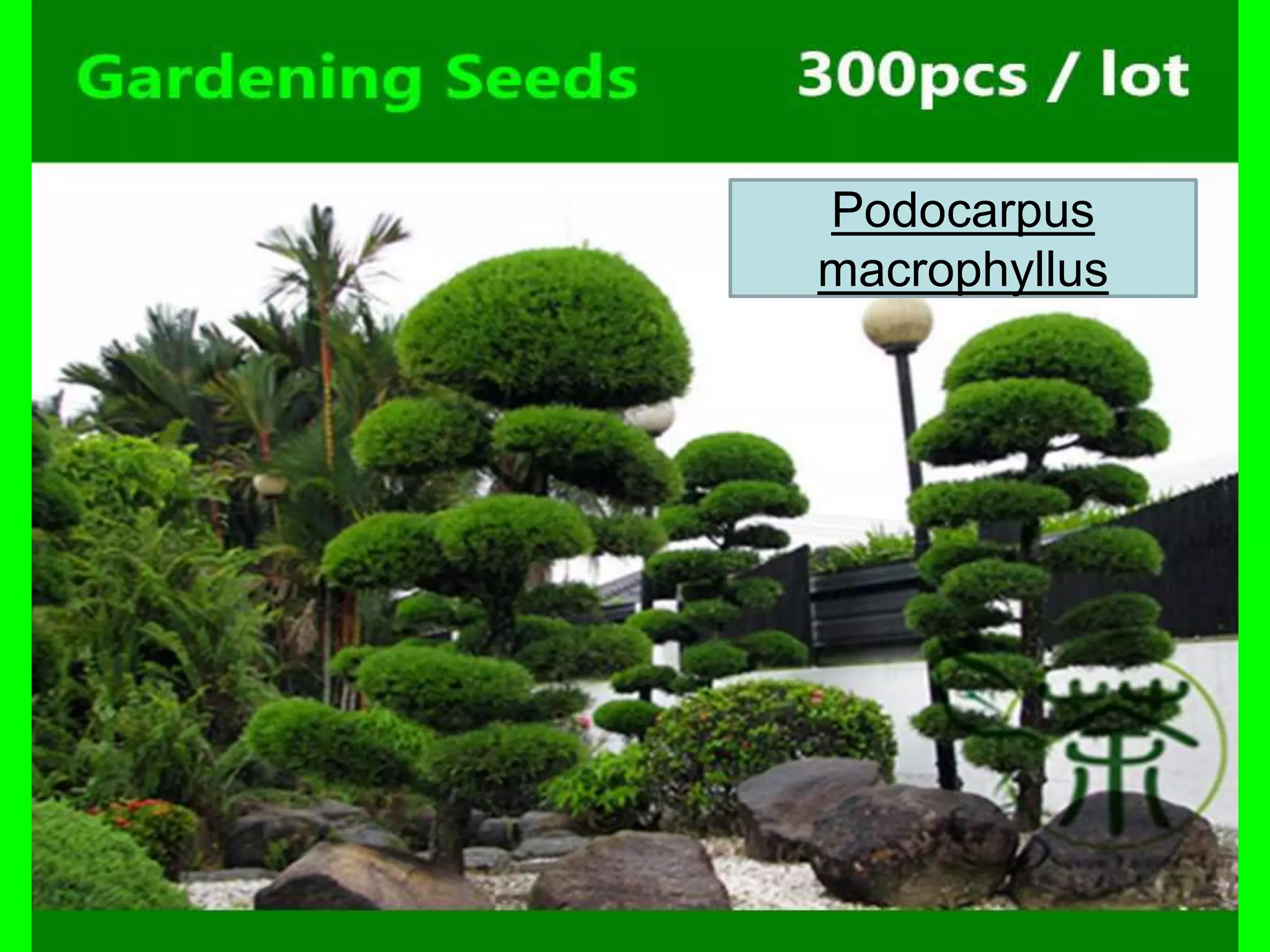
• It consist of 7 genera some are .. Podocarpus,
Dacrydium,etc
Araucariaceae
• Evergreen andhighly resinous trees.
• Leaves are small,stiff,awl-like or large and
leatherhy.
• Plant may be monoecious or dioecious.
• Pollen grain are wingless with multiple
persistant prothalial cells.
• It consist of 2 genera …Araucaria,
Agathis .
33.
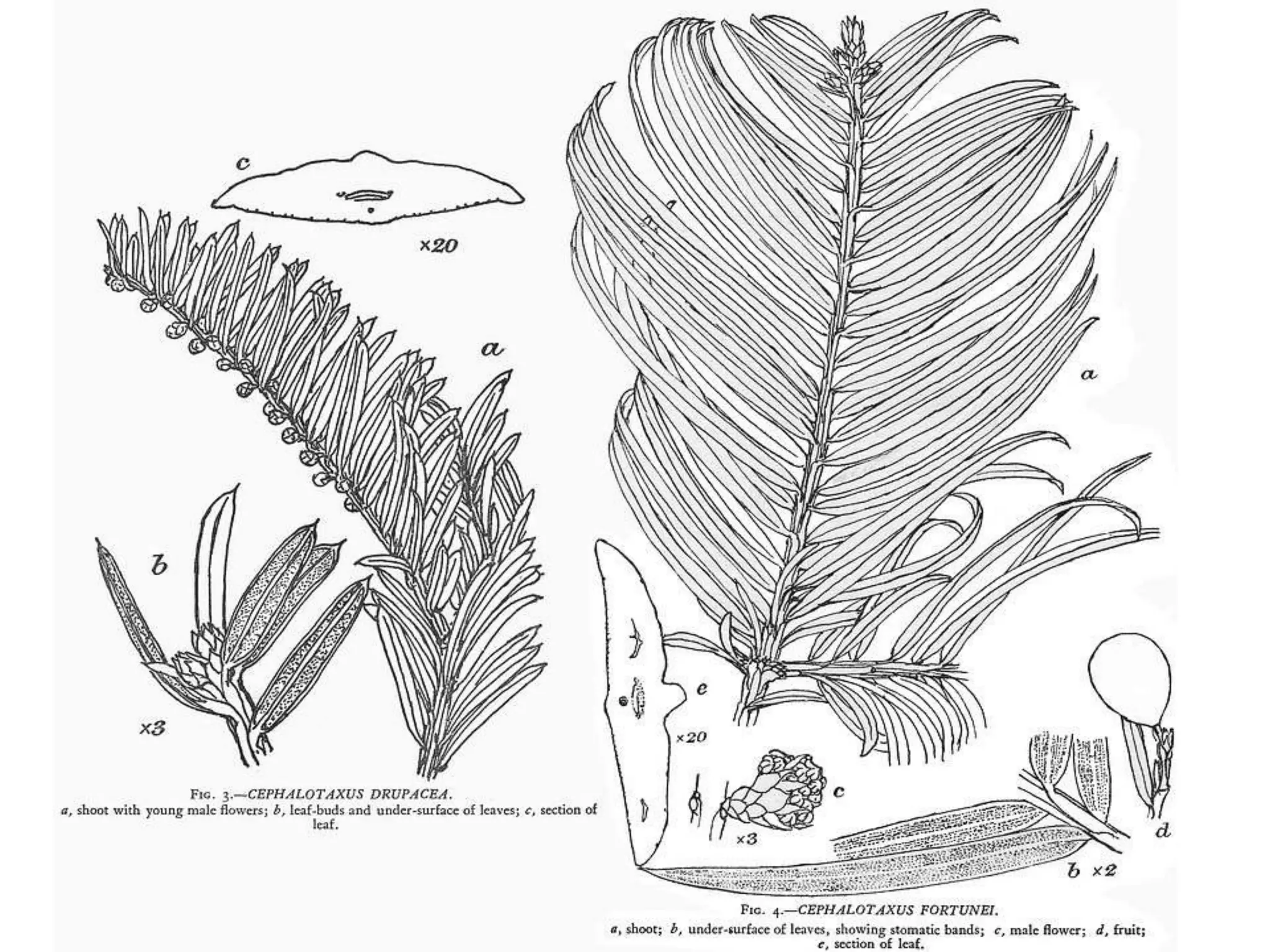
Cephalotaxaceae
• Cephalotaxaceae isa monogenic family with only one
genera Cephalotaxus.
• Named such due to shape of male cone from the greek
word “kephale” means head.
• Male cones are present in globose heads.
• Shrubs or small yew like dioecious plants.
• Male trees posses unbranched shoot.
• Leaves are more or less same size
,falcate,subacute,base round,and whitish beneath.
35.
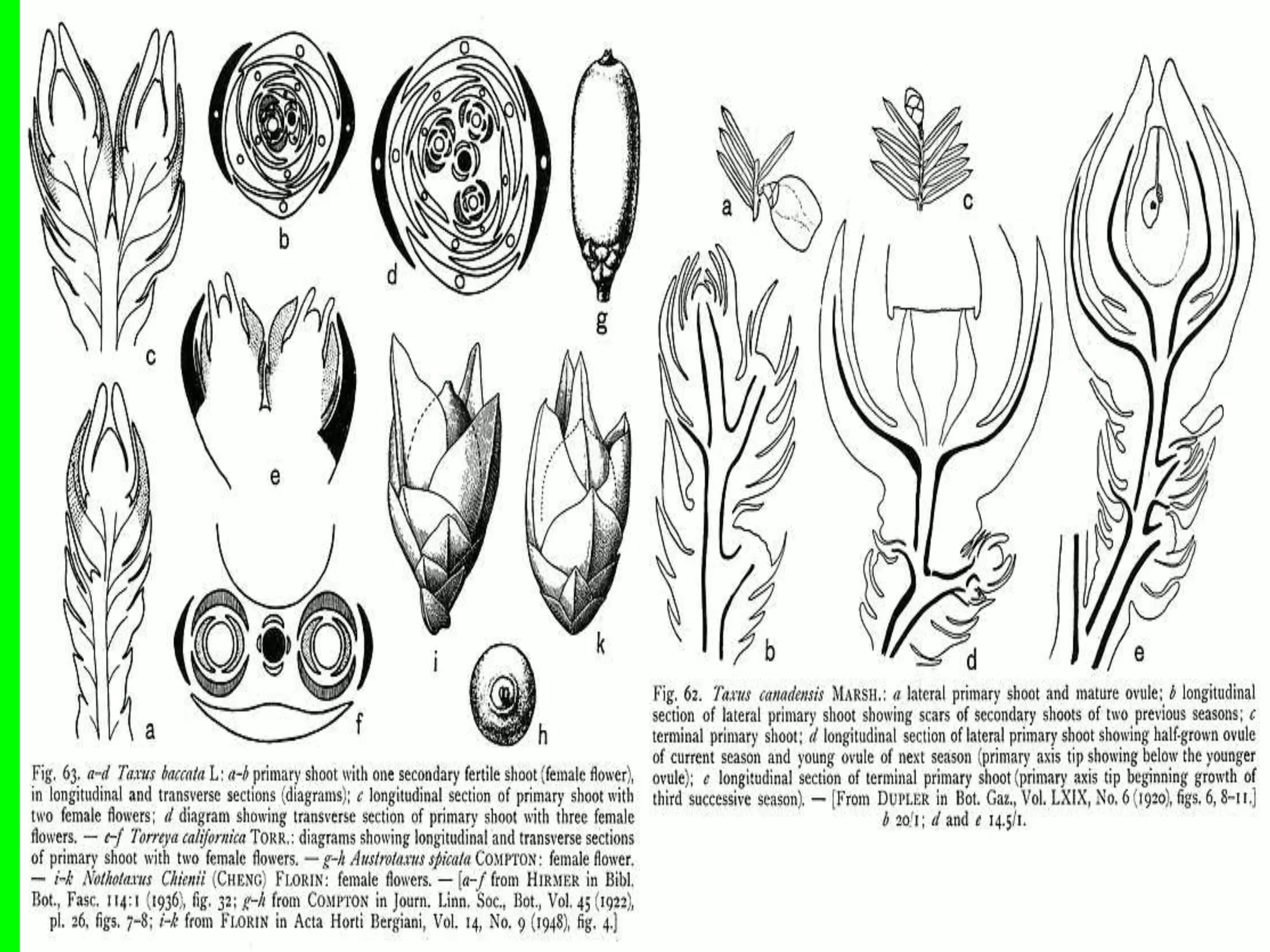
Taxaceae
• These aremuch branched evergreen woody shrub or
small,rarely large trees.
• The leaves are simple,linear and small and sre spirally
arranged.
• The wood is pycnoxylic.
• Plant is dioecious with male strobilus consist of a cone
axis.
• The family is represented by 5 living genera….
Amentotaxus,
Torreya,Taxus,Psedotaxus,Austrotaxus.
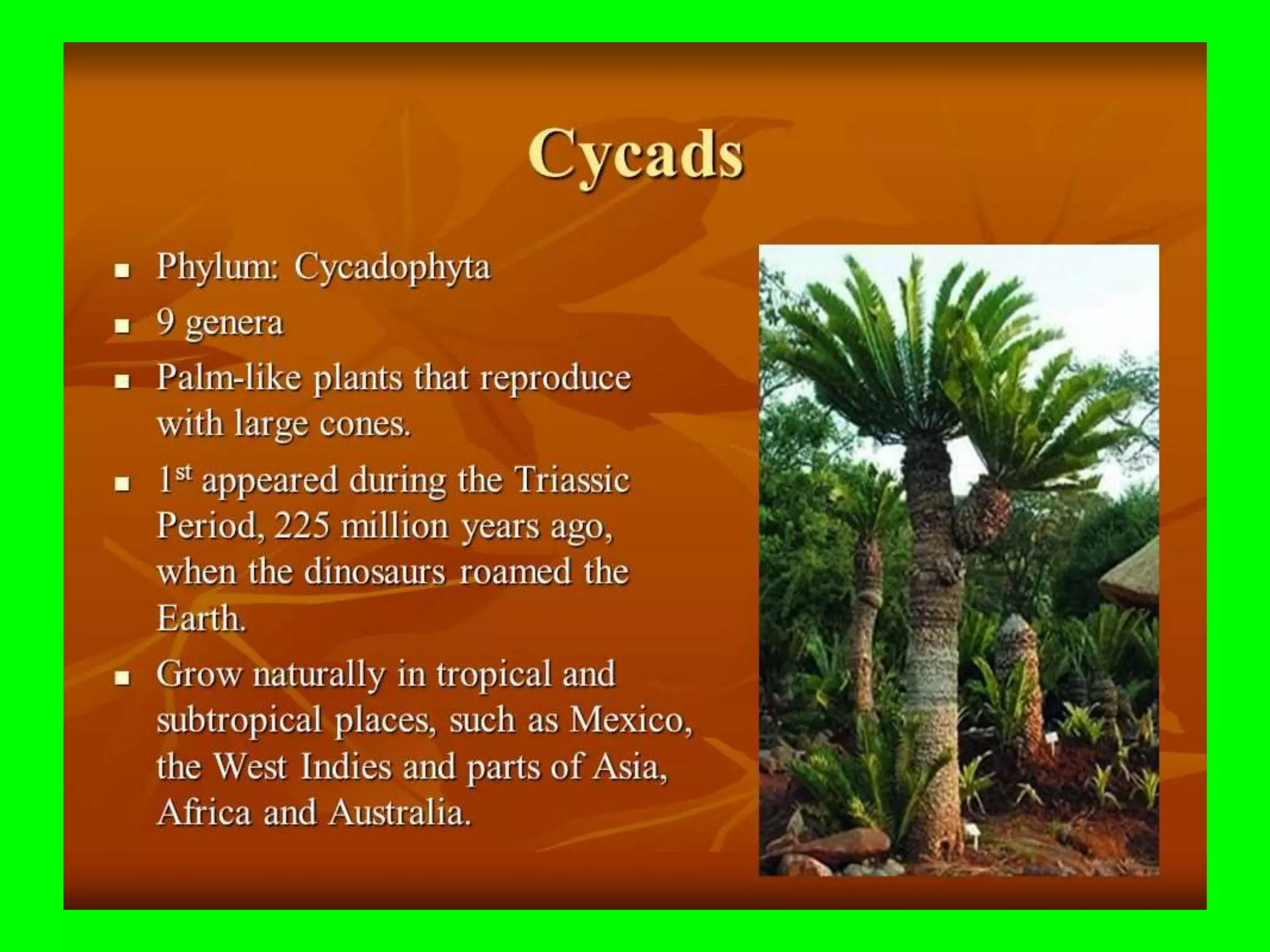
CYCADOPHYTA
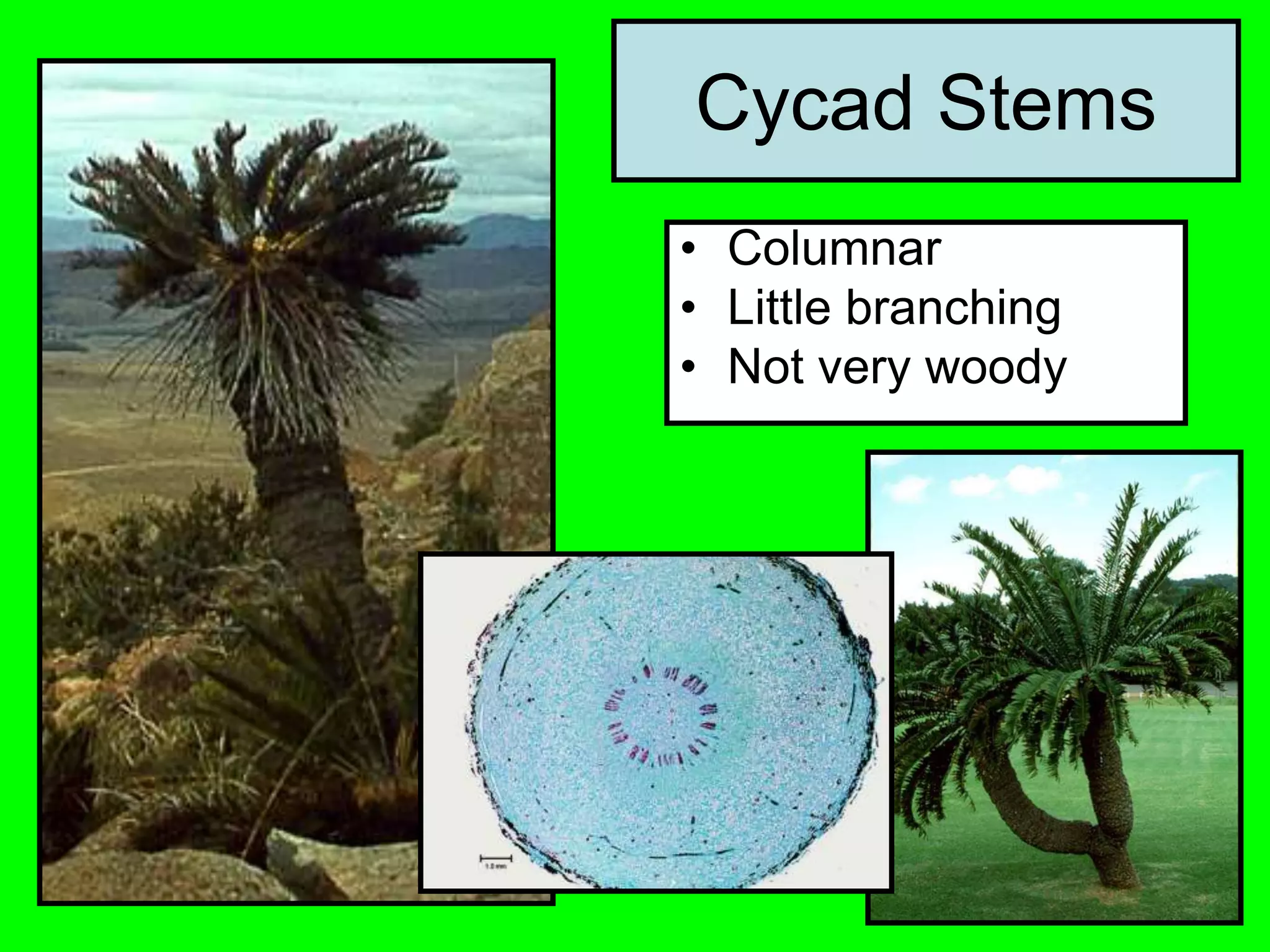
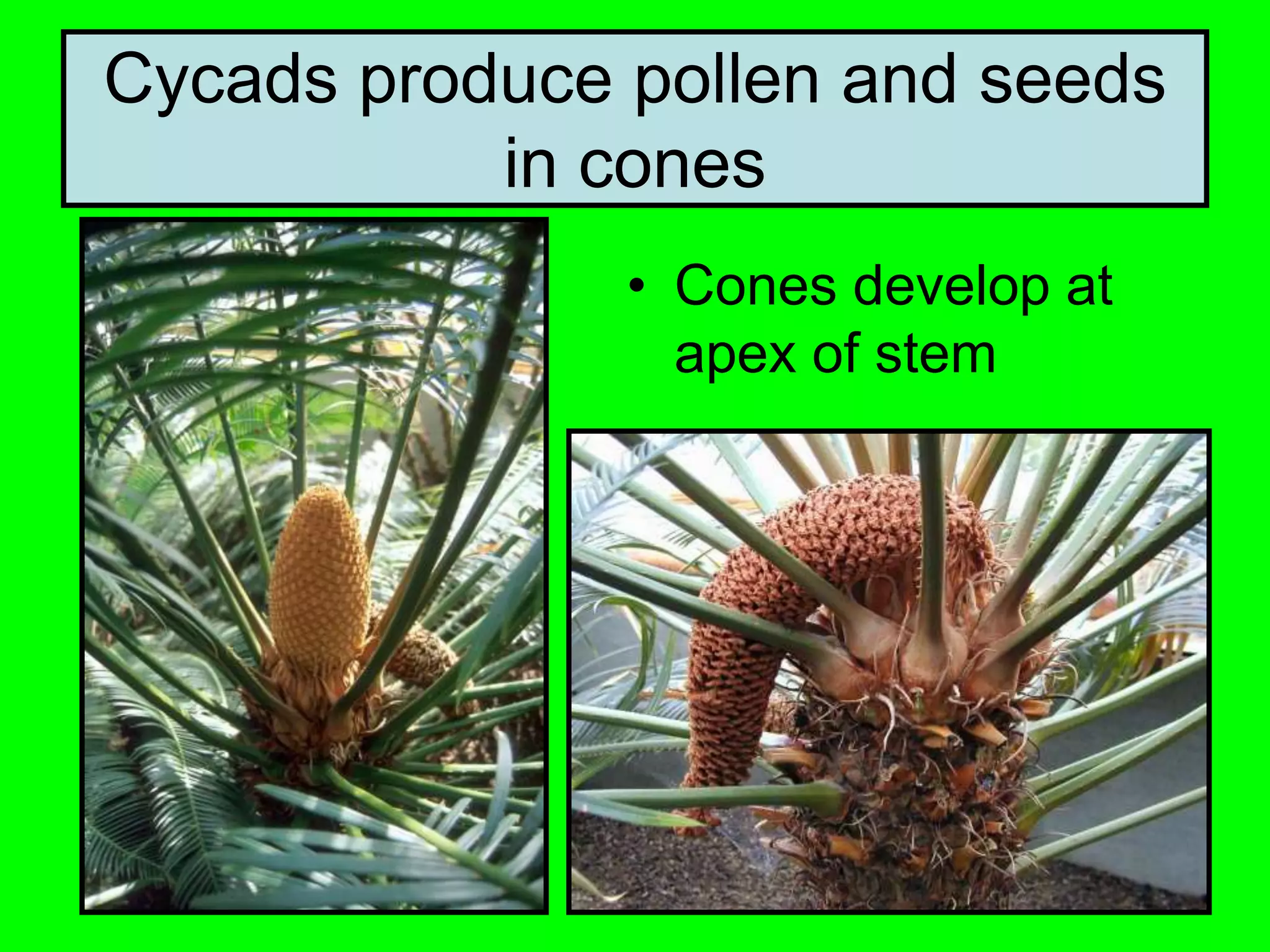
• Rarely branchedtrunks with soft pithy wood.
• Plants are dioceous in nature with compound leaves.
• Microsporangia (Male gametophyte) grows within the
ovule.
• Male gametes are multicilliated and motile.
• Motile sperm released after several months, sometimes
after the seed has fallen.
40.
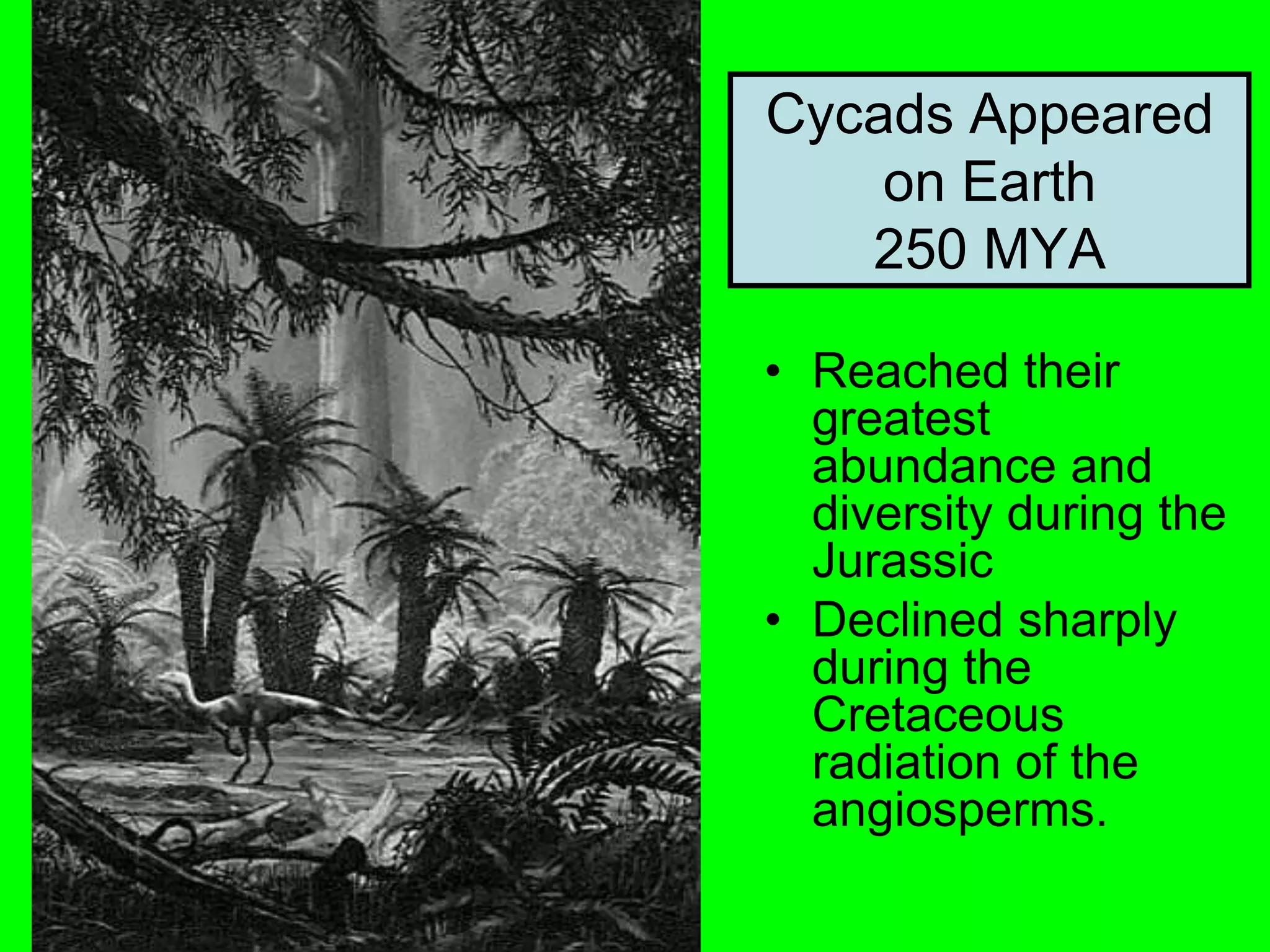
Cycads Appeared
on Earth
250MYA
• Reached their
greatest
abundance and
diversity during the
Jurassic
• Declined sharply
during the
Cretaceous
radiation of the
angiosperms.
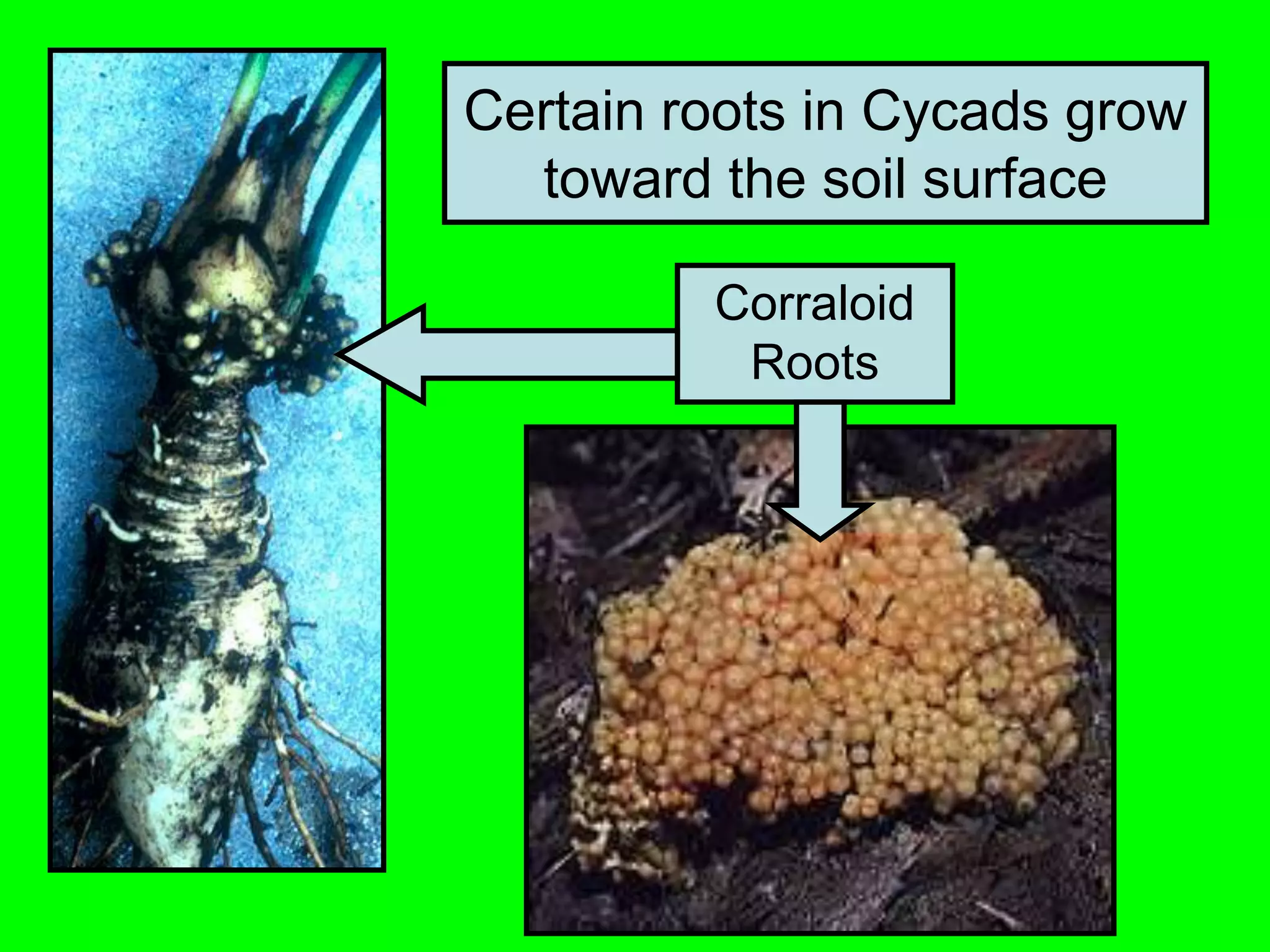
Certain roots inCycads grow
toward the soil surface
Corraloid
Roots
43.
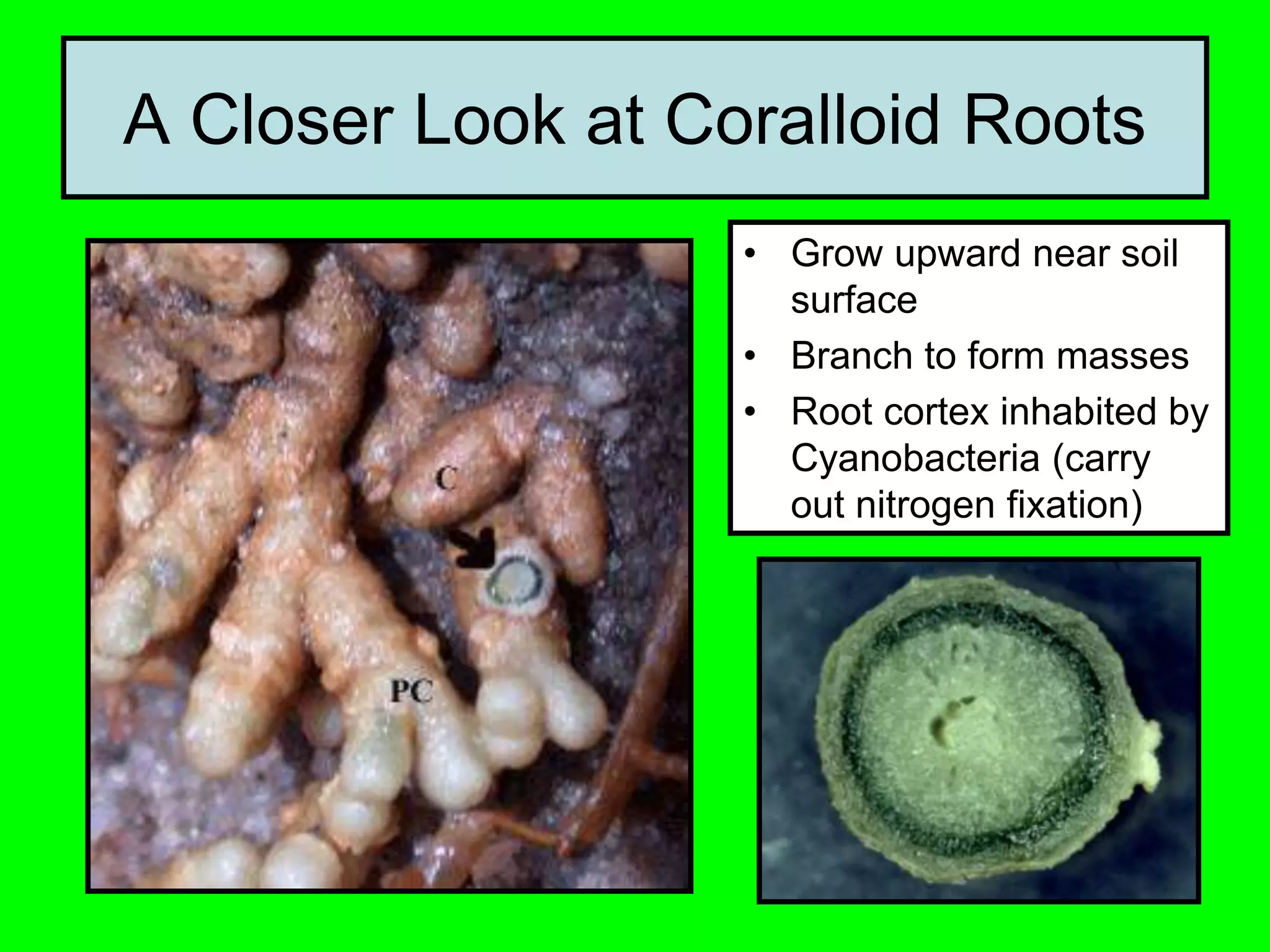
A Closer Lookat Coralloid Roots
• Grow upward near soil
surface
• Branch to form masses
• Root cortex inhabited by
Cyanobacteria (carry
out nitrogen fixation)
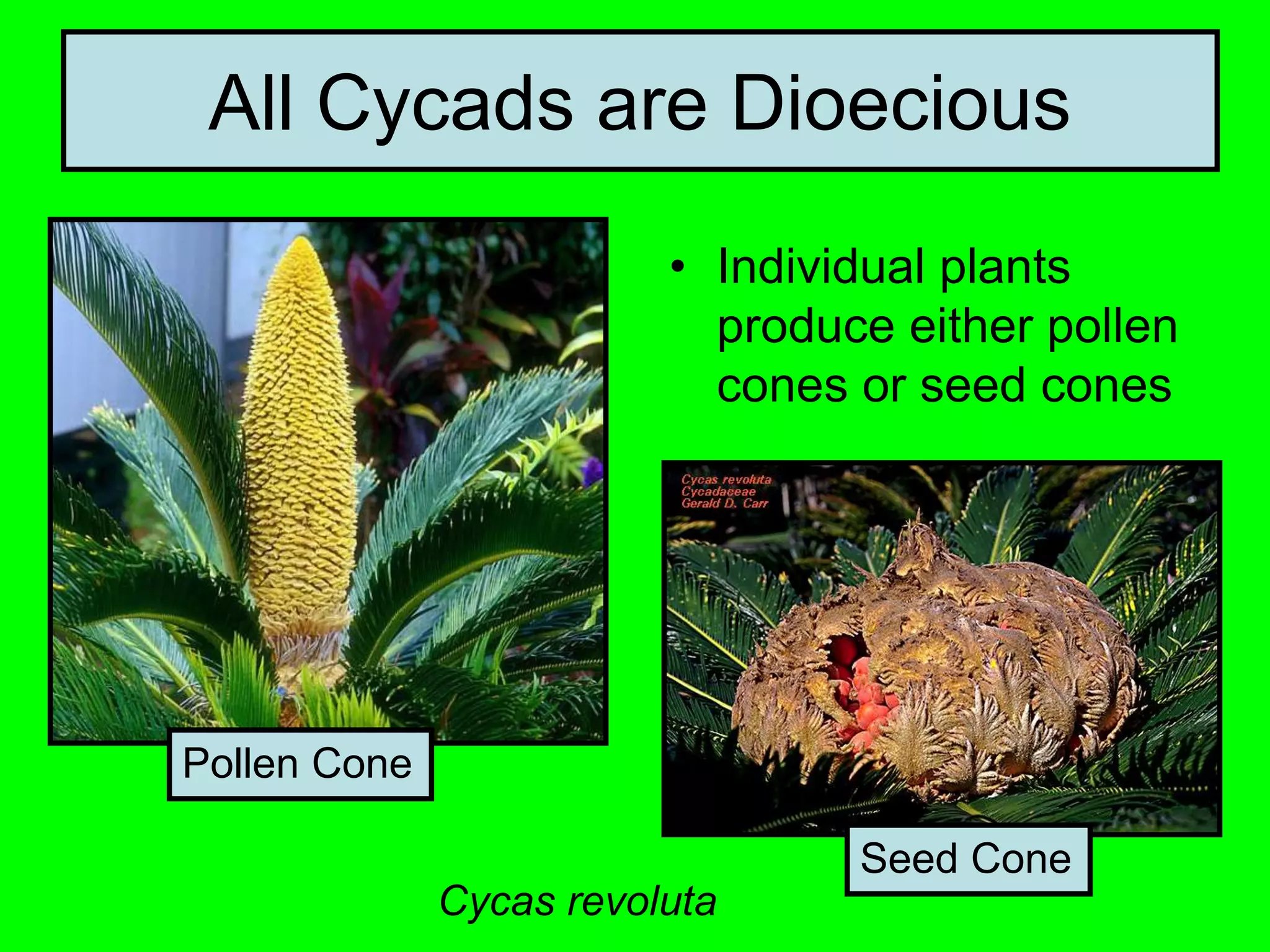
All Cycads areDioecious
• Individual plants
produce either pollen
cones or seed cones
Cycas revoluta
Pollen Cone
Seed Cone
47.
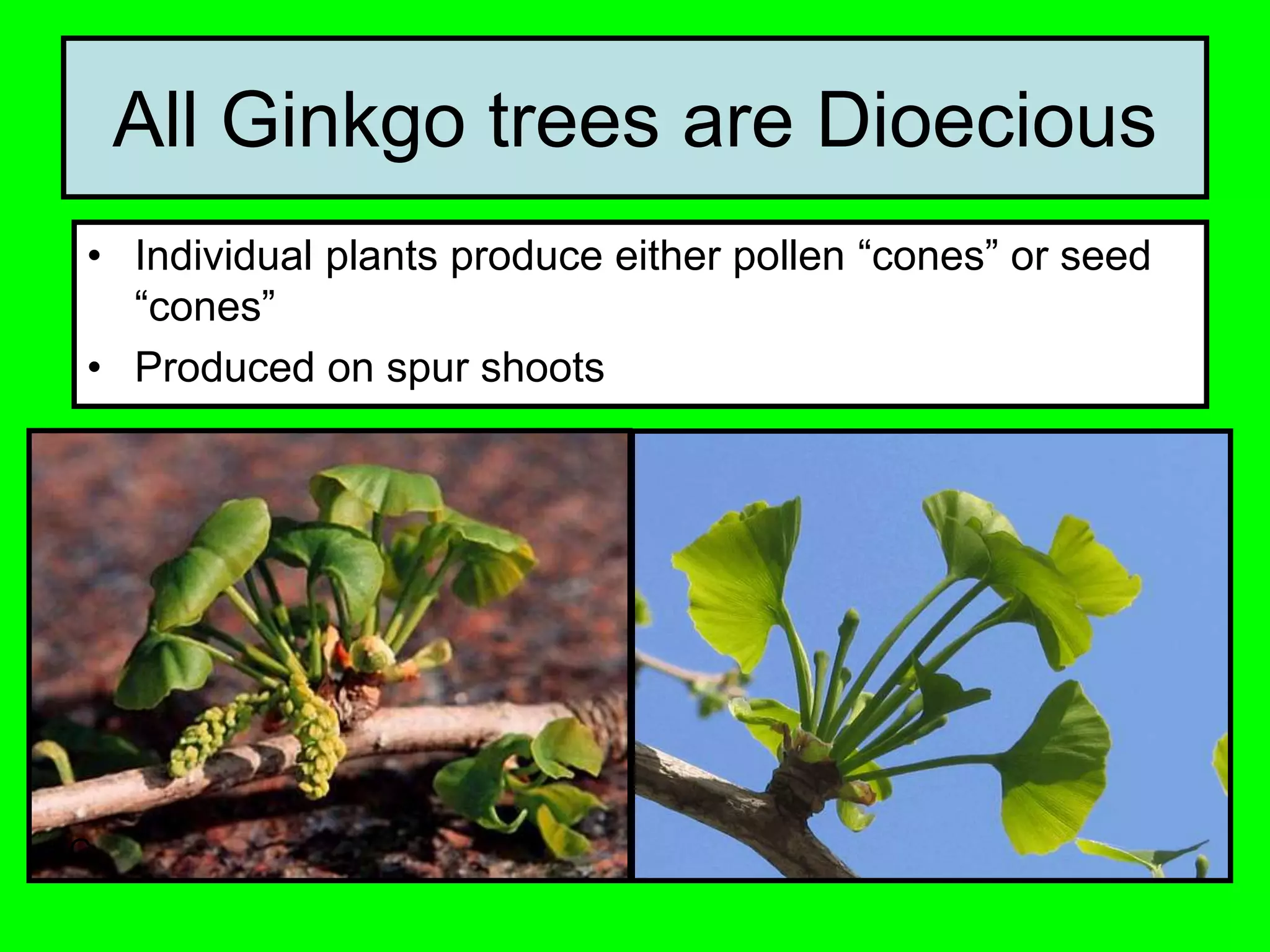
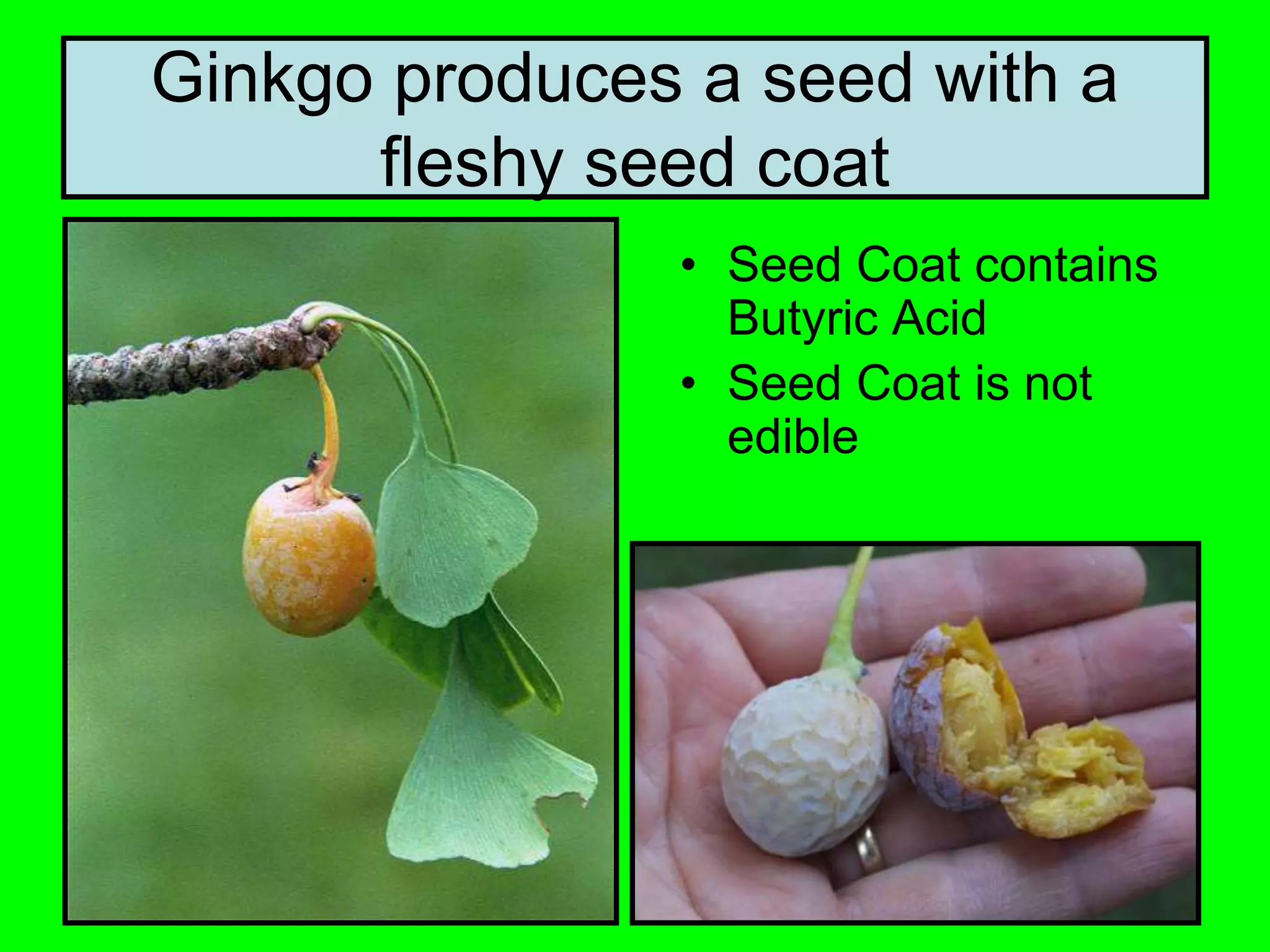
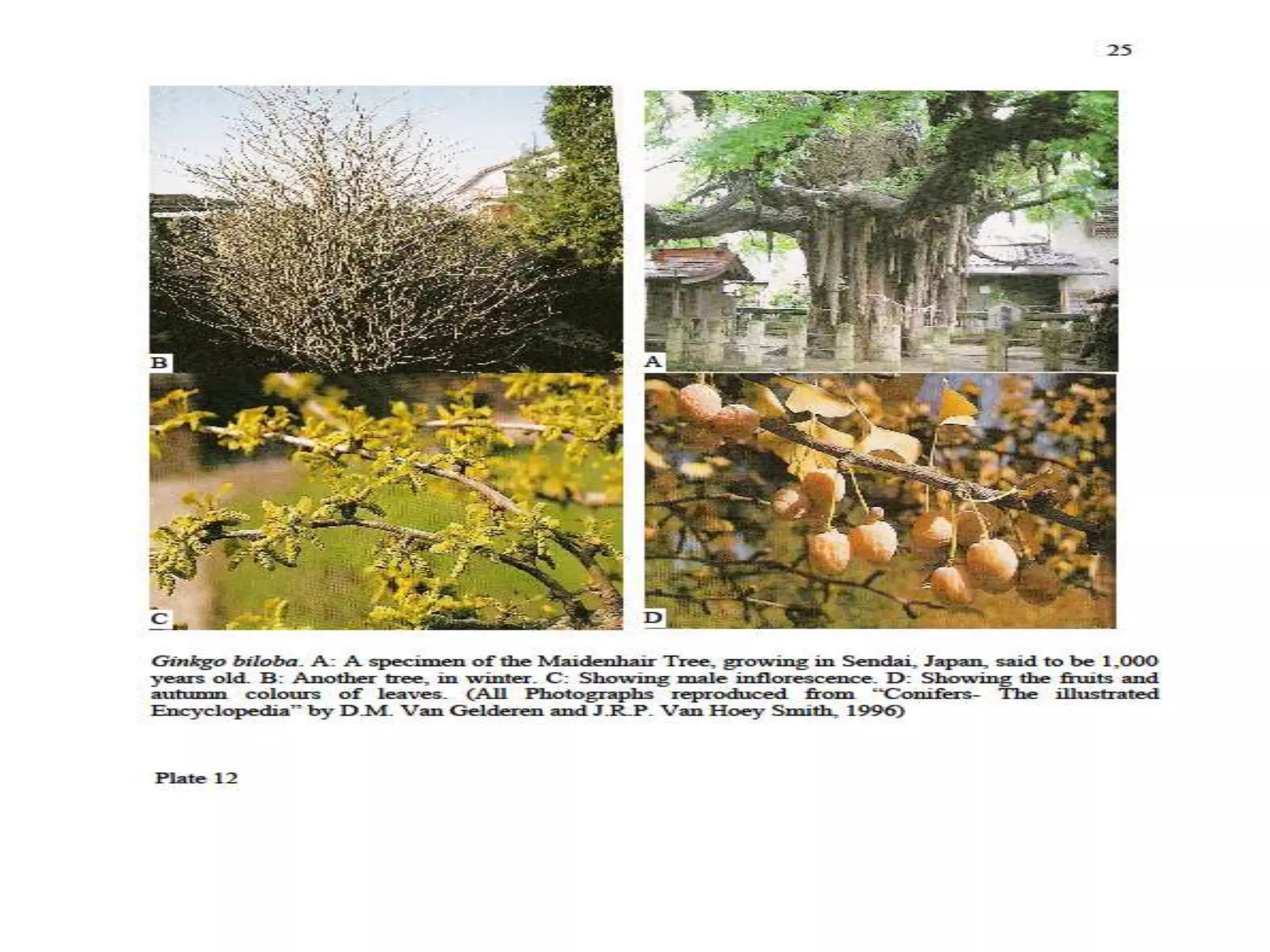
Ginkgophytes – Ginkgo
•Extensive fossil record but…only
1 living species: Ginkgo biloba!
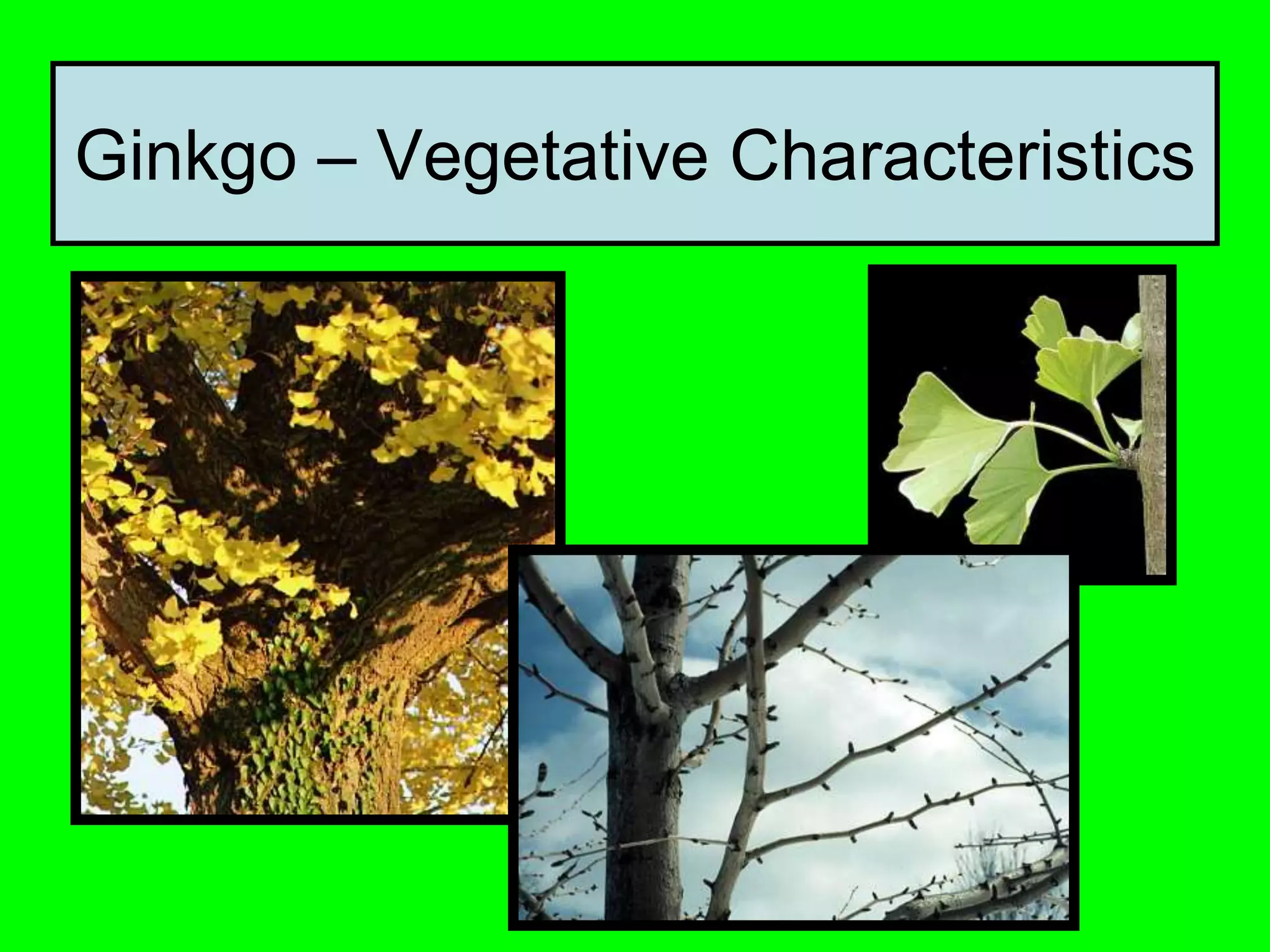
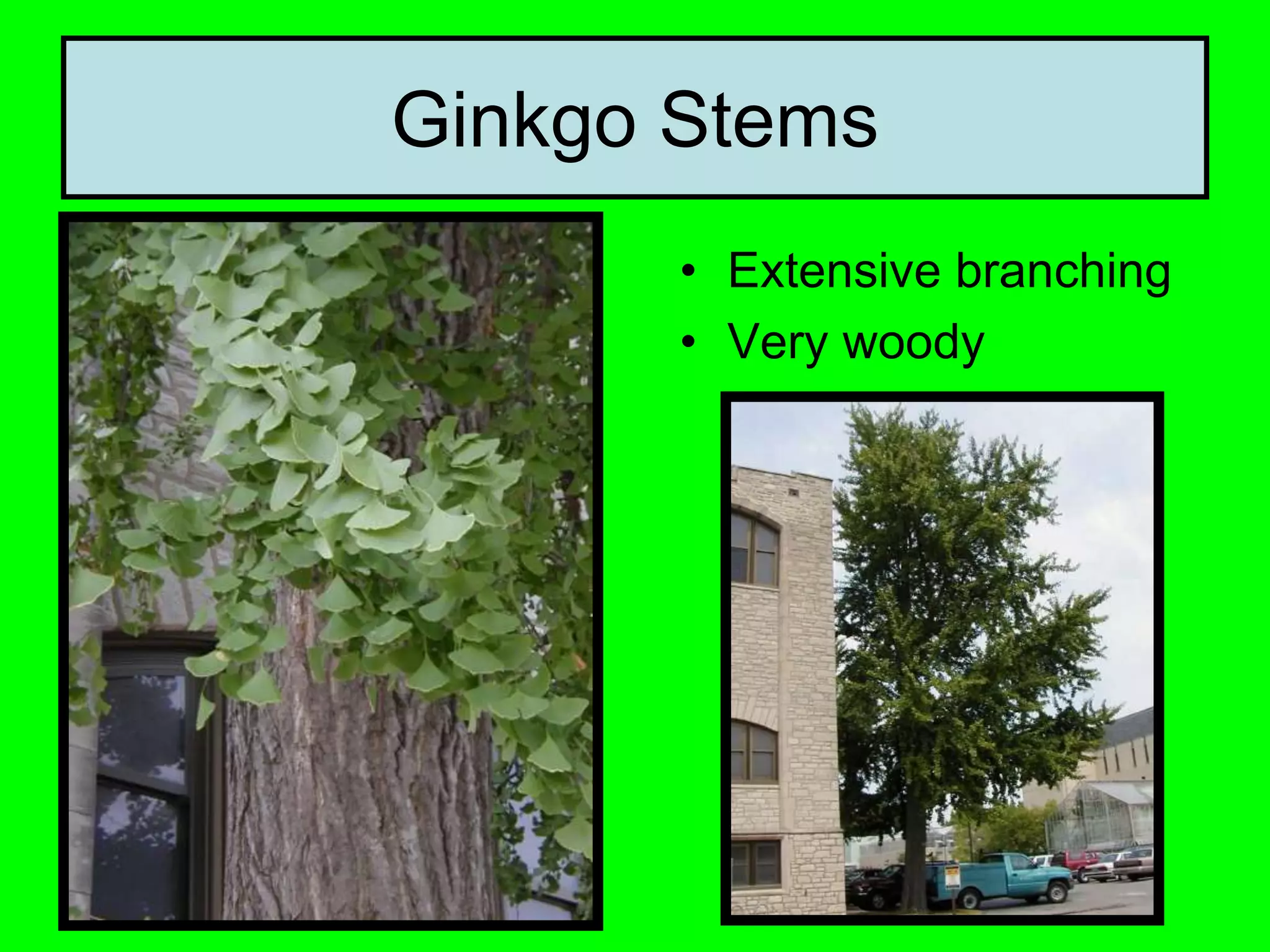
•Highly branched tree withwell developed wood.
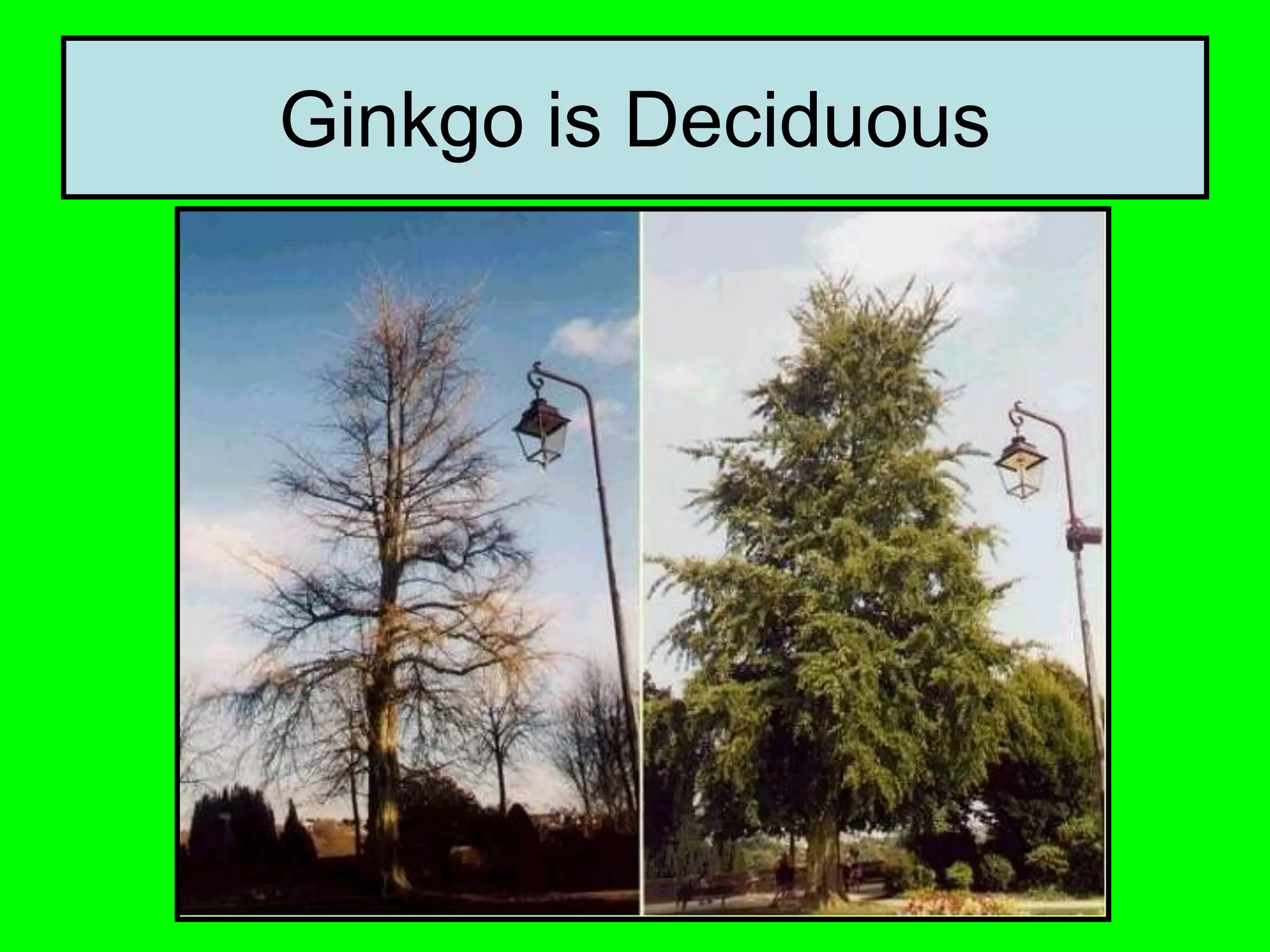
•Deciduous, fan-shaped leaves with dichotomous
venation.
•Dioecious: male and female trees
-male: “cone” with lateral stalks bearing
microsporangia
-female: no cone, axis with 2 ovules
(outer integument layer fleshy)
•motile sperm (ancestral