THE PLANT BODY
Meristems
 In flowering plants cells originate from
regions of active cell division known as
meristems.
 The cells arising from meristems give
rise to the many different cell types that
make up a plant
Types of Meristems
 Primary Meristems (also called Apical
Meristems) result in primary growth -
growth in length
 Secondary Meristems result in
secondary growth which in growth in
width (increase in diameter)
Apical meristems
 Also known as primary meristems
 Found at the tips of all roots and stems
 Contribute to the increase in length of
the plant which is called primary growth
 Give rise to the leaves, and non-woody
stems and roots
Secondary Meristems
 Some plants have additional meristems
that result in increases in diameter
which is secondary growth.
• Vascular cambium
• cork cambium
Multicellular Organisms
 In multicellular organisms, certain cells
are specialized in structure and function
 Tissues are specialized cells that
perform specific functions
 Plants composed of three basic tissues
categories
• Dermal
• Ground
• Vascular
Dermal Tissue
 Dermal tissues are the outermost layers
in a plant
 They protect the plant
 Two types of dermal tissues
• Epidermis
• Periderm
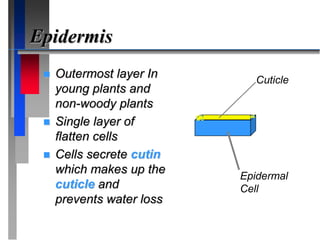
Epidermis
 Outermost layer In
young plants and
non-woody plants
 Single layer of
flatten cells
 Cells secrete cutin
which makes up the
cuticle and
prevents water loss
Epidermal
Cell
Cuticle
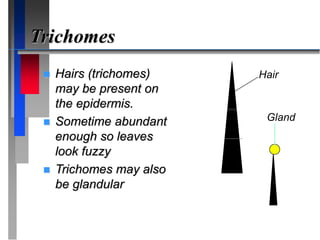
Trichomes
 Hairs (trichomes)
may be present on
the epidermis.
 Sometime abundant
enough so leaves
look fuzzy
 Trichomes may also
be glandular
Hair
Gland
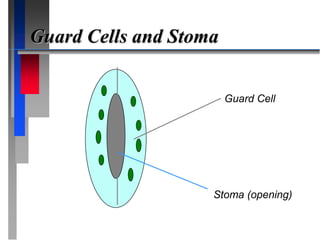
Guard Cells and Stomata
 Pores known as stomata (singular
stoma) occur on epidermis
 Gases exchange occurs through
stomata
 A pair of sausage-shaped cells, guard
cells, regulate the opening and closing
of the stomata
Guard Cells and Stoma
Guard Cell
Stoma (opening)
Periderm
 In woody plants when the tree increases
in diameter, the epidermis cracks and is
replaced by periderm
 The periderm consists:
• Cork cells
• Cork cambium
Cork Cells
 Outer bark on mature trees
 Dead cells with walls containing
suberin, a waterproofing fatty
substance.
 Prevents water loss from underlying
tissues
 Produced by cork cambium
Ground tissues
 Major tissue of non-woody plant organs
 Perform a variety of functions
 The three types of ground tissue:
• Parenchyma
• Collenchyma
• Sclerenchyma
Parenchyma
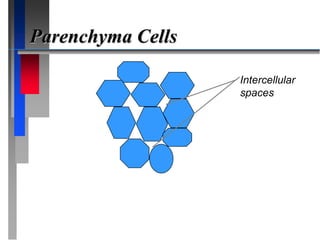
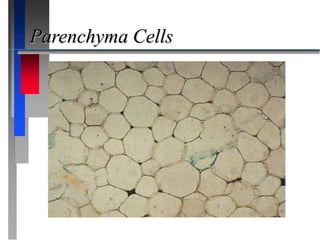
 Almost any shape or size
 Loosely arranged with intercellular
spaces
 Many different functions:
• Photosynthetic cells in leaves and green
stems
• Storage cells in plant organs for starch,
sugar, or water
Parenchyma Cells
Intercellular
spaces
Parenchyma Cells
Collenchyma
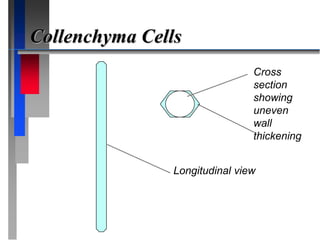
 Support tissue in young plant organs
 Found in stems, leaves, and petals
 Elongated cells with unevenly thickened
primary cell walls with the walls thickest
at the corners
 Found tightly packed together just
below the epidermis
Collenchyma Cells
Longitudinal view
Cross
section
showing
uneven
wall
thickening
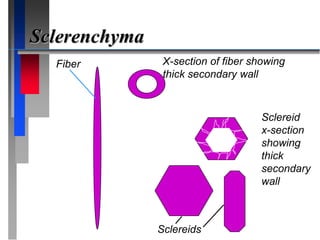
Sclerenchyma
 Two cell types
• fibers
• sclereids.
 Non-living at maturity
 Thickened secondary walls
Fibers
 Elongate cells
 Function in support
 Leaf and stem fibers from many plants
used for cloth and rope.
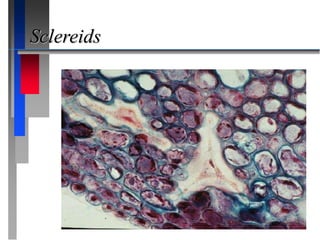
Sclereids
 Various shapes
 Functions
• mechanical support and
• protection
 Account for the hardness in nut shells
and the grit of pear fruit
Sclerenchyma
X-section of fiber showing
thick secondary wall
Fiber
Sclereid
x-section
showing
thick
secondary
wall
Sclereids
Sclereids
Vascular tissues
 Xylem - conducts water and minerals
from the roots upward
 Phloem - transports organic materials
(sugars) synthesized by the plant
Xylem
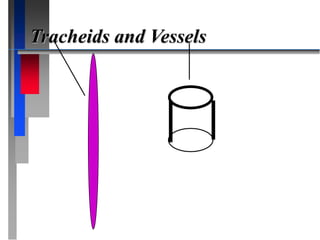
 Cells conducting water - non-living
• Tracheids - long thin cells with tapering
walls and numerous pits
• Vessel elements - short, wide, with
horizontal end walls with large openings
• Both cells have secondary walls
 Fibers - non-living - provide support
 Parenchyma cells - metabolic activity
Tracheids and Vessels
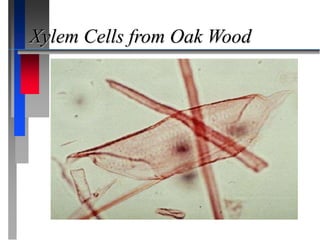
Xylem Cells from Oak Wood
Primary and Secondary Xylem
 Primary xylem develops from the
apical meristem
 Secondary xylem develops from the
vascular cambium.
 In trees secondary xylem is very
extensive
Phloem
 Cell Types in phloem
• Sieve Tube Members - transport sugars
• Companion Cells - loading and unloading
• Fibers - support
• Parenchyma - metabolic activity
 Primary and Secondary phloem
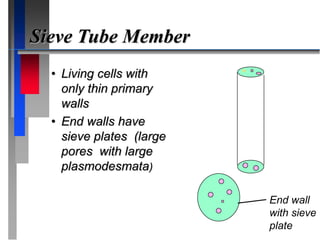
Sieve Tube Member
• Living cells with
only thin primary
walls
• End walls have
sieve plates (large
pores with large
plasmodesmata)
End wall
with sieve
plate
Companion cells
• Specialized parenchyma cell
develops alongside a sieve tube
member
• Plasmodesmata connect it to sieve
tube member
• Loading and unloading sugars for
transport
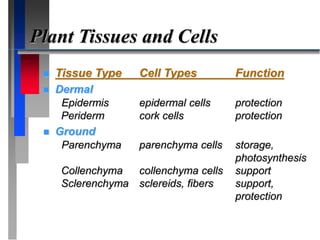
Plant Tissues and Cells
 Tissue Type Cell Types Function
 Dermal
Epidermis epidermal cells protection
Periderm cork cells protection
 Ground
Parenchyma parenchyma cells storage,
photosynthesis
Collenchyma collenchyma cells support
Sclerenchyma sclereids, fibers support,
protection
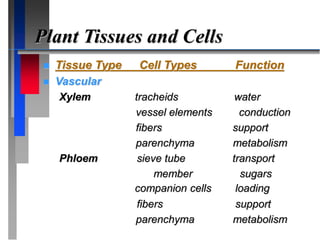
Plant Tissues and Cells
 Tissue Type Cell Types Function
 Vascular
Xylem tracheids water
vessel elements conduction
fibers support
parenchyma metabolism
Phloem sieve tube transport
member sugars
companion cells loading
fibers support
parenchyma metabolism
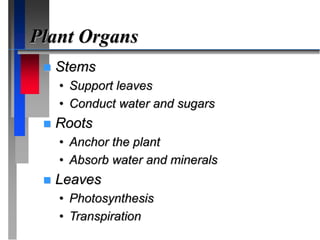
Plant Organs
 Stems
• Support leaves
• Conduct water and sugars
 Roots
• Anchor the plant
• Absorb water and minerals
 Leaves
• Photosynthesis
• Transpiration
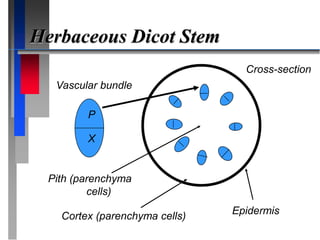
Herbaceous Dicot Stem
X
P
Epidermis
Cortex (parenchyma cells)
Pith (parenchyma
cells)
Vascular bundle
Cross-section
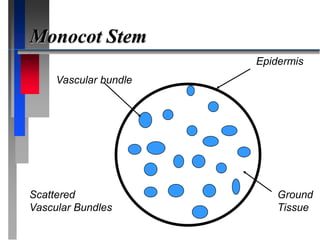
Monocot Stem
Epidermis
Ground
Tissue
Vascular bundle
Scattered
Vascular Bundles
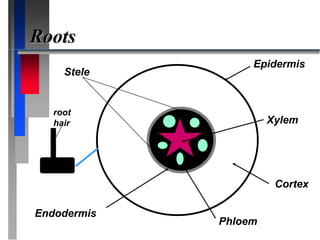
Roots
Stele
Epidermis
Xylem
Cortex
Phloem
Endodermis
root
hair
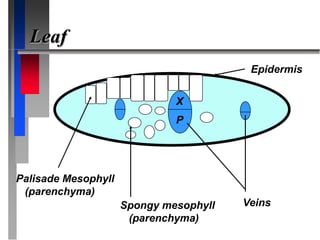
Leaf
X
P
Epidermis
Veins
Spongy mesophyll
(parenchyma)
Palisade Mesophyll
(parenchyma)
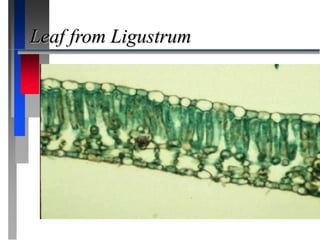
Leaf from Ligustrum
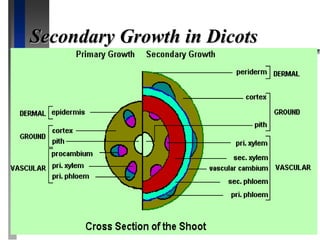
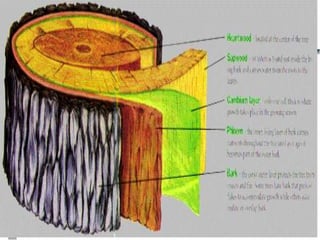
Secondary Growth in Dicots
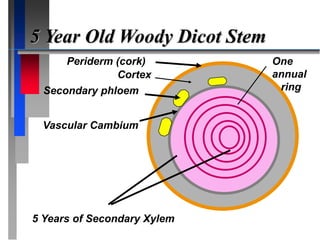
5 Year Old Woody Dicot Stem
One
annual
ring
Periderm (cork)
Cortex
Secondary phloem
Vascular Cambium
5 Years of Secondary Xylem
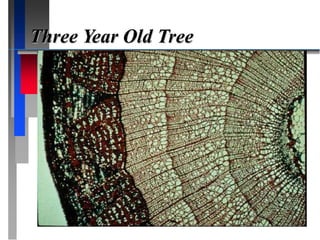
Three Year Old Tree
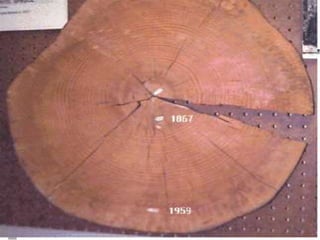
Dendrochronology
 Study of tree rings has added many
fields of study
 Can tell us about past climates
 Can be used to date from archeological
sites artifacts
 Tree ring research lab at the University
of Arizona http://www.ltrr.arizona.edu/
Summary
 Growth, replacement of cells, and
asexual reproduction all depend on cell
division
 Tissues are groups of cells that perform
a common function
 Stems, roots and leaves are made up of
three basic tissue types: dermal,
ground, and vascular