Permanenttissue
Presented by :-
GANAPATI PRADHAN
+3 2nd year
INTRODUCTION :-
Tissue:- A group of cells having a
common origin performing more or less
a common or similar function.
Type of Tissue :-
(a) Meristematic tissue.
(b) Permanent tissue.
Permanent tissue :-
Meristematic tissue divide and
differentiated to form permanent
tissue.
These are the matured meristematic
tissue.
They lost the ability to divide, may be
permanent or temporarily.
Types of permanent tissue:-
(a) Simple tissue.
(b) Complex tissue .
(c) Secretory/special tissue.
(a) Simple permanent tissue :-
These are made up of only one type of
cells i.e. all the cells are structurally as
well as functionally similar.
Generally it is divided into :
(a) Parenchyma
(b) Collenchyma
(c) Sclerenchyma
(a) Parenchyma:-
 All the cells are living in nature.
 They are more or less isodiametric in nature.
 The cells are thin walled, vacuolated.
 Abundant intercellular space are found depending in
their location.
 They are present in the cortex ,pith, ground tissues of
petioles, endosperm of seeds .
 Parenchymatous tissue forms association with
vascular tissue and known as vascular parenchyma.
 Cell wall is composed of cellulose & pectin i.e.
pectocellulosic in nature.
Type of Parenchyma:-
Chlorenchyma :- Any parenchymatous cells rich with
chlroplasts are called chlorenchyma.
 It is found in leave.
 It’s main function is photosynthesis.
Spongy tissue:- Spongy parenchyma are found
below the palisade cells.
->They are loosely arranged isodiametric cells with
lots of intercellular space.
-> They are contains lesser number of chloroplast
than palisade parenchyma.
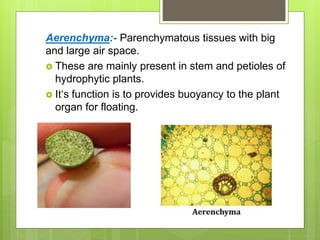
Aerenchyma:- Parenchymatous tissues with big
and large air space.
 These are mainly present in stem and petioles of
hydrophytic plants.
 It‘s function is to provides buoyancy to the plant
organ for floating.
Function of Parenchyma tissue
 Photosynthesis
 Parenchyma cells provide turgidity to
plants.
 Provide mechanical strength.
 Act as storage tissue.
 Helps in conduction in association with
vascular tissue.
 Serves as packing tissue.
(b)Collenchyma :-
 It is also a living simple tissue.
 Mainly found in peripheral regions of the stem &
beneath the epidermis i.e. hypodermis.
 If the stem has ridges, collenchyma tissue is
found below the ridges.
 The cell wall is unevenly thickened.
 It is not found in roots, due to thick wall.
 Based on the thickening pattern, collenchyma
tissue can be of 4 types –
(a) Angular collenchyma:- Collenchyma tissue having
wall thickening at the corners only.
-> Thickening due to the deposition of pectin &
hemicellulose along with cellulose.
(b) Lamellar collenchyma:- Collenchyma tissue having
wall thickening on their tangential walls.
(c) Annular collenchyma:- In this all the cell have
uniformly thickened cell walls.
(d) Lacunar collenchyma:- Only collenchymatous tissue
with intracellular spaces.
Function:- Mechanical in function.
- Gives supports to stems and pedicels.
- Provide rigidity & elasticity to the plant.
(C) Sclerenchyma :-
 These are dead tissue, due to loss of
cytoplasm at maturity.
 Have thick cell wall.
 Thickness is due to the formation of
secondary cell wall & deposition of lignin.
 Elongated cell with pits.
 Sclerenchyma cells divide into two types:
(a) Fibres
(b) Sclereids
(a) Fibres:
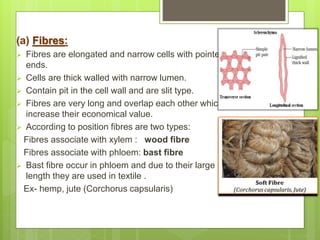
 Fibres are elongated and narrow cells with pointed
ends.
 Cells are thick walled with narrow lumen.
 Contain pit in the cell wall and are slit type.
 Fibres are very long and overlap each other which
increase their economical value.
 According to position fibres are two types:
Fibres associate with xylem : wood fibre
Fibres associate with phloem: bast fibre
 Bast fibre occur in phloem and due to their large
length they are used in textile .
Ex- hemp, jute (Corchorus capsularis)
(b) Sclereids :-
 Sclereids are known as stone cells or sclerotic
cells.
 The cells are highly thickened, lignified with
reduced lumen.
 Contains pits.
 Sclereids may be found in groups or isolated.
 The isolated sclereids are known as idioblast.
 The endocarp of stone fruit and pericarp of nuts
and the seed coats are very hard due to
presence of sclereids.
Sclereids may be of different shapes and
grouped as :
i) Brachysclereids – more or less
isodiametric
ii) Macrosclereids – rod shaped
iii) Osteosclereids – columnar cells with
enlarged ends
iv) Asterosclereids – star shaped
v) Trichosclereids – when branched hair
like
vi)Filiform sclereids – elongated thread
like
THANK YOU ALL