Lecture-
Plant Anatomy
Secretory Tissue
By: Dr. Sunita Sangwan
Assistant Prof.
Deptt. of Botany
MNSGC Bhiwani
1.
• Introduction
2.
• Laticiferous secretory tissue
3.
• Glandular secretory tissue
4.
• Nectaries, ducts & cavities
5.
• Resin, mucilagenous ducts and Hydathodes
Secretory Tissue
These are the cells or group of cells that produce a variety of secretions
are called secretory tissues.
These may be present at certain localized area in plants or may be
distributed throughout the plant body.
The secreted substance may remain deposited within the secretory cell
itself or may be excreted, that is, released from the cell.
Substances may be excreted to the surface of the plant or into
intercellular cavities or canals.
Some of the many substances contained in the secretions are not
further utilized by the plant (resins, rubber, tannins, and various
crystals), while others take part in the functions of the plant (enzymes
and hormones).
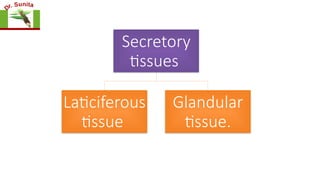
Secretory
tissues
Laticiferous
tissue
Glandular
tissue.
Laticiferous tissues
These consist of thin walled, highly elongated and branched
ducts containing a milky or yellowish colored juice known as
latex.
This mixture storage, generally milky white, other colors rarely,
form an emulsion, which are active ingredients as protein,
carbohydrates, enzymes, tannins, rubber, hormones and
alkaloids and is called latex.
They irregularly distributed in the mass of parenchymatous
cells.
The latex is of great importance for humen.
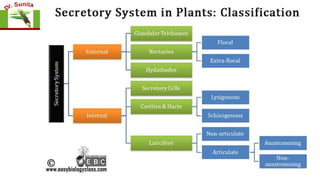
•Latex cell/ non-articulate latex ducts
•Latex vessels/ articulate latex ducts
Laticiferous ducts
Latex cell/Non-articulated
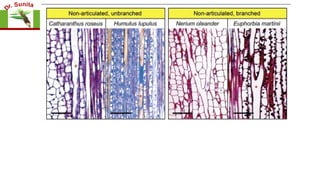
These are made up of single, long, cenocytic cell, (simple in origin),
which through continued growth develop into tube-like etc. often much
branched, but typically they undergo no fusion with other similar cells.
These types of laticifers are called Laticiferous/ latex cell. It is also two
kinds-
 (a) branched and
 (b) unbranched
Also called as "non-articulate latex ducts", which are independent units
and extend as branched structures for long distances in the plant body.
They develop as minute structures, elongate fastly and by repeated
branching, expand in all directions but do not fuse together.
Thus, a network is not formed as in latex vessels.
Latex vessel/ Articulate latex ducts
Also called "articulate latex ducts", these ducts or vessels are
made up of a series of cells that are joined together.
There are compound in origin (originated from the no. of cells),
consisting of longitudinal files of cells, the end walls of which break
down wholly or in part.
Such perforation of end walls gives rise to laticifers that are tube-
like in form and resemble xylem vessel in origin.
This type of laticifers have been formerly called laticiferous vessels.
Latex vessels are commonly found in many Angiosperm families
Papaveraceae, Asteraceae, Euphorbiaceae, Moraceae etc.
Types of articulated lactiferous
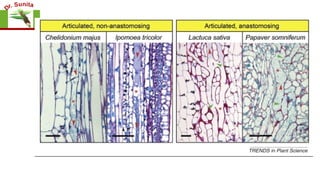
Now these Articulated liticifers are grouped into two groups:-
1. Articulated non-anastomosing
2. Articulated anastomosing
Articulated non-anastomosing-These consist of long cell chain or
compound tubes not connected with each other laterally.
Articulated anastomosing-These laticifers consists of long cell
chains or compound tubes connected with each other laterally, all
combined into a net-like stc. or reticulum.
Functions
These help in conduction of food substances.
These also store food material or reserve nutrition.
These regulate and maintain the water balance in the plant.
These work as agency for oxygen transport.
The most important function of tissues is to perform excretory
roles.
Latex in some cases is of great economic importance value,
such as source of rubber (Hevea and Ficus), opium from Papaver
somniferum, papain enzyme from Carica.
Glandular Tissue
Glandular Tissue
This tissue consists of special group of cells called the glands.
These glands consist of some secretory or excretory products.
A gland may consist of isolated cells or small group cells with or
without a central cavity.
The cells of these tissues are made up of thin cellulosic walls
containing living protoplasm.
They are of different types but most common types includes two
major groups: External and Internal glandular tissue.
Glandular Tissue
External glandular tissue may be epidermal in origin or may originate from the
sub-epidermal layer. These are divided in different categories as follows:
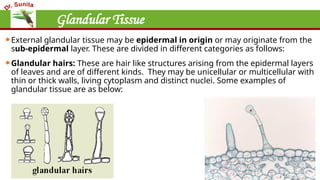
Glandular hairs: These are hair like structures arising from the epidermal layers
of leaves and are of different kinds. They may be unicellular or multicellular with
thin or thick walls, living cytoplasm and distinct nuclei. Some examples of
glandular tissue are as below:
Stinging hairs
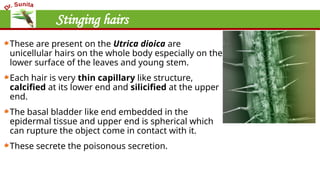
These are present on the Utrica dioica are
unicellular hairs on the whole body especially on the
lower surface of the leaves and young stem.
Each hair is very thin capillary like structure,
calcified at its lower end and silicified at the upper
end.
The basal bladder like end embedded in the
epidermal tissue and upper end is spherical which
can rupture the object come in contact with it.
These secrete the poisonous secretion.
Mucilage glands
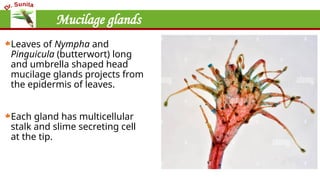
Leaves of Nympha and
Pinguicula (butterwort) long
and umbrella shaped head
mucilage glands projects from
the epidermis of leaves.
Each gland has multicellular
stalk and slime secreting cell
at the tip.
Osmophores
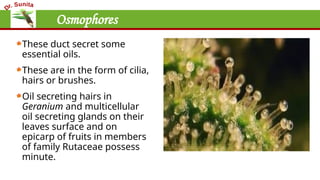
These duct secret some
essential oils.
These are in the form of cilia,
hairs or brushes.
Oil secreting hairs in
Geranium and multicellular
oil secreting glands on their
leaves surface and on
epicarp of fruits in members
of family Rutaceae possess
minute.
Nectaries
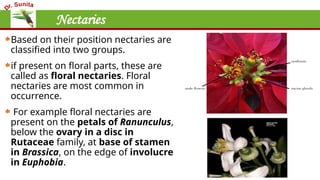
Based on their position nectaries are
classified into two groups.
if present on floral parts, these are
called as floral nectaries. Floral
nectaries are most common in
occurrence.
For example floral nectaries are
present on the petals of Ranunculus,
below the ovary in a disc in
Rutaceae family, at base of stamen
in Brassica, on the edge of involucre
in Euphobia.
Nectaries
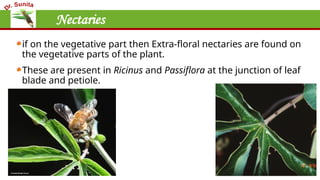
if on the vegetative part then Extra-floral nectaries are found on
the vegetative parts of the plant.
These are present in Ricinus and Passiflora at the junction of leaf
blade and petiole.
Digestive glands
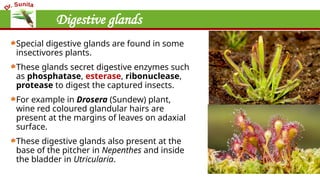
Special digestive glands are found in some
insectivores plants.
These glands secret digestive enzymes such
as phosphatase, esterase, ribonuclease,
protease to digest the captured insects.
For example in Drosera (Sundew) plant,
wine red coloured glandular hairs are
present at the margins of leaves on adaxial
surface.
These digestive glands also present at the
base of the pitcher in Nepenthes and inside
the bladder in Utricularia.
Cavities and ducts
Many plants possess glands that are embedded in various
tissues of the plant parts such as roots, stem, leaves, flowers,
fruits and seeds.
These may consist of single cells or a group of cells. These
glands are usually multicellular, thin walled and living.
Various secretory products like gums, resin, tennins, mucilage
etc are stored in the cell itself or in the cavities.
Cavities and ducts
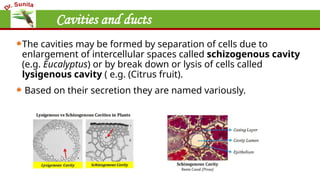
The cavities may be formed by separation of cells due to
enlargement of intercellular spaces called schizogenous cavity
(e.g. Eucalyptus) or by break down or lysis of cells called
lysigenous cavity ( e.g. (Citrus fruit).
Based on their secretion they are named variously.
Oil glands
Many plants have characteristics oil
glands consist of small group of thin
walled, densely cytoplasmic cell,
secretory in function.
These are present in stem of families
Brassicaceae, Rutaceae, Apiaceae; fruits
and seeds of Cinnamomum.
These are also present in endosperm of
Arachis and Ricinus secreting groundnut
oil and castor oil respectively.
Resin Ducts & Mucilage ducts
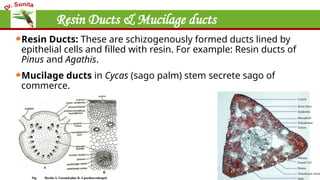
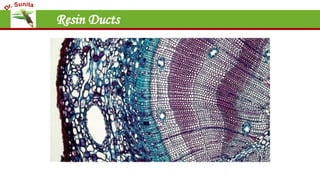
Resin Ducts: These are schizogenously formed ducts lined by
epithelial cells and filled with resin. For example: Resin ducts of
Pinus and Agathis.
Mucilage ducts in Cycas (sago palm) stem secrete sago of
commerce.
Resin Ducts
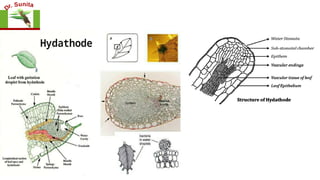
Hydathodes
Water is released in the form of liquid through these specialised
water stomata.
The phenomenon is called guttation, commonly found in the
plant inhabiting humid tropics.
The guttated water contains salt, sugars, amino acids and other
organic substances.
Guttation occurs when root pressure or exudation pressure
increases due to reduction in transpiration under humid
conditions.
Thanks

Secretory tissue present in plants..

  • 1.
    Lecture- Plant Anatomy Secretory Tissue By:Dr. Sunita Sangwan Assistant Prof. Deptt. of Botany MNSGC Bhiwani 1. • Introduction 2. • Laticiferous secretory tissue 3. • Glandular secretory tissue 4. • Nectaries, ducts & cavities 5. • Resin, mucilagenous ducts and Hydathodes
  • 2.
    Secretory Tissue These arethe cells or group of cells that produce a variety of secretions are called secretory tissues. These may be present at certain localized area in plants or may be distributed throughout the plant body. The secreted substance may remain deposited within the secretory cell itself or may be excreted, that is, released from the cell. Substances may be excreted to the surface of the plant or into intercellular cavities or canals. Some of the many substances contained in the secretions are not further utilized by the plant (resins, rubber, tannins, and various crystals), while others take part in the functions of the plant (enzymes and hormones).
  • 4.
  • 5.
    Laticiferous tissues These consistof thin walled, highly elongated and branched ducts containing a milky or yellowish colored juice known as latex. This mixture storage, generally milky white, other colors rarely, form an emulsion, which are active ingredients as protein, carbohydrates, enzymes, tannins, rubber, hormones and alkaloids and is called latex. They irregularly distributed in the mass of parenchymatous cells. The latex is of great importance for humen.
  • 6.
    •Latex cell/ non-articulatelatex ducts •Latex vessels/ articulate latex ducts Laticiferous ducts
  • 7.
    Latex cell/Non-articulated These aremade up of single, long, cenocytic cell, (simple in origin), which through continued growth develop into tube-like etc. often much branched, but typically they undergo no fusion with other similar cells. These types of laticifers are called Laticiferous/ latex cell. It is also two kinds-  (a) branched and  (b) unbranched Also called as "non-articulate latex ducts", which are independent units and extend as branched structures for long distances in the plant body. They develop as minute structures, elongate fastly and by repeated branching, expand in all directions but do not fuse together. Thus, a network is not formed as in latex vessels.
  • 9.
    Latex vessel/ Articulatelatex ducts Also called "articulate latex ducts", these ducts or vessels are made up of a series of cells that are joined together. There are compound in origin (originated from the no. of cells), consisting of longitudinal files of cells, the end walls of which break down wholly or in part. Such perforation of end walls gives rise to laticifers that are tube- like in form and resemble xylem vessel in origin. This type of laticifers have been formerly called laticiferous vessels. Latex vessels are commonly found in many Angiosperm families Papaveraceae, Asteraceae, Euphorbiaceae, Moraceae etc.
  • 10.
    Types of articulatedlactiferous Now these Articulated liticifers are grouped into two groups:- 1. Articulated non-anastomosing 2. Articulated anastomosing Articulated non-anastomosing-These consist of long cell chain or compound tubes not connected with each other laterally. Articulated anastomosing-These laticifers consists of long cell chains or compound tubes connected with each other laterally, all combined into a net-like stc. or reticulum.
  • 12.
    Functions These help inconduction of food substances. These also store food material or reserve nutrition. These regulate and maintain the water balance in the plant. These work as agency for oxygen transport. The most important function of tissues is to perform excretory roles. Latex in some cases is of great economic importance value, such as source of rubber (Hevea and Ficus), opium from Papaver somniferum, papain enzyme from Carica.
  • 13.
  • 14.
    Glandular Tissue This tissueconsists of special group of cells called the glands. These glands consist of some secretory or excretory products. A gland may consist of isolated cells or small group cells with or without a central cavity. The cells of these tissues are made up of thin cellulosic walls containing living protoplasm. They are of different types but most common types includes two major groups: External and Internal glandular tissue.
  • 15.
    Glandular Tissue External glandulartissue may be epidermal in origin or may originate from the sub-epidermal layer. These are divided in different categories as follows: Glandular hairs: These are hair like structures arising from the epidermal layers of leaves and are of different kinds. They may be unicellular or multicellular with thin or thick walls, living cytoplasm and distinct nuclei. Some examples of glandular tissue are as below:
  • 16.
    Stinging hairs These arepresent on the Utrica dioica are unicellular hairs on the whole body especially on the lower surface of the leaves and young stem. Each hair is very thin capillary like structure, calcified at its lower end and silicified at the upper end. The basal bladder like end embedded in the epidermal tissue and upper end is spherical which can rupture the object come in contact with it. These secrete the poisonous secretion.
  • 17.
    Mucilage glands Leaves ofNympha and Pinguicula (butterwort) long and umbrella shaped head mucilage glands projects from the epidermis of leaves. Each gland has multicellular stalk and slime secreting cell at the tip.
  • 18.
    Osmophores These duct secretsome essential oils. These are in the form of cilia, hairs or brushes. Oil secreting hairs in Geranium and multicellular oil secreting glands on their leaves surface and on epicarp of fruits in members of family Rutaceae possess minute.
  • 19.
    Nectaries Based on theirposition nectaries are classified into two groups. if present on floral parts, these are called as floral nectaries. Floral nectaries are most common in occurrence. For example floral nectaries are present on the petals of Ranunculus, below the ovary in a disc in Rutaceae family, at base of stamen in Brassica, on the edge of involucre in Euphobia.
  • 20.
    Nectaries if on thevegetative part then Extra-floral nectaries are found on the vegetative parts of the plant. These are present in Ricinus and Passiflora at the junction of leaf blade and petiole.
  • 21.
    Digestive glands Special digestiveglands are found in some insectivores plants. These glands secret digestive enzymes such as phosphatase, esterase, ribonuclease, protease to digest the captured insects. For example in Drosera (Sundew) plant, wine red coloured glandular hairs are present at the margins of leaves on adaxial surface. These digestive glands also present at the base of the pitcher in Nepenthes and inside the bladder in Utricularia.
  • 22.
    Cavities and ducts Manyplants possess glands that are embedded in various tissues of the plant parts such as roots, stem, leaves, flowers, fruits and seeds. These may consist of single cells or a group of cells. These glands are usually multicellular, thin walled and living. Various secretory products like gums, resin, tennins, mucilage etc are stored in the cell itself or in the cavities.
  • 23.
    Cavities and ducts Thecavities may be formed by separation of cells due to enlargement of intercellular spaces called schizogenous cavity (e.g. Eucalyptus) or by break down or lysis of cells called lysigenous cavity ( e.g. (Citrus fruit). Based on their secretion they are named variously.
  • 24.
    Oil glands Many plantshave characteristics oil glands consist of small group of thin walled, densely cytoplasmic cell, secretory in function. These are present in stem of families Brassicaceae, Rutaceae, Apiaceae; fruits and seeds of Cinnamomum. These are also present in endosperm of Arachis and Ricinus secreting groundnut oil and castor oil respectively.
  • 25.
    Resin Ducts &Mucilage ducts Resin Ducts: These are schizogenously formed ducts lined by epithelial cells and filled with resin. For example: Resin ducts of Pinus and Agathis. Mucilage ducts in Cycas (sago palm) stem secrete sago of commerce.
  • 26.
  • 27.
    Hydathodes Water is releasedin the form of liquid through these specialised water stomata. The phenomenon is called guttation, commonly found in the plant inhabiting humid tropics. The guttated water contains salt, sugars, amino acids and other organic substances. Guttation occurs when root pressure or exudation pressure increases due to reduction in transpiration under humid conditions.
  • 29.