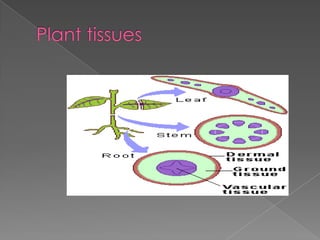
 Dermal tissue
 Ground tissues
 Vascular tissue
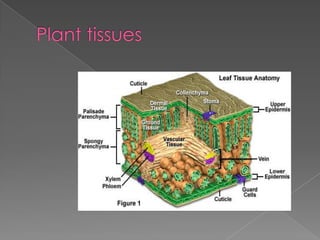
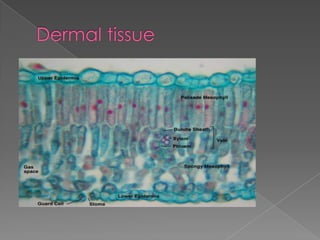
 Consists of the epidermis and the
  periderm
 Epidermis is a single layer of closely
  packed cells
 It also covers and protects the plant
 Epidermis of the plant’s leaves secretes a
  coating called cuticle
 Cuticle helps the plant retain water
 Guard cells in the epidermis regulate gas
  exchange between the plants and the
  environment
 It synthesize organic compounds
 Supports and provide storage for the
  plant
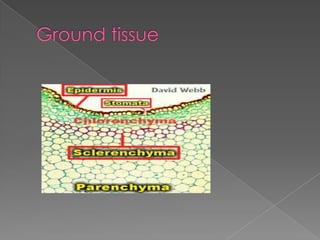
 It is made up of Parenchyma,
  Collenchyma and sclerenchyma cells
 Parenchyma cells synthesize and store
  organic products in the plants
 Parenchyma cells in leaves control
  photosynthesis
 Collenchyma cells have a support
  function in plants
 They do not restrain growth due to their
  lack of secondary cells and absence of
  a hardening agent in their primary walls
 Sclerenchyma cells also have support
  function in plants but they have a
  hardening agent and are much more
  rigid
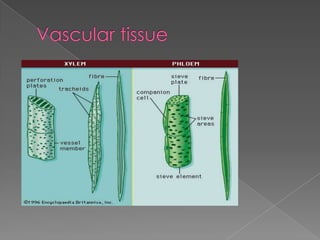
 It is made up of xylem and phloem
 The xylem and phloem allows water and
  other nutrients to be transported
  throughout the plant
 Xylem is made up of two cells called
  tracheids and vessel elements
 Tracheids and vessel elements form tube
  shaped structures that provide pathways
  for water and minerals to travel from the
  roots to the leaves
 Tracheids are found in all vascular plants
 Vessels are found only in angiosperms
 Tracheids are non-living
 Phloem consists of cells called sieve
  tubes and companion cells
 The cells assist in the transportation of
  nutrients and sugar produced during
  photosynthesis from leaves to the other
  parts of the plant
 Sieve-tubes and companion cells of
  phloem are living
 Companion cells contain nucleus and
  actively transport sugar into and out of
  the sieve tubes
http://biology.about.com/od/plantbiology
/ss/plant-tissue-systems_2.htm