Tissue an integrated group of cells with a common structure and function
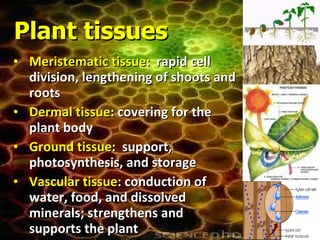
Plant tissues Meristematic tissue :  rapid cell division, lengthening of shoots and roots Dermal tissue : covering for the plant body Ground tissue :  support, photosynthesis, and storage  Vascular tissue : conduction of water, food, and dissolved minerals; strengthens and supports the plant
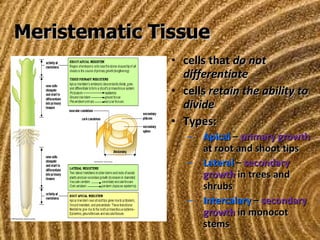
Meristematic Tissue cells that  do not differentiate cells  retain the ability to divide Types: Apical  –  primary growth  at root and shoot tips Lateral  –  secondary growth  in trees and shrubs  Intercalary  –  secondary growth  in monocot stems
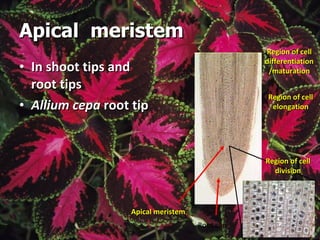
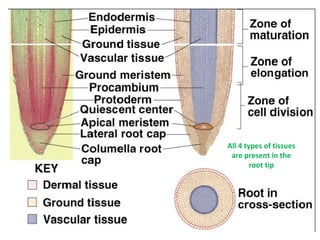
Apical  meristem In shoot tips and root tips Allium cepa  root tip Root cap Apical meristem Region of cell differentiation/maturation Region of cell elongation Region of cell division
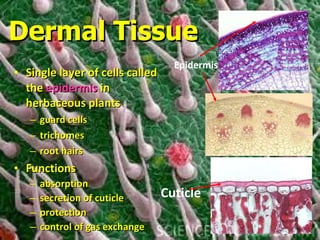
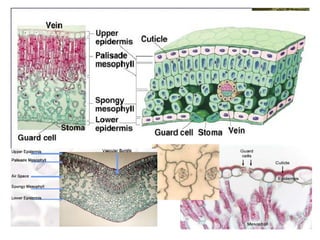
Dermal Tissue Single layer of cells called the  epidermis  in herbaceous plants guard cells trichomes root hairs Functions absorption secretion of cuticle protection control of gas exchange Epidermis Cuticle
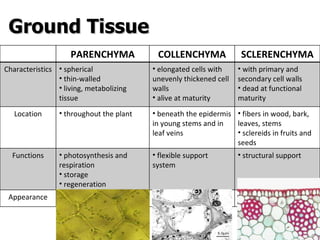
Ground Tissue PARENCHYMA COLLENCHYMA SCLERENCHYMA Characteristics spherical thin-walled living, metabolizing tissue elongated cells with unevenly thickened cell walls alive at maturity with primary and secondary cell walls dead at functional maturity Location throughout the plant beneath the epidermis in young stems and in leaf veins fibers in wood, bark, leaves, stems sclereids in fruits and seeds Functions photosynthesis and respiration storage regeneration flexible support system structural support Appearance
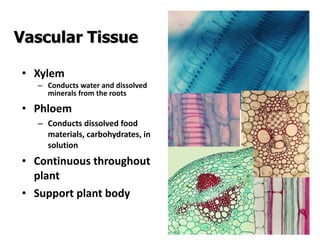
Vascular Tissue Xylem Conducts water and dissolved minerals from the roots  Phloem Conducts dissolved food materials, carbohydrates, in solution  Continuous throughout plant Support plant body
 
All 4 types of tissues are present in the root tip
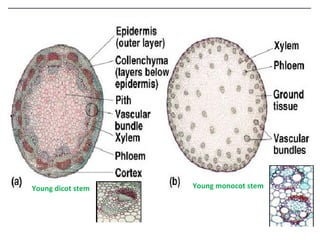
Young dicot stem Young monocot stem
 
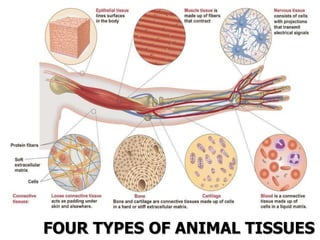
FOUR TYPES OF ANIMAL TISSUES
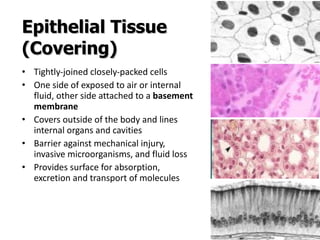
Epithelial Tissue (Covering) Tightly-joined closely-packed cells One side of exposed to air or internal fluid, other side attached to a  basement membrane Covers outside of the body and lines internal organs and cavities Barrier against mechanical injury, invasive microorganisms, and fluid loss Provides surface for absorption, excretion and transport of molecules
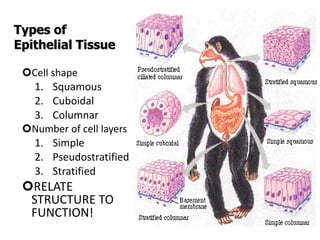
Types of Epithelial Tissue Cell shape Squamous Cuboidal Columnar Number of cell layers Simple Pseudostratified Stratified RELATE STRUCTURE TO FUNCTION!
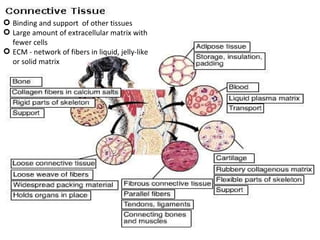
Binding and support  of other tissues Large amount of extracellular matrix with fewer cells ECM - network of fibers in liquid, jelly-like or solid matrix
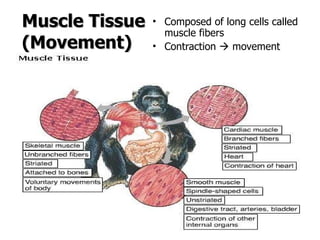
Muscle Tissue (Movement) Composed of long cells called muscle fibers Contraction    movement
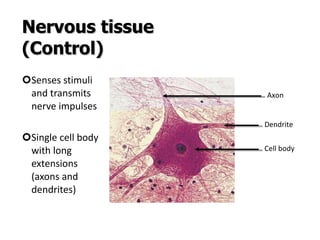
Nervous tissue (Control) Senses stimuli and transmits nerve impulses Single cell body with long extensions (axons and dendrites) Axon Dendrite Cell body

Presentation03 - Plant and Animal Tissues

  • 1.
    Tissue an integratedgroup of cells with a common structure and function
  • 2.
    Plant tissues Meristematictissue : rapid cell division, lengthening of shoots and roots Dermal tissue : covering for the plant body Ground tissue : support, photosynthesis, and storage Vascular tissue : conduction of water, food, and dissolved minerals; strengthens and supports the plant
  • 3.
    Meristematic Tissue cellsthat do not differentiate cells retain the ability to divide Types: Apical – primary growth at root and shoot tips Lateral – secondary growth in trees and shrubs Intercalary – secondary growth in monocot stems
  • 4.
    Apical meristemIn shoot tips and root tips Allium cepa root tip Root cap Apical meristem Region of cell differentiation/maturation Region of cell elongation Region of cell division
  • 5.
    Dermal Tissue Singlelayer of cells called the epidermis in herbaceous plants guard cells trichomes root hairs Functions absorption secretion of cuticle protection control of gas exchange Epidermis Cuticle
  • 6.
    Ground Tissue PARENCHYMACOLLENCHYMA SCLERENCHYMA Characteristics spherical thin-walled living, metabolizing tissue elongated cells with unevenly thickened cell walls alive at maturity with primary and secondary cell walls dead at functional maturity Location throughout the plant beneath the epidermis in young stems and in leaf veins fibers in wood, bark, leaves, stems sclereids in fruits and seeds Functions photosynthesis and respiration storage regeneration flexible support system structural support Appearance
  • 7.
    Vascular Tissue XylemConducts water and dissolved minerals from the roots Phloem Conducts dissolved food materials, carbohydrates, in solution Continuous throughout plant Support plant body
  • 8.
  • 9.
    All 4 typesof tissues are present in the root tip
  • 10.
    Young dicot stemYoung monocot stem
  • 11.
  • 12.
    FOUR TYPES OFANIMAL TISSUES
  • 13.
    Epithelial Tissue (Covering)Tightly-joined closely-packed cells One side of exposed to air or internal fluid, other side attached to a basement membrane Covers outside of the body and lines internal organs and cavities Barrier against mechanical injury, invasive microorganisms, and fluid loss Provides surface for absorption, excretion and transport of molecules
  • 14.
    Types of EpithelialTissue Cell shape Squamous Cuboidal Columnar Number of cell layers Simple Pseudostratified Stratified RELATE STRUCTURE TO FUNCTION!
  • 15.
    Binding and support of other tissues Large amount of extracellular matrix with fewer cells ECM - network of fibers in liquid, jelly-like or solid matrix
  • 16.
    Muscle Tissue (Movement)Composed of long cells called muscle fibers Contraction  movement
  • 17.
    Nervous tissue (Control)Senses stimuli and transmits nerve impulses Single cell body with long extensions (axons and dendrites) Axon Dendrite Cell body