Plant Tissues:
Meristems, Simple Tissues,
& Complex Tissues
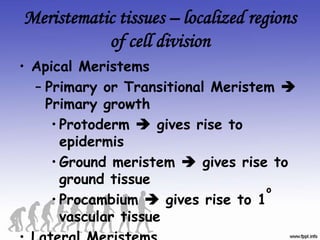
Meristematic tissues – localized regions
of cell division
• Apical Meristems
– Primary or Transitional Meristem 
Primary growth
• Protoderm  gives rise to
epidermis
• Ground meristem  gives rise to
ground tissue
• Procambium  gives rise to 1
o
vascular tissue
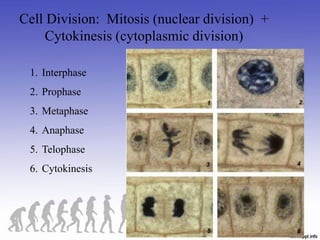
1. Interphase
2. Prophase
3. Metaphase
4. Anaphase
5. Telophase
6. Cytokinesis
Cell Division: Mitosis (nuclear division) +
Cytokinesis (cytoplasmic division)
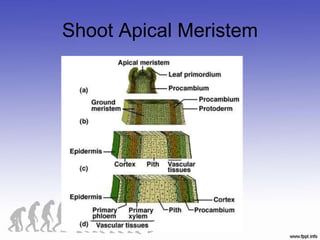
Shoot Apical Meristem
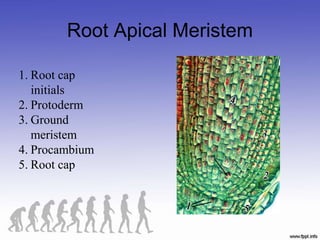
Root Apical Meristem
1. Root cap
initials
2. Protoderm
3. Ground
meristem
4. Procambium
5. Root cap
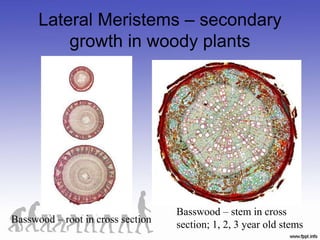
Lateral Meristems – secondary
growth in woody plants
Basswood – root in cross section
Basswood – stem in cross
section; 1, 2, 3 year old stems
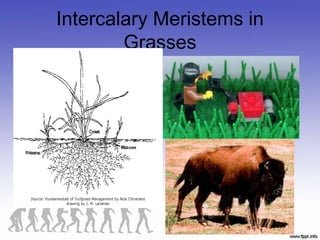
Intercalary Meristems in
Grasses
Simple Tissues – consisting of one
cell type
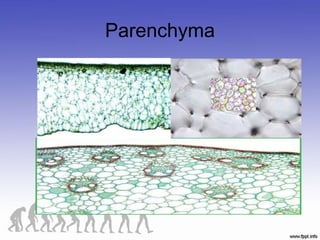
• Parenchyma – thin walled & alive at maturity; often
multifaceted.
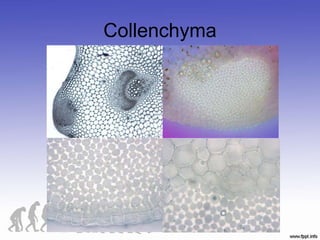
• Collenchyma – thick walled & alive at maturity
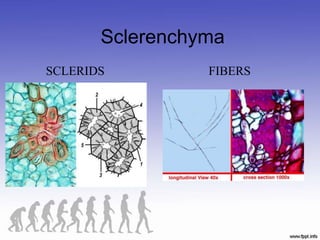
• Sclerenchyma – thick walled and dead at maturity
– Sclerids or stone cells – cells as long as they are
wide
– Fibers – cells longer than they are wide
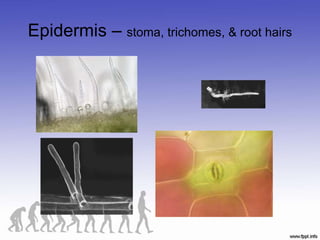
• Epidermis – alive at maturity
– Trichomes – “pubescence” or hairs on epidermis
– Root Hairs – tubular extensions of epidermal cells
Parenchyma
Collenchyma
Sclerenchyma
SCLERIDS FIBERS
Epidermis – stoma, trichomes, & root hairs
Complex Tissue
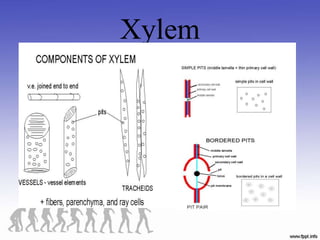
• Xylem – water conducting tissue; parenchyma,
fibers, vessels and/or tracheids, and ray cells.
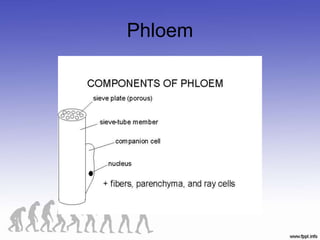
• Phloem food conducting tissue; sieve-tube members
(no nucleus at maturity, cytoplasm present),
companion cells, fibers, parenchyma, and ray
cells. In flowering plants, sieve-tube members and
companion cells arise from the same mother cell.
• Periderm – protective covering; composed of cork
and parenchyma.
• Secretory structures – responsible for making latex,
resins, nectar and other substances produced and
stored in channels inside the plant body.
Xylem
Phloem
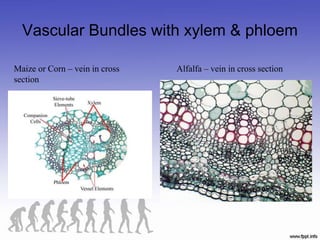
Vascular Bundles with xylem & phloem
Maize or Corn – vein in cross
section
Alfalfa – vein in cross section
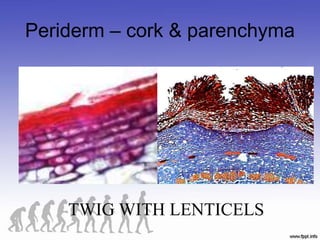
Periderm – cork & parenchyma
TWIG WITH LENTICELS
Secretory Structures
• Nectar (flowers) from nectaries
•Oils (peanuts, oranges, citrus) from accumulation of
glands and elaioplasts.
• Resins (conifers) from resin canals
•Lacticifers (e.g., latex - milkweed, rubber plants,
opium poppy)
• Hydathodes (openings for secretion of water)
• Digestive glands of carnivorous plants (enzymes)
• Salt glands that shed salt (especial in plants
adapted to environments laden with salt).

Science | Plant tissue | Meristems,Simple Tissues,&Complex Tissues

  • 1.
    Plant Tissues: Meristems, SimpleTissues, & Complex Tissues
  • 2.
    Meristematic tissues –localized regions of cell division • Apical Meristems – Primary or Transitional Meristem  Primary growth • Protoderm  gives rise to epidermis • Ground meristem  gives rise to ground tissue • Procambium  gives rise to 1 o vascular tissue
  • 3.
    1. Interphase 2. Prophase 3.Metaphase 4. Anaphase 5. Telophase 6. Cytokinesis Cell Division: Mitosis (nuclear division) + Cytokinesis (cytoplasmic division)
  • 4.
  • 5.
    Root Apical Meristem 1.Root cap initials 2. Protoderm 3. Ground meristem 4. Procambium 5. Root cap
  • 6.
    Lateral Meristems –secondary growth in woody plants Basswood – root in cross section Basswood – stem in cross section; 1, 2, 3 year old stems
  • 7.
  • 8.
    Simple Tissues –consisting of one cell type • Parenchyma – thin walled & alive at maturity; often multifaceted. • Collenchyma – thick walled & alive at maturity • Sclerenchyma – thick walled and dead at maturity – Sclerids or stone cells – cells as long as they are wide – Fibers – cells longer than they are wide • Epidermis – alive at maturity – Trichomes – “pubescence” or hairs on epidermis – Root Hairs – tubular extensions of epidermal cells
  • 9.
  • 10.
  • 11.
  • 12.
    Epidermis – stoma,trichomes, & root hairs
  • 13.
    Complex Tissue • Xylem– water conducting tissue; parenchyma, fibers, vessels and/or tracheids, and ray cells. • Phloem food conducting tissue; sieve-tube members (no nucleus at maturity, cytoplasm present), companion cells, fibers, parenchyma, and ray cells. In flowering plants, sieve-tube members and companion cells arise from the same mother cell. • Periderm – protective covering; composed of cork and parenchyma. • Secretory structures – responsible for making latex, resins, nectar and other substances produced and stored in channels inside the plant body.
  • 14.
  • 15.
  • 16.
    Vascular Bundles withxylem & phloem Maize or Corn – vein in cross section Alfalfa – vein in cross section
  • 17.
    Periderm – cork& parenchyma TWIG WITH LENTICELS
  • 18.
    Secretory Structures • Nectar(flowers) from nectaries •Oils (peanuts, oranges, citrus) from accumulation of glands and elaioplasts. • Resins (conifers) from resin canals •Lacticifers (e.g., latex - milkweed, rubber plants, opium poppy) • Hydathodes (openings for secretion of water) • Digestive glands of carnivorous plants (enzymes) • Salt glands that shed salt (especial in plants adapted to environments laden with salt).