Evolutionary
Morphology
Part 2 of Chapter 1
By Geonyzl Alviola
Function and Biological Role

Function = is restricted to mean the
action or property of a part as it
works in an organism.

Biological Role = (or just role)
refers to how the part is used in the
environment during the course of
the organism’s life history.
For example
1. Cheek muscle

Function: to close the jaw

Biological Role: for food
processing (chewing)

Biological Role: (biting) for
protection against threat
For example (one part with
several function)
2. quarate bone (in reptiles

Function: to attach the lower jaw
to the skull. It also functions to
transmit sound waves to the ear.

Biological role: feeding (food
procurement) and hearing
(detection of enemies or prey)
Example

Function?

Biological Role?

Functions of a part are determined largely in
laboratory studies; biological roles are
observed in field studies.Inferring biological
roles only from laboratory studies can be
misleading
Preadaptation

Preadaptation means that a structure or
behavior possesses the necessary form and
function before (hence pre-) the biological
role arises that it eventually serves.

In other words, a preadapted part can do
the job before the job arrives
For example:

Bird Feather Story

feathers likely evolved initially in birds (or in their
immediate ancestors) as insulation to conserve
body heat. Like hair in mammals, feathers
formed a surface barrier to retard the loss of
body heat. For warm-blooded birds, feathers
were an indispensable energy-conserving
feature. Today, feathers still play a role in
thermoregulation; however, for modern birds,
flight is the most conspicuous role of feathers.
Flight came later in avian evolution.
Phylogeny

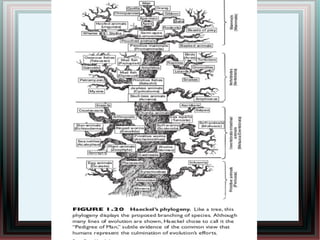
can be summarized in graphic
schemes, or dendrograms, that
depict treelike, branched
connections between groups.

Dendrograms summarize
evolution’s course
Of Beanstalks and Bushes

1896, Ernst Haeckel wrote The Evolution of
Man

Evolution does not proceed up a single
ladder, but bushes outward along several
simultaneous courses.

Humans share the current evolutionary
moment with millions of other species, all
with long histories of their own.

All adapted in their own ways to their own
environments.

The apparent discreteness of species or
groups at the current moment is partly due
to their previous divergence.

When followed back into their past, the
connectedness of species can be
determined. A dendrogram showing
lineages in three dimensions (figure 1.22)
emphasizes this continuity.
Denrograms
It is a summarized graphic representation
of the course of evolution or phylogeny
- it is also used to express relative
abundance and diversity.
- presented like a branching tree or any
form.
Gradual presentation / Abrupt dendogram
A clade is a grouping that includes a common
ancestor and all the descendants (living and
extinct) of that ancestor.
Monophyletic clade
- it includes an
ancestor and all its
descendants
Paraphyletic clade
- one that includes
a common ancestor
and some but not
all, of its
descendants.
Polyphyletic clade
Is one that does
not share an
immediate common
ancestors
Parallelism and Convergence
Parallelism is evolutionary change in two or
more lineages such that corresponding
features undergo equivalent alterations
without becoming more or less similar
a b
The ancestor
is common in
both a and b
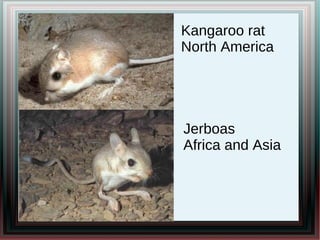
Kangaroo rat
North America
Jerboas
Africa and Asia
Convergence
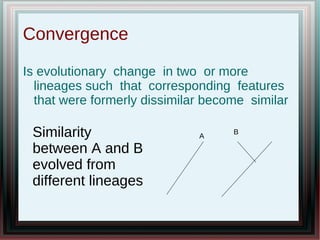
Is evolutionary change in two or more
lineages such that corresponding features
that were formerly dissimilar become similar
A
BSimilarity
between A and B
evolved from
different lineages
For example
Studying phylogeny
Studying the history of an animal
Tracing its relatives
Associating its resemblance
=======> Paleontology
Paleontology
= study the fossils
= recovery and restoration
= dating the fossils
= stratigraphy
= indexing
= radiometric dating
Chapter1part2

Chapter1part2

  • 1.
    Evolutionary Morphology Part 2 ofChapter 1 By Geonyzl Alviola
  • 2.
    Function and BiologicalRole  Function = is restricted to mean the action or property of a part as it works in an organism.  Biological Role = (or just role) refers to how the part is used in the environment during the course of the organism’s life history.
  • 3.
    For example 1. Cheekmuscle  Function: to close the jaw  Biological Role: for food processing (chewing)  Biological Role: (biting) for protection against threat
  • 5.
    For example (onepart with several function) 2. quarate bone (in reptiles  Function: to attach the lower jaw to the skull. It also functions to transmit sound waves to the ear.  Biological role: feeding (food procurement) and hearing (detection of enemies or prey)
  • 7.
  • 8.
     Functions of apart are determined largely in laboratory studies; biological roles are observed in field studies.Inferring biological roles only from laboratory studies can be misleading
  • 9.
    Preadaptation  Preadaptation means thata structure or behavior possesses the necessary form and function before (hence pre-) the biological role arises that it eventually serves.  In other words, a preadapted part can do the job before the job arrives
  • 10.
    For example:  Bird FeatherStory  feathers likely evolved initially in birds (or in their immediate ancestors) as insulation to conserve body heat. Like hair in mammals, feathers formed a surface barrier to retard the loss of body heat. For warm-blooded birds, feathers were an indispensable energy-conserving feature. Today, feathers still play a role in thermoregulation; however, for modern birds, flight is the most conspicuous role of feathers. Flight came later in avian evolution.
  • 12.
    Phylogeny  can be summarizedin graphic schemes, or dendrograms, that depict treelike, branched connections between groups.  Dendrograms summarize evolution’s course
  • 13.
    Of Beanstalks andBushes  1896, Ernst Haeckel wrote The Evolution of Man  Evolution does not proceed up a single ladder, but bushes outward along several simultaneous courses.  Humans share the current evolutionary moment with millions of other species, all with long histories of their own.  All adapted in their own ways to their own environments.
  • 16.
     The apparent discretenessof species or groups at the current moment is partly due to their previous divergence.  When followed back into their past, the connectedness of species can be determined. A dendrogram showing lineages in three dimensions (figure 1.22) emphasizes this continuity.
  • 20.
    Denrograms It is asummarized graphic representation of the course of evolution or phylogeny - it is also used to express relative abundance and diversity. - presented like a branching tree or any form.
  • 21.
    Gradual presentation /Abrupt dendogram
  • 22.
    A clade isa grouping that includes a common ancestor and all the descendants (living and extinct) of that ancestor.
  • 24.
    Monophyletic clade - itincludes an ancestor and all its descendants Paraphyletic clade - one that includes a common ancestor and some but not all, of its descendants. Polyphyletic clade Is one that does not share an immediate common ancestors
  • 25.
    Parallelism and Convergence Parallelismis evolutionary change in two or more lineages such that corresponding features undergo equivalent alterations without becoming more or less similar a b The ancestor is common in both a and b
  • 26.
  • 27.
    Convergence Is evolutionary changein two or more lineages such that corresponding features that were formerly dissimilar become similar A BSimilarity between A and B evolved from different lineages
  • 28.
  • 29.
    Studying phylogeny Studying thehistory of an animal Tracing its relatives Associating its resemblance =======> Paleontology
  • 30.
    Paleontology = study thefossils = recovery and restoration = dating the fossils = stratigraphy = indexing = radiometric dating