Prepared By,
Mr. Nishant Agrawal
Plant Layout
METAS Adventist College (NEHU)
Session outline
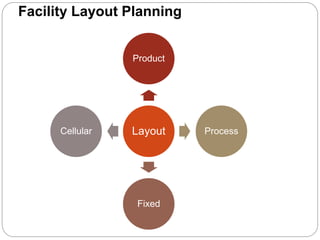
 Facility Layout Planning
 Product Layout
 Process Layout
 Fixed position layout
 Cellular layout
 Factors affecting location plant
 Merit and Demerits
Plant Layout
 A plant layout study is an engineering study used to analyze
different physical configurations for a manufacturing plant.
 In industry sectors, it is important to manufacture the products which
have good quality and meet customers’ demand.
 This action could be conducted under existing resources such as
employees, machines and other facilities.
 However, plant layout improvement, could be one of the tools to
response to increasing industrial productivity.
Continue…..
 Plant layout design has become a fundamental basis of today’s
industrial plants which can influence parts of work efficiency.
 It is needed to appropriately plan and position employees, materials,
machines, equipment, and other manufacturing supports and
facilities to create the most effective plant layout.
Plant Layout Principles
1. Integration of all factors - The plant should integrate all the essential
resources of men, machines and materials in order to give an optimum level
of production.
2. Minimum Movement - The less the movement of men, machines and
materials, the less will be the cost of production. Thus, minimum movement of
theses resources will provide cost efficiency.
3. Unidirectional flow - All materials should progressively move towards the
same direction i.e. towards the stage of completion.
Continue….
4. Maximum protection - The layout should ensure the protection of the
materials and machines while they are in the working or the storage stage.
5. Maximum flexibility - The plant layout should not be rigid and permanent. If
the need arises, the plant layout should be able to change itself without being
expensive.
6. Safety and security - The environment of the plant should be safe for the
workers as well as the machines. There should be minimum contact of the
labour to chemicals and environment.
Facility Layout Planning
Layout
Product
Process
Fixed
Cellular
Product Layout / An Assembly line
 It is suitable when product having standard features is to be
produced in large volumes.
 The production process involves repetitive tasks to be performed
on items arrange in sequence
 The specialized machines and equipment are arranged once after
other. This production line is often called assembly line.
 The assembly line has mechanized moving platform , which moves
at regular interval of time.
 The basic structure of the products to be manufactured in the raw
form are placed on conveyor at equal distance from each other.
Continue….
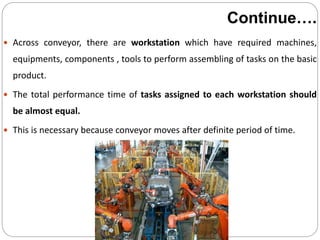
 Across conveyor, there are workstation which have required machines,
equipments, components , tools to perform assembling of tasks on the basic
product.
 The total performance time of tasks assigned to each workstation should
be almost equal.
 This is necessary because conveyor moves after definite period of time.
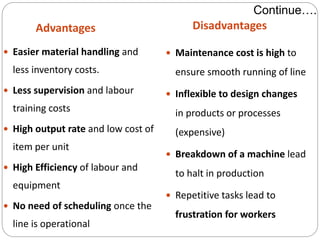
Advantages Disadvantages
 Easier material handling and
less inventory costs.
 Less supervision and labour
training costs
 High output rate and low cost of
item per unit
 High Efficiency of labour and
equipment
 No need of scheduling once the
line is operational
 Maintenance cost is high to
ensure smooth running of line
 Inflexible to design changes
in products or processes
(expensive)
 Breakdown of a machine lead
to halt in production
 Repetitive tasks lead to
frustration for workers
Continue….
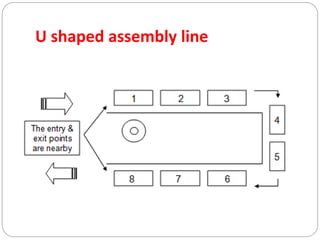
U shaped assembly line
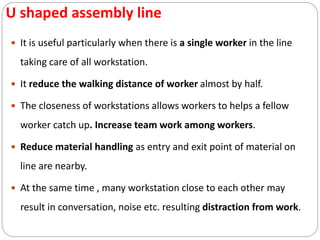
 It is useful particularly when there is a single worker in the line
taking care of all workstation.
 It reduce the walking distance of worker almost by half.
 The closeness of workstations allows workers to helps a fellow
worker catch up. Increase team work among workers.
 Reduce material handling as entry and exit point of material on
line are nearby.
 At the same time , many workstation close to each other may
result in conversation, noise etc. resulting distraction from work.
U shaped assembly line
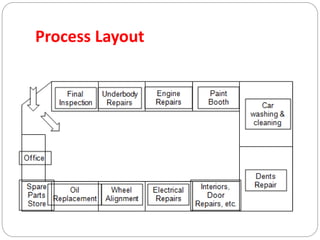
Process Layout
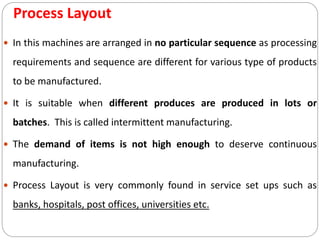
 In this machines are arranged in no particular sequence as processing
requirements and sequence are different for various type of products
to be manufactured.
 It is suitable when different produces are produced in lots or
batches. This is called intermittent manufacturing.
 The demand of items is not high enough to deserve continuous
manufacturing.
 Process Layout is very commonly found in service set ups such as
banks, hospitals, post offices, universities etc.
Process Layout
Fixed Position Layout
 The product is very bulky , heavy , large or has fixed position.
Ex. Construction of building, dam or plant
 Equipment , raw materials, and workers team are brought to
side according to a time schedule for better utilization of the
space available.
Cellular layout and Group Technology
 Product layout is desirable by most organization , but low volume.
 Cellular manufacturing a model for workplace design, is an integral
part of just-in-time manufacturing and lean manufacturing,
 In this groups of items with similar processing requirements are
identified and separate manufacturing cells forms for each group.
Factors affecting Plant Layout
(1) Policies of management:
 It is important to keep in mind various managerial policies and plans before deciding
plant layout.
(2) Plant location:
 Location of a plant greatly influences the layout of the plant. Shape, climate
conditions, and size of the site selected will influence the general arrangement of the
layout and the flow of work in and out of the building.
(3) Nature of the product:
 Nature of the commodity or article to be produced greatly affects the type of layout to
be adopted. In case of process industries, where the production is carried in a
sequence, product layout is suitable.
Continue....
(4) Volume of production:
 Plant layout is generally determined by taking into consideration the quantum of production to
be produced.
(5) Availability of floor space:
 Availability of floor space can be other decisive factor in adopting a particular mode of layout.
On the other hand more space may lead to the adoption of process layout.
(6) Repairs and maintenance of equipment and machines:
 The plant layout should be designed in such a manner as to take proper care with regard to
repairs & maintenance of different types of machines & equipment being used in the industry.
 The machines should not be installed so closely that it may create the problems of their
maintenance and repairs.
Questions
Que.1 ) Explain Product layout and Process layout in detail
OR
 Discuss types of Plant Layout with suitable examples.
OR
 Define the various types of plant layout in brief with suitable
examples of each.
OR
 What is Plant layout? List the various types of Plant layout. Carry
out a comparative analysis product and process layout with an
example.
OR
 How many types of Basic Layouts are there for a facility? Briefly
explain each of them.
Plant Layout

Plant Layout

  • 1.
    Prepared By, Mr. NishantAgrawal Plant Layout METAS Adventist College (NEHU)
  • 2.
    Session outline  FacilityLayout Planning  Product Layout  Process Layout  Fixed position layout  Cellular layout  Factors affecting location plant  Merit and Demerits
  • 3.
    Plant Layout  Aplant layout study is an engineering study used to analyze different physical configurations for a manufacturing plant.  In industry sectors, it is important to manufacture the products which have good quality and meet customers’ demand.  This action could be conducted under existing resources such as employees, machines and other facilities.  However, plant layout improvement, could be one of the tools to response to increasing industrial productivity.
  • 4.
    Continue…..  Plant layoutdesign has become a fundamental basis of today’s industrial plants which can influence parts of work efficiency.  It is needed to appropriately plan and position employees, materials, machines, equipment, and other manufacturing supports and facilities to create the most effective plant layout.
  • 5.
    Plant Layout Principles 1.Integration of all factors - The plant should integrate all the essential resources of men, machines and materials in order to give an optimum level of production. 2. Minimum Movement - The less the movement of men, machines and materials, the less will be the cost of production. Thus, minimum movement of theses resources will provide cost efficiency. 3. Unidirectional flow - All materials should progressively move towards the same direction i.e. towards the stage of completion.
  • 6.
    Continue…. 4. Maximum protection- The layout should ensure the protection of the materials and machines while they are in the working or the storage stage. 5. Maximum flexibility - The plant layout should not be rigid and permanent. If the need arises, the plant layout should be able to change itself without being expensive. 6. Safety and security - The environment of the plant should be safe for the workers as well as the machines. There should be minimum contact of the labour to chemicals and environment.
  • 7.
  • 8.
    Product Layout /An Assembly line  It is suitable when product having standard features is to be produced in large volumes.  The production process involves repetitive tasks to be performed on items arrange in sequence  The specialized machines and equipment are arranged once after other. This production line is often called assembly line.  The assembly line has mechanized moving platform , which moves at regular interval of time.  The basic structure of the products to be manufactured in the raw form are placed on conveyor at equal distance from each other.
  • 9.
    Continue….  Across conveyor,there are workstation which have required machines, equipments, components , tools to perform assembling of tasks on the basic product.  The total performance time of tasks assigned to each workstation should be almost equal.  This is necessary because conveyor moves after definite period of time.
  • 10.
    Advantages Disadvantages  Easiermaterial handling and less inventory costs.  Less supervision and labour training costs  High output rate and low cost of item per unit  High Efficiency of labour and equipment  No need of scheduling once the line is operational  Maintenance cost is high to ensure smooth running of line  Inflexible to design changes in products or processes (expensive)  Breakdown of a machine lead to halt in production  Repetitive tasks lead to frustration for workers Continue….
  • 11.
    U shaped assemblyline  It is useful particularly when there is a single worker in the line taking care of all workstation.  It reduce the walking distance of worker almost by half.  The closeness of workstations allows workers to helps a fellow worker catch up. Increase team work among workers.  Reduce material handling as entry and exit point of material on line are nearby.  At the same time , many workstation close to each other may result in conversation, noise etc. resulting distraction from work.
  • 12.
  • 13.
    Process Layout  Inthis machines are arranged in no particular sequence as processing requirements and sequence are different for various type of products to be manufactured.  It is suitable when different produces are produced in lots or batches. This is called intermittent manufacturing.  The demand of items is not high enough to deserve continuous manufacturing.  Process Layout is very commonly found in service set ups such as banks, hospitals, post offices, universities etc.
  • 14.
  • 15.
    Fixed Position Layout The product is very bulky , heavy , large or has fixed position. Ex. Construction of building, dam or plant  Equipment , raw materials, and workers team are brought to side according to a time schedule for better utilization of the space available.
  • 16.
    Cellular layout andGroup Technology  Product layout is desirable by most organization , but low volume.  Cellular manufacturing a model for workplace design, is an integral part of just-in-time manufacturing and lean manufacturing,  In this groups of items with similar processing requirements are identified and separate manufacturing cells forms for each group.
  • 17.
    Factors affecting PlantLayout (1) Policies of management:  It is important to keep in mind various managerial policies and plans before deciding plant layout. (2) Plant location:  Location of a plant greatly influences the layout of the plant. Shape, climate conditions, and size of the site selected will influence the general arrangement of the layout and the flow of work in and out of the building. (3) Nature of the product:  Nature of the commodity or article to be produced greatly affects the type of layout to be adopted. In case of process industries, where the production is carried in a sequence, product layout is suitable.
  • 18.
    Continue.... (4) Volume ofproduction:  Plant layout is generally determined by taking into consideration the quantum of production to be produced. (5) Availability of floor space:  Availability of floor space can be other decisive factor in adopting a particular mode of layout. On the other hand more space may lead to the adoption of process layout. (6) Repairs and maintenance of equipment and machines:  The plant layout should be designed in such a manner as to take proper care with regard to repairs & maintenance of different types of machines & equipment being used in the industry.  The machines should not be installed so closely that it may create the problems of their maintenance and repairs.
  • 19.
    Questions Que.1 ) ExplainProduct layout and Process layout in detail OR  Discuss types of Plant Layout with suitable examples. OR  Define the various types of plant layout in brief with suitable examples of each. OR  What is Plant layout? List the various types of Plant layout. Carry out a comparative analysis product and process layout with an example. OR  How many types of Basic Layouts are there for a facility? Briefly explain each of them.

Editor's Notes

  • #8 http://www.yourarticlelibrary.com/industries/plant-layout/four-main-types-of-plant-layout/34604/ http://www.yourarticlelibrary.com/industries/7-major-factors-affecting-plant-layout-industrial-management/26164/