Presented by-
Ananya Upadhyay
Introduction
 Manufacturing is the process of converting raw
material into finished or semi finished part.
 Production is the use of man, material and machine to
produce finished products.
 Production system can be defined as a transformation
system in which a saleable product or service is created
by working upon a set of inputs.
Production system
Production system can be broadly classified as-
 Job shop production- products are made to satisfy a
specific order.
 Batch production- number of identical articles are
manufactured either to meet a continuous demand or
present demand.
 Mass production- same type of products is
manufactured to meet the continuous demand of the
product.
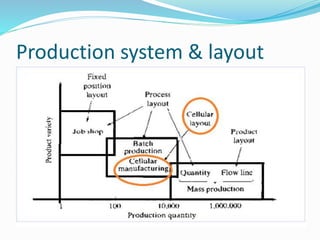
Production system & layout
Cellular manufacturing
 Organizing the production equipment into
machine cells, where each cell specialize in the
production of a part family is called cellular
manufacturing.
 It is an application of group technology in
manufacturing.
 Cellular manufacturing can be implemented by
manual or automated methods.
 When automated, the term flexible
manufacturing is applied.
Product A,B,C-
different part
families.
Cell 1,2,3-set of
machines to
produce part
families.
Cellular manufacturing
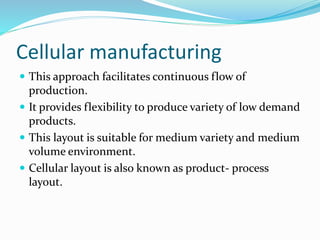
 This approach facilitates continuous flow of
production.
 It provides flexibility to produce variety of low demand
products.
 This layout is suitable for medium variety and medium
volume environment.
 Cellular layout is also known as product- process
layout.
Group technology
 A manufacturing philosophy in which similar parts are
identified & grouped together to take advantage of
their similarities in design and production.
 It contributes to the integration of CAD (Computer
Aided Design) and CAM (Computer Aided
Manufacturing).
 The group of similar parts is known as part family and
the group of machineries used to process an individual
part family is known as machine cell
Conditions for applications
 The plant currently uses process type layout.
 The parts can be grouped into part families is a must
condition.
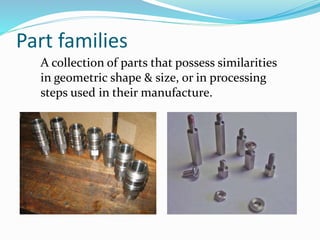
Part families
A collection of parts that possess similarities
in geometric shape & size, or in processing
steps used in their manufacture.
Methods to identify part families
 Visual Inspection- using best judgment to group
parts into part families.
 Part Classification & Coding- identifying the
similarities among parts & relating them with
numerical coding system.
 Production flow analysis- Using operation and route
sheets to classify parts into part families.
Improving Layouts Using Work
Cells
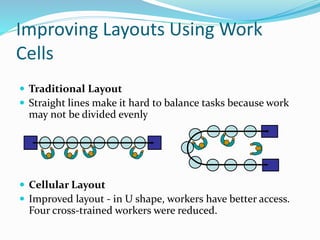
 Traditional Layout
 Straight lines make it hard to balance tasks because work
may not be divided evenly
 Cellular Layout
 Improved layout - in U shape, workers have better access.
Four cross-trained workers were reduced.
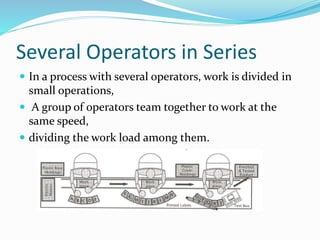
Several Operators in Series
 In a process with several operators, work is divided in
small operations,
 A group of operators team together to work at the
same speed,
 dividing the work load among them.
Advantages
 Reduced work-in-process inventory
 Less floor space required
 Shorter flow time of the product, no wait in batches
due to less distance between machines
 Reduced raw material and finished goods inventory
 Reduced set up time
 Heightened sense of employee participation
 Increased use of equipment and machinery
Limitations
 When new products manufacturing are required, if
they do not fit into the existing cell then whole
manufacturing set up needs to be restructured.
 To implement cellular layout cost required is high.
Case study
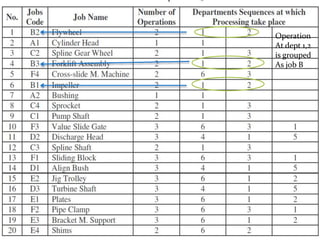
 The jobs were taken from company records for the last year.
Therefore, it is most likely that the company will receive
the same type of jobs in the following year.
 The jobs are chosen on pareto analysis which is a method
of classifying items according to their relative importance.
The importance in this case is the Annual Revenue
Value(ARV) for the company under study. This amounted
to 20 jobs.
 The jobs arrive at the shop with a mean time of 45 mints.
These jobs to be manufactured require processing from
department 1 to 3. The sequence of processing through
their respective departments are shown in the next slide.
Operation
At dept 1,2
is grouped
As job B
The processing of jobs is accomplished with the aid of 15
machines arranged in 6 functional departments in the
machine shop.
Existing Layout of the plant
Lathe machines
Boring machines
Milling
machines
Grinding Machines
Shaper Machines
Drilling Machines
Existing system
 As jobs arrive in the shop they are held in a waiting
queue.
 Based on operations required by jobs they are
sequenced.
 Scheduling of jobs is determined on the customers
delivery date or FIFO.
 Jobs are processed on first free machine of the
department.
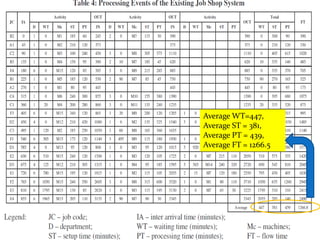
Average WT=447,
Average ST = 381,
Average PT = 439,
Average FT = 1266.5
Cellular Manufacturing System
(new)
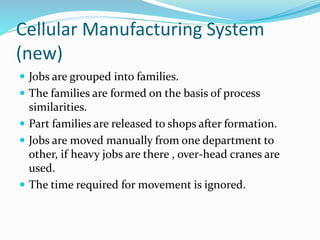
 Jobs are grouped into families.
 The families are formed on the basis of process
similarities.
 Part families are released to shops after formation.
 Jobs are moved manually from one department to
other, if heavy jobs are there , over-head cranes are
used.
 The time required for movement is ignored.
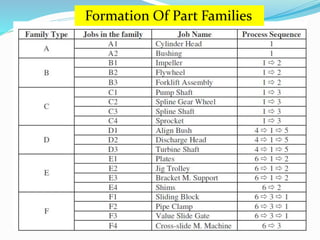
Formation Of Part Families
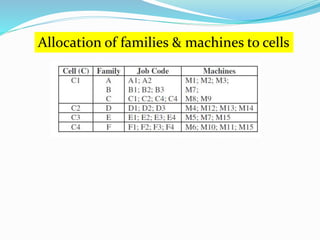
Allocation of families & machines to cells
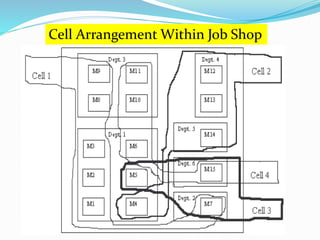
Cell Arrangement Within Job Shop
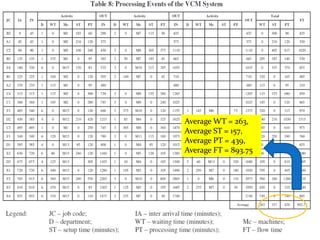
Average WT = 263,
Average ST = 157,
Average PT = 439,
Average FT = 893.75
Conclusion
 In this case study emphasis was given to reduce waste,
in terms of delays in flow time.
 By applying cellular manufacturing to this plant the
average WT, ST & FT were reduced by 41%, 59% & 30%
respectively.
 Cost associated with this venture is considerably small
in comparison to benefit derived.
References
 Bansee ,J. & Chowdary, B.V., 2007, “ A new concept
cellular manufacturing”, 5th Latin American &
Caribbean Conference for Engg. & technology,7D.1-10.
 Askin & Standridge,1993, “Group Technolgy”, p.p.1-24.
 Groover, M.P., 2012, “Cellular Manufacturing”, ch-
18,p.p.-445 - 490
Thank You

Cellular manufacturing

  • 1.
  • 2.
    Introduction  Manufacturing isthe process of converting raw material into finished or semi finished part.  Production is the use of man, material and machine to produce finished products.  Production system can be defined as a transformation system in which a saleable product or service is created by working upon a set of inputs.
  • 3.
    Production system Production systemcan be broadly classified as-  Job shop production- products are made to satisfy a specific order.  Batch production- number of identical articles are manufactured either to meet a continuous demand or present demand.  Mass production- same type of products is manufactured to meet the continuous demand of the product.
  • 4.
  • 5.
    Cellular manufacturing  Organizingthe production equipment into machine cells, where each cell specialize in the production of a part family is called cellular manufacturing.  It is an application of group technology in manufacturing.  Cellular manufacturing can be implemented by manual or automated methods.  When automated, the term flexible manufacturing is applied.
  • 6.
    Product A,B,C- different part families. Cell1,2,3-set of machines to produce part families.
  • 7.
    Cellular manufacturing  Thisapproach facilitates continuous flow of production.  It provides flexibility to produce variety of low demand products.  This layout is suitable for medium variety and medium volume environment.  Cellular layout is also known as product- process layout.
  • 8.
    Group technology  Amanufacturing philosophy in which similar parts are identified & grouped together to take advantage of their similarities in design and production.  It contributes to the integration of CAD (Computer Aided Design) and CAM (Computer Aided Manufacturing).  The group of similar parts is known as part family and the group of machineries used to process an individual part family is known as machine cell
  • 9.
    Conditions for applications The plant currently uses process type layout.  The parts can be grouped into part families is a must condition.
  • 10.
    Part families A collectionof parts that possess similarities in geometric shape & size, or in processing steps used in their manufacture.
  • 11.
    Methods to identifypart families  Visual Inspection- using best judgment to group parts into part families.  Part Classification & Coding- identifying the similarities among parts & relating them with numerical coding system.  Production flow analysis- Using operation and route sheets to classify parts into part families.
  • 12.
    Improving Layouts UsingWork Cells  Traditional Layout  Straight lines make it hard to balance tasks because work may not be divided evenly  Cellular Layout  Improved layout - in U shape, workers have better access. Four cross-trained workers were reduced.
  • 13.
    Several Operators inSeries  In a process with several operators, work is divided in small operations,  A group of operators team together to work at the same speed,  dividing the work load among them.
  • 14.
    Advantages  Reduced work-in-processinventory  Less floor space required  Shorter flow time of the product, no wait in batches due to less distance between machines  Reduced raw material and finished goods inventory  Reduced set up time  Heightened sense of employee participation  Increased use of equipment and machinery
  • 15.
    Limitations  When newproducts manufacturing are required, if they do not fit into the existing cell then whole manufacturing set up needs to be restructured.  To implement cellular layout cost required is high.
  • 16.
    Case study  Thejobs were taken from company records for the last year. Therefore, it is most likely that the company will receive the same type of jobs in the following year.  The jobs are chosen on pareto analysis which is a method of classifying items according to their relative importance. The importance in this case is the Annual Revenue Value(ARV) for the company under study. This amounted to 20 jobs.  The jobs arrive at the shop with a mean time of 45 mints. These jobs to be manufactured require processing from department 1 to 3. The sequence of processing through their respective departments are shown in the next slide.
  • 17.
    Operation At dept 1,2 isgrouped As job B
  • 18.
    The processing ofjobs is accomplished with the aid of 15 machines arranged in 6 functional departments in the machine shop.
  • 19.
    Existing Layout ofthe plant Lathe machines Boring machines Milling machines Grinding Machines Shaper Machines Drilling Machines
  • 20.
    Existing system  Asjobs arrive in the shop they are held in a waiting queue.  Based on operations required by jobs they are sequenced.  Scheduling of jobs is determined on the customers delivery date or FIFO.  Jobs are processed on first free machine of the department.
  • 22.
    Average WT=447, Average ST= 381, Average PT = 439, Average FT = 1266.5
  • 24.
    Cellular Manufacturing System (new) Jobs are grouped into families.  The families are formed on the basis of process similarities.  Part families are released to shops after formation.  Jobs are moved manually from one department to other, if heavy jobs are there , over-head cranes are used.  The time required for movement is ignored.
  • 25.
  • 26.
    Allocation of families& machines to cells
  • 27.
  • 28.
    Average WT =263, Average ST = 157, Average PT = 439, Average FT = 893.75
  • 30.
    Conclusion  In thiscase study emphasis was given to reduce waste, in terms of delays in flow time.  By applying cellular manufacturing to this plant the average WT, ST & FT were reduced by 41%, 59% & 30% respectively.  Cost associated with this venture is considerably small in comparison to benefit derived.
  • 31.
    References  Bansee ,J.& Chowdary, B.V., 2007, “ A new concept cellular manufacturing”, 5th Latin American & Caribbean Conference for Engg. & technology,7D.1-10.  Askin & Standridge,1993, “Group Technolgy”, p.p.1-24.  Groover, M.P., 2012, “Cellular Manufacturing”, ch- 18,p.p.-445 - 490
  • 32.

Editor's Notes

  • #3 Manufacturing process is a value addition process to raw material. Set of inputs are man, machine and material.
  • #10 If the plant uses batch production with process type layout it results in much material handling effort, high in process inventory and long manufacturing lead time. The parts can be grouped into part families should be a necessary condition. In a typical medium volume and medium variety production firm most of the parts can be grouped into part families because of the similarities in them.
  • #11 1.Two parts similar in geometry 2.Parts similar due to manufacturing processes.
  • #12 1.Visual Inspection- this method is based on judgment done by workers. On the basis of photos and external looks of part it is grouped into families.# chances of error are high. 2.Part classification & coding- # most time consuming method but this method is used because it gives following information's: Design retrivals, Automated process planning and Machine cell design.
  • #31 Flow time is the total time a job takes to be completed. FT=ST+WT+PT