PRODUCTION
PLANNING AND
CONROL
Submitted by
Reshma Babu
Roll no.: 42
Content
 Production
 Production Planning
 Production control
 Production Planning and control
 Objectives
 Importance
 Limitation
 Elements
 Refernces
Production
 Production is concerned with transforming raw
material into finished product with the help of
energy, capital, manpower and machinery.
 The aim of a good production policy is to achieve
maximum output with minimum input.
 Production policies and procedures are concerned
with production planning and control.
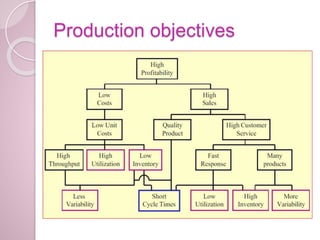
Production objectives
Production Planning
Meaning:
Production planning involves management decisions
on the resources that the firm will require for its
manufacturing operations and the selection of these
resources to produce the desired goods at the
appropriate time and at the least possible cost.
Definition:
According to Ray Wild, production planning is defined
as follows:
“Production Planning is concerned with the
determination, acquisition and arrangement of all
facilities necessary for future operations.”
Objectives of Production
Planning
1. Effective utilization of resources
2. Steady flow of production
3. Estimate resources
4. Ensure optimum inventory
5. Coordinate activities of departments
6. Minimize wastage of raw materials
7. Improper the labor productivity
8. Help to capture the market
9. Provide a better work environment
10. Facilitate quality improvement
11. Result in consumer satisfaction
12. Reduce the production costs.
Functions of Production
Planning
 Product selection & design
 Process selection & planning
 Facility location
 Facility layout & materials handling
 Capacity planning
 Systems & procedures
 Estimating quantity/costs of production, men
 Routing operation sequence
 Job scheduling & loading
Production Control
Meaning:
Production control guides and directs flow of
production so that products are manufactured in a
best way and conform to a planned schedule and
are of the right quality. Control facilitates the task of
manufacturing and sees that every theme goes as
per the plan.
Definition:
“ Production control is the art and science of ensuring
that all which occurs is in accordance with the rules
established and the instructions issued”.—Henry
Fayol
Objectives of Production
Control
1. To ensure that various inputs are available in
required quantity and quality
2. To organize production schedule in conformity
with the demand forecasts.
3. Resources used in best possible manner – cost
of production is minimized and delivery date is
maintained.
4. To ensure regular and timely supply of raw
material in prescribed quality and quantity to
avoid delays in production.
5. To perform inspection and use quality control
techniques.
6. Proper co-ordination of operation of various
sections/department responsible for production.

Functions of Production
Control
•Inventory control: MRP; JIT
•Time management
•Quality control
•Maintenance & replacement
•Cost reduction & cost control
•Dispatch
•Expediting/Follow-up/ Progressing
Production Planning and
Control
Meaning:
Production planning and control is concerned
with directing production along the lines set by
the planning department.
Definition:
"Production planning and control is the co-ordination
of series of functions according to a plan which
will economically utilize the plant facilities and
regulate the orderly movement of goods through
the entire manufacturing cycle from the
procurement of all materials to the shipping of
finished goods at a predetermined rate."
-CHARLES A. KOEPKE
Production planning and control can be
defined as “the process of planning or
deciding on the resources the firm will require
for its future manufacturing operations and of
allocating and time scheduling these
resources to produce the desired products on
time at the least total cost”.
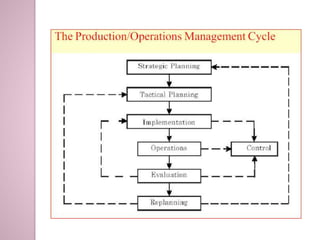
Three stages in Production Planning and Control
function are:
Planning - Choosing the best course of action among several
alternatives.
Operation- Execution as per plan
Control- Maintaining the performance by companies the actual
results with performance standards set and taking appropriate
corrective action if necessary to reduce variance.
Objectives of Production
Planning and Control
1. To deliver quality goods in required quantities to the
customer in the required delivery schedule to achieve
maximum customer satisfaction and minimum possible
cost.
2. To ensure maximum utilization of all resources
3. To ensure production of quality products
4. To minimize the product through-put time or
production/manufacturing cycle time
5. To maintain optimum inventory levels.
6. To maintain flexibility in manufacturing operation.
7. To coordinate between labor and machines and various
supporting departments
8. To plan for plant capacities for future requirements
9. To remove bottle neck at all stages of production and to
solve problems related to production
10. To ensure effective cost reduction and cost control.
Requirements for Effective
Production Planning and Control
•Sound organizational structure
•Delegation of authority
•Reliable, up-to-date feedback
•Standardization
•Trained people
•Flexibility to adapt
•Appropriate management policies
•Accurate assessment of manufacturing/
procurement lead times
•Adequate plant capacity.
Need and Importance of
production planning and control
1. For increasing production
2. For co-coordinating plant activity
3. For cost control
4. For rationalization of production
activities
5. Consumers
Benefits of Production
planning & Control
•Higher quality
•Better resource utilization
•Reduced inventory
•Reduced manufacturing cycle time
•Faster delivery
•Better customer services
•Lower production costs
Benefits(continued)
 Lower capital investment
 Higher customer service
 Improved sales turnover
 Improved market share
 Improved profitability
 Competitive advantage
 Flexibility
 Dependability
 Lower price.
Limitations of Production
Planning and Control
1. Based on assumptions
2. Rigidity
3. Difficult for small firms
4. Costly
5. Dependence on external factors
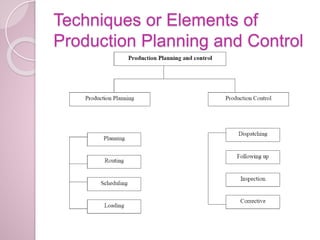
Techniques or Elements of
Production Planning and Control
Planning
 First and most important element
 Refers to deciding in advance what is to be
done in future.
 Anticipates possible difficulties
 Separate dept- responsible for the
preparation of policies and plans
 Control devices also decided in advance-
activities are carried on properly.
 If production planning defective, then
control defective.
Routing
 “Routing may be defined as the selection of paths
or routes over which each piece is to travel in being
transformed from raw material into finished
product”.—Kimball and Kimball Jr.
 It determines what work will be done on a product and
how it will be done.
Routing procedure involves the following different
activities:
(1) An analysis of the article to determine what to make
and what to buy.
(2) To determine the quality and type of material
(3) Determining the manufacturing operations and their
sequence.
(4) A determination of lot sizes
(5) Determination of scrap factors
(6) an analysis of cost of the article
Scheduling
 Scheduling is the determining of time and date
when each operation is to be commenced and
completed. It includes the scheduling of materials,
machines and all other requisites of production.
 “The determination of the time that should be
required to perform each operation and also the
time necessary to perform the entire series as
routed, making allowance for all factors
concerned.”—Kimball and Kimball Jr.
 “Work Scheduling consists of the assignment of
starting and completion times for the various
operations to be performed.”—James C. Lundy
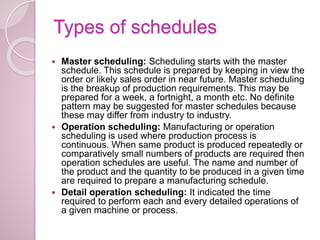
Types of schedules
 Master scheduling: Scheduling starts with the master
schedule. This schedule is prepared by keeping in view the
order or likely sales order in near future. Master scheduling
is the breakup of production requirements. This may be
prepared for a week, a fortnight, a month etc. No definite
pattern may be suggested for master schedules because
these may differ from industry to industry.
 Operation scheduling: Manufacturing or operation
scheduling is used where production process is
continuous. When same product is produced repeatedly or
comparatively small numbers of products are required then
operation schedules are useful. The name and number of
the product and the quantity to be produced in a given time
are required to prepare a manufacturing schedule.
 Detail operation scheduling: It indicated the time
required to perform each and every detailed operations of
a given machine or process.
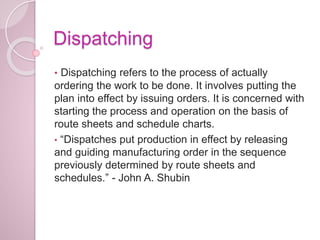
Dispatching
• Dispatching refers to the process of actually
ordering the work to be done. It involves putting the
plan into effect by issuing orders. It is concerned with
starting the process and operation on the basis of
route sheets and schedule charts.
• “Dispatches put production in effect by releasing
and guiding manufacturing order in the sequence
previously determined by route sheets and
schedules.” - John A. Shubin
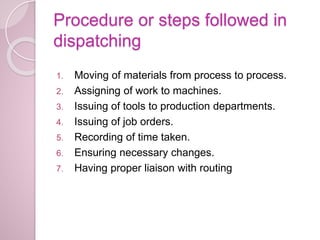
Procedure or steps followed in
dispatching
1. Moving of materials from process to process.
2. Assigning of work to machines.
3. Issuing of tools to production departments.
4. Issuing of job orders.
5. Recording of time taken.
6. Ensuring necessary changes.
7. Having proper liaison with routing
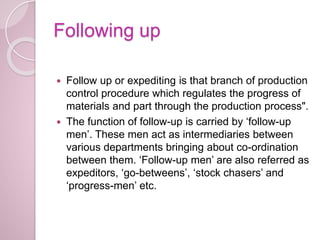
Following up
 Follow up or expediting is that branch of production
control procedure which regulates the progress of
materials and part through the production process".
 The function of follow-up is carried by ‘follow-up
men’. These men act as intermediaries between
various departments bringing about co-ordination
between them. ‘Follow-up men’ are also referred as
expeditors, ‘go-betweens’, ‘stock chasers’ and
‘progress-men’ etc.
Generally production is assumed to progress as
expected. But there may be differences which
may arise due to the following reasons:
1. Materials may be delivered late or may not be
delivered at all.
2. Associated departments may have fallen
behind in their own production.
3. There may be excessive absenteeism on the
part of the worker.
4. The customer may insist on changing the
specification or delivery date.
5. Machines may break down.
6. There may be errors in drawings.
7. There may be too many rejections due to poor
material quality.
Inspection
•In the words of Kimball and Kimball Jr. “Inspection is
the art of comparing materials, product or
performance with established standards.”
• Inspection is the process of ensuring whether the
products manufactured are of requisite quality or not.
•Inspection is undertaken both of products and
inputs.
•It is carried on at various levels of production
process so that pre-determined standards of quality
are achieved.
•Inspection ensures the maintenance of pre-
determined quality of products.
Corrective measures
 Corrective action may involve any of those
activities of adjusting the route, rescheduling of
work, changing the workloads, repairs and
maintenance of machinery or equipment, control
over inventories, poor performance of the
employees.
 Certain personnel decisions like training, transfer,
demotion etc. may have to be taken.
 Alternative methods may be suggested to handle
peak loads.
Conclusion
•Smooth working process
•Sales maximization
•Profit maximization
•Consumers satisfaction
•Continuous flow of production and distribution
References
1. http://www.yourarticlelibrary.com/production-management/elements-of-
production-planning-and-control-in-an-organization/26170/
2. http://www.managementstudyguide.com/production-planning-and-
control.htm
3. http://kalyan-city.blogspot.com/2013/02/stages-or-steps-in-production-
planning.html
4. http://www.bms.co.in/objectives-of-production-planning-control/
5. James B. Dilworth, 1993,”production and operations management”
manufacturing and services, fifth edition.
6. Seetharama L. Narasiimhan, Dennis W. McLeavey, Peter J. Billington,
1995, “production planning and inventory control, second edition.
7. B. Mahadevan, 1964, “operations management theory and practice”,
second edition.
8. http://www.managementstudyguide.com/production-planning-and-
control.htm
9. http://kkhsou.in/main/EVidya2/management/production_planning.html
10. http://en.wikipedia.org/wiki/Ppc_cycle
11. http://www.mbaofficial.com/mba-courses/operations-management/what-
are-the-objectives-and-functions-of-production-planning-and-control/
References(continued)
12. http://www.yourarticlelibrary.com/production-management/production-
planning-its-meaning-and-objectives/26168/
13. http://kalyan-city.blogspot.com/2012/01/what-is-production-planning-
meaning.html
14. https://www.welingkaronline.org/DLP/OPERATIONS%20%28REVISED%
29%20-Machineshop%20Production%20and%20planning-
HEMANT%20NAGARE.pdf
15. http://www.slideshare.net/VIP26082010/production-planning-control-
ppc?related=1
16. http://www.slideshare.net/amirthakarthi/production-planning-control-
15402497?related=2
17. http://www.slideshare.net/WelingkarDLP/product-operation-planning-
control?related=3
18. http://discovery.bits-
pilani.ac.in/dlpd/courses/coursecontent/courseMaterial%5Cmmzg511%5
CMOML18.pdf
19. http://www.slideshare.net/SwatanuSatpathy/group-8-8792098?related=2
20. http://www.slideshare.net/abubashars/production-planning-
controlppc?related=3
21. http://www.slideshare.net/laxmikantd/production-planning-and-control-
11495751
production planning and control

production planning and control

  • 1.
  • 2.
    Content  Production  ProductionPlanning  Production control  Production Planning and control  Objectives  Importance  Limitation  Elements  Refernces
  • 3.
    Production  Production isconcerned with transforming raw material into finished product with the help of energy, capital, manpower and machinery.  The aim of a good production policy is to achieve maximum output with minimum input.  Production policies and procedures are concerned with production planning and control.
  • 4.
  • 6.
    Production Planning Meaning: Production planninginvolves management decisions on the resources that the firm will require for its manufacturing operations and the selection of these resources to produce the desired goods at the appropriate time and at the least possible cost. Definition: According to Ray Wild, production planning is defined as follows: “Production Planning is concerned with the determination, acquisition and arrangement of all facilities necessary for future operations.”
  • 7.
    Objectives of Production Planning 1.Effective utilization of resources 2. Steady flow of production 3. Estimate resources 4. Ensure optimum inventory 5. Coordinate activities of departments 6. Minimize wastage of raw materials 7. Improper the labor productivity 8. Help to capture the market 9. Provide a better work environment 10. Facilitate quality improvement 11. Result in consumer satisfaction 12. Reduce the production costs.
  • 8.
    Functions of Production Planning Product selection & design  Process selection & planning  Facility location  Facility layout & materials handling  Capacity planning  Systems & procedures  Estimating quantity/costs of production, men  Routing operation sequence  Job scheduling & loading
  • 9.
    Production Control Meaning: Production controlguides and directs flow of production so that products are manufactured in a best way and conform to a planned schedule and are of the right quality. Control facilitates the task of manufacturing and sees that every theme goes as per the plan. Definition: “ Production control is the art and science of ensuring that all which occurs is in accordance with the rules established and the instructions issued”.—Henry Fayol
  • 10.
    Objectives of Production Control 1.To ensure that various inputs are available in required quantity and quality 2. To organize production schedule in conformity with the demand forecasts. 3. Resources used in best possible manner – cost of production is minimized and delivery date is maintained. 4. To ensure regular and timely supply of raw material in prescribed quality and quantity to avoid delays in production. 5. To perform inspection and use quality control techniques. 6. Proper co-ordination of operation of various sections/department responsible for production.
  • 11.
    Functions of Production Control •Inventorycontrol: MRP; JIT •Time management •Quality control •Maintenance & replacement •Cost reduction & cost control •Dispatch •Expediting/Follow-up/ Progressing
  • 12.
    Production Planning and Control Meaning: Productionplanning and control is concerned with directing production along the lines set by the planning department. Definition: "Production planning and control is the co-ordination of series of functions according to a plan which will economically utilize the plant facilities and regulate the orderly movement of goods through the entire manufacturing cycle from the procurement of all materials to the shipping of finished goods at a predetermined rate." -CHARLES A. KOEPKE
  • 13.
    Production planning andcontrol can be defined as “the process of planning or deciding on the resources the firm will require for its future manufacturing operations and of allocating and time scheduling these resources to produce the desired products on time at the least total cost”. Three stages in Production Planning and Control function are: Planning - Choosing the best course of action among several alternatives. Operation- Execution as per plan Control- Maintaining the performance by companies the actual results with performance standards set and taking appropriate corrective action if necessary to reduce variance.
  • 14.
    Objectives of Production Planningand Control 1. To deliver quality goods in required quantities to the customer in the required delivery schedule to achieve maximum customer satisfaction and minimum possible cost. 2. To ensure maximum utilization of all resources 3. To ensure production of quality products 4. To minimize the product through-put time or production/manufacturing cycle time 5. To maintain optimum inventory levels. 6. To maintain flexibility in manufacturing operation. 7. To coordinate between labor and machines and various supporting departments 8. To plan for plant capacities for future requirements 9. To remove bottle neck at all stages of production and to solve problems related to production 10. To ensure effective cost reduction and cost control.
  • 15.
    Requirements for Effective ProductionPlanning and Control •Sound organizational structure •Delegation of authority •Reliable, up-to-date feedback •Standardization •Trained people •Flexibility to adapt •Appropriate management policies •Accurate assessment of manufacturing/ procurement lead times •Adequate plant capacity.
  • 16.
    Need and Importanceof production planning and control 1. For increasing production 2. For co-coordinating plant activity 3. For cost control 4. For rationalization of production activities 5. Consumers
  • 17.
    Benefits of Production planning& Control •Higher quality •Better resource utilization •Reduced inventory •Reduced manufacturing cycle time •Faster delivery •Better customer services •Lower production costs
  • 18.
    Benefits(continued)  Lower capitalinvestment  Higher customer service  Improved sales turnover  Improved market share  Improved profitability  Competitive advantage  Flexibility  Dependability  Lower price.
  • 19.
    Limitations of Production Planningand Control 1. Based on assumptions 2. Rigidity 3. Difficult for small firms 4. Costly 5. Dependence on external factors
  • 20.
    Techniques or Elementsof Production Planning and Control
  • 21.
    Planning  First andmost important element  Refers to deciding in advance what is to be done in future.  Anticipates possible difficulties  Separate dept- responsible for the preparation of policies and plans  Control devices also decided in advance- activities are carried on properly.  If production planning defective, then control defective.
  • 22.
    Routing  “Routing maybe defined as the selection of paths or routes over which each piece is to travel in being transformed from raw material into finished product”.—Kimball and Kimball Jr.  It determines what work will be done on a product and how it will be done. Routing procedure involves the following different activities: (1) An analysis of the article to determine what to make and what to buy. (2) To determine the quality and type of material (3) Determining the manufacturing operations and their sequence. (4) A determination of lot sizes (5) Determination of scrap factors (6) an analysis of cost of the article
  • 23.
    Scheduling  Scheduling isthe determining of time and date when each operation is to be commenced and completed. It includes the scheduling of materials, machines and all other requisites of production.  “The determination of the time that should be required to perform each operation and also the time necessary to perform the entire series as routed, making allowance for all factors concerned.”—Kimball and Kimball Jr.  “Work Scheduling consists of the assignment of starting and completion times for the various operations to be performed.”—James C. Lundy
  • 24.
    Types of schedules Master scheduling: Scheduling starts with the master schedule. This schedule is prepared by keeping in view the order or likely sales order in near future. Master scheduling is the breakup of production requirements. This may be prepared for a week, a fortnight, a month etc. No definite pattern may be suggested for master schedules because these may differ from industry to industry.  Operation scheduling: Manufacturing or operation scheduling is used where production process is continuous. When same product is produced repeatedly or comparatively small numbers of products are required then operation schedules are useful. The name and number of the product and the quantity to be produced in a given time are required to prepare a manufacturing schedule.  Detail operation scheduling: It indicated the time required to perform each and every detailed operations of a given machine or process.
  • 25.
    Dispatching • Dispatching refersto the process of actually ordering the work to be done. It involves putting the plan into effect by issuing orders. It is concerned with starting the process and operation on the basis of route sheets and schedule charts. • “Dispatches put production in effect by releasing and guiding manufacturing order in the sequence previously determined by route sheets and schedules.” - John A. Shubin
  • 26.
    Procedure or stepsfollowed in dispatching 1. Moving of materials from process to process. 2. Assigning of work to machines. 3. Issuing of tools to production departments. 4. Issuing of job orders. 5. Recording of time taken. 6. Ensuring necessary changes. 7. Having proper liaison with routing
  • 27.
    Following up  Followup or expediting is that branch of production control procedure which regulates the progress of materials and part through the production process".  The function of follow-up is carried by ‘follow-up men’. These men act as intermediaries between various departments bringing about co-ordination between them. ‘Follow-up men’ are also referred as expeditors, ‘go-betweens’, ‘stock chasers’ and ‘progress-men’ etc.
  • 28.
    Generally production isassumed to progress as expected. But there may be differences which may arise due to the following reasons: 1. Materials may be delivered late or may not be delivered at all. 2. Associated departments may have fallen behind in their own production. 3. There may be excessive absenteeism on the part of the worker. 4. The customer may insist on changing the specification or delivery date. 5. Machines may break down. 6. There may be errors in drawings. 7. There may be too many rejections due to poor material quality.
  • 29.
    Inspection •In the wordsof Kimball and Kimball Jr. “Inspection is the art of comparing materials, product or performance with established standards.” • Inspection is the process of ensuring whether the products manufactured are of requisite quality or not. •Inspection is undertaken both of products and inputs. •It is carried on at various levels of production process so that pre-determined standards of quality are achieved. •Inspection ensures the maintenance of pre- determined quality of products.
  • 30.
    Corrective measures  Correctiveaction may involve any of those activities of adjusting the route, rescheduling of work, changing the workloads, repairs and maintenance of machinery or equipment, control over inventories, poor performance of the employees.  Certain personnel decisions like training, transfer, demotion etc. may have to be taken.  Alternative methods may be suggested to handle peak loads.
  • 31.
    Conclusion •Smooth working process •Salesmaximization •Profit maximization •Consumers satisfaction •Continuous flow of production and distribution
  • 32.
    References 1. http://www.yourarticlelibrary.com/production-management/elements-of- production-planning-and-control-in-an-organization/26170/ 2. http://www.managementstudyguide.com/production-planning-and- control.htm 3.http://kalyan-city.blogspot.com/2013/02/stages-or-steps-in-production- planning.html 4. http://www.bms.co.in/objectives-of-production-planning-control/ 5. James B. Dilworth, 1993,”production and operations management” manufacturing and services, fifth edition. 6. Seetharama L. Narasiimhan, Dennis W. McLeavey, Peter J. Billington, 1995, “production planning and inventory control, second edition. 7. B. Mahadevan, 1964, “operations management theory and practice”, second edition. 8. http://www.managementstudyguide.com/production-planning-and- control.htm 9. http://kkhsou.in/main/EVidya2/management/production_planning.html 10. http://en.wikipedia.org/wiki/Ppc_cycle 11. http://www.mbaofficial.com/mba-courses/operations-management/what- are-the-objectives-and-functions-of-production-planning-and-control/
  • 33.
    References(continued) 12. http://www.yourarticlelibrary.com/production-management/production- planning-its-meaning-and-objectives/26168/ 13. http://kalyan-city.blogspot.com/2012/01/what-is-production-planning- meaning.html 14.https://www.welingkaronline.org/DLP/OPERATIONS%20%28REVISED% 29%20-Machineshop%20Production%20and%20planning- HEMANT%20NAGARE.pdf 15. http://www.slideshare.net/VIP26082010/production-planning-control- ppc?related=1 16. http://www.slideshare.net/amirthakarthi/production-planning-control- 15402497?related=2 17. http://www.slideshare.net/WelingkarDLP/product-operation-planning- control?related=3 18. http://discovery.bits- pilani.ac.in/dlpd/courses/coursecontent/courseMaterial%5Cmmzg511%5 CMOML18.pdf 19. http://www.slideshare.net/SwatanuSatpathy/group-8-8792098?related=2 20. http://www.slideshare.net/abubashars/production-planning- controlppc?related=3 21. http://www.slideshare.net/laxmikantd/production-planning-and-control- 11495751