Plant–Location & Layout
PLANT LOCATION AND LAYOUT
 Location of Plant involves commitment of resources to a
long range plan
 Need for selection of location
 Business newly started
 Existing business has outgrown the capacity of the original facilities
 Volume of business or extent of market needs establishing of
branches
 Lease expires and the landlord does not renew the lease
 Other social or economic reasons e.g. Inadequate labour supply,
shifting of markets etc.
PLANT LOCATION AND LAYOUT
Principal factors which influence the choice of
location are.
1. Proximity to market
2. Integration with other parts of the organisation
3. Availability of labour and skills
4. Availability of amenities
5. Availability of transport
6. Availability of inputs
PLANT LOCATION AND LAYOUT
7. Availability of services
8. Suitability of land and climate
9. Regional regulations
10. Room for expansions
11. Safety requirements
12. Site cost
13. Political, cultural and economics situation
14. Special grants, regional taxes and import/export
barriers
PLANT LOCATION AND LAYOUT
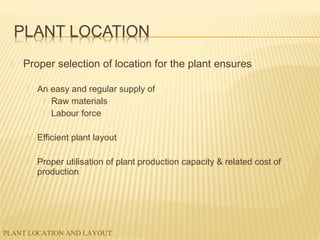
 Proper selection of location for the plant ensures
 An easy and regular supply of
 Raw materials
 Labour force
 Efficient plant layout
 Proper utilisation of plant production capacity & related cost of
production
PLANT LOCATION AND LAYOUT
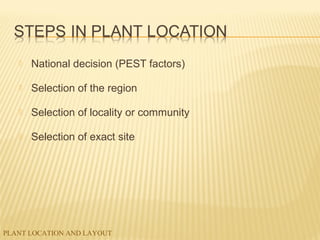
 National decision (PEST factors)
 Selection of the region
 Selection of locality or community
 Selection of exact site
PLANT LOCATION AND LAYOUT
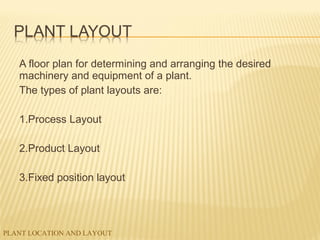
A floor plan for determining and arranging the desired
machinery and equipment of a plant.
The types of plant layouts are:
1.Process Layout
2.Product Layout
3.Fixed position layout
PLANT LOCATION AND LAYOUT
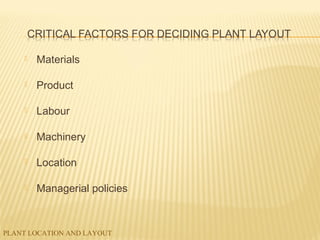
 Materials
 Product
 Labour
 Machinery
 Location
 Managerial policies
PLANT LOCATION AND LAYOUT
 Grouping together of similar machines in one
department
 Material moves from one group of machines to the
other
 Movement over longer distance and along criss-cross
paths
 May also involve part finished inventory waiting
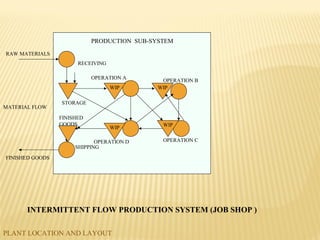
PRODUCTION SUB-SYSTEM
RECEIVING
STORAGE
OPERATION A
OPERATION B
OPERATION COPERATION D
SHIPPING
INTERMITTENT FLOW PRODUCTION SYSTEM (JOB SHOP )
WIP
WIP
WIP
WIP
FINISHED
GOODS
RAW MATERIALS
MATERIAL FLOW
FINISHED GOODS
PLANT LOCATION AND LAYOUT
 Advantages
 Reduced investment on machines, being general purpose
machines
 Greater flexibility in production
 Better and more efficient supervision
 Greater scope of expansion
 Better utilisation of resources
 Handling breakdown of equipment easier-jobs can be
transferred to other machines
 Full utilisation of machinery
PLANT LOCATION AND LAYOUT
 Limitations
 Difficulty in movement of materials
 Layout requires more space
 Difficulty in production control
 Production time increased because of extra travel
 Accumulation of work-in-process at different machines
PLANT LOCATION AND LAYOUT
 Machines arranged in a line depending upon sequence of
operations
 Material moves in a line from the first machine to the
finished product on the last machine.
 Investment higher as compared to process layout
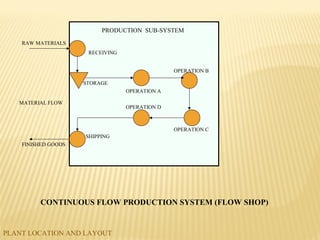
FINISHED GOODS
MATERIAL FLOW
RAW MATERIALS
PRODUCTION SUB-SYSTEM
RECEIVING
STORAGE
OPERATION A
OPERATION B
OPERATION C
OPERATION D
SHIPPING
CONTINUOUS FLOW PRODUCTION SYSTEM (FLOW SHOP)
PLANT LOCATION AND LAYOUT
 Advantages
 Reduction in material handling cost due to mechanisation
 Layout avoids production bottlenecks
 Economy in manufacturing time
 Better production control
 Requires less floor area per unit of production
 Work-in-progress in reduced
 Early detection of mistakes
PLANT LOCATION AND LAYOUT
 Limitations
 Layout inflexible
 Layout expensive
 Difficulty in supervision
 Expansion is difficult
 Any breakdown along the line can disrupt total production
PLANT LOCATION AND LAYOUT
 Movement of men & machinery to the product
 Product remains stationary
 Cost of moving product is high, product being bulky
PLANT LOCATION AND LAYOUT
Advantages
 Men/machinery can be moved for a wide variety of operations
producing different products
 Worker identifies himself with the product & takes pride when
the work is completed
 Investment on layout is small
 High cost & difficulty in transporting a bulky job avoided
PLANT LOCATION AND LAYOUT
Limitations
Layout usage is only one time
Skilled workforce required
Work location not favourable
Work completion requires a lot of time
PLANT LOCATION AND LAYOUT
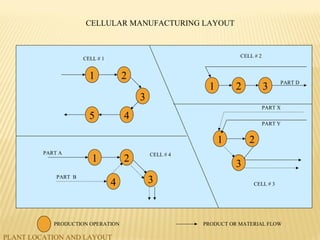
 Grouping of machines into cells
 Cells function somewhat like product layout within a
larger shop or process layout
 Each cell in the cm formed to produce a single part /
a few parts
 All with common characteristics which usually requires
similar machines and settings
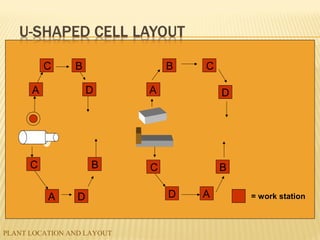
 Flow of parts within the cell can take many forms
1 2
3
45
1 2 3
1 2
34
21
CELL # 3
CELL # 4
CELL # 1
CELL # 2
PRODUCTION OPERATION PRODUCT OR MATERIAL FLOW
CELLULAR MANUFACTURING LAYOUT
PART D
PART Y
PART X
PART A
PART B
3
PLANT LOCATION AND LAYOUT
A
C B
D A
B C
D
C
A D
B C
D A
B
= work station
PLANT LOCATION AND LAYOUT
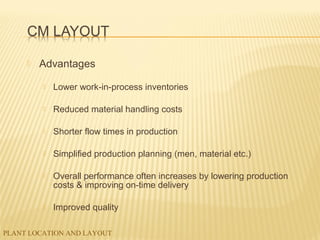
 Advantages
 Lower work-in-process inventories
 Reduced material handling costs
 Shorter flow times in production
 Simplified production planning (men, material etc.)
 Overall performance often increases by lowering production
costs & improving on-time delivery
 Improved quality
PLANT LOCATION AND LAYOUT
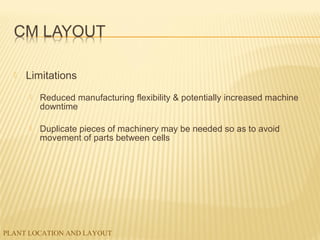
 Limitations
 Reduced manufacturing flexibility & potentially increased machine
downtime
 Duplicate pieces of machinery may be needed so as to avoid
movement of parts between cells
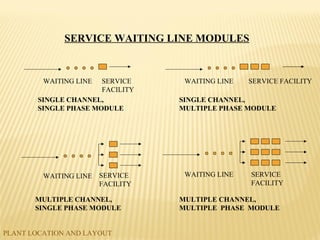
SERVICE WAITING LINE MODULES
SINGLE CHANNEL,
SINGLE PHASE MODULE
WAITING LINE SERVICE
FACILITY
MULTIPLE CHANNEL,
SINGLE PHASE MODULE
SERVICE
FACILITY
WAITING LINE
SINGLE CHANNEL,
MULTIPLE PHASE MODULE
WAITING LINE SERVICE FACILITY
SERVICE
FACILITY
WAITING LINE
MULTIPLE CHANNEL,
MULTIPLE PHASE MODULE
PLANT LOCATION AND LAYOUT
 Plant layout has to provide for other facilities also
 Location for receiving and shipping departments
 Storage
 Inspection
 Maintenance
 Employee facilities
 Others, as applicable to various plants
 Power generators
 Water treatment plants
 Oil tankers
 Compressed air, Chilled water plants etc.
THANK YOU

Plant location and layout

  • 1.
  • 2.
    PLANT LOCATION ANDLAYOUT  Location of Plant involves commitment of resources to a long range plan  Need for selection of location  Business newly started  Existing business has outgrown the capacity of the original facilities  Volume of business or extent of market needs establishing of branches  Lease expires and the landlord does not renew the lease  Other social or economic reasons e.g. Inadequate labour supply, shifting of markets etc.
  • 3.
    PLANT LOCATION ANDLAYOUT Principal factors which influence the choice of location are. 1. Proximity to market 2. Integration with other parts of the organisation 3. Availability of labour and skills 4. Availability of amenities 5. Availability of transport 6. Availability of inputs
  • 4.
    PLANT LOCATION ANDLAYOUT 7. Availability of services 8. Suitability of land and climate 9. Regional regulations 10. Room for expansions 11. Safety requirements 12. Site cost 13. Political, cultural and economics situation 14. Special grants, regional taxes and import/export barriers
  • 5.
    PLANT LOCATION ANDLAYOUT  Proper selection of location for the plant ensures  An easy and regular supply of  Raw materials  Labour force  Efficient plant layout  Proper utilisation of plant production capacity & related cost of production
  • 6.
    PLANT LOCATION ANDLAYOUT  National decision (PEST factors)  Selection of the region  Selection of locality or community  Selection of exact site
  • 7.
    PLANT LOCATION ANDLAYOUT A floor plan for determining and arranging the desired machinery and equipment of a plant. The types of plant layouts are: 1.Process Layout 2.Product Layout 3.Fixed position layout
  • 8.
    PLANT LOCATION ANDLAYOUT  Materials  Product  Labour  Machinery  Location  Managerial policies
  • 9.
    PLANT LOCATION ANDLAYOUT  Grouping together of similar machines in one department  Material moves from one group of machines to the other  Movement over longer distance and along criss-cross paths  May also involve part finished inventory waiting
  • 10.
    PRODUCTION SUB-SYSTEM RECEIVING STORAGE OPERATION A OPERATIONB OPERATION COPERATION D SHIPPING INTERMITTENT FLOW PRODUCTION SYSTEM (JOB SHOP ) WIP WIP WIP WIP FINISHED GOODS RAW MATERIALS MATERIAL FLOW FINISHED GOODS PLANT LOCATION AND LAYOUT
  • 11.
    PLANT LOCATION ANDLAYOUT  Advantages  Reduced investment on machines, being general purpose machines  Greater flexibility in production  Better and more efficient supervision  Greater scope of expansion  Better utilisation of resources  Handling breakdown of equipment easier-jobs can be transferred to other machines  Full utilisation of machinery
  • 12.
    PLANT LOCATION ANDLAYOUT  Limitations  Difficulty in movement of materials  Layout requires more space  Difficulty in production control  Production time increased because of extra travel  Accumulation of work-in-process at different machines
  • 13.
    PLANT LOCATION ANDLAYOUT  Machines arranged in a line depending upon sequence of operations  Material moves in a line from the first machine to the finished product on the last machine.  Investment higher as compared to process layout
  • 14.
    FINISHED GOODS MATERIAL FLOW RAWMATERIALS PRODUCTION SUB-SYSTEM RECEIVING STORAGE OPERATION A OPERATION B OPERATION C OPERATION D SHIPPING CONTINUOUS FLOW PRODUCTION SYSTEM (FLOW SHOP) PLANT LOCATION AND LAYOUT
  • 15.
    PLANT LOCATION ANDLAYOUT  Advantages  Reduction in material handling cost due to mechanisation  Layout avoids production bottlenecks  Economy in manufacturing time  Better production control  Requires less floor area per unit of production  Work-in-progress in reduced  Early detection of mistakes
  • 16.
    PLANT LOCATION ANDLAYOUT  Limitations  Layout inflexible  Layout expensive  Difficulty in supervision  Expansion is difficult  Any breakdown along the line can disrupt total production
  • 17.
    PLANT LOCATION ANDLAYOUT  Movement of men & machinery to the product  Product remains stationary  Cost of moving product is high, product being bulky
  • 18.
    PLANT LOCATION ANDLAYOUT Advantages  Men/machinery can be moved for a wide variety of operations producing different products  Worker identifies himself with the product & takes pride when the work is completed  Investment on layout is small  High cost & difficulty in transporting a bulky job avoided
  • 19.
    PLANT LOCATION ANDLAYOUT Limitations Layout usage is only one time Skilled workforce required Work location not favourable Work completion requires a lot of time
  • 20.
    PLANT LOCATION ANDLAYOUT  Grouping of machines into cells  Cells function somewhat like product layout within a larger shop or process layout  Each cell in the cm formed to produce a single part / a few parts  All with common characteristics which usually requires similar machines and settings  Flow of parts within the cell can take many forms
  • 21.
    1 2 3 45 1 23 1 2 34 21 CELL # 3 CELL # 4 CELL # 1 CELL # 2 PRODUCTION OPERATION PRODUCT OR MATERIAL FLOW CELLULAR MANUFACTURING LAYOUT PART D PART Y PART X PART A PART B 3 PLANT LOCATION AND LAYOUT
  • 22.
    PLANT LOCATION ANDLAYOUT A C B D A B C D C A D B C D A B = work station
  • 23.
    PLANT LOCATION ANDLAYOUT  Advantages  Lower work-in-process inventories  Reduced material handling costs  Shorter flow times in production  Simplified production planning (men, material etc.)  Overall performance often increases by lowering production costs & improving on-time delivery  Improved quality
  • 24.
    PLANT LOCATION ANDLAYOUT  Limitations  Reduced manufacturing flexibility & potentially increased machine downtime  Duplicate pieces of machinery may be needed so as to avoid movement of parts between cells
  • 25.
    SERVICE WAITING LINEMODULES SINGLE CHANNEL, SINGLE PHASE MODULE WAITING LINE SERVICE FACILITY MULTIPLE CHANNEL, SINGLE PHASE MODULE SERVICE FACILITY WAITING LINE SINGLE CHANNEL, MULTIPLE PHASE MODULE WAITING LINE SERVICE FACILITY SERVICE FACILITY WAITING LINE MULTIPLE CHANNEL, MULTIPLE PHASE MODULE PLANT LOCATION AND LAYOUT
  • 26.
    PLANT LOCATION ANDLAYOUT  Plant layout has to provide for other facilities also  Location for receiving and shipping departments  Storage  Inspection  Maintenance  Employee facilities  Others, as applicable to various plants  Power generators  Water treatment plants  Oil tankers  Compressed air, Chilled water plants etc.
  • 27.