Prepared By,
Mr. Nishant Agrawal
Production and Operations
Management
METAS Adventist College (NEHU)
Session Outline
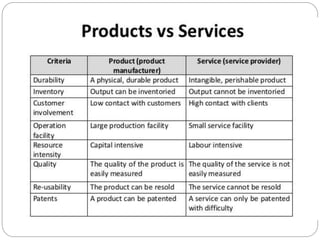
 Product Vs Service
 Concept of Production and OM
 Functions /Scope of POM
 Operation Strategy
 Transformation Process
 Product Design & Product Process
 History of POM
 Issues in POM
“the step-by-step conversion of one form of material into another form
through chemical or mechanical process to create or enhance the utility of the
product to the user.”
• Thus production is a value addition process.
• At each stage of processing, there will be value addition.
• Edwood Buffa defines production as ‘a process by which goods and services are
created’.
Why study Operations Management ?
 This Operations Management course will introduce you to basic
business ideas and their implementations.
 Operations and Supply Chain Management will enable you to solve
complex business problems related to the journey of products and
services from the manufacturer or provider to the end customer.
 it is such a costly part of an organization. A large percentage of the
revenue of most firms is spent in the Operations Management function.
Continue…
 OM is one of the three major functions of any organization, and
its integrally related to all the other business functions.
 We study OM because we want to know how goods and services
are produce.
 We study OM to understand what operations managers do.
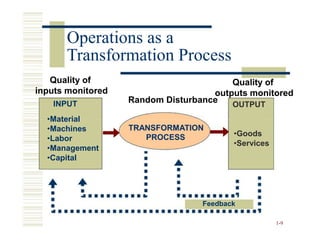
Operations as a
Transformation Process
INPUT
•Material
•Machines
•Labor
•Management
•Capital
TRANSFORMATION
PROCESS
OUTPUT
•Goods
•Services
Feedback
1-9
Quality of
inputs monitored
Quality of
outputs monitored
Random Disturbance
Transformation Process
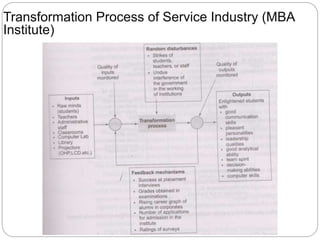
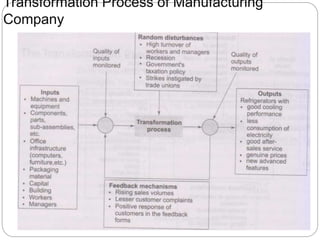
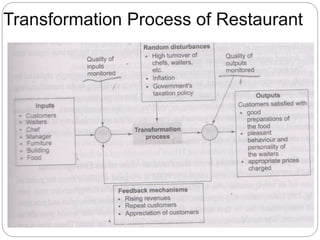
 For getting desired output , quality of inputs has to be monitored.
 The quality of actual output obtained also has continually compared with
the desired output.
 Feedback mechanisms are required to monitor the performance of the
transformation process.
 Random disturbance are unexpected and sometimes not planned for.
They are mostly due to external environment.
Transformation Process of Service Industry (MBA
Institute)
Transformation Process of Manufacturing
Company
Transformation Process of Restaurant
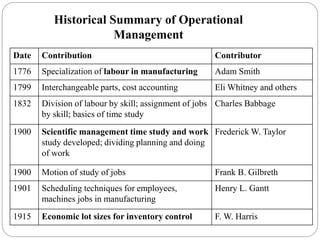
Historical Summary of Operational
Management
Date Contribution Contributor
1776 Specialization of labour in manufacturing Adam Smith
1799 Interchangeable parts, cost accounting Eli Whitney and others
1832 Division of labour by skill; assignment of jobs
by skill; basics of time study
Charles Babbage
1900 Scientific management time study and work
study developed; dividing planning and doing
of work
Frederick W. Taylor
1900 Motion of study of jobs Frank B. Gilbreth
1901 Scheduling techniques for employees,
machines jobs in manufacturing
Henry L. Gantt
1915 Economic lot sizes for inventory control F. W. Harris
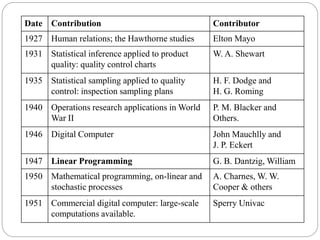
Date Contribution Contributor
1927 Human relations; the Hawthorne studies Elton Mayo
1931 Statistical inference applied to product
quality: quality control charts
W. A. Shewart
1935 Statistical sampling applied to quality
control: inspection sampling plans
H. F. Dodge and
H. G. Roming
1940 Operations research applications in World
War II
P. M. Blacker and
Others.
1946 Digital Computer John Mauchlly and
J. P. Eckert
1947 Linear Programming G. B. Dantzig, William
1950 Mathematical programming, on-linear and
stochastic processes
A. Charnes, W. W.
Cooper & others
1951 Commercial digital computer: large-scale
computations available.
Sperry Univac
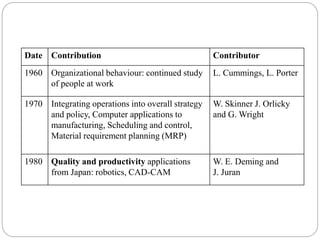
Date Contribution Contributor
1960 Organizational behaviour: continued study
of people at work
L. Cummings, L. Porter
1970 Integrating operations into overall strategy
and policy, Computer applications to
manufacturing, Scheduling and control,
Material requirement planning (MRP)
W. Skinner J. Orlicky
and G. Wright
1980 Quality and productivity applications
from Japan: robotics, CAD-CAM
W. E. Deming and
J. Juran
What is Operations Strategy?
 According to Slack and Lewis, operations strategy is :
 “Operations strategy is the total pattern of decisions which shape the
long-term capabilities of any type of operations and their contribution to
the overall strategy.”
 Operations strategy is the tool that helps to define the methods of
producing goods or a service offered to the customer.
 It is typically driven by the overall business strategy of the organization,
and is designed to maximize the effectiveness of production and
support elements while minimizing costs.
Criteria of Performance for the OM System
 Three objectives or criteria of performance of the production and
operations management system are
 1. Customer satisfaction
2. Effectiveness
3. Efficiency
 Customer satisfaction refers to the extent to which customers are happy
with the products and services provided by a business. Customer
satisfaction levels can be measured using survey techniques and
questionnaires.
Continue…
 Effectiveness is any kind of practice which allows a business or
other organization to maximize the use of their inputs
by developing products at a faster pace than competitors or
reducing defects.
 Efficiency is Performing in the best possible manner with the least
waste of time and effort.
 Companies usually seek to increase and improve the efficiency of their
operations and sales processes. When working with limited resources,
they would prefer to maximize the use of each of these resources.
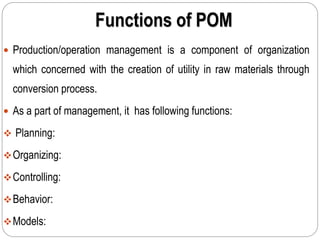
Functions of POM
 Production/operation management is a component of organization
which concerned with the creation of utility in raw materials through
conversion process.
 As a part of management, it has following functions:
 Planning:
Organizing:
Controlling:
Behavior:
Models:
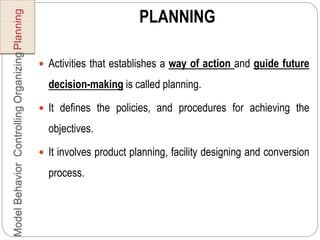
PLANNING
 Activities that establishes a way of action and guide future
decision-making is called planning.
 It defines the policies, and procedures for achieving the
objectives.
 It involves product planning, facility designing and conversion
process.
PlanningOrganizingControllingBehaviorModel
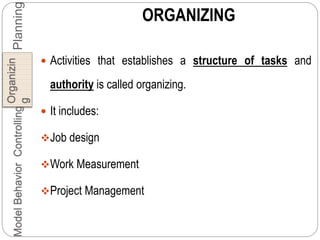
ORGANIZING
 Activities that establishes a structure of tasks and
authority is called organizing.
 It includes:
Job design
Work Measurement
Project Management
Planning
Organizin
g
ControllingBehaviorModel
CONTROLLING
 Activities that guarantee the actual performance in
accordance with planned performance is called
Controlling.
 Controlling costs, quality, and schedules are the important
functions for POM.
Material Control
PlanningOrganizingControllingBehaviorModel
BEHAVIOUR
 Human aspect on the job is called behavior.
 POM also want to know how the behavior of subordinates
can affect management’s planning, organizing, and
controlling actions.
 The behavior is affected by the leadership, motivation,
communication, inter-intra personnel relationship and
their attitudes.
PlanningOrganizingControllingBehaviorModel
MODELS
 The techniques which are used for problem solving is called
Models.
 The models are:
 Aggregate planning models for examining how best to use
existing capacity in short-term.
 Break even analysis to identify break even volumes.
 Linear programming and computer simulation for capacity
utilization.
 Decision tree analysis for long-term capacity problem of facility
expansion.
PlanningOrganizing
Controllin
g
BehaviorModel
Functions / Scope of POM
• POM concern with the conversion of inputs into outputs, using physical resources, so
as to provide the desired utilities to the customer while meeting the other organizational
objectives of effectiveness, efficiency.
• Following are the activities which are listed under production and operations
management functions:
1. Location of facilities
2. Plant layouts and material handling
3. Product design
4. Process design
5. Production and planning control
6. Quality control
7. Materials management
Classification of Decision areas
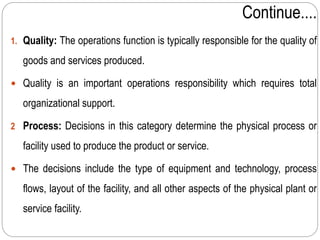
 The production and operations management function can be broadly
divided in to the following five areas:
Decision
Area
Quality
Process
CapacityInventory
Work force
Continue....
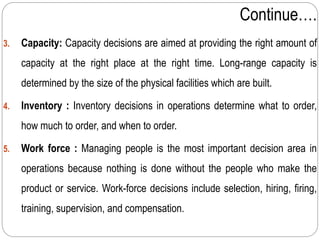
1. Quality: The operations function is typically responsible for the quality of
goods and services produced.
 Quality is an important operations responsibility which requires total
organizational support.
2 Process: Decisions in this category determine the physical process or
facility used to produce the product or service.
 The decisions include the type of equipment and technology, process
flows, layout of the facility, and all other aspects of the physical plant or
service facility.
Continue….
3. Capacity: Capacity decisions are aimed at providing the right amount of
capacity at the right place at the right time. Long-range capacity is
determined by the size of the physical facilities which are built.
4. Inventory : Inventory decisions in operations determine what to order,
how much to order, and when to order.
5. Work force : Managing people is the most important decision area in
operations because nothing is done without the people who make the
product or service. Work-force decisions include selection, hiring, firing,
training, supervision, and compensation.
What is a Production System?
 Production System are those activities of an organization where
resources flowing within a defined system
in a controlled manner to add value
in accordance to the policies communicated by the
management.
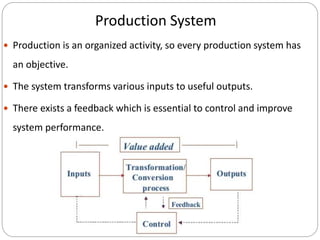
Production System
 Production is an organized activity, so every production system has
an objective.
 The system transforms various inputs to useful outputs.
 There exists a feedback which is essential to control and improve
system performance.
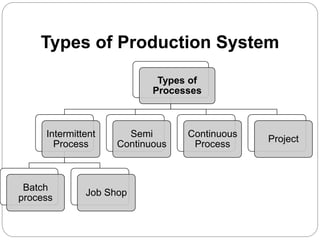
Types of Production System
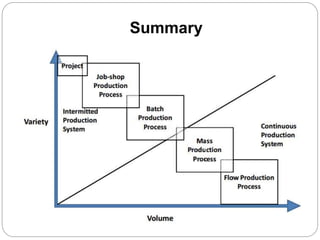
Types of
Processes
Intermittent
Process
Batch
process
Job Shop
Semi
Continuous
Continuous
Process
Project
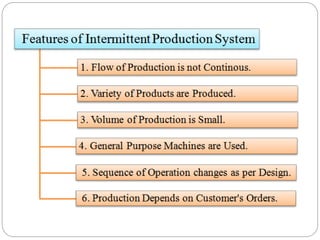
Intermittent Process
 It stop at regular intervals of time because product requires
processing on variety of machines.
 The volume of each product is low. Generally produces make-to-
order.
 There are no standard routings. Products may follow different
paths.
Batch Process
 As a form of manufacturing in which the job passes through the
functional departments in batches and each lot may have a different
routing.
 Equipment used is the same in all the cases with the same
processing steps but cleaning and adjustments of the equipment
may be required after each production run.
 Here, products having same or similar processes may be grouped
into a product family.
Job Shop
 It can handle larger variety of products with low volume that the
batch process.
 Process may be so difficult from each other. Highly skilled operators
who can take up each job as a challenge because of uniqueness.
 Large inventory of materials, tools, parts.
 Job shop results in low volume of output at given time and thus
costlier products compared to continuous process.
Continuous Process
 As name suggest it is continues in nature. Some products flow
continuously through a linear process. These types of operations are
called continuous process
 Set up time : Long (Once it started they continue for a long duration)
 Product produced by such process are highly standardized with
almost no variety and measure on continues basis.
 Ex. Urea chemical plant, steel , plastic, sugar, textile etc.
Semi-continuous Process
 These are assembly process, which are repetitive in nature.
Produce High volume of output with little variety.
 Required highly specialized machine, semi skilled workers and
result in low cost per unit.
 Ex. Automobile , electronics etc.
Mass Production
• This production system is justified by very large volume of
production.
• Less skilled operators are required.
• Manufacturing cost per unit is low and High investment in
production facilities. Ex. Chinese Toys , pen drive etc
Projects
 Projects are processes that handle very complex and unique sets
of activities or tasks.
 Usually the item to be produced stays in a fixed place and all the
resources come to it.
 Ex. R&D projects, construction of plants , implementation of
specialized software in organization , ship construction, bridge
construction
Summary
Questions
1) “Operations management is a transformation process”. Support this statement
with examples if you agree with it.
OR
 What is Transformation Process: Explain the transformation Process
OR
 Define operations management. Describe input-transformation output relationship
in an automobile factory, a restaurant, hospital, and a College
2) What do you understand by the term “operations Management”?
OR
 Define production & operations management and explain functions/Activities of
operations management
OR
 What are the major issues in OM that faced in India?
3) Explain the types of manufacturing process in brief.
OR
 Explain batch production and mass production along with its advantages and
disadvantages.
OR
 Discuss the types of processes. What are the merits and demerits of each? Give an
example of each.
OR
 Suggest suitable method of production for below categories and why
 Automobile & Computers
Production and Operations Management

Production and Operations Management

  • 1.
    Prepared By, Mr. NishantAgrawal Production and Operations Management METAS Adventist College (NEHU)
  • 2.
    Session Outline  ProductVs Service  Concept of Production and OM  Functions /Scope of POM  Operation Strategy  Transformation Process  Product Design & Product Process  History of POM  Issues in POM
  • 4.
    “the step-by-step conversionof one form of material into another form through chemical or mechanical process to create or enhance the utility of the product to the user.” • Thus production is a value addition process. • At each stage of processing, there will be value addition. • Edwood Buffa defines production as ‘a process by which goods and services are created’.
  • 5.
    Why study OperationsManagement ?  This Operations Management course will introduce you to basic business ideas and their implementations.  Operations and Supply Chain Management will enable you to solve complex business problems related to the journey of products and services from the manufacturer or provider to the end customer.  it is such a costly part of an organization. A large percentage of the revenue of most firms is spent in the Operations Management function.
  • 6.
    Continue…  OM isone of the three major functions of any organization, and its integrally related to all the other business functions.  We study OM because we want to know how goods and services are produce.  We study OM to understand what operations managers do.
  • 7.
    Operations as a TransformationProcess INPUT •Material •Machines •Labor •Management •Capital TRANSFORMATION PROCESS OUTPUT •Goods •Services Feedback 1-9 Quality of inputs monitored Quality of outputs monitored Random Disturbance
  • 8.
    Transformation Process  Forgetting desired output , quality of inputs has to be monitored.  The quality of actual output obtained also has continually compared with the desired output.  Feedback mechanisms are required to monitor the performance of the transformation process.  Random disturbance are unexpected and sometimes not planned for. They are mostly due to external environment.
  • 9.
    Transformation Process ofService Industry (MBA Institute)
  • 10.
    Transformation Process ofManufacturing Company
  • 11.
  • 12.
    Historical Summary ofOperational Management Date Contribution Contributor 1776 Specialization of labour in manufacturing Adam Smith 1799 Interchangeable parts, cost accounting Eli Whitney and others 1832 Division of labour by skill; assignment of jobs by skill; basics of time study Charles Babbage 1900 Scientific management time study and work study developed; dividing planning and doing of work Frederick W. Taylor 1900 Motion of study of jobs Frank B. Gilbreth 1901 Scheduling techniques for employees, machines jobs in manufacturing Henry L. Gantt 1915 Economic lot sizes for inventory control F. W. Harris
  • 13.
    Date Contribution Contributor 1927Human relations; the Hawthorne studies Elton Mayo 1931 Statistical inference applied to product quality: quality control charts W. A. Shewart 1935 Statistical sampling applied to quality control: inspection sampling plans H. F. Dodge and H. G. Roming 1940 Operations research applications in World War II P. M. Blacker and Others. 1946 Digital Computer John Mauchlly and J. P. Eckert 1947 Linear Programming G. B. Dantzig, William 1950 Mathematical programming, on-linear and stochastic processes A. Charnes, W. W. Cooper & others 1951 Commercial digital computer: large-scale computations available. Sperry Univac
  • 14.
    Date Contribution Contributor 1960Organizational behaviour: continued study of people at work L. Cummings, L. Porter 1970 Integrating operations into overall strategy and policy, Computer applications to manufacturing, Scheduling and control, Material requirement planning (MRP) W. Skinner J. Orlicky and G. Wright 1980 Quality and productivity applications from Japan: robotics, CAD-CAM W. E. Deming and J. Juran
  • 15.
    What is OperationsStrategy?  According to Slack and Lewis, operations strategy is :  “Operations strategy is the total pattern of decisions which shape the long-term capabilities of any type of operations and their contribution to the overall strategy.”  Operations strategy is the tool that helps to define the methods of producing goods or a service offered to the customer.  It is typically driven by the overall business strategy of the organization, and is designed to maximize the effectiveness of production and support elements while minimizing costs.
  • 16.
    Criteria of Performancefor the OM System  Three objectives or criteria of performance of the production and operations management system are  1. Customer satisfaction 2. Effectiveness 3. Efficiency  Customer satisfaction refers to the extent to which customers are happy with the products and services provided by a business. Customer satisfaction levels can be measured using survey techniques and questionnaires.
  • 17.
    Continue…  Effectiveness isany kind of practice which allows a business or other organization to maximize the use of their inputs by developing products at a faster pace than competitors or reducing defects.  Efficiency is Performing in the best possible manner with the least waste of time and effort.  Companies usually seek to increase and improve the efficiency of their operations and sales processes. When working with limited resources, they would prefer to maximize the use of each of these resources.
  • 18.
    Functions of POM Production/operation management is a component of organization which concerned with the creation of utility in raw materials through conversion process.  As a part of management, it has following functions:  Planning: Organizing: Controlling: Behavior: Models:
  • 19.
    PLANNING  Activities thatestablishes a way of action and guide future decision-making is called planning.  It defines the policies, and procedures for achieving the objectives.  It involves product planning, facility designing and conversion process. PlanningOrganizingControllingBehaviorModel
  • 20.
    ORGANIZING  Activities thatestablishes a structure of tasks and authority is called organizing.  It includes: Job design Work Measurement Project Management Planning Organizin g ControllingBehaviorModel
  • 21.
    CONTROLLING  Activities thatguarantee the actual performance in accordance with planned performance is called Controlling.  Controlling costs, quality, and schedules are the important functions for POM. Material Control PlanningOrganizingControllingBehaviorModel
  • 22.
    BEHAVIOUR  Human aspecton the job is called behavior.  POM also want to know how the behavior of subordinates can affect management’s planning, organizing, and controlling actions.  The behavior is affected by the leadership, motivation, communication, inter-intra personnel relationship and their attitudes. PlanningOrganizingControllingBehaviorModel
  • 23.
    MODELS  The techniqueswhich are used for problem solving is called Models.  The models are:  Aggregate planning models for examining how best to use existing capacity in short-term.  Break even analysis to identify break even volumes.  Linear programming and computer simulation for capacity utilization.  Decision tree analysis for long-term capacity problem of facility expansion. PlanningOrganizing Controllin g BehaviorModel
  • 24.
    Functions / Scopeof POM • POM concern with the conversion of inputs into outputs, using physical resources, so as to provide the desired utilities to the customer while meeting the other organizational objectives of effectiveness, efficiency. • Following are the activities which are listed under production and operations management functions: 1. Location of facilities 2. Plant layouts and material handling 3. Product design 4. Process design 5. Production and planning control 6. Quality control 7. Materials management
  • 25.
    Classification of Decisionareas  The production and operations management function can be broadly divided in to the following five areas: Decision Area Quality Process CapacityInventory Work force
  • 26.
    Continue.... 1. Quality: Theoperations function is typically responsible for the quality of goods and services produced.  Quality is an important operations responsibility which requires total organizational support. 2 Process: Decisions in this category determine the physical process or facility used to produce the product or service.  The decisions include the type of equipment and technology, process flows, layout of the facility, and all other aspects of the physical plant or service facility.
  • 27.
    Continue…. 3. Capacity: Capacitydecisions are aimed at providing the right amount of capacity at the right place at the right time. Long-range capacity is determined by the size of the physical facilities which are built. 4. Inventory : Inventory decisions in operations determine what to order, how much to order, and when to order. 5. Work force : Managing people is the most important decision area in operations because nothing is done without the people who make the product or service. Work-force decisions include selection, hiring, firing, training, supervision, and compensation.
  • 28.
    What is aProduction System?  Production System are those activities of an organization where resources flowing within a defined system in a controlled manner to add value in accordance to the policies communicated by the management.
  • 29.
    Production System  Productionis an organized activity, so every production system has an objective.  The system transforms various inputs to useful outputs.  There exists a feedback which is essential to control and improve system performance.
  • 30.
    Types of ProductionSystem Types of Processes Intermittent Process Batch process Job Shop Semi Continuous Continuous Process Project
  • 31.
    Intermittent Process  Itstop at regular intervals of time because product requires processing on variety of machines.  The volume of each product is low. Generally produces make-to- order.  There are no standard routings. Products may follow different paths.
  • 33.
    Batch Process  Asa form of manufacturing in which the job passes through the functional departments in batches and each lot may have a different routing.  Equipment used is the same in all the cases with the same processing steps but cleaning and adjustments of the equipment may be required after each production run.  Here, products having same or similar processes may be grouped into a product family.
  • 34.
    Job Shop  Itcan handle larger variety of products with low volume that the batch process.  Process may be so difficult from each other. Highly skilled operators who can take up each job as a challenge because of uniqueness.  Large inventory of materials, tools, parts.  Job shop results in low volume of output at given time and thus costlier products compared to continuous process.
  • 35.
    Continuous Process  Asname suggest it is continues in nature. Some products flow continuously through a linear process. These types of operations are called continuous process  Set up time : Long (Once it started they continue for a long duration)  Product produced by such process are highly standardized with almost no variety and measure on continues basis.  Ex. Urea chemical plant, steel , plastic, sugar, textile etc.
  • 36.
    Semi-continuous Process  Theseare assembly process, which are repetitive in nature. Produce High volume of output with little variety.  Required highly specialized machine, semi skilled workers and result in low cost per unit.  Ex. Automobile , electronics etc.
  • 37.
    Mass Production • Thisproduction system is justified by very large volume of production. • Less skilled operators are required. • Manufacturing cost per unit is low and High investment in production facilities. Ex. Chinese Toys , pen drive etc
  • 38.
    Projects  Projects areprocesses that handle very complex and unique sets of activities or tasks.  Usually the item to be produced stays in a fixed place and all the resources come to it.  Ex. R&D projects, construction of plants , implementation of specialized software in organization , ship construction, bridge construction
  • 39.
  • 40.
    Questions 1) “Operations managementis a transformation process”. Support this statement with examples if you agree with it. OR  What is Transformation Process: Explain the transformation Process OR  Define operations management. Describe input-transformation output relationship in an automobile factory, a restaurant, hospital, and a College 2) What do you understand by the term “operations Management”? OR  Define production & operations management and explain functions/Activities of operations management OR  What are the major issues in OM that faced in India?
  • 41.
    3) Explain thetypes of manufacturing process in brief. OR  Explain batch production and mass production along with its advantages and disadvantages. OR  Discuss the types of processes. What are the merits and demerits of each? Give an example of each. OR  Suggest suitable method of production for below categories and why  Automobile & Computers

Editor's Notes

  • #5 Some examples of production are: manufacturing custom-made products like, boilers with a specific capacity, constructing flats, some structural fabrication works for selected customers, etc., and manufacturing standardized products like, car, bus, motor cycle, radio, television, etc.
  • #34  Following are the advantages of job shop production: 1. Because of general purpose machines and facilities variety of products can be produced. 2. Operators will become more skilled and competent, as each job gives them learning opportunities. 3. Full potential of operators can be utilised. 4. Opportunity exists for creative methods and innovative ideas. Following are the limitations of job shop production: 1. Higher cost due to frequent set up changes. 2. Higher level of inventory at all levels and hence higher inventory cost. 3. Production planning is complicated. 4. Larger space requirements. Following are the advantages of batch production: 1. Better utilisation of plant and machinery. 2. Promotes functional specialisation. 3. Cost per unit is lower as compared to job order production. 4. Lower investment in plant and machinery. 5. Flexibility to accommodate and process number of products. 6. Job satisfaction exists for operators. Following are the limitations of batch production: 1. Material handling is complex because of irregular and longer flows. 2. Production planning and control is complex. 3.Work in process inventory is higher compared to continuous production. 4. Higher set up costs due to frequent changes in set up. Following are the advantages of mass production: 1. Higher rate of production with reduced cycle time. 2. Higher capacity utilisation due to line balancing. 3. Low process inventory. Following are the limitations of mass production: 1. Breakdown of one machine will stop an entire production line. 2. Line layout needs major change with the changes in the product design. 3. The cycle time is determined by the slowest operation.
  • #36 – Product differentiation is limited. – Involves high initial investments. Persons with limited skills can be used for production process. – Unit cost is low due to high volume of production . Highest capacity utilization due to line balancing
  • #38 Mass production is used under the following circumstances: 1. Standardisation of product and process sequence. 2. Dedicated special purpose machines having higher production capacities and output rates. 3. Large volume of products. 4. Shorter cycle time of production. 5. Lower in process inventory. 6. Perfectly balanced production lines. 7. Flow of materials, components and parts is continuous and without any back tracking. 8. Production planning and control is easy. 9. Material handling can be completely automatic. Continuous production is used under the following circumstances: 1. Dedicated plant and equipment with zero flexibility. 2. Material handling is fully automated. 3. Process follows a predetermined sequence of operations. 4. Component materials cannot be readily identified with final product. 5. Planning and scheduling is a routine action. Following are the advantages of continuous production: 1. Standardisation of product and process sequence. 2. Higher rate of production with reduced cycle time. 3. Higher capacity utilisation due to line balancing. 4. Manpower is not required for material handling as it is completely automatic. 5. Person with limited skills can be used on the production line. 6. Unit cost is lower due to high volume of production. Following are the limitations of continuous production: 1. Flexibility to accommodate and process number of products does not exist. 2. Very high investment for setting flow lines. 3. Product differentiation is limited.