Setting Product Strategy
Prepared By,
Mr. Nishant Agrawal
Chapter Questions
• What are the characteristics of products and
how do marketers classify products?
• How can companies differentiate products?
• How can a company build and manage its
product mix and product lines?
Chapter Questions (cont.)
• How can companies combine products to
create strong co-brands or ingredient brands?
• How can companies use packaging, labeling,
warranties, and guarantees as marketing tools?
What is a Product?
A product is anything that can be offered to a market
to satisfy a want or need, including physical goods,
experiences, persons, places, properties,
organizations etc.
Components of the
Market Offering
1. Product features and quality
2. Services mix and quality
Five Product Levels
1. Core benefit: the benefit the customer is really buying. A hotel
guest is buying rest and sleep.
2. Basic product : Hotel room include bed, bathroom, towels etc
3. Expected product : Set of attribute buyers normally expect
when they purchase the product
4. Augmented product : Exceeds customer expectations.
5. Potential product : Here companies search for new ways to
satisfy customers and distinguish their offering.
Product Classification Schemes
1. Durability
2. Tangibility
3. Use
Durability and Tangibility
1.Nondurable goods: tangible goods normally consumed. Ex.
Soft drinks ,shampoos. These goods are purchase frequently.
Appropriate strategy is to make them available in many location.
2. Durable goods : tangible goods normally survive many uses.
Refrigeration , machine tools , cloth. Product require more
personal selling and service & require more seller guarantees.
3.Services : are intangible , inseparable and perishable products
Consumer Goods Classification
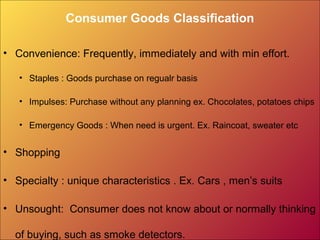
• Convenience: Frequently, immediately and with min effort.
• Staples : Goods purchase on regualr basis
• Impulses: Purchase without any planning ex. Chocolates, potatoes chips
• Emergency Goods : When need is urgent. Ex. Raincoat, sweater etc
• Shopping
• Specialty : unique characteristics . Ex. Cars , men’s suits
• Unsought: Consumer does not know about or normally thinking
of buying, such as smoke detectors.
Industrial Goods Classification
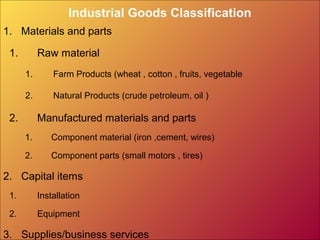
1. Materials and parts
1. Raw material
1. Farm Products (wheat , cotton , fruits, vegetable
2. Natural Products (crude petroleum, oil )
2. Manufactured materials and parts
1. Component material (iron ,cement, wires)
2. Component parts (small motors , tires)
2. Capital items
1. Installation
2. Equipment
3. Supplies/business services
Product Differentiation
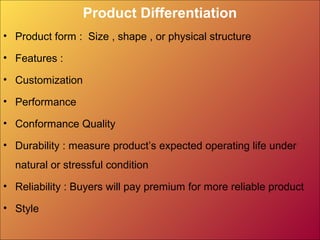
• Product form : Size , shape , or physical structure
• Features :
• Customization
• Performance
• Conformance Quality
• Durability : measure product’s expected operating life under
natural or stressful condition
• Reliability : Buyers will pay premium for more reliable product
• Style
Service Differentiation
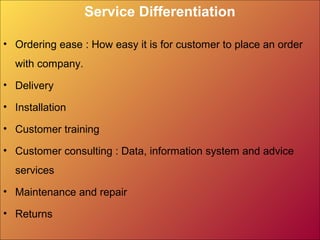
• Ordering ease : How easy it is for customer to place an order
with company.
• Delivery
• Installation
• Customer training
• Customer consulting : Data, information system and advice
services
• Maintenance and repair
• Returns
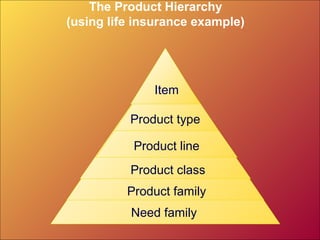
The Product Hierarchy
(using life insurance example)
Need family
Product family
Product class
Product line
Product type
Item
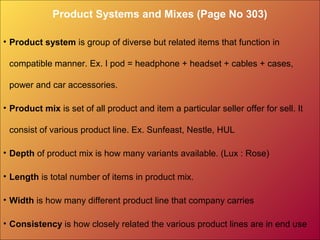
Product Systems and Mixes (Page No 303)
• Product system is group of diverse but related items that function in
compatible manner. Ex. I pod = headphone + headset + cables + cases,
power and car accessories.
• Product mix is set of all product and item a particular seller offer for sell. It
consist of various product line. Ex. Sunfeast, Nestle, HUL
• Depth of product mix is how many variants available. (Lux : Rose)
• Length is total number of items in product mix.
• Width is how many different product line that company carries
• Consistency is how closely related the various product lines are in end use
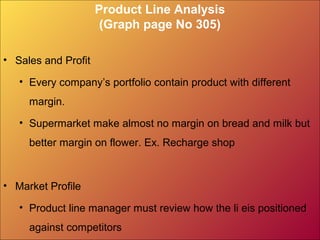
Product Line Analysis
(Graph page No 305)
• Sales and Profit
• Every company’s portfolio contain product with different
margin.
• Supermarket make almost no margin on bread and milk but
better margin on flower. Ex. Recharge shop
• Market Profile
• Product line manager must review how the li eis positioned
against competitors
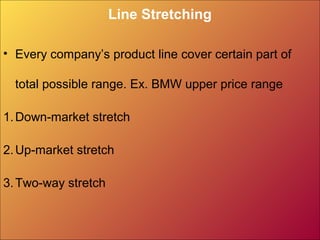
Line Stretching
• Every company’s product line cover certain part of
total possible range. Ex. BMW upper price range
1.Down-market stretch
2.Up-market stretch
3.Two-way stretch
Product-Mix Pricing
• Product-line pricing : Companies normally develop product lines
rather than single products. Ex. Men jeans Rs.500 , 1000, 1500
• Optional-feature pricing : companies offer optional product, feature
and service with their main product. Ex. Automobile advertise entry
level model at low prices to pull people into showroom
• Two-part pricing : consist of fixed fee + variable usage fees. Cell
phone users pay min fees + charges calls. Fixed fees should low
enough to introduce purchase ,profit can then come from usage fees.
• By-product pricing : the production of certain goods like petroleum
and other chemical often result in by products that should be priced
on their value.
What is the Fifth P?
Packaging , labeling warranties
Packaging, sometimes called the 5th
P, is all the activities of
designing and producing the container for a product.
Package might have up to 3 layers.
1.Primary Package (Basic Bottle)
2.Secondary package (cardboard box)
3.Shipping Package (contain six dozen box)
Factors Contributing to the
Emphasis on Packaging
• Self-service
• Consumer affluence : Rising affluence means consumer are
willing to pay little more for the convenience , appearance, and
prestige of better packing
• Company/brand image
• Innovation opportunity
Packaging Objectives
• Identify the brand
• Convey descriptive and persuasive/credible
information
• Facilitate product transportation and protection
• Assist at-home storage
• Aid product consumption
Functions of Labels
• Identifies : product or brand
• Grades : Oil like pure or Veg / Non Veg
• Describes : Who , when made it
• Promotes : bright graphics
Assignment
• What is a Product Line? Discuss some decisions
related to the Product Line Length with a suitable
example
Thank You

Setting Product Strategy

  • 1.
    Setting Product Strategy PreparedBy, Mr. Nishant Agrawal
  • 2.
    Chapter Questions • Whatare the characteristics of products and how do marketers classify products? • How can companies differentiate products? • How can a company build and manage its product mix and product lines?
  • 3.
    Chapter Questions (cont.) •How can companies combine products to create strong co-brands or ingredient brands? • How can companies use packaging, labeling, warranties, and guarantees as marketing tools?
  • 4.
    What is aProduct? A product is anything that can be offered to a market to satisfy a want or need, including physical goods, experiences, persons, places, properties, organizations etc.
  • 5.
    Components of the MarketOffering 1. Product features and quality 2. Services mix and quality
  • 6.
    Five Product Levels 1.Core benefit: the benefit the customer is really buying. A hotel guest is buying rest and sleep. 2. Basic product : Hotel room include bed, bathroom, towels etc 3. Expected product : Set of attribute buyers normally expect when they purchase the product 4. Augmented product : Exceeds customer expectations. 5. Potential product : Here companies search for new ways to satisfy customers and distinguish their offering.
  • 7.
    Product Classification Schemes 1.Durability 2. Tangibility 3. Use
  • 8.
    Durability and Tangibility 1.Nondurablegoods: tangible goods normally consumed. Ex. Soft drinks ,shampoos. These goods are purchase frequently. Appropriate strategy is to make them available in many location. 2. Durable goods : tangible goods normally survive many uses. Refrigeration , machine tools , cloth. Product require more personal selling and service & require more seller guarantees. 3.Services : are intangible , inseparable and perishable products
  • 9.
    Consumer Goods Classification •Convenience: Frequently, immediately and with min effort. • Staples : Goods purchase on regualr basis • Impulses: Purchase without any planning ex. Chocolates, potatoes chips • Emergency Goods : When need is urgent. Ex. Raincoat, sweater etc • Shopping • Specialty : unique characteristics . Ex. Cars , men’s suits • Unsought: Consumer does not know about or normally thinking of buying, such as smoke detectors.
  • 10.
    Industrial Goods Classification 1.Materials and parts 1. Raw material 1. Farm Products (wheat , cotton , fruits, vegetable 2. Natural Products (crude petroleum, oil ) 2. Manufactured materials and parts 1. Component material (iron ,cement, wires) 2. Component parts (small motors , tires) 2. Capital items 1. Installation 2. Equipment 3. Supplies/business services
  • 11.
    Product Differentiation • Productform : Size , shape , or physical structure • Features : • Customization • Performance • Conformance Quality • Durability : measure product’s expected operating life under natural or stressful condition • Reliability : Buyers will pay premium for more reliable product • Style
  • 12.
    Service Differentiation • Orderingease : How easy it is for customer to place an order with company. • Delivery • Installation • Customer training • Customer consulting : Data, information system and advice services • Maintenance and repair • Returns
  • 13.
    The Product Hierarchy (usinglife insurance example) Need family Product family Product class Product line Product type Item
  • 14.
    Product Systems andMixes (Page No 303) • Product system is group of diverse but related items that function in compatible manner. Ex. I pod = headphone + headset + cables + cases, power and car accessories. • Product mix is set of all product and item a particular seller offer for sell. It consist of various product line. Ex. Sunfeast, Nestle, HUL • Depth of product mix is how many variants available. (Lux : Rose) • Length is total number of items in product mix. • Width is how many different product line that company carries • Consistency is how closely related the various product lines are in end use
  • 15.
    Product Line Analysis (Graphpage No 305) • Sales and Profit • Every company’s portfolio contain product with different margin. • Supermarket make almost no margin on bread and milk but better margin on flower. Ex. Recharge shop • Market Profile • Product line manager must review how the li eis positioned against competitors
  • 16.
    Line Stretching • Everycompany’s product line cover certain part of total possible range. Ex. BMW upper price range 1.Down-market stretch 2.Up-market stretch 3.Two-way stretch
  • 17.
    Product-Mix Pricing • Product-linepricing : Companies normally develop product lines rather than single products. Ex. Men jeans Rs.500 , 1000, 1500 • Optional-feature pricing : companies offer optional product, feature and service with their main product. Ex. Automobile advertise entry level model at low prices to pull people into showroom • Two-part pricing : consist of fixed fee + variable usage fees. Cell phone users pay min fees + charges calls. Fixed fees should low enough to introduce purchase ,profit can then come from usage fees. • By-product pricing : the production of certain goods like petroleum and other chemical often result in by products that should be priced on their value.
  • 18.
    What is theFifth P? Packaging , labeling warranties Packaging, sometimes called the 5th P, is all the activities of designing and producing the container for a product. Package might have up to 3 layers. 1.Primary Package (Basic Bottle) 2.Secondary package (cardboard box) 3.Shipping Package (contain six dozen box)
  • 19.
    Factors Contributing tothe Emphasis on Packaging • Self-service • Consumer affluence : Rising affluence means consumer are willing to pay little more for the convenience , appearance, and prestige of better packing • Company/brand image • Innovation opportunity
  • 20.
    Packaging Objectives • Identifythe brand • Convey descriptive and persuasive/credible information • Facilitate product transportation and protection • Assist at-home storage • Aid product consumption
  • 21.
    Functions of Labels •Identifies : product or brand • Grades : Oil like pure or Veg / Non Veg • Describes : Who , when made it • Promotes : bright graphics
  • 22.
    Assignment • What isa Product Line? Discuss some decisions related to the Product Line Length with a suitable example
  • 23.