The Consumer
Research Process
METAS Adventist College (NEHU)
Prepared By,
Mr. Nishant Agrawal
The Importance of the Consumer
Research Process
Largely Influenced by Psychology, sociology, and anthropology
• Marketers must understand customers
effective:
to design
–
–
–
marketing strategies
products
promotional messages
Chapter Two Slide 7
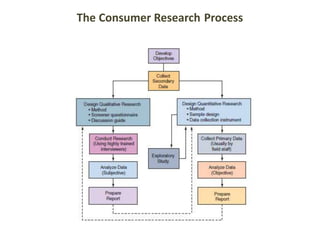
The Consumer Research Process
•
•
Secondary research
Primary research
– Qualitative research includes focus groups and in‐depth
interviews
– Quantitative
research
observational research, experimentation, and survey
Chapter Two Slide 9
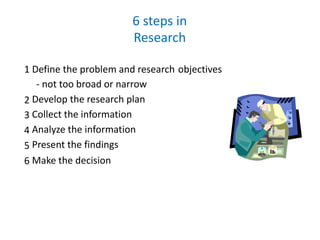
6 steps in
Research
1 Define the problem and research
‐ not too broad or narrow
Develop the research plan
Collect the information
Analyze the information
Present the findings
Make the decision
objectives
2
3
4
5
6
Developing Research Objectives
• Defining purposes and objectives helps ensure an
appropriate research design.
• A written statement of objectives helps to define the
type and level of information needed.
Discussion Questions
• Assume you are planning to open a new pizza
restaurant near your campus.
– What might be three objectives of
for your new business?
a research plan
– How could you gather these data?
•
•
Secondary Data
Data that has been collected
for reasons other than the
specific research
hand
project at
Includes
external
internal
data
and
Types of Secondary Data
Internal Data
Data generated in‐house
May include analysis of customer
files
Useful for calculating customer
lifetime value
External Data
Data collected by an outside
organization
Includes federal government,
periodicals, newspapers, books,
search engines
Commercial data is also available
from market research firms
•
•
•
•
•
•
U.S. Census Data
weblink
Discussion Questions
Personal Privacy
• Many people do not like the fact that their personal
used for marketing.
data are
• How can marketers justify their need for data?
• How can they acquire data and maintain customer privacy?
Designing Primary Research
Qualitative Collection Method
Depth Interview
Also called one‐on‐one interview•
• Usually 20 minutes to 1 hour
• Non‐structured
• Session is usually recorded
Interpreted by trained researcher•
Examine Options for Interviews
Qualitative Collection Method
Focus Group
•
•
8‐10 participants
Respondents are recruited through
questionnaire
Lasts about 2 hours
a screener
•
•
•
Always taped or videotaped to assist analysis
Online focus groups are growing
Focus Group Discussion Guide
Chapter Two Slide 22
Qualitative Collection Method
Projective Techniques
• Research procedures designed to identify consumers’
subconscious feelings and underlying motivations
– Done one on one & in closed settings
• Consist of a variety of “tests”
Common Projective Exercises
Table 2.1
people cannot easily locate and verbalize their true feelings toward a product category or brand.
Description
Word
Associations
The researcher has a list of words, some of them to be studied and some just as
“filler.” The researcher asks the respondent (s) to react, one-at-a time, to each word
by stating or (in a focus group setting) writing on a pad the first word that comes to
mind, and to explain the link.
Sentence
Completion
The researcher has a series of incomplete sentences that the respondent (s) needs to
complete with a word or phrase.
Photo/Visual
for Storytelling
The researcher creates/selects a series of photos of consumers, different brands or
products, range of print ads, etc., to serve as stimuli. The respondents are asked to
discuss or tell a story based on their response to a photo or some other visual
stimulus.
Role Playing Is quite similar to storytelling; however, instead of telling a story, the participant (s)
will be given a situation and asked to “act out” the role (s), often with regard to a
product or brand, or particular selling situation.
Qualitative Collection Method
Metaphor Analysis
• Based on belief that metaphors are the most basic method of thought and
communication
– much of communication is nonverbal and that people do not
think as much in words as they do in images
• Zaltman Metaphor Elicitation Technique (ZMET) combines collage
research and metaphor analysis to bring to the surface the mental models
and the major themes or constructs that drive consumer thinking and
behavior.
– Respondents are asked to find pictures that describe their
thoughts, feelings, and beliefs about products, companies, and
brands.
– The results are then combined to see if there are common
themes or constructs that consumers mention in their results
Chapter Two Slide 25
Qualitative Collection Method
“Looking‐In”
• Look at information from threads and postings on social media, including
blogs and discussion forums
– Emerging field of consumer research that works to interpret online
conversations
• Methodology to capture consumers’ experiences, opinions, forecasts,
needs, and interests
– Growth in social marketing, there are increasing conversations and
comments online regarding products and brands
Designing Primary Research
Quantitative Research
• The objective of quantitative research is to
develop mathematical models, theories and/or
hypotheses phenomena.
• Quantitative methods can be used to verify which of such
hypotheses are true.
• Qualitative research, on the other hand, asks broad
questions and collects data from participants.
Data Collection Methods
Observational Research
• Helps marketers gain an in‐depth understanding of
the relationship between people and products by
watching them buying and using products
• Helps researchers gain a better understanding of
what the product symbolizes
Data Collection Methods
Mechanical Observational Research
• Uses mechanical or electronic device to record consumer behavior or
response
– electronic traffic counters, video technology
• Consumers’ increased use of highly convenient technologies will create
more records for marketers
– frequent shopper cards / smart cards‐freq
• Audits are a type of mechanical observation which monitor sales
Foxwoods Casino Uses Mechanical
Observational Research
Data Collection Methods
Experimentation
• Can be used to test the relative sales appeal of many
types of variables
• An experiment is usually controlled with only some
variables manipulated at a time while the others are
constant
• Test markets are conducted on a single market area
• Experimentation can be conducted in laboratories or in
the field
Discussion Questions
• What might direct marketers test in experiments?
• How can they use the results?
Chapter Two Slide 31
Surveys
Data Collection Methods
Personal Interview
Mail
Telephone
Online
MAIL TELEPHONE
PERSONAL
INTERVIEW
ONLINE
Cost Low Moderate High Low
Response
rate
Low Moderate High
Self-
selection
Geographic
flexibility
Excellent Good Difficult Excellent
Interviewer
bias
N/A Moderate Problematic N/A
Interviewer
supervision
N/A Easy Difficult N/A
Quality of
response
Limited Limited Excellent Excellent
Table 2.2 Comparative Advantages
Validity and Reliability
• If a study has validity, it collects the appropriate data for the
study.
– Validity asks the question of whether the data is really applying to the
objectives you have set
• A study has reliability if the same questions, asked of a similar
sample, produce the same findings.
– Reliability tells you, the researcher, if the results would be repeated if
conducted on a similar group at the same time.
Attitude Scales
*Semantic differential is a type of a rating scale designed to measure objects, events, and
concepts.
Example
Customer Satisfaction
•It is a measure of how products and services supplied by a company
meet customer expectation.
•It is defined as "the number of customers whose reported experience with
a firm, its products, or its services exceeds specified satisfaction goals.“
•In researching satisfaction, firms generally ask customers whether their
product or service has met or exceeded expectations.
•Thus, expectations are a key factor behind satisfaction. When
customers have high expectations and the reality falls short, they will be
disappointed
Customer Satisfaction Survey
Customer Retention
• Customer retention refers to the ability of a company or product
to retain its customers over some specified period.
• Successful customer retention involves more than giving the
customer what they expect. Generating loyalty of the brand might
mean exceeding customer expectations.
• Customer retention has a direct impact on profitability.
• It is the measure of how well the customer STAYS and STAYS
ENGAGED with the organization OR with specific products and
services
Customer Satisfaction Measurement
• Customer Satisfaction
Surveys
– Analysis of
Expectations versus
Experience
Mystery Shoppers
Customer Complaint
Analysis
•
•
Sampling and Data Collection
• Samples are a subset of the population
used to estimate characteristics
entire population.
of the
• A sampling plan addresses:
–
–
–
Whom to survey
How many to survey
How to select them
• Researcher must choose
non‐probabililty sample.
probability or
Data Analysis and Reporting Findings
• Open‐ended questions are coded and quantified.
• All responses are tabulated and analyzed.
• Final report includes executive summary, body,
tables, and graphs.
Chapter Two Slide 37
Secondary Research vs.
Primary Research
Advantages Disadvantages
Secondary research
e.g census
• Inexpensive
• Easy to access
• Immediate
• Often outdated
• Potentially unreliable
• May not be relevant
Primary research • Applicable & useable
• Accurate & reliable
• Up-to-date
• Expensive
• Not available immediately
• Not always readily accessible
Thank You…!!!

The Consumer Research Process

  • 1.
    The Consumer Research Process METASAdventist College (NEHU) Prepared By, Mr. Nishant Agrawal
  • 2.
    The Importance ofthe Consumer Research Process Largely Influenced by Psychology, sociology, and anthropology • Marketers must understand customers effective: to design – – – marketing strategies products promotional messages Chapter Two Slide 7
  • 3.
  • 4.
    The Consumer ResearchProcess • • Secondary research Primary research – Qualitative research includes focus groups and in‐depth interviews – Quantitative research observational research, experimentation, and survey Chapter Two Slide 9
  • 5.
    6 steps in Research 1Define the problem and research ‐ not too broad or narrow Develop the research plan Collect the information Analyze the information Present the findings Make the decision objectives 2 3 4 5 6
  • 6.
    Developing Research Objectives •Defining purposes and objectives helps ensure an appropriate research design. • A written statement of objectives helps to define the type and level of information needed.
  • 7.
    Discussion Questions • Assumeyou are planning to open a new pizza restaurant near your campus. – What might be three objectives of for your new business? a research plan – How could you gather these data?
  • 8.
    • • Secondary Data Data thathas been collected for reasons other than the specific research hand project at Includes external internal data and
  • 9.
    Types of SecondaryData Internal Data Data generated in‐house May include analysis of customer files Useful for calculating customer lifetime value External Data Data collected by an outside organization Includes federal government, periodicals, newspapers, books, search engines Commercial data is also available from market research firms • • • • • •
  • 10.
  • 11.
    Discussion Questions Personal Privacy •Many people do not like the fact that their personal used for marketing. data are • How can marketers justify their need for data? • How can they acquire data and maintain customer privacy?
  • 12.
  • 13.
    Qualitative Collection Method DepthInterview Also called one‐on‐one interview• • Usually 20 minutes to 1 hour • Non‐structured • Session is usually recorded Interpreted by trained researcher•
  • 14.
  • 15.
    Qualitative Collection Method FocusGroup • • 8‐10 participants Respondents are recruited through questionnaire Lasts about 2 hours a screener • • • Always taped or videotaped to assist analysis Online focus groups are growing
  • 16.
    Focus Group DiscussionGuide Chapter Two Slide 22
  • 17.
    Qualitative Collection Method ProjectiveTechniques • Research procedures designed to identify consumers’ subconscious feelings and underlying motivations – Done one on one & in closed settings • Consist of a variety of “tests”
  • 18.
    Common Projective Exercises Table2.1 people cannot easily locate and verbalize their true feelings toward a product category or brand. Description Word Associations The researcher has a list of words, some of them to be studied and some just as “filler.” The researcher asks the respondent (s) to react, one-at-a time, to each word by stating or (in a focus group setting) writing on a pad the first word that comes to mind, and to explain the link. Sentence Completion The researcher has a series of incomplete sentences that the respondent (s) needs to complete with a word or phrase. Photo/Visual for Storytelling The researcher creates/selects a series of photos of consumers, different brands or products, range of print ads, etc., to serve as stimuli. The respondents are asked to discuss or tell a story based on their response to a photo or some other visual stimulus. Role Playing Is quite similar to storytelling; however, instead of telling a story, the participant (s) will be given a situation and asked to “act out” the role (s), often with regard to a product or brand, or particular selling situation.
  • 19.
    Qualitative Collection Method MetaphorAnalysis • Based on belief that metaphors are the most basic method of thought and communication – much of communication is nonverbal and that people do not think as much in words as they do in images • Zaltman Metaphor Elicitation Technique (ZMET) combines collage research and metaphor analysis to bring to the surface the mental models and the major themes or constructs that drive consumer thinking and behavior. – Respondents are asked to find pictures that describe their thoughts, feelings, and beliefs about products, companies, and brands. – The results are then combined to see if there are common themes or constructs that consumers mention in their results Chapter Two Slide 25
  • 20.
    Qualitative Collection Method “Looking‐In” •Look at information from threads and postings on social media, including blogs and discussion forums – Emerging field of consumer research that works to interpret online conversations • Methodology to capture consumers’ experiences, opinions, forecasts, needs, and interests – Growth in social marketing, there are increasing conversations and comments online regarding products and brands
  • 21.
  • 22.
    Quantitative Research • Theobjective of quantitative research is to develop mathematical models, theories and/or hypotheses phenomena. • Quantitative methods can be used to verify which of such hypotheses are true. • Qualitative research, on the other hand, asks broad questions and collects data from participants.
  • 23.
    Data Collection Methods ObservationalResearch • Helps marketers gain an in‐depth understanding of the relationship between people and products by watching them buying and using products • Helps researchers gain a better understanding of what the product symbolizes
  • 24.
    Data Collection Methods MechanicalObservational Research • Uses mechanical or electronic device to record consumer behavior or response – electronic traffic counters, video technology • Consumers’ increased use of highly convenient technologies will create more records for marketers – frequent shopper cards / smart cards‐freq • Audits are a type of mechanical observation which monitor sales
  • 25.
    Foxwoods Casino UsesMechanical Observational Research
  • 26.
    Data Collection Methods Experimentation •Can be used to test the relative sales appeal of many types of variables • An experiment is usually controlled with only some variables manipulated at a time while the others are constant • Test markets are conducted on a single market area • Experimentation can be conducted in laboratories or in the field
  • 27.
    Discussion Questions • Whatmight direct marketers test in experiments? • How can they use the results? Chapter Two Slide 31
  • 28.
    Surveys Data Collection Methods PersonalInterview Mail Telephone Online
  • 29.
    MAIL TELEPHONE PERSONAL INTERVIEW ONLINE Cost LowModerate High Low Response rate Low Moderate High Self- selection Geographic flexibility Excellent Good Difficult Excellent Interviewer bias N/A Moderate Problematic N/A Interviewer supervision N/A Easy Difficult N/A Quality of response Limited Limited Excellent Excellent Table 2.2 Comparative Advantages
  • 30.
    Validity and Reliability •If a study has validity, it collects the appropriate data for the study. – Validity asks the question of whether the data is really applying to the objectives you have set • A study has reliability if the same questions, asked of a similar sample, produce the same findings. – Reliability tells you, the researcher, if the results would be repeated if conducted on a similar group at the same time.
  • 31.
    Attitude Scales *Semantic differentialis a type of a rating scale designed to measure objects, events, and concepts.
  • 32.
  • 33.
    Customer Satisfaction •It isa measure of how products and services supplied by a company meet customer expectation. •It is defined as "the number of customers whose reported experience with a firm, its products, or its services exceeds specified satisfaction goals.“ •In researching satisfaction, firms generally ask customers whether their product or service has met or exceeded expectations. •Thus, expectations are a key factor behind satisfaction. When customers have high expectations and the reality falls short, they will be disappointed
  • 34.
  • 35.
    Customer Retention • Customerretention refers to the ability of a company or product to retain its customers over some specified period. • Successful customer retention involves more than giving the customer what they expect. Generating loyalty of the brand might mean exceeding customer expectations. • Customer retention has a direct impact on profitability. • It is the measure of how well the customer STAYS and STAYS ENGAGED with the organization OR with specific products and services
  • 36.
    Customer Satisfaction Measurement •Customer Satisfaction Surveys – Analysis of Expectations versus Experience Mystery Shoppers Customer Complaint Analysis • •
  • 37.
    Sampling and DataCollection • Samples are a subset of the population used to estimate characteristics entire population. of the • A sampling plan addresses: – – – Whom to survey How many to survey How to select them • Researcher must choose non‐probabililty sample. probability or
  • 38.
    Data Analysis andReporting Findings • Open‐ended questions are coded and quantified. • All responses are tabulated and analyzed. • Final report includes executive summary, body, tables, and graphs. Chapter Two Slide 37
  • 39.
    Secondary Research vs. PrimaryResearch Advantages Disadvantages Secondary research e.g census • Inexpensive • Easy to access • Immediate • Often outdated • Potentially unreliable • May not be relevant Primary research • Applicable & useable • Accurate & reliable • Up-to-date • Expensive • Not available immediately • Not always readily accessible
  • 40.