Presented by :
Vikash Barnwal
Assist. Professor
Concept of plant layout
Plant layout is a plan for effective utilisation of facilities for
the manufacture of products; involving a most efficient and
economical arrangement of machines, materials,
personnel, storage space and all supporting services, within
available floor space.
Definition:
 According to More, "Plant layout is a plan of optimum
arrangement of facilities including personnel, equipment’s,
storage space, material handling equipment and all other
supporting services along with the decision of best
structure to contain all these facilities.”
Objectives/Advantages of Plant Layout:
 Streamline flow of materials through the plant
 Minimize material handling
 Facilitate manufacturing progress by maintaining balance in the
process
 Maintain flexibility of arrangements and of operation
 Maintaining high turnover of in-process inventory
 Effective utilization of men, equipment and space
 Increase employee morale
 Minimize interference (i.e. interruption) from machines
 Reduce hazards affecting employees
 According to Riggs, “the overall objective of plant
layout is to design a physical arrangement that most
economically meets the required output – quantity
and quality.”
Principles of Plant Layout:
 Principle of Minimum Movement: Materials and labor should be
moved over minimum distances; saving cost and time of transportation
and material handling.
 Principle of Space Utilization: All available cubic space should be
effectively utilized – both horizontally and vertically.
 Principle of Flexibility: Layout should be flexible enough to be
adaptable to changes required by expansion or technological
development.
 Principle of Interdependence: Interdependent operations and
processes should be located in close proximity to each other; to
minimize product travel.
 Principle of Overall Integration: All the plant facilities and services
should be fully integrated into a single operating unit; to minimize cost
of production.
 Principle of Safety: There should be in-built provision in the design
of layout, to provide for comfort and safety of workers
 (vii) Principle of Smooth Flow: The layout should be so designed as
to reduce work bottlenecks and facilitate uninterrupted flow of work
throughout the plant.
 (viii) Principle of Economy: The layout should aim at effecting
economy in terms of investment in fixed assets.
Types of Plant Layout:
 (a) Product Layout (or Line Layout):
 (b) Process Layout (or Functional Layout):
 (c) Combination Layout:
 (d) Fixed Position Layout
(a) Product Layout (or Line Layout):
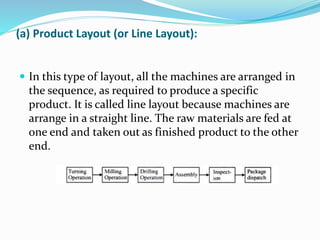
 In this type of layout, all the machines are arranged in
the sequence, as required to produce a specific
product. It is called line layout because machines are
arrange in a straight line. The raw materials are fed at
one end and taken out as finished product to the other
end.
Advantages:
 1. Reduced material handling cost due to mechanized
handling systems and straight flow
 2. Perfect line balancing which eliminates bottlenecks and
idle capacity.
 3. Short manufacturing cycle due to uninterrupted flow of
materials
 4. Simplified production planning and control; and simple
and effective inspection of work.
 5. Small amount of work-in-progress inventory
 6. Lesser wage cost, as unskilled workers can learn and
manage production.
Disadvantages:
 1. Lack of flexibility of operations, as layout cannot be
adapted to the manufacture of any other type of product.
 2. Large capital investment, because of special purpose
machines.
 3. Dependence of whole activity on each part; any
breakdown of one machine in the sequence may result in
stoppage of production.
 4. Same machines duplicated for manufacture of different
products; leading to high overall operational costs.
 5. Delicate special purpose machines require costly
maintenance / repairs.
Product layout is suitable in the following cases:
 1. Where one or few standardized products are manufactured.
 2. Where a large volume of production of each item has to travel
the production process, over a considerable period of time.
 3. Where time and motion studies can be done to determine the
rate of work.
 4. Where a possibility of a good balance of labour and equipment
exists.
 5. Where minimum of inspection is required, during sequence of
operations.
 6. Where materials and products permit bulk or continuous
handling by mechanical parts.
 7. Where minimum of set-ups are required.
(b) Process Layout (or Functional Layout)
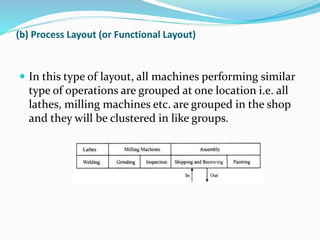
 In this type of layout, all machines performing similar
type of operations are grouped at one location i.e. all
lathes, milling machines etc. are grouped in the shop
and they will be clustered in like groups.
Advantages:
 1. Greater flexibility with regard to work distribution to
machinery and personnel. Adapted to frequent changes in
sequence of operations.
 2. Lower investment due to general purpose machines;
which usually are less costly than special purpose
machines.
 3. Higher utilization of production facilities; which can be
adapted to a variety of products.
 4. Variety of jobs makes the work challenging and
interesting.
 5. Breakdown of one machine does not result in complete
stoppage of work.
Disadvantages:
 1. Backtracking and long movements occur in handling
of materials. As such, material handling costs are
higher.
 2. Mechanisation of material handling is not possible.
 3. Production planning and control is difficult
 4. More space requirement; as work-in-progress
inventory is high-requiring greater storage space.
 5. As the work has to pass through different
departments; it is quite difficult to trace the
responsibility for the finished product.
Process layout is suitable in the following cases
 1. Non-standardised products are manufactured; as the emphasis
is on special orders.
 2. It is difficult to achieve good labour and equipment balance.
 3. Production is not carried on a large scale.
 4. It is difficult to undertake adequate time and motion studies.
 5. It is frequently necessary to use the same machine or work
station for two or more difficult operations.
 6. During the sequence of operations, many inspections are
required.
 7. Process may have to be brought to work, instead of “vice-
versa”; because materials or products are too large or heavy to
permit bulk or continuous handling by mechanical means.
c. Combination Layout:
 Combination Layout:
In practice, plants are rarely laid out either in
product or process layout form. Generally a
combination of the two basic layouts is employed;
to derive the advantages of both systems of layout.
For example, refrigerator manufacturing uses a
combination layout.
(d) Fixed Position Layout:
 It is also called stationary layout. In this type of layout
men, materials and machines are brought to a product
that remains in one place owing to its size. Ship-
building, air-craft manufacturing, wagon building,
heavy construction of dams, bridges, buildings etc. are
typical examples of such layout.

Plant layout

  • 1.
    Presented by : VikashBarnwal Assist. Professor
  • 2.
    Concept of plantlayout Plant layout is a plan for effective utilisation of facilities for the manufacture of products; involving a most efficient and economical arrangement of machines, materials, personnel, storage space and all supporting services, within available floor space. Definition:  According to More, "Plant layout is a plan of optimum arrangement of facilities including personnel, equipment’s, storage space, material handling equipment and all other supporting services along with the decision of best structure to contain all these facilities.”
  • 3.
    Objectives/Advantages of PlantLayout:  Streamline flow of materials through the plant  Minimize material handling  Facilitate manufacturing progress by maintaining balance in the process  Maintain flexibility of arrangements and of operation  Maintaining high turnover of in-process inventory  Effective utilization of men, equipment and space  Increase employee morale  Minimize interference (i.e. interruption) from machines  Reduce hazards affecting employees
  • 4.
     According toRiggs, “the overall objective of plant layout is to design a physical arrangement that most economically meets the required output – quantity and quality.”
  • 5.
    Principles of PlantLayout:  Principle of Minimum Movement: Materials and labor should be moved over minimum distances; saving cost and time of transportation and material handling.  Principle of Space Utilization: All available cubic space should be effectively utilized – both horizontally and vertically.  Principle of Flexibility: Layout should be flexible enough to be adaptable to changes required by expansion or technological development.  Principle of Interdependence: Interdependent operations and processes should be located in close proximity to each other; to minimize product travel.
  • 6.
     Principle ofOverall Integration: All the plant facilities and services should be fully integrated into a single operating unit; to minimize cost of production.  Principle of Safety: There should be in-built provision in the design of layout, to provide for comfort and safety of workers  (vii) Principle of Smooth Flow: The layout should be so designed as to reduce work bottlenecks and facilitate uninterrupted flow of work throughout the plant.  (viii) Principle of Economy: The layout should aim at effecting economy in terms of investment in fixed assets.
  • 7.
    Types of PlantLayout:  (a) Product Layout (or Line Layout):  (b) Process Layout (or Functional Layout):  (c) Combination Layout:  (d) Fixed Position Layout
  • 8.
    (a) Product Layout(or Line Layout):  In this type of layout, all the machines are arranged in the sequence, as required to produce a specific product. It is called line layout because machines are arrange in a straight line. The raw materials are fed at one end and taken out as finished product to the other end.
  • 9.
    Advantages:  1. Reducedmaterial handling cost due to mechanized handling systems and straight flow  2. Perfect line balancing which eliminates bottlenecks and idle capacity.  3. Short manufacturing cycle due to uninterrupted flow of materials  4. Simplified production planning and control; and simple and effective inspection of work.  5. Small amount of work-in-progress inventory  6. Lesser wage cost, as unskilled workers can learn and manage production.
  • 10.
    Disadvantages:  1. Lackof flexibility of operations, as layout cannot be adapted to the manufacture of any other type of product.  2. Large capital investment, because of special purpose machines.  3. Dependence of whole activity on each part; any breakdown of one machine in the sequence may result in stoppage of production.  4. Same machines duplicated for manufacture of different products; leading to high overall operational costs.  5. Delicate special purpose machines require costly maintenance / repairs.
  • 11.
    Product layout issuitable in the following cases:  1. Where one or few standardized products are manufactured.  2. Where a large volume of production of each item has to travel the production process, over a considerable period of time.  3. Where time and motion studies can be done to determine the rate of work.  4. Where a possibility of a good balance of labour and equipment exists.  5. Where minimum of inspection is required, during sequence of operations.  6. Where materials and products permit bulk or continuous handling by mechanical parts.  7. Where minimum of set-ups are required.
  • 12.
    (b) Process Layout(or Functional Layout)  In this type of layout, all machines performing similar type of operations are grouped at one location i.e. all lathes, milling machines etc. are grouped in the shop and they will be clustered in like groups.
  • 13.
    Advantages:  1. Greaterflexibility with regard to work distribution to machinery and personnel. Adapted to frequent changes in sequence of operations.  2. Lower investment due to general purpose machines; which usually are less costly than special purpose machines.  3. Higher utilization of production facilities; which can be adapted to a variety of products.  4. Variety of jobs makes the work challenging and interesting.  5. Breakdown of one machine does not result in complete stoppage of work.
  • 14.
    Disadvantages:  1. Backtrackingand long movements occur in handling of materials. As such, material handling costs are higher.  2. Mechanisation of material handling is not possible.  3. Production planning and control is difficult  4. More space requirement; as work-in-progress inventory is high-requiring greater storage space.  5. As the work has to pass through different departments; it is quite difficult to trace the responsibility for the finished product.
  • 15.
    Process layout issuitable in the following cases  1. Non-standardised products are manufactured; as the emphasis is on special orders.  2. It is difficult to achieve good labour and equipment balance.  3. Production is not carried on a large scale.  4. It is difficult to undertake adequate time and motion studies.  5. It is frequently necessary to use the same machine or work station for two or more difficult operations.  6. During the sequence of operations, many inspections are required.  7. Process may have to be brought to work, instead of “vice- versa”; because materials or products are too large or heavy to permit bulk or continuous handling by mechanical means.
  • 16.
    c. Combination Layout: Combination Layout: In practice, plants are rarely laid out either in product or process layout form. Generally a combination of the two basic layouts is employed; to derive the advantages of both systems of layout. For example, refrigerator manufacturing uses a combination layout.
  • 17.
    (d) Fixed PositionLayout:  It is also called stationary layout. In this type of layout men, materials and machines are brought to a product that remains in one place owing to its size. Ship- building, air-craft manufacturing, wagon building, heavy construction of dams, bridges, buildings etc. are typical examples of such layout.