PRODUCTION MANAGEMENT
LECTURE –III & IV
• The Production Function
• Types of production system
• Elementary knowledge of manufacturing processes
• Plant Layouts
• Material Handling
• Location Problems
• Inventory management
• Scheduling
• Network Analysis
• Break Even Point Analysis
• Reliability maintenance & plant services
• Quality control
• Emerging Trends
• Concept of Productivity
Syllabus
• Plant Layouts :
• Objectives
• Symptoms Of Poor Layout
• Types Of Layout
• Functional Layout
• Line Layout
• Static Product Layout
• Group Layout
• Factors Influencing Layouts
• Plant Layout Tools & Techniques
CHAPTER -III
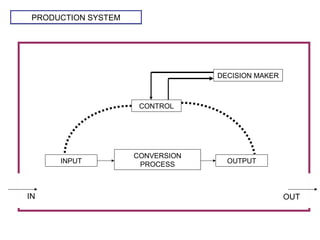
PRODUCTION SYSTEM
CONVERSION
PROCESSINPUT OUTPUT
CONTROL
DECISION MAKER
IN OUT
Definitions of plant layout :
A method of organizing the elements of a production process, in
which similar processes and functions are grouped together
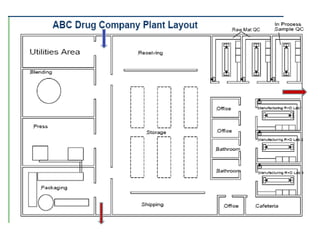
Plant Layout is the physical arrangement of equipment and facilities
within a Plant
Plant layout is the organization of physical facilities like machinery ,
equipment & the allocation of space for the various activities of the
plant & personnel working in the plant
PLAN LAYOUT
To improve productivity, safety and quality of Products
Unnecessary efforts of materials handling can be avoided when the
Plant Layout is optimized
This is valid for :
- Distances Material has to move
- Distances Equipment has to move
- Distances Operators have to move
- Types of Handling Equipment needed
- Energy required to move items against resistance (i.e. gravity)
Optimizing the Layout of a Plant
Provide space for machine / materials / storage / etc
•Flexible for future changes in capacity / Design / Process etc
( Cellular design)
• Accommodate future expansion
•Comply with government rules & regulations ( Municipal corporation /
Labor law & rules
• Safety of employees / visitors / vendors is prime concern
• Achieve economy in operation
Plant Layout Characteristics :
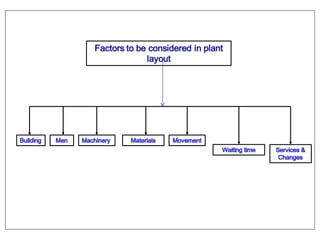
Building & Structure :
Depend on type of production system ( Intermittent / Continuous)
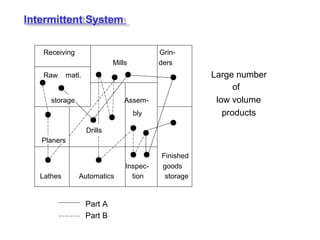
Intermittent System : Building & Shades are constructed & layouts done in
shades with best possible options & then machinery will be brought
inside
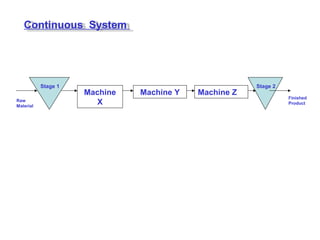
Continuous System : Arrange machines first then construction around . It
should withstand & offer support to cranes / hoists / trolleys etc.
The floor should be designed considering the load it should carry ( Tons /
Sq m)
Men :
• Number of people
• Unskilled ( More space ) / Skilled ( Less space i.e. Computer operator)
• Physic of workers ( ex. height )
Receiving Grin-
Mills ders
Raw matl. Large number
of
storage Assem- low volume
bly products
Drills
Planers
Finished
Inspec- goods
Lathes Automatics tion storage
Part A
Part B
Intermittent System
Stage 1 Stage 2
Machine
X
Machine Y Machine Z
Raw
Material
Finished
Product
Continuous System
: Type of machine :
• General purpose machines : Compact in size & requires less
space
• Special Purpose machines (SPM) : Large in size ,
complicated , high level of automation
• Number of machines :
• Level of automation ( Semi / fully automated)
• Higher complexity wider space
• Level & frequency of maintenance
Machine
• Nature of material ( Flammable / inflammable / Hazardous & Non
Hazardous , Corrosive , Methalene , mercury , oils , fuels)
• Form of material ( Solid / Liquid / Powder etc)
• Quantity of material to be handled
• Cycle Time : Consumption of material
• Availability of material
•
Materials :
Movement :
• Movement of people / machines / cranes ( length & frequency)
• Purpose of movement ( With load / without load / Quantity of load)
Waiting Time :
• Cycle time for completeting each activity
• Intermittent –
•Uncertain & High
• More storage places between machines & facilities
• Continuous –
•Defined & low
• Purpose of waiting
• Process ( low space)
• Idling (More space)
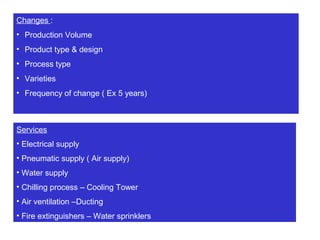
Changes :
• Production Volume
• Product type & design
• Process type
• Varieties
• Frequency of change ( Ex 5 years)
Services
• Electrical supply
• Pneumatic supply ( Air supply)
• Water supply
• Chilling process – Cooling Tower
• Air ventilation –Ducting
• Fire extinguishers – Water sprinklers
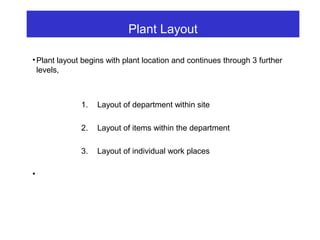
•Plant layout begins with plant location and continues through 3 further
levels,
1. Layout of department within site
2. Layout of items within the department
3. Layout of individual work places
•
Plant Layout
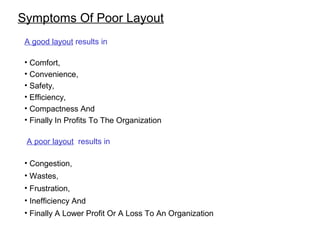
Symptoms Of Poor Layout
A good layout results in
• Comfort,
• Convenience,
• Safety,
• Efficiency,
• Compactness And
• Finally In Profits To The Organization
A poor layout results in
• Congestion,
• Wastes,
• Frustration,
• Inefficiency And
• Finally A Lower Profit Or A Loss To An Organization
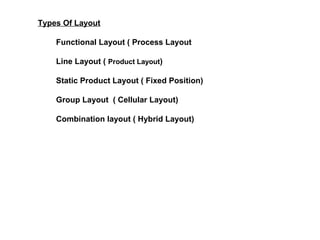
Types Of Layout
Functional Layout ( Process Layout
Line Layout ( Product Layout)
Static Product Layout ( Fixed Position)
Group Layout ( Cellular Layout)
Combination layout ( Hybrid Layout)
Functional Layout ( Process Layout)
• Also called as process layout
• Its best suited for intermittent type of operation
• Machines on layout are called as general purpose machines
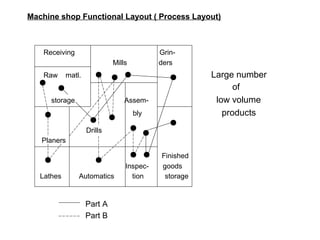
• It involves a grouping together of like machines in one section / dept
Example :
• Machines performing grinding operation are installed in grinding dept
• Machines performing drilling operation are installed in drilling dept
• Heat Treatment / Painting etc
Receiving Grin-
Mills ders
Raw matl. Large number
of
storage Assem- low volume
bly products
Drills
Planers
Finished
Inspec- goods
Lathes Automatics tion storage
Part A
Part B
Machine shop Functional Layout ( Process Layout)
Functional Layout ( Process Layout)
Advantages :
• Greater flexibility in production
• Easy to handle M/c breakdown by transfer of to another machine
• Greater Scope for expansion
• Investment on equipment will be comparatively low
• Full utilization of equipment
• Greater incentive to operators to improve performance
Disadvantages :
• Accumulation of work in progress
• Requires more floor space
• Difficulty in movement of material
• Production control is difficult
• High production time as WIP has to travel from place to place
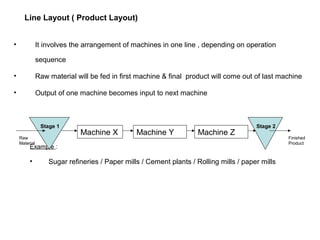
• It involves the arrangement of machines in one line , depending on operation
sequence
• Raw material will be fed in first machine & final product will come out of last machine
• Output of one machine becomes input to next machine
Example :
• Sugar refineries / Paper mills / Cement plants / Rolling mills / paper mills
Line Layout ( Product Layout)
Stage 1 Stage 2
Machine X Machine Y Machine Z
Raw
Material
Finished
Product
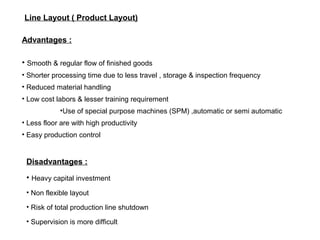
Advantages :
• Smooth & regular flow of finished goods
• Shorter processing time due to less travel , storage & inspection frequency
• Reduced material handling
• Low cost labors & lesser training requirement
•Use of special purpose machines (SPM) ,automatic or semi automatic
• Less floor are with high productivity
• Easy production control
Disadvantages :
• Heavy capital investment
• Non flexible layout
• Risk of total production line shutdown
• Supervision is more difficult
Line Layout ( Product Layout)
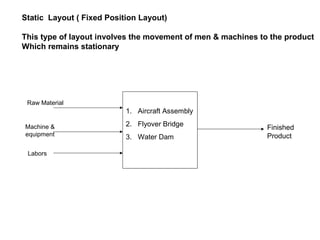
Static Layout ( Fixed Position Layout)
This type of layout involves the movement of men & machines to the product
Which remains stationary
1. Aircraft Assembly
2. Flyover Bridge
3. Water Dam
Raw Material
Machine &
equipment
Labors
Finished
Product
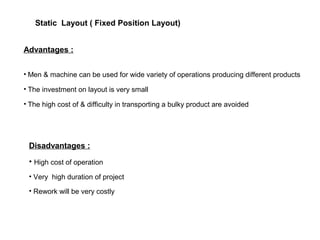
Advantages :
• Men & machine can be used for wide variety of operations producing different products
• The investment on layout is very small
• The high cost of & difficulty in transporting a bulky product are avoided
Disadvantages :
• High cost of operation
• Very high duration of project
• Rework will be very costly
Static Layout ( Fixed Position Layout)
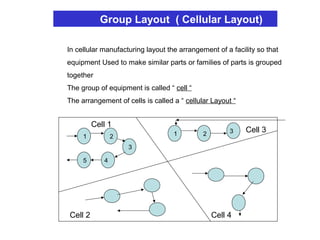
In cellular manufacturing layout the arrangement of a facility so that
equipment Used to make similar parts or families of parts is grouped
together
The group of equipment is called “ cell “
The arrangement of cells is called a “ cellular Layout “
1
5
2
4
3
1
Cell 1
211 3 Cell 3
Cell 2 Cell 4
Group Layout ( Cellular Layout)
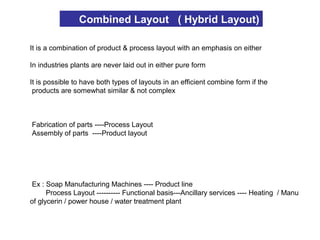
It is a combination of product & process layout with an emphasis on either
In industries plants are never laid out in either pure form
It is possible to have both types of layouts in an efficient combine form if the
products are somewhat similar & not complex
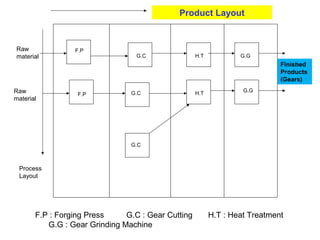
Fabrication of parts ----Process Layout
Assembly of parts ----Product layout
Ex : Soap Manufacturing Machines ---- Product line
Process Layout ---------- Functional basis---Ancillary services ---- Heating / Manu
of glycerin / power house / water treatment plant
Combined Layout ( Hybrid Layout)
F.P
F.P
G.C
G.C
G.C
H.T
H.T
G.G
G.G
Process
Layout
Product Layout
Raw
material
Raw
material
Finished
Products
(Gears)
F.P : Forging Press G.C : Gear Cutting H.T : Heat Treatment
G.G : Gear Grinding Machine
Line Balancing
Line balancing is the phase of assembly line study that
equally divides the work to be done among the workers so
that the total number of employees Required on assembly
line are minimized & no employee of equipment will remain
idle.
Factors Influencing Layouts
1.Factory Building : The nature & size of building determines the floor space available
for layout
While designing the special requirements i.e. Air conditioning , dust control , Humidity
control ,Noise proofing etc must be kept in mind
2. Nature of product : Product layout is suitable for uniform products
Process layout is suitable for custom made products
3. Production process : In assembly line industries product layout is better.
In job order or intermittent manufacturing process layout is desirable
4.Types of machinery : General purpose machines are arranged as per process layout ,
Special purpose machines are arranged as per product layout
5. Repairs & Maintenance : Machines / Equipments must be arranged keeping in mind
the movement of operators & maintenance tools
6. Human Needs : Adequate arrangement should be made for Wash rooms, drinking
water / Canteen & other employee facilities
7.Plant Environment : Heat / Noise / Light / Ventilation & other aspects should be duly
considered e.g. Paint shop / Fabrication / Plating section should be located separately to
protect employees from harmful fumes etc. Adequate safety arrangement should be
made
• The plant layout should be conducive to health & safety of
employees
• It should ensure free & efficient flow of employees & materials
• Future expansion & diversification may also be considered while
planning factory layout
To conclude
Factors Influencing Layouts
Plant Layout Tools & Techniques
1. Process Chart
i. Operations process chart
ii. Flow process chart
2. Process Flow Diagrams
3. Machine Data cards
4. Visualization of layout
i. Two dimensional plan or template
ii. Three dimensional plan or machine models
Process Chart : It is a classification & graphic representation of production activities in
a plant
Very useful for systematic analysis of various operations & material movements in
production process & there effectiveness
Study helps to identify operations that can be eliminated / rearranged / or simplified to
achieve economy in production
Operation Process Chart :
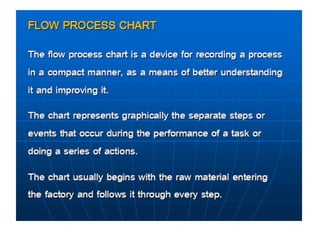
Flow Process Chart :
It is graphic representation of all the activities occurring on the floor of the plant
This chart accumulates & classifies the complete information necessary for the analysis
& improvement of plant operations .
Plant Layout Tools & Techniques
2. Process Flow Diagram : It helps to visualize the movement of material on
an existing floor layout
Helps in identifying excessive movement of materials & helps in relocations
of plant activities to reduce travel distance
3.Machine Data Cards : This is an effective method to provide necessary
information for placement Or layout of the equipment
The cards indicates machines capacity / space & power requirements , handling
needs & corresponding dimensions
4.Visualisation of Layout :Most common method of planning a layout by making
replicas of machines ,racks , benches , & equipment & then arranging these on a
2d /3d plan of the floor space
i) Two Dimensional Plan (Template)
ii) Three Dimensional plan ( Miniature models )
SUMMARY
Decisions about layout are made only periodically. As they have long term
consequences ,they must be made with careful planning .The layout design
affects the cost of producing goods & delivering services for many years in
future. Here we have discussed three “Traditional “ Basic layouts: 1) Process 2)
Product 3) Fixed Position.
Process Layout arrange work centers according to function.
Product Layouts ( Assembly layout) arrange work centers & equipments in line
to perform specialized sequence of tasks.
In Fixed position Layout ,the product remains in one location & resources are
brought to it.
In process & product layouts , the design begin with a statement of goals of
facility. The layouts are designed to meet these goals.
After initial designs have been developed , improved designs are sought which
will be cumbersome ,hence to take care of it quantitative & computer based
models are used.

Lecture on Production management- Plant layout

  • 1.
  • 2.
    • The ProductionFunction • Types of production system • Elementary knowledge of manufacturing processes • Plant Layouts • Material Handling • Location Problems • Inventory management • Scheduling • Network Analysis • Break Even Point Analysis • Reliability maintenance & plant services • Quality control • Emerging Trends • Concept of Productivity Syllabus
  • 3.
    • Plant Layouts: • Objectives • Symptoms Of Poor Layout • Types Of Layout • Functional Layout • Line Layout • Static Product Layout • Group Layout • Factors Influencing Layouts • Plant Layout Tools & Techniques CHAPTER -III
  • 4.
  • 5.
    Definitions of plantlayout : A method of organizing the elements of a production process, in which similar processes and functions are grouped together Plant Layout is the physical arrangement of equipment and facilities within a Plant Plant layout is the organization of physical facilities like machinery , equipment & the allocation of space for the various activities of the plant & personnel working in the plant PLAN LAYOUT
  • 7.
    To improve productivity,safety and quality of Products Unnecessary efforts of materials handling can be avoided when the Plant Layout is optimized This is valid for : - Distances Material has to move - Distances Equipment has to move - Distances Operators have to move - Types of Handling Equipment needed - Energy required to move items against resistance (i.e. gravity) Optimizing the Layout of a Plant
  • 8.
    Provide space formachine / materials / storage / etc •Flexible for future changes in capacity / Design / Process etc ( Cellular design) • Accommodate future expansion •Comply with government rules & regulations ( Municipal corporation / Labor law & rules • Safety of employees / visitors / vendors is prime concern • Achieve economy in operation Plant Layout Characteristics :
  • 10.
    Building & Structure: Depend on type of production system ( Intermittent / Continuous) Intermittent System : Building & Shades are constructed & layouts done in shades with best possible options & then machinery will be brought inside Continuous System : Arrange machines first then construction around . It should withstand & offer support to cranes / hoists / trolleys etc. The floor should be designed considering the load it should carry ( Tons / Sq m) Men : • Number of people • Unskilled ( More space ) / Skilled ( Less space i.e. Computer operator) • Physic of workers ( ex. height )
  • 11.
    Receiving Grin- Mills ders Rawmatl. Large number of storage Assem- low volume bly products Drills Planers Finished Inspec- goods Lathes Automatics tion storage Part A Part B Intermittent System
  • 12.
    Stage 1 Stage2 Machine X Machine Y Machine Z Raw Material Finished Product Continuous System
  • 13.
    : Type ofmachine : • General purpose machines : Compact in size & requires less space • Special Purpose machines (SPM) : Large in size , complicated , high level of automation • Number of machines : • Level of automation ( Semi / fully automated) • Higher complexity wider space • Level & frequency of maintenance Machine
  • 14.
    • Nature ofmaterial ( Flammable / inflammable / Hazardous & Non Hazardous , Corrosive , Methalene , mercury , oils , fuels) • Form of material ( Solid / Liquid / Powder etc) • Quantity of material to be handled • Cycle Time : Consumption of material • Availability of material • Materials :
  • 15.
    Movement : • Movementof people / machines / cranes ( length & frequency) • Purpose of movement ( With load / without load / Quantity of load) Waiting Time : • Cycle time for completeting each activity • Intermittent – •Uncertain & High • More storage places between machines & facilities • Continuous – •Defined & low • Purpose of waiting • Process ( low space) • Idling (More space)
  • 16.
    Changes : • ProductionVolume • Product type & design • Process type • Varieties • Frequency of change ( Ex 5 years) Services • Electrical supply • Pneumatic supply ( Air supply) • Water supply • Chilling process – Cooling Tower • Air ventilation –Ducting • Fire extinguishers – Water sprinklers
  • 17.
    •Plant layout beginswith plant location and continues through 3 further levels, 1. Layout of department within site 2. Layout of items within the department 3. Layout of individual work places • Plant Layout
  • 18.
    Symptoms Of PoorLayout A good layout results in • Comfort, • Convenience, • Safety, • Efficiency, • Compactness And • Finally In Profits To The Organization A poor layout results in • Congestion, • Wastes, • Frustration, • Inefficiency And • Finally A Lower Profit Or A Loss To An Organization
  • 19.
    Types Of Layout FunctionalLayout ( Process Layout Line Layout ( Product Layout) Static Product Layout ( Fixed Position) Group Layout ( Cellular Layout) Combination layout ( Hybrid Layout)
  • 20.
    Functional Layout (Process Layout) • Also called as process layout • Its best suited for intermittent type of operation • Machines on layout are called as general purpose machines • It involves a grouping together of like machines in one section / dept Example : • Machines performing grinding operation are installed in grinding dept • Machines performing drilling operation are installed in drilling dept • Heat Treatment / Painting etc
  • 21.
    Receiving Grin- Mills ders Rawmatl. Large number of storage Assem- low volume bly products Drills Planers Finished Inspec- goods Lathes Automatics tion storage Part A Part B Machine shop Functional Layout ( Process Layout)
  • 22.
    Functional Layout (Process Layout) Advantages : • Greater flexibility in production • Easy to handle M/c breakdown by transfer of to another machine • Greater Scope for expansion • Investment on equipment will be comparatively low • Full utilization of equipment • Greater incentive to operators to improve performance Disadvantages : • Accumulation of work in progress • Requires more floor space • Difficulty in movement of material • Production control is difficult • High production time as WIP has to travel from place to place
  • 23.
    • It involvesthe arrangement of machines in one line , depending on operation sequence • Raw material will be fed in first machine & final product will come out of last machine • Output of one machine becomes input to next machine Example : • Sugar refineries / Paper mills / Cement plants / Rolling mills / paper mills Line Layout ( Product Layout) Stage 1 Stage 2 Machine X Machine Y Machine Z Raw Material Finished Product
  • 24.
    Advantages : • Smooth& regular flow of finished goods • Shorter processing time due to less travel , storage & inspection frequency • Reduced material handling • Low cost labors & lesser training requirement •Use of special purpose machines (SPM) ,automatic or semi automatic • Less floor are with high productivity • Easy production control Disadvantages : • Heavy capital investment • Non flexible layout • Risk of total production line shutdown • Supervision is more difficult Line Layout ( Product Layout)
  • 25.
    Static Layout (Fixed Position Layout) This type of layout involves the movement of men & machines to the product Which remains stationary 1. Aircraft Assembly 2. Flyover Bridge 3. Water Dam Raw Material Machine & equipment Labors Finished Product
  • 26.
    Advantages : • Men& machine can be used for wide variety of operations producing different products • The investment on layout is very small • The high cost of & difficulty in transporting a bulky product are avoided Disadvantages : • High cost of operation • Very high duration of project • Rework will be very costly Static Layout ( Fixed Position Layout)
  • 27.
    In cellular manufacturinglayout the arrangement of a facility so that equipment Used to make similar parts or families of parts is grouped together The group of equipment is called “ cell “ The arrangement of cells is called a “ cellular Layout “ 1 5 2 4 3 1 Cell 1 211 3 Cell 3 Cell 2 Cell 4 Group Layout ( Cellular Layout)
  • 28.
    It is acombination of product & process layout with an emphasis on either In industries plants are never laid out in either pure form It is possible to have both types of layouts in an efficient combine form if the products are somewhat similar & not complex Fabrication of parts ----Process Layout Assembly of parts ----Product layout Ex : Soap Manufacturing Machines ---- Product line Process Layout ---------- Functional basis---Ancillary services ---- Heating / Manu of glycerin / power house / water treatment plant Combined Layout ( Hybrid Layout)
  • 29.
    F.P F.P G.C G.C G.C H.T H.T G.G G.G Process Layout Product Layout Raw material Raw material Finished Products (Gears) F.P :Forging Press G.C : Gear Cutting H.T : Heat Treatment G.G : Gear Grinding Machine
  • 30.
    Line Balancing Line balancingis the phase of assembly line study that equally divides the work to be done among the workers so that the total number of employees Required on assembly line are minimized & no employee of equipment will remain idle.
  • 31.
    Factors Influencing Layouts 1.FactoryBuilding : The nature & size of building determines the floor space available for layout While designing the special requirements i.e. Air conditioning , dust control , Humidity control ,Noise proofing etc must be kept in mind 2. Nature of product : Product layout is suitable for uniform products Process layout is suitable for custom made products 3. Production process : In assembly line industries product layout is better. In job order or intermittent manufacturing process layout is desirable 4.Types of machinery : General purpose machines are arranged as per process layout , Special purpose machines are arranged as per product layout 5. Repairs & Maintenance : Machines / Equipments must be arranged keeping in mind the movement of operators & maintenance tools 6. Human Needs : Adequate arrangement should be made for Wash rooms, drinking water / Canteen & other employee facilities 7.Plant Environment : Heat / Noise / Light / Ventilation & other aspects should be duly considered e.g. Paint shop / Fabrication / Plating section should be located separately to protect employees from harmful fumes etc. Adequate safety arrangement should be made
  • 32.
    • The plantlayout should be conducive to health & safety of employees • It should ensure free & efficient flow of employees & materials • Future expansion & diversification may also be considered while planning factory layout To conclude Factors Influencing Layouts
  • 33.
    Plant Layout Tools& Techniques 1. Process Chart i. Operations process chart ii. Flow process chart 2. Process Flow Diagrams 3. Machine Data cards 4. Visualization of layout i. Two dimensional plan or template ii. Three dimensional plan or machine models
  • 34.
    Process Chart :It is a classification & graphic representation of production activities in a plant Very useful for systematic analysis of various operations & material movements in production process & there effectiveness Study helps to identify operations that can be eliminated / rearranged / or simplified to achieve economy in production Operation Process Chart : Flow Process Chart : It is graphic representation of all the activities occurring on the floor of the plant This chart accumulates & classifies the complete information necessary for the analysis & improvement of plant operations . Plant Layout Tools & Techniques
  • 36.
    Plant Layout Tools& Techniques 2. Process Flow Diagram : It helps to visualize the movement of material on an existing floor layout Helps in identifying excessive movement of materials & helps in relocations of plant activities to reduce travel distance 3.Machine Data Cards : This is an effective method to provide necessary information for placement Or layout of the equipment The cards indicates machines capacity / space & power requirements , handling needs & corresponding dimensions 4.Visualisation of Layout :Most common method of planning a layout by making replicas of machines ,racks , benches , & equipment & then arranging these on a 2d /3d plan of the floor space i) Two Dimensional Plan (Template) ii) Three Dimensional plan ( Miniature models )
  • 37.
    SUMMARY Decisions about layoutare made only periodically. As they have long term consequences ,they must be made with careful planning .The layout design affects the cost of producing goods & delivering services for many years in future. Here we have discussed three “Traditional “ Basic layouts: 1) Process 2) Product 3) Fixed Position. Process Layout arrange work centers according to function. Product Layouts ( Assembly layout) arrange work centers & equipments in line to perform specialized sequence of tasks. In Fixed position Layout ,the product remains in one location & resources are brought to it. In process & product layouts , the design begin with a statement of goals of facility. The layouts are designed to meet these goals. After initial designs have been developed , improved designs are sought which will be cumbersome ,hence to take care of it quantitative & computer based models are used.