HNC year 1
                                      Design for Manufacture
Author: Leicester College
Date created:
Date revised: 2009

Abstract: A major cost factor in the production of and component or assembly is its assembly. This section
looks at some commonly used techniques which a designer can employ to ensure that assembly is cost
effective and efficient. This is then linked to the use of jigs and fixtures for this purpose.


           © Leicester College 2009. This work is licensed under
           a Creative Commons Attribution 2.0 License.
                                                           Design for Assembly
      Introduction
      Assembly Methods
      Design Guidelines for Manual Assembly
      Using Jigs & Fixtures
      Design Guidelines for Automated Assembly
      Basic DFA Guidelines
      Credits


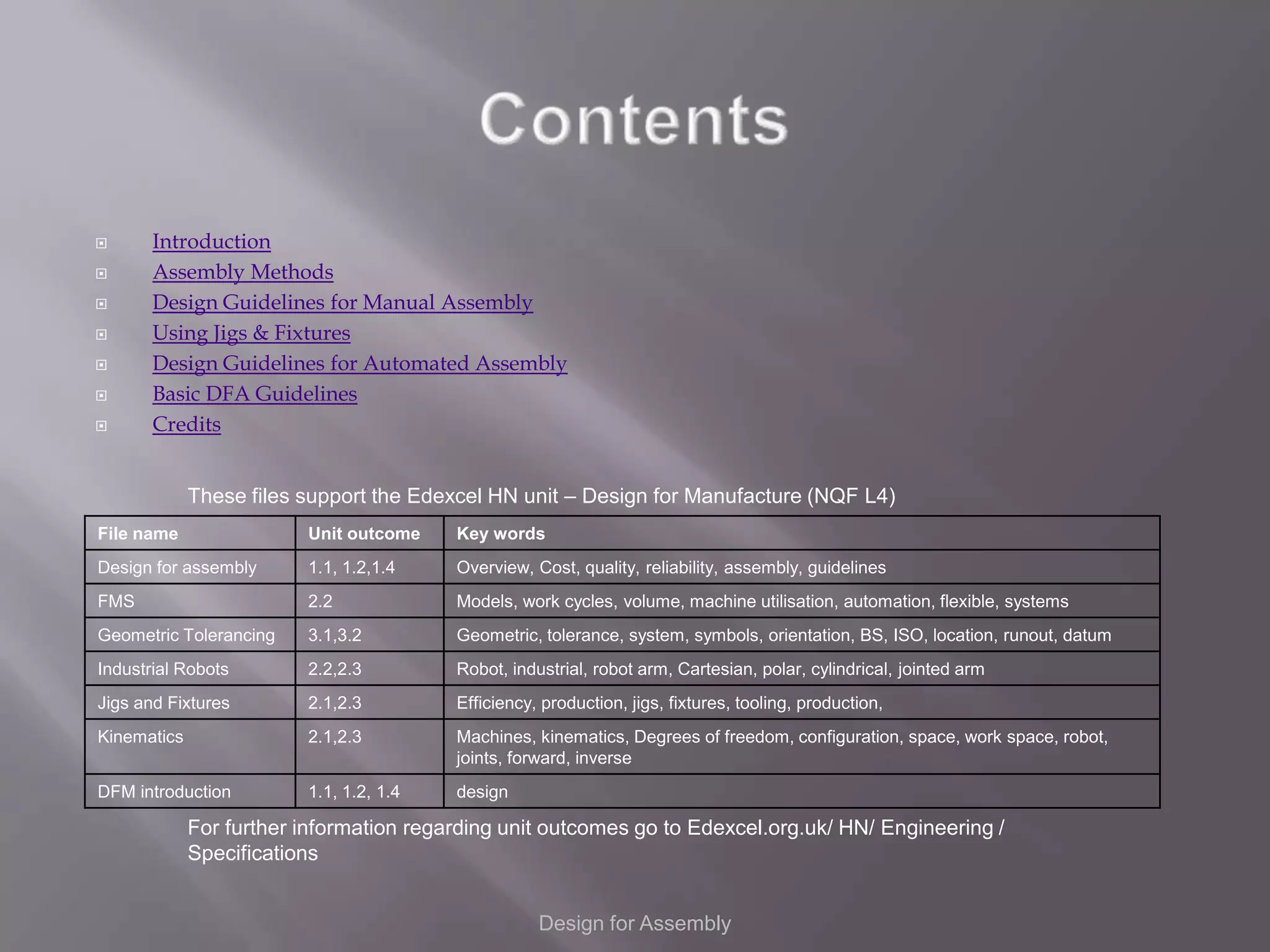
             These files support the Edexcel HN unit – Design for Manufacture (NQF L4)
File name                Unit outcome    Key words
Design for assembly      1.1, 1.2,1.4    Overview, Cost, quality, reliability, assembly, guidelines
FMS                      2.2             Models, work cycles, volume, machine utilisation, automation, flexible, systems
Geometric Tolerancing    3.1,3.2         Geometric, tolerance, system, symbols, orientation, BS, ISO, location, runout, datum
Industrial Robots        2.2,2.3         Robot, industrial, robot arm, Cartesian, polar, cylindrical, jointed arm
Jigs and Fixtures        2.1,2.3         Efficiency, production, jigs, fixtures, tooling, production,
Kinematics               2.1,2.3         Machines, kinematics, Degrees of freedom, configuration, space, work space, robot,
                                         joints, forward, inverse
DFM introduction         1.1, 1.2, 1.4   design

             For further information regarding unit outcomes go to Edexcel.org.uk/ HN/ Engineering /
             Specifications


                                                    Design for Assembly
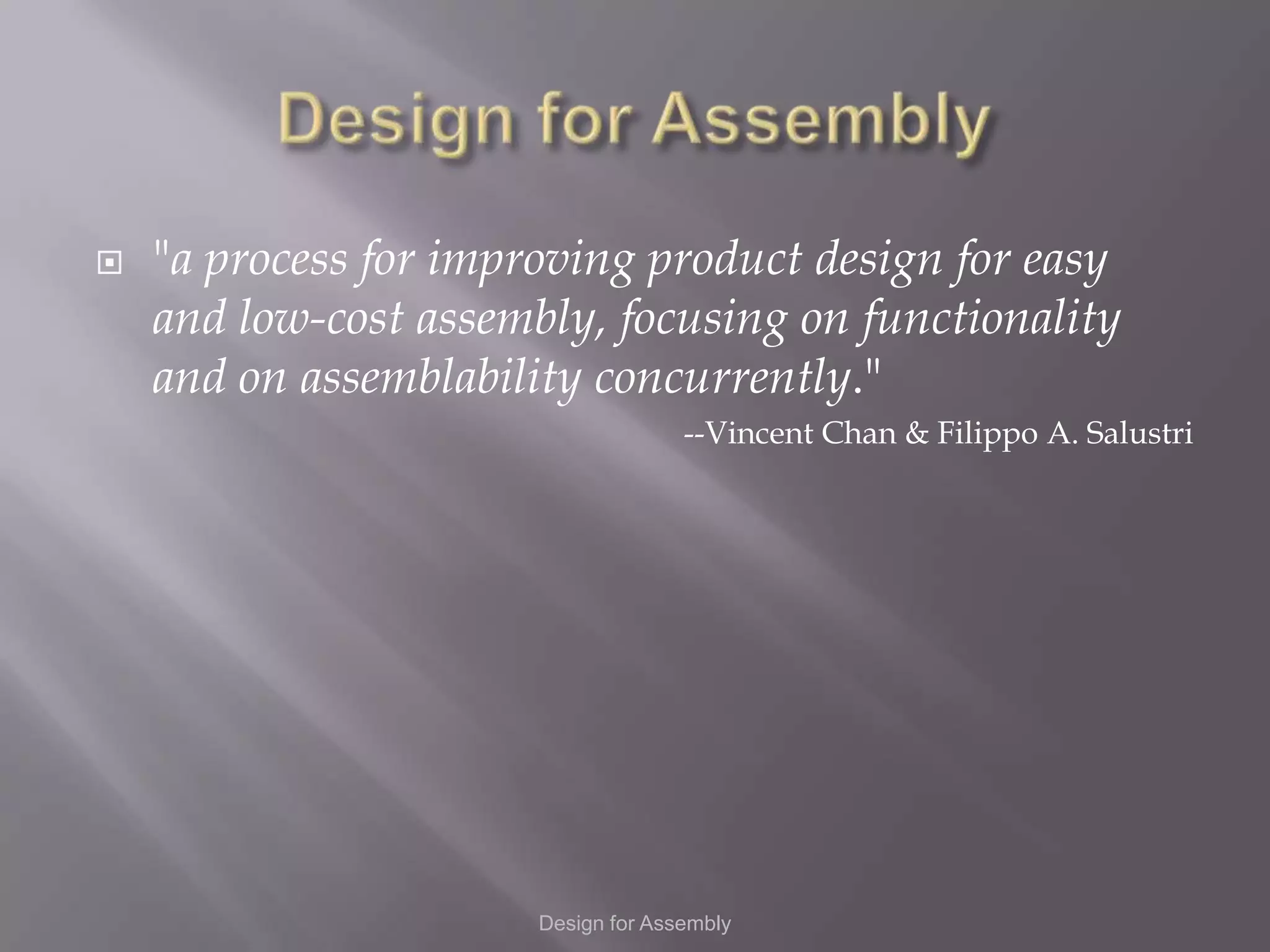
   "a process for improving product design for easy
    and low-cost assembly, focusing on functionality
    and on assemblability concurrently."
                                     --Vincent Chan & Filippo A. Salustri


                       Design for Assembly
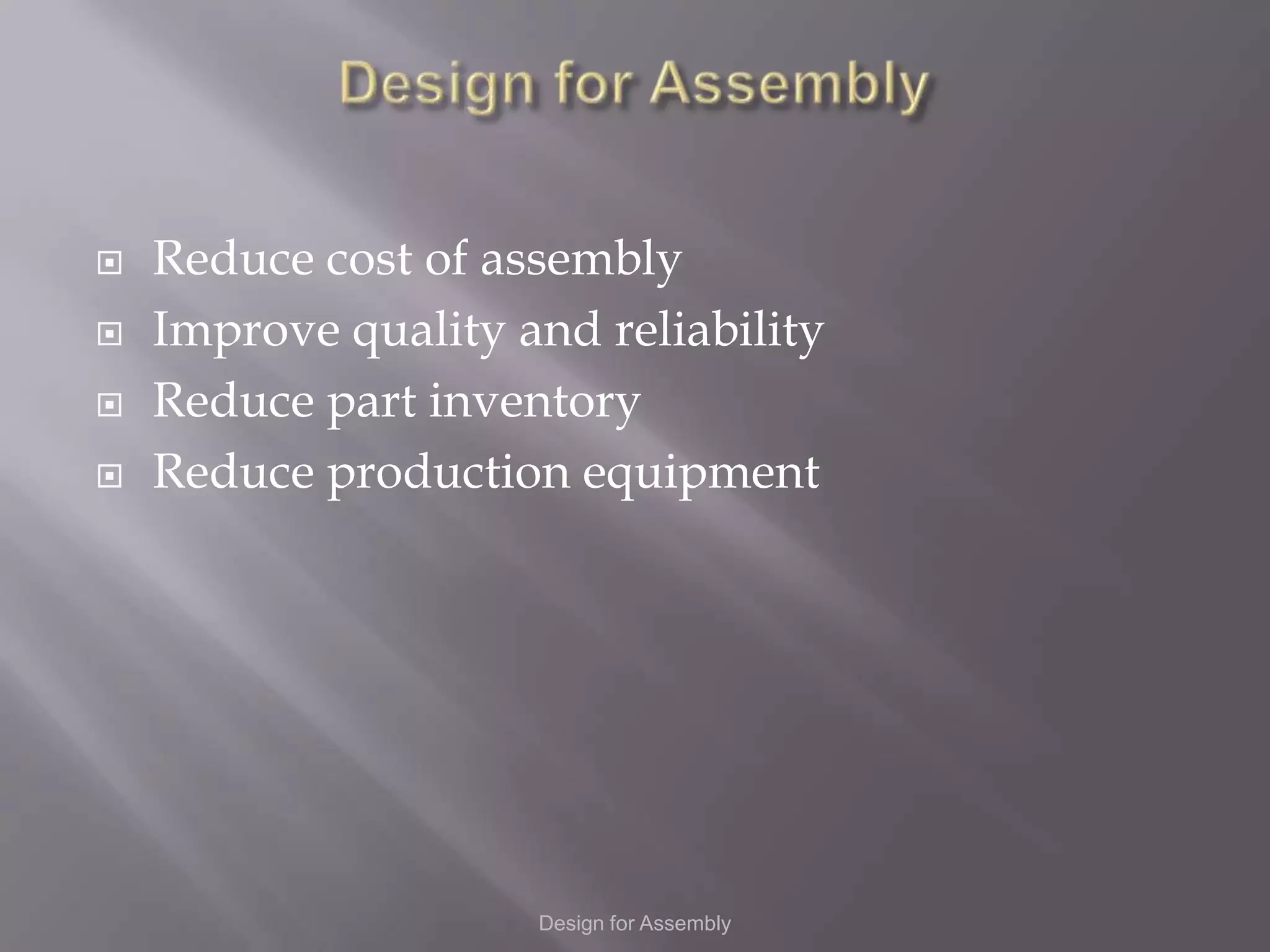
   Reduce cost of assembly
   Improve quality and reliability
   Reduce part inventory
   Reduce production equipment


                     Design for Assembly
   Manual assembly
   Fixed automatic assembly
   Flexible automatic assembly


                  Design for Assembly
   eliminate the need for workers to make
    decisions or adjustments.
   ensure accessibility and visibility.
   eliminate the need for assembly tools and
    gauges (i.e. prefer self-locating parts).


                  Design for Assembly
Hull Forming Jigs at Offshore Steel Boats Ltd.
Image source: www.geograph.org.uk/photo/1230702
© Copyright David Wright and licensed for reuse under this Creative Commons Licence.
   Minimise the number of standard different
    parts – use ‘standard parts.’
   minimise the number of parts.
   avoid or minimise part orientation during
    assembly (i.e. prefer symmetrical parts).
   prefer easily handled parts that do not tangle
    or nest within one another.


                   Design for Assembly
   reduce the number of different components by
    considering
     does the part move relative to other parts?
     must the part be isolated from other parts (electrical,
      vibration, etc.)?
     must the part be separate to allow assembly (cover
      plates, etc.)?
   use self-aligning and self-locating features
   avoid screws/bolts


                     Design for Assembly
   use the largest and most rigid part as the
    assembly base and fixture.
   Assembly should be performed in a layered,
    bottom-up manner.
   use standard components and materials.


                 Design for Assembly
   avoid tangling or nesting parts.
   avoid flexible and fragile parts.
   avoid parts that require orientation.
   use parts that can be fed automatically.
   design parts with a low centre of gravity.


                   Design for Assembly
   Minimise part count by incorporating multiple
    functions into single parts
   Modularise multiple parts into single sub-
    assemblies
   Assemble in open space, not in confined
    spaces; never bury important components
   Make parts such that it is easy to identify how
    they should be oriented for insertion
   Prefer self-locating parts

                  Design for Assembly
   Standardise to reduce part variety
   Maximise part symmetry
   Eliminate tangling parts
   Colour code parts that are different but shaped
    similarly
   Prevent nesting of parts; prefer stacked
    assemblies
   Provide alignment features


                  Design for Assembly
   Design the mating features for easy insertion
   Insert new parts into an assembly from above
   Eliminate re-orientation of both parts and
    assemblies
   Eliminate fasteners


                  Design for Assembly
   Place fasteners away from obstructions; design
    in fastener access
   Deep channels should be sufficiently wide to
    provide access to fastening tools; eliminate
    channels if possible
   Provide flats for uniform fastening and
    fastening ease
   Ensure sufficient space between fasteners and
    other features for a fastening tool
   Prefer easily handled parts
                  Design for Assembly
HNC year 1
This resource was created Leicester College and released as an open educational resource through the Open
Engineering Resources project of the Higher Education Academy Engineering Subject Centre. The Open
Engineering Resources project was funded by HEFCE and part of the JISC/HE Academy UKOER programme.


© 2009 Leicester College


This work is licensed under a Creative Commons Attribution 2.0 License.

The JISC logo is licensed under the terms of the Creative Commons Attribution-Non-Commercial-No Derivative Works 2.0 UK:
England & Wales Licence. All reproductions must comply with the terms of that licence.

The HEA logo is owned by the Higher Education Academy Limited may be freely distributed and copied for educational purposes
only, provided that appropriate acknowledgement is given to the Higher Education Academy as the copyright holder and original
publisher.

The Leicester College name and logo is owned by the College and should not be produced without the express permission of the
College.

                                                     Design for Assembly

Design For Assembly

  • 1.
    HNC year 1 Design for Manufacture Author: Leicester College Date created: Date revised: 2009 Abstract: A major cost factor in the production of and component or assembly is its assembly. This section looks at some commonly used techniques which a designer can employ to ensure that assembly is cost effective and efficient. This is then linked to the use of jigs and fixtures for this purpose. © Leicester College 2009. This work is licensed under a Creative Commons Attribution 2.0 License. Design for Assembly
  • 2.
    Introduction  Assembly Methods  Design Guidelines for Manual Assembly  Using Jigs & Fixtures  Design Guidelines for Automated Assembly  Basic DFA Guidelines  Credits These files support the Edexcel HN unit – Design for Manufacture (NQF L4) File name Unit outcome Key words Design for assembly 1.1, 1.2,1.4 Overview, Cost, quality, reliability, assembly, guidelines FMS 2.2 Models, work cycles, volume, machine utilisation, automation, flexible, systems Geometric Tolerancing 3.1,3.2 Geometric, tolerance, system, symbols, orientation, BS, ISO, location, runout, datum Industrial Robots 2.2,2.3 Robot, industrial, robot arm, Cartesian, polar, cylindrical, jointed arm Jigs and Fixtures 2.1,2.3 Efficiency, production, jigs, fixtures, tooling, production, Kinematics 2.1,2.3 Machines, kinematics, Degrees of freedom, configuration, space, work space, robot, joints, forward, inverse DFM introduction 1.1, 1.2, 1.4 design For further information regarding unit outcomes go to Edexcel.org.uk/ HN/ Engineering / Specifications Design for Assembly
  • 3.
    "a process for improving product design for easy and low-cost assembly, focusing on functionality and on assemblability concurrently." --Vincent Chan & Filippo A. Salustri Design for Assembly
  • 4.
    Reduce cost of assembly  Improve quality and reliability  Reduce part inventory  Reduce production equipment Design for Assembly
  • 5.
    Manual assembly  Fixed automatic assembly  Flexible automatic assembly Design for Assembly
  • 6.
    eliminate the need for workers to make decisions or adjustments.  ensure accessibility and visibility.  eliminate the need for assembly tools and gauges (i.e. prefer self-locating parts). Design for Assembly
  • 7.
    Hull Forming Jigsat Offshore Steel Boats Ltd. Image source: www.geograph.org.uk/photo/1230702 © Copyright David Wright and licensed for reuse under this Creative Commons Licence.
  • 8.
    Minimise the number of standard different parts – use ‘standard parts.’  minimise the number of parts.  avoid or minimise part orientation during assembly (i.e. prefer symmetrical parts).  prefer easily handled parts that do not tangle or nest within one another. Design for Assembly
  • 9.
    reduce the number of different components by considering  does the part move relative to other parts?  must the part be isolated from other parts (electrical, vibration, etc.)?  must the part be separate to allow assembly (cover plates, etc.)?  use self-aligning and self-locating features  avoid screws/bolts Design for Assembly
  • 10.
    use the largest and most rigid part as the assembly base and fixture.  Assembly should be performed in a layered, bottom-up manner.  use standard components and materials. Design for Assembly
  • 11.
    avoid tangling or nesting parts.  avoid flexible and fragile parts.  avoid parts that require orientation.  use parts that can be fed automatically.  design parts with a low centre of gravity. Design for Assembly
  • 12.
    Minimise part count by incorporating multiple functions into single parts  Modularise multiple parts into single sub- assemblies  Assemble in open space, not in confined spaces; never bury important components  Make parts such that it is easy to identify how they should be oriented for insertion  Prefer self-locating parts Design for Assembly
  • 13.
    Standardise to reduce part variety  Maximise part symmetry  Eliminate tangling parts  Colour code parts that are different but shaped similarly  Prevent nesting of parts; prefer stacked assemblies  Provide alignment features Design for Assembly
  • 14.
    Design the mating features for easy insertion  Insert new parts into an assembly from above  Eliminate re-orientation of both parts and assemblies  Eliminate fasteners Design for Assembly
  • 15.
    Place fasteners away from obstructions; design in fastener access  Deep channels should be sufficiently wide to provide access to fastening tools; eliminate channels if possible  Provide flats for uniform fastening and fastening ease  Ensure sufficient space between fasteners and other features for a fastening tool  Prefer easily handled parts Design for Assembly
  • 16.
  • 17.
    This resource wascreated Leicester College and released as an open educational resource through the Open Engineering Resources project of the Higher Education Academy Engineering Subject Centre. The Open Engineering Resources project was funded by HEFCE and part of the JISC/HE Academy UKOER programme. © 2009 Leicester College This work is licensed under a Creative Commons Attribution 2.0 License. The JISC logo is licensed under the terms of the Creative Commons Attribution-Non-Commercial-No Derivative Works 2.0 UK: England & Wales Licence. All reproductions must comply with the terms of that licence. The HEA logo is owned by the Higher Education Academy Limited may be freely distributed and copied for educational purposes only, provided that appropriate acknowledgement is given to the Higher Education Academy as the copyright holder and original publisher. The Leicester College name and logo is owned by the College and should not be produced without the express permission of the College. Design for Assembly