Plant Layout
WORK STUDY METHODOLOGY

Presented by,

Zaghum chahal

Page 1
Lay-out
Layout refers to the configuration of departments, work
centers, and equipment, with particular emphasis on
movement of work (customers or materials) through the
system.
Layout decisions are important for three basic
reasons:
1. require substantial investments of money and effort;
2. involve long-term commitments, which makes
mistakes difficult to overcome; and
3. have a significant impact on the cost and efficiency
of operations

Page 2
The basic objective of layout design is to facilitate a
smooth flow of work, material, and information through the
system. Supporting objectives generally involve the
following:
To facilitate attainment of product or service quality.
To use workers and space efficiently.
To avoid bottlenecks.
To minimize material handling costs.
To eliminate unnecessary movements of workers or
materials.
To minimize production time or customer service time.
To design for safety.

Page 3
Factors affecting Layout
1. Plant location and building
2. Nature of Product

3. Type of Industry
4. Plant Environment
5. Repairs and Maintenance
6. Management Policy

7. Human Needs
8. Types of machinery and equipment

Page 4
General Criteria
•

Inherent safety. Dangerous processes should not be accessible without
authorization. Fire exits should be clearly marked with uninhibited access.
Pathways should be clearly defined and not cluttered.

•

Length of flow. The flow of materials and information should be channeled
by the layout to fit best the objectives of the operation.
This generally means minimizing the distance travelled by materials.

•

Clarity of flow. All flow of materials should be clearly signposted, for
example using clearly marked routes.

•

Staff comfort. The layout should provide for a well ventilated, well lit and,
where possible, pleasant working environment

Page 5
General Criteria
•

Accessibility. All machines, plant and equipment should be easily accessible
for cleaning and maintenance.

•

Use of space. All layouts should make best use of the total space available
(including height as well as floor space). This usually means minimizing the
space for a particular process

Page 6
Plant Layout
• A plant layout study is an engineering
study used to analyze different physical
configurations for an manufacturing plant.
It is also known as Facilities or industrial Layout.

Page 7
Plant Lay-out: Types
The production process normally determines the
type of plant layout to be applied to the facility:
• Fixed position plant layout

Product stays and resources move to it.
• Product oriented plant layout

Machinery and Materials are placed following the
product path.
• Process oriented plant layout (Functional Layout).

Machinery is placed according to what they do
and materials go to them.
• Combined Layout

Combine aspects of both process and product
layouts
Page 8
Product oriented plant layout
It involves the arrangements of machines in
one line, depending upon sequence of
operations.
This type of plant layout is useful when the
production process is organized in a continuous or
repetitive way.
 Continuous flow : The correct operations flow is
reached through the layout design and the equipment
and machinery specifications.
 Repetitive flow (assembly line): The correct
operations flow will be based in a line balancing
exercise, in order to avoid problems generated by
bottle necks.
Page 9
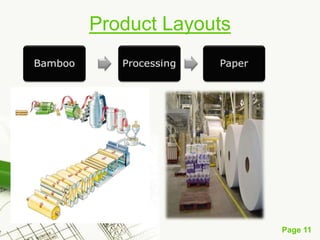
Product Layouts
• Product layouts are used to achieve a smooth and rapid flow
of large volumes of goods or customers through a system.

Page 10
Product Layouts

Page 11
Product Layout at Just Born,
Inc.
•

Page 12
Advantages






A high rate of output
Low unit cost due to high volume
Labor specialization
Low material-handling cost per unit
A high utilization of labor and
equipment

Disadvantages






Morale problems and to repetitive
stress injuries.
Lack of maintaining equipment or
quality of output.
Inflexible for output or design
Highly susceptible to shutdowns
A high utilization of labor and
equipment

Page 13
product oriented plant
layout

Page 14
• Process oriented plant layout (Functional
Layout)
This type of plant layout is useful when the production
process is organized in batches.
– Personnel and equipment to perform the same function
are allocated in the same area.
– The different items have to move from one area to another
one, according to the sequence of operations previously
established.
– The variety of products to produce will lead to a diversity of
flows through the facility.

Page 15
Process Layouts
• Process layouts are designed to process items or provide
services that involve a variety of processing requirements.

Page 16
Process Layout at Vermont Teddy
Bear Company

Page 17
Process oriented layout for an hospital

•

Page 18
Advantages

Disadvantages












Handle a variety of processing
requirements
Not vulnerable to equipment failures
General-purpose equipment is less
costly and is easier and less costly to
maintain
Possible to use individual incentive
systems





In-process inventory costs can be high
Equipment utilization rates are low
Material handling is slow and
inefficient, and more costly per unit
Job complexities reduce the span of
supervision and result higher
supervisory costs
Special attention necessary for each
product or customer and low volumes
result in higher unit costs

Page 19
Fixed-Position Layouts
• In fixed-position layouts, the item being worked on remains
stationary, and workers, materials, and equipment are moved
about as needed.
• Fixed-position layouts are widely used in farming, firefighting,
road building, home building, remodeling and repair, and
drilling for oil. In each case, compelling reasons bring workers,
materials, and equipment to the “product’s” location instead of
the other way around.
• E.g Ship building, Dam & flyover construction.Aircrafts
manufacturing
Page 20
Fixed-Position Layouts

Page 21
Fixed-Position Layouts
•

Page 22
Fixed position layout
•

Page 23
Advantages

Disadvantages




•




Saves time and cost in movement
Flexible as changes in job design can
be easily incorporated
More economical when several orders
in different stages are executed
Adjustments can be made to meet
shortage of materials or absence of
workers.

•
•

Production period being very long,
capital investment is quite heavy
Very large space is required for
storage of materials and equipment
As several operations are carried
simultaneously, possibility of confusion
and conflicts are high

Page 24
Combination Layouts
• In many manufacturing units, several
products are produced in repeated
numbers with no likelihood of continuous
production, combined layout is followed.

• E.g. Soap industry, all inputs are almost
manufactured in separate units vise
glycerin, water treatment, fragrance etc.
Page 25
Combination Layouts
e.g. soaps

Page 26
Combination Layouts
• Ssupermarket Layouts are essentially process layouts, most use fixedpath material-handling devices such as roller-type conveyors in the
stockroom and belt-type conveyors at the cash registers.
• Hospitals also use the basic process arrangement, although frequently
patient care involves more of a fixed-position approach, in which nurses,
doctors, medicines, and special equipment are brought to the patient.
Cellular manufacturing - Group technology
• Cellular manufacturing is a type of layout where machines are grouped
according to the process requirements for a set of similar items (part
families) that require similar processing. These groups are called cells.
• Processes are grouped into cells using a technique known as group
technology (GT)
Page 27
Cellular Layout

Page 28
Advantages
• Reduced materials handling cost.
• Shorter flow times in production.
• Simplified production planning
(meterials&labour)
• Increased operators responsibilities.
• Improved visual control & fewer tooling changes,
therefore facilitating quicker set ups.
• .Quality also tends to improve

Page 29
Dis-advantage
Reduced manufacturing flexibility
&potentially increased machine- down time

Page 30
Benefits
•

A well designed plant layout is one that can be beneficial in achieving the
following objectives:

•

Proper and efficient utilization of available floor space

•

·Transportation of work from one point to another point without any delay

•

·Proper utilization of production capacity.

•

Reduce material handling costs

•

·Utilize labour efficiently

•

· Reduce accidents
Page 31
Benefits
•

Provide for volume and product flexibility

•

Provide ease of supervision and control

•

Provide for employee safety and health

•

Allow easy maintenance of machines and plant.

•

Improve productivity

Page 32
Page 33

Plant layouts(presentation)

  • 1.
    Plant Layout WORK STUDYMETHODOLOGY Presented by, Zaghum chahal Page 1
  • 2.
    Lay-out Layout refers tothe configuration of departments, work centers, and equipment, with particular emphasis on movement of work (customers or materials) through the system. Layout decisions are important for three basic reasons: 1. require substantial investments of money and effort; 2. involve long-term commitments, which makes mistakes difficult to overcome; and 3. have a significant impact on the cost and efficiency of operations Page 2
  • 3.
    The basic objectiveof layout design is to facilitate a smooth flow of work, material, and information through the system. Supporting objectives generally involve the following: To facilitate attainment of product or service quality. To use workers and space efficiently. To avoid bottlenecks. To minimize material handling costs. To eliminate unnecessary movements of workers or materials. To minimize production time or customer service time. To design for safety. Page 3
  • 4.
    Factors affecting Layout 1.Plant location and building 2. Nature of Product 3. Type of Industry 4. Plant Environment 5. Repairs and Maintenance 6. Management Policy 7. Human Needs 8. Types of machinery and equipment Page 4
  • 5.
    General Criteria • Inherent safety.Dangerous processes should not be accessible without authorization. Fire exits should be clearly marked with uninhibited access. Pathways should be clearly defined and not cluttered. • Length of flow. The flow of materials and information should be channeled by the layout to fit best the objectives of the operation. This generally means minimizing the distance travelled by materials. • Clarity of flow. All flow of materials should be clearly signposted, for example using clearly marked routes. • Staff comfort. The layout should provide for a well ventilated, well lit and, where possible, pleasant working environment Page 5
  • 6.
    General Criteria • Accessibility. Allmachines, plant and equipment should be easily accessible for cleaning and maintenance. • Use of space. All layouts should make best use of the total space available (including height as well as floor space). This usually means minimizing the space for a particular process Page 6
  • 7.
    Plant Layout • Aplant layout study is an engineering study used to analyze different physical configurations for an manufacturing plant. It is also known as Facilities or industrial Layout. Page 7
  • 8.
    Plant Lay-out: Types Theproduction process normally determines the type of plant layout to be applied to the facility: • Fixed position plant layout Product stays and resources move to it. • Product oriented plant layout Machinery and Materials are placed following the product path. • Process oriented plant layout (Functional Layout). Machinery is placed according to what they do and materials go to them. • Combined Layout Combine aspects of both process and product layouts Page 8
  • 9.
    Product oriented plantlayout It involves the arrangements of machines in one line, depending upon sequence of operations. This type of plant layout is useful when the production process is organized in a continuous or repetitive way.  Continuous flow : The correct operations flow is reached through the layout design and the equipment and machinery specifications.  Repetitive flow (assembly line): The correct operations flow will be based in a line balancing exercise, in order to avoid problems generated by bottle necks. Page 9
  • 10.
    Product Layouts • Productlayouts are used to achieve a smooth and rapid flow of large volumes of goods or customers through a system. Page 10
  • 11.
  • 12.
    Product Layout atJust Born, Inc. • Page 12
  • 13.
    Advantages      A high rateof output Low unit cost due to high volume Labor specialization Low material-handling cost per unit A high utilization of labor and equipment Disadvantages      Morale problems and to repetitive stress injuries. Lack of maintaining equipment or quality of output. Inflexible for output or design Highly susceptible to shutdowns A high utilization of labor and equipment Page 13
  • 14.
  • 15.
    • Process orientedplant layout (Functional Layout) This type of plant layout is useful when the production process is organized in batches. – Personnel and equipment to perform the same function are allocated in the same area. – The different items have to move from one area to another one, according to the sequence of operations previously established. – The variety of products to produce will lead to a diversity of flows through the facility. Page 15
  • 16.
    Process Layouts • Processlayouts are designed to process items or provide services that involve a variety of processing requirements. Page 16
  • 17.
    Process Layout atVermont Teddy Bear Company Page 17
  • 18.
    Process oriented layoutfor an hospital • Page 18
  • 19.
    Advantages Disadvantages        Handle a varietyof processing requirements Not vulnerable to equipment failures General-purpose equipment is less costly and is easier and less costly to maintain Possible to use individual incentive systems   In-process inventory costs can be high Equipment utilization rates are low Material handling is slow and inefficient, and more costly per unit Job complexities reduce the span of supervision and result higher supervisory costs Special attention necessary for each product or customer and low volumes result in higher unit costs Page 19
  • 20.
    Fixed-Position Layouts • Infixed-position layouts, the item being worked on remains stationary, and workers, materials, and equipment are moved about as needed. • Fixed-position layouts are widely used in farming, firefighting, road building, home building, remodeling and repair, and drilling for oil. In each case, compelling reasons bring workers, materials, and equipment to the “product’s” location instead of the other way around. • E.g Ship building, Dam & flyover construction.Aircrafts manufacturing Page 20
  • 21.
  • 22.
  • 23.
  • 24.
    Advantages Disadvantages   •   Saves time andcost in movement Flexible as changes in job design can be easily incorporated More economical when several orders in different stages are executed Adjustments can be made to meet shortage of materials or absence of workers. • • Production period being very long, capital investment is quite heavy Very large space is required for storage of materials and equipment As several operations are carried simultaneously, possibility of confusion and conflicts are high Page 24
  • 25.
    Combination Layouts • Inmany manufacturing units, several products are produced in repeated numbers with no likelihood of continuous production, combined layout is followed. • E.g. Soap industry, all inputs are almost manufactured in separate units vise glycerin, water treatment, fragrance etc. Page 25
  • 26.
  • 27.
    Combination Layouts • SsupermarketLayouts are essentially process layouts, most use fixedpath material-handling devices such as roller-type conveyors in the stockroom and belt-type conveyors at the cash registers. • Hospitals also use the basic process arrangement, although frequently patient care involves more of a fixed-position approach, in which nurses, doctors, medicines, and special equipment are brought to the patient. Cellular manufacturing - Group technology • Cellular manufacturing is a type of layout where machines are grouped according to the process requirements for a set of similar items (part families) that require similar processing. These groups are called cells. • Processes are grouped into cells using a technique known as group technology (GT) Page 27
  • 28.
  • 29.
    Advantages • Reduced materialshandling cost. • Shorter flow times in production. • Simplified production planning (meterials&labour) • Increased operators responsibilities. • Improved visual control & fewer tooling changes, therefore facilitating quicker set ups. • .Quality also tends to improve Page 29
  • 30.
  • 31.
    Benefits • A well designedplant layout is one that can be beneficial in achieving the following objectives: • Proper and efficient utilization of available floor space • ·Transportation of work from one point to another point without any delay • ·Proper utilization of production capacity. • Reduce material handling costs • ·Utilize labour efficiently • · Reduce accidents Page 31
  • 32.
    Benefits • Provide for volumeand product flexibility • Provide ease of supervision and control • Provide for employee safety and health • Allow easy maintenance of machines and plant. • Improve productivity Page 32
  • 33.