PRODUCTION PLANNING AND
CONTROL
PRESENTED BY
SIMRAN KAUR
INTRODUCTION
 Production planning and control is the direction and
coordination of the firm’s material and physical
facilities towards the attainment of pre-specified
production goals in the most efficient available way
 It involves planning, routing, scheduling,
dispatching, and expediting to coordinate the
movements of materials, machines, and manpower
as to quantity, quality, time and place
OBJECTIVES OF PRODUCTION PLANNING AND
CONTROL
 Continuous flow of production
 Planned requirements of resources
 Coordinated work schedules
 Optimum inventory
 Increased productivity
 Customer satisfaction
 Production and employment stabilization
 Evaluation of performance
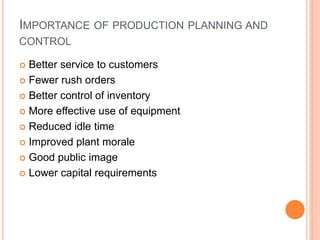
IMPORTANCE OF PRODUCTION PLANNING AND
CONTROL
 Better service to customers
 Fewer rush orders
 Better control of inventory
 More effective use of equipment
 Reduced idle time
 Improved plant morale
 Good public image
 Lower capital requirements
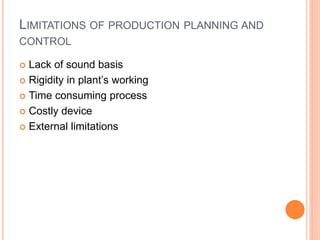
LIMITATIONS OF PRODUCTION PLANNING AND
CONTROL
 Lack of sound basis
 Rigidity in plant’s working
 Time consuming process
 Costly device
 External limitations
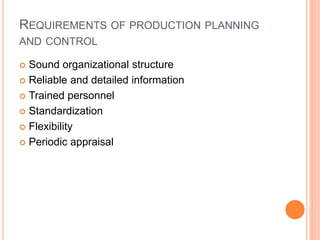
REQUIREMENTS OF PRODUCTION PLANNING
AND CONTROL
 Sound organizational structure
 Reliable and detailed information
 Trained personnel
 Standardization
 Flexibility
 Periodic appraisal
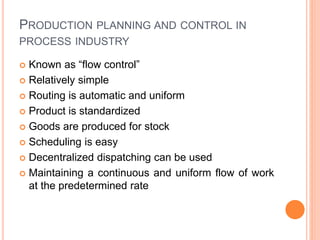
PRODUCTION PLANNING AND CONTROL IN
PROCESS INDUSTRY
 Known as “flow control”
 Relatively simple
 Routing is automatic and uniform
 Product is standardized
 Goods are produced for stock
 Scheduling is easy
 Decentralized dispatching can be used
 Maintaining a continuous and uniform flow of work
at the predetermined rate
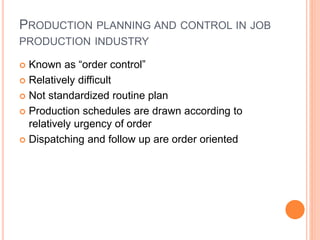
PRODUCTION PLANNING AND CONTROL IN JOB
PRODUCTION INDUSTRY
 Known as “order control”
 Relatively difficult
 Not standardized routine plan
 Production schedules are drawn according to
relatively urgency of order
 Dispatching and follow up are order oriented
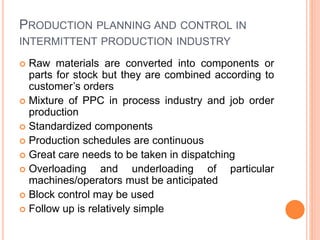
PRODUCTION PLANNING AND CONTROL IN
INTERMITTENT PRODUCTION INDUSTRY
 Raw materials are converted into components or
parts for stock but they are combined according to
customer’s orders
 Mixture of PPC in process industry and job order
production
 Standardized components
 Production schedules are continuous
 Great care needs to be taken in dispatching
 Overloading and underloading of particular
machines/operators must be anticipated
 Block control may be used
 Follow up is relatively simple
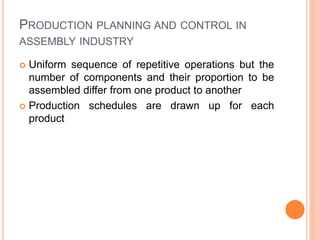
PRODUCTION PLANNING AND CONTROL IN
ASSEMBLY INDUSTRY
 Uniform sequence of repetitive operations but the
number of components and their proportion to be
assembled differ from one product to another
 Production schedules are drawn up for each
product
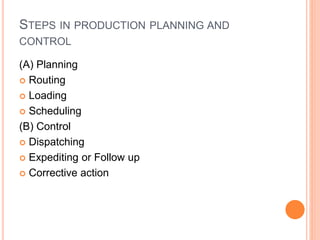
STEPS IN PRODUCTION PLANNING AND
CONTROL
(A) Planning
 Routing
 Loading
 Scheduling
(B) Control
 Dispatching
 Expediting or Follow up
 Corrective action
ROUTING
 Laying down of path which work will follow and
order in which various operations will be carried out
 It consist of determination of operations through
which product must pass and arrangement of
operations in the sequence that will require a
minimum of handling, transportation, storage and
deterioration through exposure
 It permits best utilization of physical human
resources employed in production
 It depends on considerations of type of work
stations, characteristics of individual machines,
needs of personnel, etc
LOADING
 It deals with the amount of work assigned to a
machine or a worker
 It deals with record of workload of different shops
 It results in a tabulated list or chart showing
planned utilization of machines or work stations in
plant
SCHEDULING
 It involves fixing priorities for different items and
operations and providing for their release to the
plant at proper time
 It establishes time sequence of operations and
indicates time required for each job and operation
 Determination of time that should be required to
perform each operation and also the time
necessary to perform the entire series, as routed
making allowance for all factors concerned
 It ensures that every job is started at the right time
and it is completed before delivery date
DISPATCHING
 Setting of productive activities in motion through
release of orders and instructions, in accordance
with previously planned timings as embodied on
operation sheet, route card and loading schedules
 Provides official authorization and information for
movement of materials, tools and fixtures, recording
of beginning and completion time, movement of
work in accordance with a routing schedule, control
of progress of all operations and making of
necessary adjustments in release of operations
 It requires coordination among all that departments
concerned
EXPEDITING OR FOLLOW-UP
 Last step in production planning and control
 It involves determination of the progress of work,
removing bottlenecks in flow of work and ensuring
that productive operations are taking place in
accordance with plans
 It serves as a catalytic agent to fuse the separate
productive activities into a unified whole
 It seeks to ensure that the promise is backed up by
performance and the work done is upto the pre-
determined standards as to quantity, quality, time
and cost
CORRECTIVE ACTION
 Maintaining full control over production activities
 Abnormal situations like strike and break-down of
machinery or power may upset work schedules
 Strong need of performance appraisal of all
employees
 Certain personnel decisions like demotion, transfer
and training may be essential
THANK YOU!!!

Production planning and control

  • 1.
  • 2.
    INTRODUCTION  Production planningand control is the direction and coordination of the firm’s material and physical facilities towards the attainment of pre-specified production goals in the most efficient available way  It involves planning, routing, scheduling, dispatching, and expediting to coordinate the movements of materials, machines, and manpower as to quantity, quality, time and place
  • 3.
    OBJECTIVES OF PRODUCTIONPLANNING AND CONTROL  Continuous flow of production  Planned requirements of resources  Coordinated work schedules  Optimum inventory  Increased productivity  Customer satisfaction  Production and employment stabilization  Evaluation of performance
  • 4.
    IMPORTANCE OF PRODUCTIONPLANNING AND CONTROL  Better service to customers  Fewer rush orders  Better control of inventory  More effective use of equipment  Reduced idle time  Improved plant morale  Good public image  Lower capital requirements
  • 5.
    LIMITATIONS OF PRODUCTIONPLANNING AND CONTROL  Lack of sound basis  Rigidity in plant’s working  Time consuming process  Costly device  External limitations
  • 6.
    REQUIREMENTS OF PRODUCTIONPLANNING AND CONTROL  Sound organizational structure  Reliable and detailed information  Trained personnel  Standardization  Flexibility  Periodic appraisal
  • 7.
    PRODUCTION PLANNING ANDCONTROL IN PROCESS INDUSTRY  Known as “flow control”  Relatively simple  Routing is automatic and uniform  Product is standardized  Goods are produced for stock  Scheduling is easy  Decentralized dispatching can be used  Maintaining a continuous and uniform flow of work at the predetermined rate
  • 8.
    PRODUCTION PLANNING ANDCONTROL IN JOB PRODUCTION INDUSTRY  Known as “order control”  Relatively difficult  Not standardized routine plan  Production schedules are drawn according to relatively urgency of order  Dispatching and follow up are order oriented
  • 9.
    PRODUCTION PLANNING ANDCONTROL IN INTERMITTENT PRODUCTION INDUSTRY  Raw materials are converted into components or parts for stock but they are combined according to customer’s orders  Mixture of PPC in process industry and job order production  Standardized components  Production schedules are continuous  Great care needs to be taken in dispatching  Overloading and underloading of particular machines/operators must be anticipated  Block control may be used  Follow up is relatively simple
  • 10.
    PRODUCTION PLANNING ANDCONTROL IN ASSEMBLY INDUSTRY  Uniform sequence of repetitive operations but the number of components and their proportion to be assembled differ from one product to another  Production schedules are drawn up for each product
  • 11.
    STEPS IN PRODUCTIONPLANNING AND CONTROL (A) Planning  Routing  Loading  Scheduling (B) Control  Dispatching  Expediting or Follow up  Corrective action
  • 12.
    ROUTING  Laying downof path which work will follow and order in which various operations will be carried out  It consist of determination of operations through which product must pass and arrangement of operations in the sequence that will require a minimum of handling, transportation, storage and deterioration through exposure  It permits best utilization of physical human resources employed in production  It depends on considerations of type of work stations, characteristics of individual machines, needs of personnel, etc
  • 13.
    LOADING  It dealswith the amount of work assigned to a machine or a worker  It deals with record of workload of different shops  It results in a tabulated list or chart showing planned utilization of machines or work stations in plant
  • 14.
    SCHEDULING  It involvesfixing priorities for different items and operations and providing for their release to the plant at proper time  It establishes time sequence of operations and indicates time required for each job and operation  Determination of time that should be required to perform each operation and also the time necessary to perform the entire series, as routed making allowance for all factors concerned  It ensures that every job is started at the right time and it is completed before delivery date
  • 15.
    DISPATCHING  Setting ofproductive activities in motion through release of orders and instructions, in accordance with previously planned timings as embodied on operation sheet, route card and loading schedules  Provides official authorization and information for movement of materials, tools and fixtures, recording of beginning and completion time, movement of work in accordance with a routing schedule, control of progress of all operations and making of necessary adjustments in release of operations  It requires coordination among all that departments concerned
  • 16.
    EXPEDITING OR FOLLOW-UP Last step in production planning and control  It involves determination of the progress of work, removing bottlenecks in flow of work and ensuring that productive operations are taking place in accordance with plans  It serves as a catalytic agent to fuse the separate productive activities into a unified whole  It seeks to ensure that the promise is backed up by performance and the work done is upto the pre- determined standards as to quantity, quality, time and cost
  • 17.
    CORRECTIVE ACTION  Maintainingfull control over production activities  Abnormal situations like strike and break-down of machinery or power may upset work schedules  Strong need of performance appraisal of all employees  Certain personnel decisions like demotion, transfer and training may be essential
  • 18.