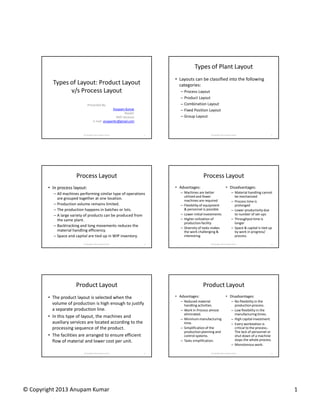
Types of Plant Layout
                                                                        • Layouts can be classified into the following
          Types of Layout: Product Layout                                 categories:
                v/s Process Layout                                        – Process Layout
                                                                          – Product Layout
                               Presented By:                              – Combination Layout
                                                   Anupam Kumar           – Fixed Position Layout
                                                          Reader
                                                     SMS Varanasi         – Group Layout
                                     E mail: anupamkr@gmail.com


                           © Copyright 2013 Anupam Kumar            1                         © Copyright 2013 Anupam Kumar                     2


                      Process Layout                                                     Process Layout
        • In process layout:                                            • Advantages:                         • Disadvantages:
          – All machines performing similar type of operations            – Machines are better                      – Material handling cannot
                                                                            utilized and fewer                         be mechanized
            are grouped together at one location.                           machines are required                    – Process time is
          – Production volume remains limited.                            – Flexibility of equipment                   prolonged
          – The production happens in batches or lots.                      & personnel is possible                  – Lower productivity due
          – A large variety of products can be produced from              – Lower initial investments                  to number of set-ups
            the same plant.                                               – Higher utilization of                    – Throughput time is
                                                                            production facility                        longer
          – Backtracking and long movements reduces the                   – Diversity of tasks makes                 – Space & capital is tied up
            material handling efficiency.                                   the work challenging &                     by work in progress/
          – Space and capital are tied up in WIP inventory.                 interesting.                               process.

                           © Copyright 2013 Anupam Kumar            3                         © Copyright 2013 Anupam Kumar                     4


                      Product Layout                                                    Product Layout
        • The product layout is selected when the                       • Advantages:                         • Disadvantages:
                                                                          – Reduced material                         – No flexibility in the
          volume of production is high enough to justify                    handling activities.                       production process.
          a separate production line.                                     – Work In Process almost                   – Low flexibility in the
                                                                            eliminated.                                manufacturing times.
        • In this type of layout, the machines and                        – Minimum manufacturing                    – High capital investment.
          auxiliary services are located according to the                   time.                                    – Every workstation is
          processing sequence of the product.                             – Simplification of the                      critical to the process.-
                                                                            production planning and                    The lack of personnel or
        • The facilities are arranged to ensure efficient                   control systems.                           shut down of a machine
          flow of material and lower cost per unit.                       – Tasks simplification.                      stops the whole process.
                                                                                                                     – Monotonous work.

                           © Copyright 2013 Anupam Kumar            5                         © Copyright 2013 Anupam Kumar                     6


© Copyright 2013 Anupam Kumar                                                                                                                       1
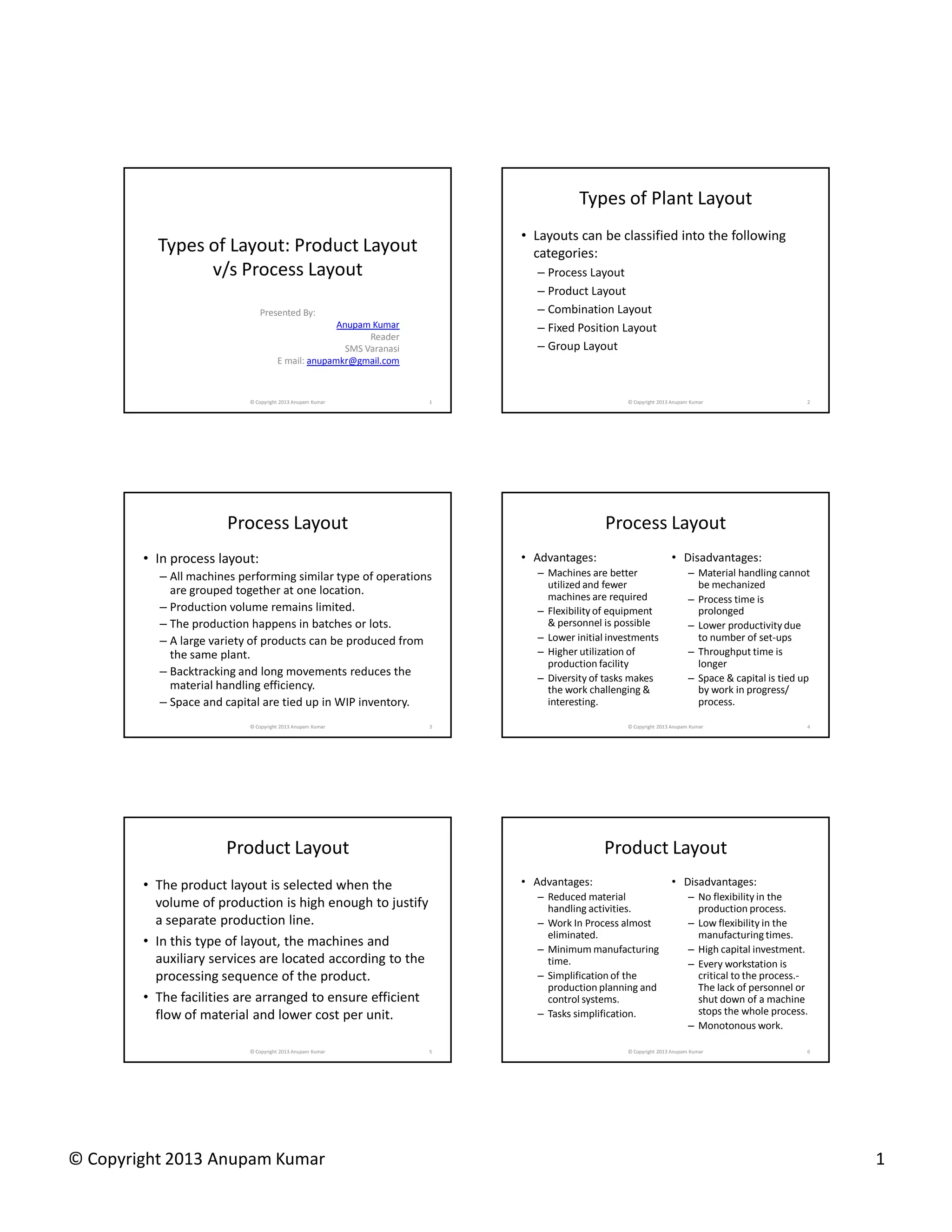
Combination or Matrix Layout                                                                           Combination or Matrix Layout
        • A combination layout combines the advantages of
          both the process and product layouts.
        • It is used when the same item is being manufactured
          in different types or sizes.
        • In this, the machines are arranged in the process
          layout format but process grouping is arranged in a
          sequence.
        • The sequence of operation with each of the product
          variety however remains the same.

                                        © Copyright 2013 Anupam Kumar                                  7                              © Copyright 2013 Anupam Kumar                8


                        Fixed Position Layout                                                                 Group Layout or Cellular Layout
        • This type of layout is suitable when one or a few                                                • Group Layout is also a combination of Product and
          identical heavy items are to be manufactured.                                                      Process Layout.
        • The materials are kept fixed because the cost of                                                 • It identifies the families of components that require
          transportation of material is very high.                                                           similar types of requirements and machines which
        • In this type of layout,                                                                            are clubbed together as cells.
           – the material or the major component remain fixed and                                          • The cellular layout is also called a multi-objective
           – the tools, machinery, men and other materials move                                              layout because this layout tries to minimize
             around it.                                                                                       – The sum of the cost of transportation
        • This type of layout is also called project type layout.                                             – The cost of equipment


                                        © Copyright 2013 Anupam Kumar                                  9                              © Copyright 2013 Anupam Kumar               10


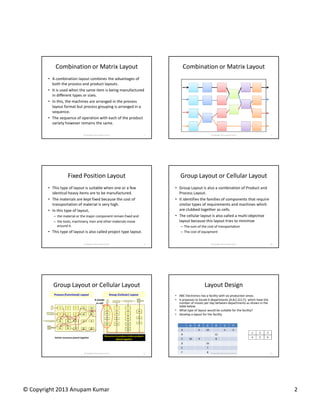
           Group Layout or Cellular Layout                                                                                      Layout Design
           Process (Functional) Layout                                Group (Cellular) Layout              • ABC Electronics has a facility with six production areas.
                                                     A cluster                                             • It proposes to locate 6 departments (A,B,C,D,E,F), which have the
                                                      or cell                                                number of moves per day between departments as shown in the
                T       T      T      CG        CG               T         T        T
                                                                                                             table below.
                                                                                               M           • What type of layout would be suitable for the facility?
                                                                 M         M        T
                T       T      T      SG        SG                                                         • Develop a layout for the facility.
                                                                 D         D        M           D
                M      M       D       D        D
                                                                 SG        CG       CG          D
                                                                                                                     A     B     C        D         E         F
                M      M       D       D        D                                   SG
                                                                                                               A           5     10                 3         2
                                                                                                                                                                      1   2   3
                                                                                                               B                          12
                                                               Resources to produce similar products                                                                  4   5   6
            Similar resources placed together
                                                                          placed together                      C     10    4               8
                                                                                                               D                 16
                                                                                                               E                 7
                                        © Copyright 2013 Anupam Kumar                               11         F                 8    © Copyright 2013 Anupam Kumar               12


© Copyright 2013 Anupam Kumar                                                                                                                                                          2
Bibliography
                                                              •   Buffa, E.S. and Sarin, R.K., “Modern Production/Operations Management,” Eighth Edition.
                                                                  Singapore: John Wiley & Sons (Asia). 1994.
                                                              •   Martinich, J.S., “Production and Operations Management: An Applied Approach”, Singapore: John
                                                                  Wiley & Sons (Asia), 2003.
                                                              •   Badi, R.V. and Badi, N.V., “Production and Operations Management”, Second Edition, New Delhi:
                                                                  Vrinda Publication, 2008.
               For further details…                           •   Chary, S.N., “Productions and Operations Management,” Third Edition, New Delhi: Tata McGraw
                                                                  Hill, 2004
                                                              •   Goel, B.S., “Production Operations Management”, Twenty Second Edition, Meerut, U.P.: Pragati
                                                                  Prakashan, 2010.
                                                              •   Kachru, U. “Production and Operations Management: Text and Cases,” New Delhi: Excel Books,
                                                                  2007.
                           Contact                            •   Rama Murthy, P., “Production and Operations Management,” New Delhi: New Age International,
                                        Anupam Kumar              2012.
                                                              •   Chunawalla, S.A., and Patel, D.R., “Production and Operations Management,” Mumbai: Himalaya
                                               Reader             Publishing House, 2006.
                                                              •   Jauhari, V. and Dutta, K., “Services: Marketing Operations and Management,” New Delhi: Oxford
                                          SMS Varanasi            University Press, 2010.
                                                              •   Verma, H.V., “Services Marketing: Text and Cases,” New Delhi: Dorling Kindersley, Pearson
                          E mail: anupamkr@gmail.com              Education, 2009.


                    © Copyright 2013 Anupam Kumar        13                                       © Copyright 2013 Anupam Kumar                                   15


© Copyright 2013 Anupam Kumar                                                                                                                                          3

Types of layouts

  • 1.
    Types of PlantLayout • Layouts can be classified into the following Types of Layout: Product Layout categories: v/s Process Layout – Process Layout – Product Layout Presented By: – Combination Layout Anupam Kumar – Fixed Position Layout Reader SMS Varanasi – Group Layout E mail: anupamkr@gmail.com © Copyright 2013 Anupam Kumar 1 © Copyright 2013 Anupam Kumar 2 Process Layout Process Layout • In process layout: • Advantages: • Disadvantages: – All machines performing similar type of operations – Machines are better – Material handling cannot utilized and fewer be mechanized are grouped together at one location. machines are required – Process time is – Production volume remains limited. – Flexibility of equipment prolonged – The production happens in batches or lots. & personnel is possible – Lower productivity due – A large variety of products can be produced from – Lower initial investments to number of set-ups the same plant. – Higher utilization of – Throughput time is production facility longer – Backtracking and long movements reduces the – Diversity of tasks makes – Space & capital is tied up material handling efficiency. the work challenging & by work in progress/ – Space and capital are tied up in WIP inventory. interesting. process. © Copyright 2013 Anupam Kumar 3 © Copyright 2013 Anupam Kumar 4 Product Layout Product Layout • The product layout is selected when the • Advantages: • Disadvantages: – Reduced material – No flexibility in the volume of production is high enough to justify handling activities. production process. a separate production line. – Work In Process almost – Low flexibility in the eliminated. manufacturing times. • In this type of layout, the machines and – Minimum manufacturing – High capital investment. auxiliary services are located according to the time. – Every workstation is processing sequence of the product. – Simplification of the critical to the process.- production planning and The lack of personnel or • The facilities are arranged to ensure efficient control systems. shut down of a machine flow of material and lower cost per unit. – Tasks simplification. stops the whole process. – Monotonous work. © Copyright 2013 Anupam Kumar 5 © Copyright 2013 Anupam Kumar 6 © Copyright 2013 Anupam Kumar 1
  • 2.
    Combination or MatrixLayout Combination or Matrix Layout • A combination layout combines the advantages of both the process and product layouts. • It is used when the same item is being manufactured in different types or sizes. • In this, the machines are arranged in the process layout format but process grouping is arranged in a sequence. • The sequence of operation with each of the product variety however remains the same. © Copyright 2013 Anupam Kumar 7 © Copyright 2013 Anupam Kumar 8 Fixed Position Layout Group Layout or Cellular Layout • This type of layout is suitable when one or a few • Group Layout is also a combination of Product and identical heavy items are to be manufactured. Process Layout. • The materials are kept fixed because the cost of • It identifies the families of components that require transportation of material is very high. similar types of requirements and machines which • In this type of layout, are clubbed together as cells. – the material or the major component remain fixed and • The cellular layout is also called a multi-objective – the tools, machinery, men and other materials move layout because this layout tries to minimize around it. – The sum of the cost of transportation • This type of layout is also called project type layout. – The cost of equipment © Copyright 2013 Anupam Kumar 9 © Copyright 2013 Anupam Kumar 10 Group Layout or Cellular Layout Layout Design Process (Functional) Layout Group (Cellular) Layout • ABC Electronics has a facility with six production areas. A cluster • It proposes to locate 6 departments (A,B,C,D,E,F), which have the or cell number of moves per day between departments as shown in the T T T CG CG T T T table below. M • What type of layout would be suitable for the facility? M M T T T T SG SG • Develop a layout for the facility. D D M D M M D D D SG CG CG D A B C D E F M M D D D SG A 5 10 3 2 1 2 3 B 12 Resources to produce similar products 4 5 6 Similar resources placed together placed together C 10 4 8 D 16 E 7 © Copyright 2013 Anupam Kumar 11 F 8 © Copyright 2013 Anupam Kumar 12 © Copyright 2013 Anupam Kumar 2
  • 3.
    Bibliography • Buffa, E.S. and Sarin, R.K., “Modern Production/Operations Management,” Eighth Edition. Singapore: John Wiley & Sons (Asia). 1994. • Martinich, J.S., “Production and Operations Management: An Applied Approach”, Singapore: John Wiley & Sons (Asia), 2003. • Badi, R.V. and Badi, N.V., “Production and Operations Management”, Second Edition, New Delhi: Vrinda Publication, 2008. For further details… • Chary, S.N., “Productions and Operations Management,” Third Edition, New Delhi: Tata McGraw Hill, 2004 • Goel, B.S., “Production Operations Management”, Twenty Second Edition, Meerut, U.P.: Pragati Prakashan, 2010. • Kachru, U. “Production and Operations Management: Text and Cases,” New Delhi: Excel Books, 2007. Contact • Rama Murthy, P., “Production and Operations Management,” New Delhi: New Age International, Anupam Kumar 2012. • Chunawalla, S.A., and Patel, D.R., “Production and Operations Management,” Mumbai: Himalaya Reader Publishing House, 2006. • Jauhari, V. and Dutta, K., “Services: Marketing Operations and Management,” New Delhi: Oxford SMS Varanasi University Press, 2010. • Verma, H.V., “Services Marketing: Text and Cases,” New Delhi: Dorling Kindersley, Pearson E mail: anupamkr@gmail.com Education, 2009. © Copyright 2013 Anupam Kumar 13 © Copyright 2013 Anupam Kumar 15 © Copyright 2013 Anupam Kumar 3