Aggregate Production
Planning
Prepared BY : FARHAN MUKHTAR
AQIB ALI
KASHIF KHAN
AZAD ANSARI
FAISAL SUHAIL
Jamia Hamdard University
AGGREGATE PRODUCTION/OPERATION
PLANNING
 It is a planning exercise done for operations using data at an aggregate level.
 Its about translating demand forecasts into production and capacity levels over a
fixed planning horizon.
 Assumes the demand forecast is fairly accurate.
 It helps firms in arriving at the quantity and timing of resources to be committed to
ensure continuous flow of goods and services to customers.
 It generally uses an aggregate unit of production.
EXAMPLE OF APP
 At the end of an aggregate production planning exercise, a garment manufacturer
may arrive at the following plan
I. Produce at the rate of 9k meters of cloth everyday during the months of January
to March, increase it to 11k meters during April to August and change the
production rate to 10k meters during September to December.
II. Carry 10% of monthly production as inventory during the first 9 months of
production.
III. Work on a one-shift basis through out the year with 20% overtime during July to
October.
WHY IS PRODUCTION PLANNING
NECESSARY
 Demand Fluctuations: Organizations hardly experience a stable or even demand, the
demand for garments in India is high during august to October due to the festive season.
Meeting surges in demand requires some prior planning.
 Capacity Fluctuation: While demand fluctuations happen on account of seasonality, there
are fluctuations in capacity too.
WHY IS PRODUCTION PLANNING
NECESSARY
 Difficulty level in altering production rates: Different complex production system
requires different amount of prior planning and coordination with related system
on the supplier and distributive sides.
 Benefits of multi period planning: It is known that planning just for a period with no
consideration of potential events in the near future amounts to a knee-jerk reaction
than any attempt to reach optimal and cost saving decisions.
PLANNING STRATEGIES
 Level strategy
Maintain a stable workforce working at constant output rate; absorb demand
variations with inventory, backlogs, or lost sales.
 Chase strategy
Matching the production rate to exactly meet the order rate by hiring and laying off
workers as the order rate varies.
 Mixed strategy
A combination of chase and level strategies to match supply and demand.
PURE AND MIXED STRATEGY
Pure Strategy
A combination of chase and level strategies to match supply and demand.
Mixed Strategy
Either a chase strategy when product exactly matches demand or a level strategy when
production remains constant over a specified number of periods.
Production / Operation Scheduling
 Scheduling is the process of arranging, controlling and optimizing work and
workloads in a production process or manufacturing process.
 Scheduling is used to allocate plant and machinery resources, plan human
resources, plan production processes and purchase materials.
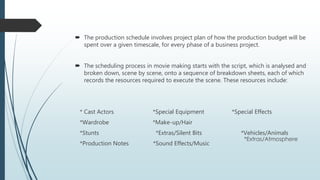
 The production schedule involves project plan of how the production budget will be
spent over a given timescale, for every phase of a business project.
 The scheduling process in movie making starts with the script, which is analysed and
broken down, scene by scene, onto a sequence of breakdown sheets, each of which
records the resources required to execute the scene. These resources include:
* Cast Actors *Special Equipment *Special Effects
*Wardrobe *Make-up/Hair
*Stunts *Extras/Silent Bits *Vehicles/Animals
*Production Notes *Sound Effects/Music
Production / Operation Scheduling
(Contd.)
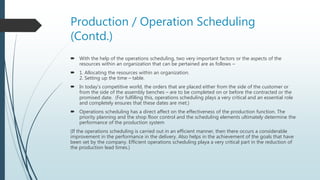
 With the help of the operations scheduling, two very important factors or the aspects of the
resources within an organization that can be pertained are as follows –
 1. Allocating the resources within an organization.
2. Setting up the time – table.
 In today’s competitive world, the orders that are placed either from the side of the customer or
from the side of the assembly benches – are to be completed on or before the contracted or the
promised date. (For fulfilling this, operations scheduling plays a very critical and an essential role
and completely ensures that these dates are met.)
 Operations scheduling has a direct affect on the effectiveness of the production function. The
priority planning and the shop floor control and the scheduling elements ultimately determine the
performance of the production system
(If the operations scheduling is carried out in an efficient manner, then there occurs a considerable
improvement in the performance in the delivery. Also helps in the achievement of the goals that have
been set by the company. Efficient operations scheduling playa a very critical part in the reduction of
the production lead times.)
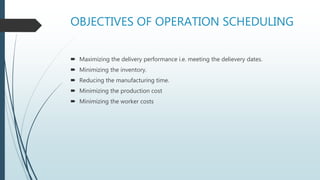
OBJECTIVES OF OPERATION SCHEDULING
 Maximizing the delivery performance i.e. meeting the delievery dates.
 Minimizing the inventory.
 Reducing the manufacturing time.
 Minimizing the production cost
 Minimizing the worker costs
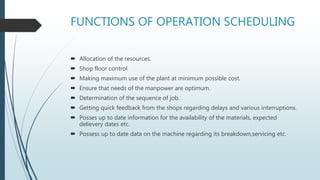
FUNCTIONS OF OPERATION SCHEDULING
 Allocation of the resources.
 Shop floor control
 Making maximum use of the plant at minimum possible cost.
 Ensure that needs of the manpower are optimum.
 Determination of the sequence of job.
 Getting quick feedback from the shops regarding delays and various interruptions.
 Posses up to date information for the availability of the materials, expected
delievery dates etc.
 Possess up to date data on the machine regarding its breakdown,servicing etc.
CONCLUSION
(OPERATION SCHEDULING)
 The impact of scheduling can be increased by focusing on the schedules of
bottleneck resources so as to maximize the flow of total value added funds.
 If the operations scheduling is carried out in an efficient manner, then there occurs
a considerable improvement in the performance in the delivery.
 It helps in the achievement of the goals that have been set by the company.
 https://www.youtube.com/watch?v=mBQ2W3l7IRc
 https://www.youtube.com/watch?v=3XEqPIVhh-Q

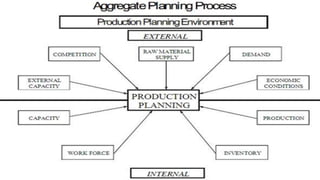
AGGREGATE PRODUCTION PLANNING

  • 1.
    Aggregate Production Planning Prepared BY: FARHAN MUKHTAR AQIB ALI KASHIF KHAN AZAD ANSARI FAISAL SUHAIL Jamia Hamdard University
  • 2.
    AGGREGATE PRODUCTION/OPERATION PLANNING  Itis a planning exercise done for operations using data at an aggregate level.  Its about translating demand forecasts into production and capacity levels over a fixed planning horizon.  Assumes the demand forecast is fairly accurate.  It helps firms in arriving at the quantity and timing of resources to be committed to ensure continuous flow of goods and services to customers.  It generally uses an aggregate unit of production.
  • 3.
    EXAMPLE OF APP At the end of an aggregate production planning exercise, a garment manufacturer may arrive at the following plan I. Produce at the rate of 9k meters of cloth everyday during the months of January to March, increase it to 11k meters during April to August and change the production rate to 10k meters during September to December. II. Carry 10% of monthly production as inventory during the first 9 months of production. III. Work on a one-shift basis through out the year with 20% overtime during July to October.
  • 5.
    WHY IS PRODUCTIONPLANNING NECESSARY  Demand Fluctuations: Organizations hardly experience a stable or even demand, the demand for garments in India is high during august to October due to the festive season. Meeting surges in demand requires some prior planning.  Capacity Fluctuation: While demand fluctuations happen on account of seasonality, there are fluctuations in capacity too.
  • 6.
    WHY IS PRODUCTIONPLANNING NECESSARY  Difficulty level in altering production rates: Different complex production system requires different amount of prior planning and coordination with related system on the supplier and distributive sides.  Benefits of multi period planning: It is known that planning just for a period with no consideration of potential events in the near future amounts to a knee-jerk reaction than any attempt to reach optimal and cost saving decisions.
  • 8.
    PLANNING STRATEGIES  Levelstrategy Maintain a stable workforce working at constant output rate; absorb demand variations with inventory, backlogs, or lost sales.  Chase strategy Matching the production rate to exactly meet the order rate by hiring and laying off workers as the order rate varies.  Mixed strategy A combination of chase and level strategies to match supply and demand.
  • 9.
    PURE AND MIXEDSTRATEGY Pure Strategy A combination of chase and level strategies to match supply and demand. Mixed Strategy Either a chase strategy when product exactly matches demand or a level strategy when production remains constant over a specified number of periods.
  • 10.
    Production / OperationScheduling  Scheduling is the process of arranging, controlling and optimizing work and workloads in a production process or manufacturing process.  Scheduling is used to allocate plant and machinery resources, plan human resources, plan production processes and purchase materials.
  • 11.
     The productionschedule involves project plan of how the production budget will be spent over a given timescale, for every phase of a business project.  The scheduling process in movie making starts with the script, which is analysed and broken down, scene by scene, onto a sequence of breakdown sheets, each of which records the resources required to execute the scene. These resources include: * Cast Actors *Special Equipment *Special Effects *Wardrobe *Make-up/Hair *Stunts *Extras/Silent Bits *Vehicles/Animals *Production Notes *Sound Effects/Music
  • 12.
    Production / OperationScheduling (Contd.)  With the help of the operations scheduling, two very important factors or the aspects of the resources within an organization that can be pertained are as follows –  1. Allocating the resources within an organization. 2. Setting up the time – table.  In today’s competitive world, the orders that are placed either from the side of the customer or from the side of the assembly benches – are to be completed on or before the contracted or the promised date. (For fulfilling this, operations scheduling plays a very critical and an essential role and completely ensures that these dates are met.)  Operations scheduling has a direct affect on the effectiveness of the production function. The priority planning and the shop floor control and the scheduling elements ultimately determine the performance of the production system (If the operations scheduling is carried out in an efficient manner, then there occurs a considerable improvement in the performance in the delivery. Also helps in the achievement of the goals that have been set by the company. Efficient operations scheduling playa a very critical part in the reduction of the production lead times.)
  • 13.
    OBJECTIVES OF OPERATIONSCHEDULING  Maximizing the delivery performance i.e. meeting the delievery dates.  Minimizing the inventory.  Reducing the manufacturing time.  Minimizing the production cost  Minimizing the worker costs
  • 14.
    FUNCTIONS OF OPERATIONSCHEDULING  Allocation of the resources.  Shop floor control  Making maximum use of the plant at minimum possible cost.  Ensure that needs of the manpower are optimum.  Determination of the sequence of job.  Getting quick feedback from the shops regarding delays and various interruptions.  Posses up to date information for the availability of the materials, expected delievery dates etc.  Possess up to date data on the machine regarding its breakdown,servicing etc.
  • 15.
    CONCLUSION (OPERATION SCHEDULING)  Theimpact of scheduling can be increased by focusing on the schedules of bottleneck resources so as to maximize the flow of total value added funds.  If the operations scheduling is carried out in an efficient manner, then there occurs a considerable improvement in the performance in the delivery.  It helps in the achievement of the goals that have been set by the company.
  • 16.