Rusdi Noor Rosa
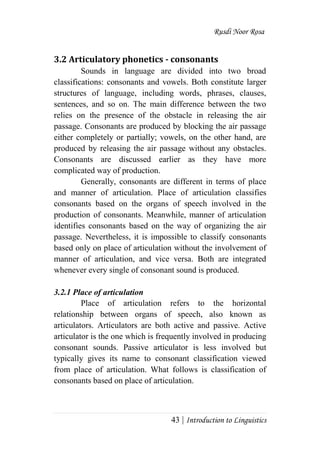
34 | Introduction to Linguistics
Rusdi Noor Rosa
35 | Introduction to Linguistics
3.
PHONETICS
3.0 Introduction
An obvious way of beginning an analysis of spoken
language is by studying its sounds which is called phonetics
(Crane et al., 1981:57). Phonetics is a branch of linguistics that
studies the material aspects of speech sounds. What is meant
by ―material aspect‖? And what other features exist which
characterize sounds? Well, material aspects of sounds are those
aspects that make for the physical production, transportation
and comprehension of the sound. Another aspect of a sound is
its function within a language. The function of sounds is,
however, examined by another linguistic discipline, namely
phonology. Please take note of the fact though that this
represents the European (including the English) categorization
of these linguistic disciplines and that Americans follow a
different convention. Americans use the term ―phonology‖ to
refer to our understanding of both phonetics and phonology.
They refer to what we call ―phonetics‖ also as ―phonetics‖, but
refer to what Europeans call ―phonology‖ as ―phonemics‖. So
if you ever come across the American terminology, do not be
confused. In any way, in this textbook we will stick to the
European terms.
The modern alphabet does not suffice to transcribe all
sounds on a one-to-one basis. There are many instances
though, when we need an internationally comprehensible code
for the detailed transcription of sounds, such as in linguistic
research, as well as in foreign language teaching. A special
alphabet devised by the International Phonetic Association
Rusdi Noor Rosa
36 | Introduction to Linguistics
(IPA) is then used. Phonetic characters refer to the actual
utterance of a sound. In phonetic writing, the symbols for these
sounds are put within brackets, such as: [θ].
Back to phonetics, we stated above that there are three
different physical aspects of a sound. These are the articulatory
aspect of the speaker, the acoustic aspect of the channel, and
the auditory aspect of the hearer.
 Articulatory phonetics researches where and how
sounds are originated and thus carries out
physiological studies of the respiratory tract, trying to
locate precisely at which location and in which manner
a sound is produced.
 Acoustic phonetics examines the length, frequency and
pitch of sounds. Special instruments are required to
measure and analyze the sounds while they travel via
the channel.
 Auditory phonetics studies what happens inside the ear
and brain when sounds are finally received. It also
interested in our ability to identify and differentiate
sounds.
3.1 How speech is produced
Everyday, we always speak to other people without
any consciousness why we are able to produce the sound of
utterances. How and where sounds are produced within our
vocal tracts determines the acoustic properties of those sounds.
Gleason and Ratner (1998:113) noted three major systems for
speech production: (1) the vocal tract, (2) the larynx, and (3)
the subglottal system.
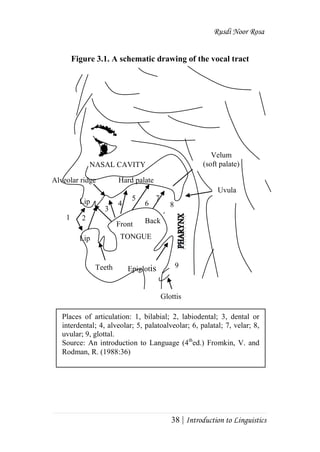
Let us first identify the body parts that are involved in
speech production. Figure 3.1 is a diagram of most of the
Rusdi Noor Rosa
37 | Introduction to Linguistics
organs used in speech production that shows the places of
articulation for English consonants. Starting at the bottom of
figure 3.1, we can see the glottis, which is part of the larynx.
The larynx contains vocal folds, and the glottis is the opening
between the vocal folds where the folds meet when they
vibrate to produce voice or phonation. We can also see the
pharynx, the nasal cavity, and the various parts of the oral
cavity. These include the uvula, the velum (or soft palate), the
hard palate, the alveolar ridge, tongue, teeth, and lips. The area
from the larynx to the lips is called the vocal tract.
The subglottal system includes the lungs and
associated muscles needed for inhalation and exhalation and
the trachea or the windpipe. The subglottal system provides the
air support for speech, which is produced on exhalation.
Vowels and consonants are produced differently. The major
difference is that consonants are produced with more
articulatory movement and more constriction – narrowing in a
location in the vocal tract – than are vowels.
Rusdi Noor Rosa
38 | Introduction to Linguistics
Figure 3.1. A schematic drawing of the vocal tract
Places of articulation: 1, bilabial; 2, labiodental; 3, dental or
interdental; 4, alveolar; 5, palatoalveolar; 6, palatal; 7, velar; 8,
uvular; 9, glottal.
Source: An introduction to Language (4th
ed.) Fromkin, V. and
Rodman, R. (1988:36)
Lip
21
9
8
7
6
5
4
3
Hard palateAlveolar ridge
NASAL CAVITY
Velum
(soft palate)
Uvula
Epiglotis
BackFront
Lip
Teeth
TONGUE
Glottis
Rusdi Noor Rosa
39 | Introduction to Linguistics
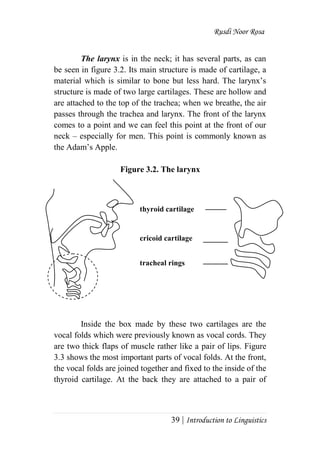
The larynx is in the neck; it has several parts, as can
be seen in figure 3.2. Its main structure is made of cartilage, a
material which is similar to bone but less hard. The larynx‘s
structure is made of two large cartilages. These are hollow and
are attached to the top of the trachea; when we breathe, the air
passes through the trachea and larynx. The front of the larynx
comes to a point and we can feel this point at the front of our
neck – especially for men. This point is commonly known as
the Adam‘s Apple.
Figure 3.2. The larynx
Inside the box made by these two cartilages are the
vocal folds which were previously known as vocal cords. They
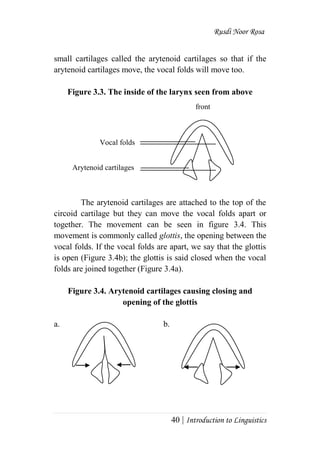
are two thick flaps of muscle rather like a pair of lips. Figure
3.3 shows the most important parts of vocal folds. At the front,
the vocal folds are joined together and fixed to the inside of the
thyroid cartilage. At the back they are attached to a pair of
thyroid cartilage
tracheal rings
cricoid cartilage
Rusdi Noor Rosa
40 | Introduction to Linguistics
small cartilages called the arytenoid cartilages so that if the
arytenoid cartilages move, the vocal folds will move too.
Figure 3.3. The inside of the larynx seen from above
The arytenoid cartilages are attached to the top of the
circoid cartilage but they can move the vocal folds apart or
together. The movement can be seen in figure 3.4. This
movement is commonly called glottis, the opening between the
vocal folds. If the vocal folds are apart, we say that the glottis
is open (Figure 3.4b); the glottis is said closed when the vocal
folds are joined together (Figure 3.4a).
Figure 3.4. Arytenoid cartilages causing closing and
opening of the glottis
a. b.
Vocal folds
Arytenoid cartilages
front
Rusdi Noor Rosa
41 | Introduction to Linguistics
The movement of closing and opening of the glottis
seems quite simple; however, this movement can, in fact,
produce a very complex range of changes in the vocald folds
and their positions. These changes are often important in
speech as they help humans to produce varieties of consonant
sounds. The two movements above are developed into more
different positions of vocal folds.
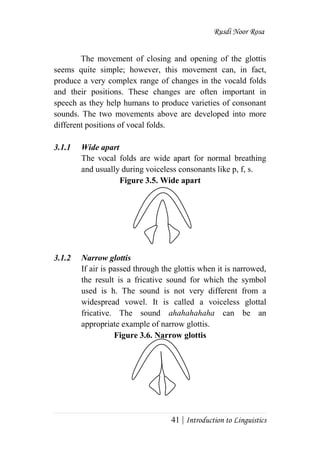
3.1.1 Wide apart
The vocal folds are wide apart for normal breathing
and usually during voiceless consonants like p, f, s.
Figure 3.5. Wide apart
3.1.2 Narrow glottis
If air is passed through the glottis when it is narrowed,
the result is a fricative sound for which the symbol
used is h. The sound is not very different from a
widespread vowel. It is called a voiceless glottal
fricative. The sound ahahahahaha can be an
appropriate example of narrow glottis.
Figure 3.6. Narrow glottis
Rusdi Noor Rosa
42 | Introduction to Linguistics
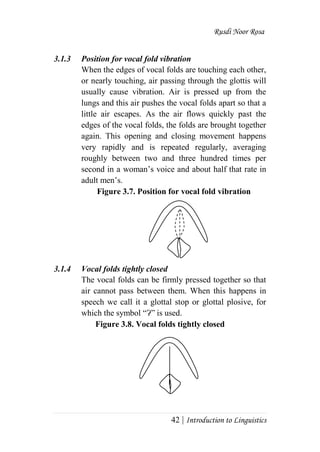
3.1.3 Position for vocal fold vibration
When the edges of vocal folds are touching each other,
or nearly touching, air passing through the glottis will
usually cause vibration. Air is pressed up from the
lungs and this air pushes the vocal folds apart so that a
little air escapes. As the air flows quickly past the
edges of the vocal folds, the folds are brought together
again. This opening and closing movement happens
very rapidly and is repeated regularly, averaging
roughly between two and three hundred times per
second in a woman‘s voice and about half that rate in
adult men‘s.
Figure 3.7. Position for vocal fold vibration
3.1.4 Vocal folds tightly closed
The vocal folds can be firmly pressed together so that
air cannot pass between them. When this happens in
speech we call it a glottal stop or glottal plosive, for
which the symbol ―Ɂ‖ is used.
Figure 3.8. Vocal folds tightly closed
Rusdi Noor Rosa
43 | Introduction to Linguistics
3.2 Articulatory phonetics - consonants
Sounds in language are divided into two broad
classifications: consonants and vowels. Both constitute larger
structures of language, including words, phrases, clauses,
sentences, and so on. The main difference between the two
relies on the presence of the obstacle in releasing the air
passage. Consonants are produced by blocking the air passage
either completely or partially; vowels, on the other hand, are
produced by releasing the air passage without any obstacles.
Consonants are discussed earlier as they have more
complicated way of production.
Generally, consonants are different in terms of place
and manner of articulation. Place of articulation classifies
consonants based on the organs of speech involved in the
production of consonants. Meanwhile, manner of articulation
identifies consonants based on the way of organizing the air
passage. Nevertheless, it is impossible to classify consonants
based only on place of articulation without the involvement of
manner of articulation, and vice versa. Both are integrated
whenever every single of consonant sound is produced.
3.2.1 Place of articulation
Place of articulation refers to the horizontal
relationship between organs of speech, also known as
articulators. Articulators are both active and passive. Active
articulator is the one which is frequently involved in producing
consonant sounds. Passive articulator is less involved but
typically gives its name to consonant classification viewed
from place of articulation. What follows is classification of
consonants based on place of articulation.
Rusdi Noor Rosa
44 | Introduction to Linguistics
 Bilabials are consonants that are articulated by
pressing the lips, like [m].
 Labiodentals are consonants articulated by bringing
the lower lip to the upper teeth, like [f]. As the lower
lip experiences some movement, it is categorized as
active articulator and the upper teeth are passive
because they do not show any movement.
Nevertheless, the name is taken from the combination
of the two articulators.
 Interdentals or Dentals are the sounds at the
beginning of ―thin‖ and ―then‖, in IPA: [θ] and [ð]. In
order to articulate these, the tongue must be pressed
between the teeth.
 Alveolars are consonants articulated by raising the tip
of the tongue to thealveolar ridge (a linguistic term for
teeth ridge), like [d]. The name of the group, alveolar,
is taken from the passive articulator, alveolar ridge.
 Post-alveolars are consonants articulated by raising
the tip of the tongue to the space between alveolar
ridge and hard palate. They are neither alveolar as the
tongue position is not in the area of alveolar ridge nor
palatal as the tongue fails to reach the exact area of
hard palate. Sounds [ʧ], [ʤ], and [r] are examples of
post-alveolars.
 Palatals as in the middle of the word ―wash‖ are
produced by the contact of the front part of the tongue
with the hard palate just behind the alveolar ridge. An
example is [ʃ].
 Velars are sounds which are articulated by raising the
back of the tongue to the soft palate, linguistically
known as velum. An example is [g].
Rusdi Noor Rosa
45 | Introduction to Linguistics
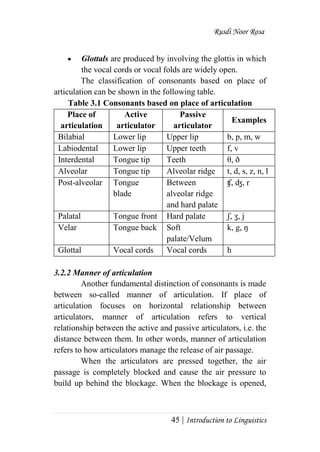
 Glottals are produced by involving the glottis in which
the vocal cords or vocal folds are widely open.
The classification of consonants based on place of
articulation can be shown in the following table.
Table 3.1 Consonants based on place of articulation
Place of
articulation
Active
articulator
Passive
articulator
Examples
Bilabial Lower lip Upper lip b, p, m, w
Labiodental Lower lip Upper teeth f, v
Interdental Tongue tip Teeth θ, ð
Alveolar Tongue tip Alveolar ridge t, d, s, z, n, l
Post-alveolar Tongue
blade
Between
alveolar ridge
and hard palate
ʧ, ʤ, r
Palatal Tongue front Hard palate ʃ, ʒ, j
Velar Tongue back Soft
palate/Velum
k, g, ŋ
Glottal Vocal cords Vocal cords h
3.2.2 Manner of articulation
Another fundamental distinction of consonants is made
between so-called manner of articulation. If place of
articulation focuses on horizontal relationship between
articulators, manner of articulation refers to vertical
relationship between the active and passive articulators, i.e. the
distance between them. In other words, manner of articulation
refers to how articulators manage the release of air passage.
When the articulators are pressed together, the air
passage is completely blocked and cause the air pressure to
build up behind the blockage. When the blockage is opened,
Rusdi Noor Rosa
46 | Introduction to Linguistics
the air is released in rush, the sounds which are produced
through this way are called stops, also known as plossives, e.g.
[t]. But, when the blockage is kept and the air is released
through the nose, we call the resulting consonant is a nasal, as
in [m].
When the articulators are closed together, but without
complete closure, the air passage is forced to go through the
narrow space of articulators. This action results in friction, a
sound turbulance. As the sound produced is followed by the
presence of friction, the sound is named fricative. Other
sounds that are followed by friction are affricates. However,
they are different from fricatives in the way that the sounds, in
the beginning of production, must have a complete closure of
articulators. This means that the air passage is blocked before
it is released through narrow space of articulators, such as in
[ʧ]. These sounds are also known as a result of fricative-stop
combination.
The other two types – liquids and glides – let the air
passage go freely through oral cavity. However, the exact
manner of articulation is obviously different. Liquids, also
known as laterals, block force the air passage to go through
each side of the oral cavity. Some part of the tongue that is
pressed onto the alveolar ridege blocks the the middle part of
the oral cavity. Meanwhile, liquids, also known as semi-
vowels, shape the articulators wide apart and let the air flow
out freely. It seems that they resemble vowels in the manner of
―free release without blocking‖; however, the involvement of
articulators, such as lips and front tongue make themselves
consonants.
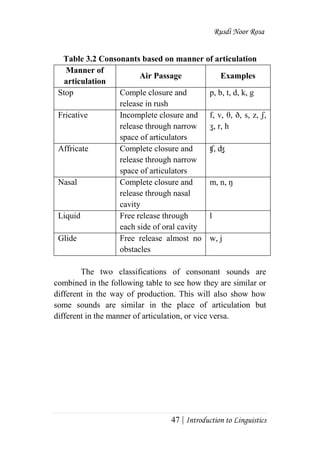
The classification of consonants based on manner of
articulation can be shown in the following table.
Rusdi Noor Rosa
47 | Introduction to Linguistics
Table 3.2 Consonants based on manner of articulation
Manner of
articulation
Air Passage Examples
Stop Comple closure and
release in rush
p, b, t, d, k, g
Fricative Incomplete closure and
release through narrow
space of articulators
f, v, θ, ð, s, z, ʃ,
ʒ, r, h
Affricate Complete closure and
release through narrow
space of articulators
ʧ, ʤ
Nasal Complete closure and
release through nasal
cavity
m, n, ŋ
Liquid Free release through
each side of oral cavity
l
Glide Free release almost no
obstacles
w, j
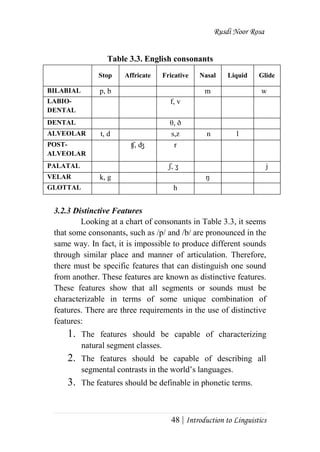
The two classifications of consonant sounds are
combined in the following table to see how they are similar or
different in the way of production. This will also show how
some sounds are similar in the place of articulation but
different in the manner of articulation, or vice versa.
Rusdi Noor Rosa
48 | Introduction to Linguistics
Table 3.3. English consonants
Stop Affricate Fricative Nasal Liquid Glide
BILABIAL p, b _ _ m _ w _
LABIO-
DENTAL
_
_
f, v _ _ _
DENTAL _ θ, ð _
ALVEOLAR t, d s,z n_ l _ _
POST-
ALVEOLAR
_ ʧ, ʤ r _ _ _
PALATAL _ __ ʃ, ʒ_ _ _ j
VELAR k, g _ ŋ _ _
GLOTTAL _ _ h _ _ _
3.2.3 Distinctive Features
Looking at a chart of consonants in Table 3.3, it seems
that some consonants, such as /p/ and /b/ are pronounced in the
same way. In fact, it is impossible to produce different sounds
through similar place and manner of articulation. Therefore,
there must be specific features that can distinguish one sound
from another. These features are known as distinctive features.
These features show that all segments or sounds must be
characterizable in terms of some unique combination of
features. There are three requirements in the use of distinctive
features:
1. The features should be capable of characterizing
natural segment classes.
2. The features should be capable of describing all
segmental contrasts in the world‘s languages.
3. The features should be definable in phonetic terms.
Rusdi Noor Rosa
49 | Introduction to Linguistics
The first type of distinctive features is anterior. It
belongs to a group of place features as it characterizes certain
consonants by referring to their place of articulation. Anterior
distinguishes between sounds produced in the front of the
mouth and other sounds. The front of the mouth includes lips,
teeth, and alveolar ridge; therefore, all sounds which are
produced by involving these speech organs belong to anterior.
The other feature that refers to the place of articulation is
coronal. Unlike anterior, coronal distinguishes between sounds
produced by involving the front of the tongue and other
sounds. The front of the tongue is involving such sounds as
dentals, alveolar, post-alveolar, and palatal.
Furthermore, types of distinctive features can also be
seen from the use of manner of articulation, known as manner
features. The first type is continuant. This feature
characterizes the sounds in which there is free airflow through
the oral cavity. In other words, after the sounds are produced,
the airflow must still be let free. Next is nasal which
distinguishes between sounds produced through nasal cavity
and other sounds. Another type of manner features is strident.
This feature characterizes the sounds in which there is a
friction (hiss sound). The friction is a result of forcing the air
passage through narrow space of articulators.
Besides, the features can also be seen from
consonantal features that are divided into two types. The first
type, consonantal, distinguishes between sounds produced
with the presence of blockage in the air passage and other
sounds. All of consonants must be consonantal, except /w/ and
/j/. The second type, voice, characterizes the sounds produced
cause the vibration in the vocal cords from other sounds. The
Rusdi Noor Rosa
50 | Introduction to Linguistics
other sounds, the ones that do not cause vibration in the vocal
cords, are known as voiceless.
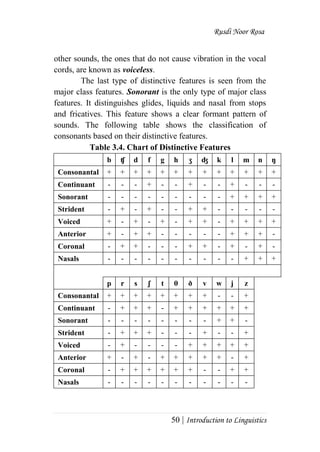
The last type of distinctive features is seen from the
major class features. Sonorant is the only type of major class
features. It distinguishes glides, liquids and nasal from stops
and fricatives. This feature shows a clear formant pattern of
sounds. The following table shows the classification of
consonants based on their distinctive features.
Table 3.4. Chart of Distinctive Features
b ʧ d f g h ʒ ʤ k l m n ŋ
Consonantal + + + + + + + + + + + + +
Continuant - - - + - - + - - + - - -
Sonorant - - - - - - - - - + + + +
Strident - + - + - - + + - - - - -
Voiced + - + - + - + + - + + + +
Anterior + - + + - - - - - + + + -
Coronal - + + - - - + + - + - + -
Nasals - - - - - - - - - - + + +
p r s ʃ t θ ð v w j z
Consonantal + + + + + + + + - - +
Continuant - + + + - + + + + + +
Sonorant - - - - - - - - + + -
Strident - + + + - - - + - - +
Voiced - + - - - - + + + + +
Anterior + - + - + + + + + - +
Coronal - + + + + + + - - + +
Nasals - - - - - - - - - - -
Rusdi Noor Rosa
51 | Introduction to Linguistics
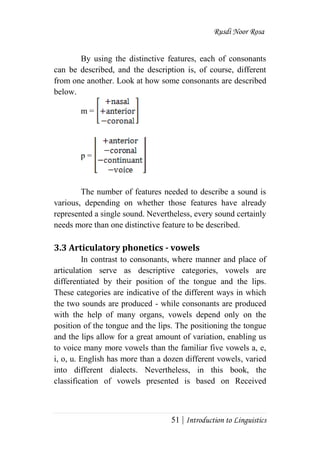
By using the distinctive features, each of consonants
can be described, and the description is, of course, different
from one another. Look at how some consonants are described
below.
m =
p =
The number of features needed to describe a sound is
various, depending on whether those features have already
represented a single sound. Nevertheless, every sound certainly
needs more than one distinctive feature to be described.
3.3 Articulatory phonetics - vowels
In contrast to consonants, where manner and place of
articulation serve as descriptive categories, vowels are
differentiated by their position of the tongue and the lips.
These categories are indicative of the different ways in which
the two sounds are produced - while consonants are produced
with the help of many organs, vowels depend only on the
position of the tongue and the lips. The positioning the tongue
and the lips allow for a great amount of variation, enabling us
to voice many more vowels than the familiar five vowels a, e,
i, o, u. English has more than a dozen different vowels, varied
into different dialects. Nevertheless, in this book, the
classification of vowels presented is based on Received
Rusdi Noor Rosa
52 | Introduction to Linguistics
Pronunciation (RP). Besides, in English, as in other world‘s
languages, several diphthongs are introduced.
Vowels can be produced by raising the tongue high,
keeping it in the middle, or low in the mouth; also, the tongue
can be moved to the front, center or back. The lips can be
rounded or unrounded. If you try to articulate while moving
your lips and your tongue around, you will notice how many
folds the resulting vowel-like sounds are. In addition to these
ways of vowel production, vowels are also distinguished in the
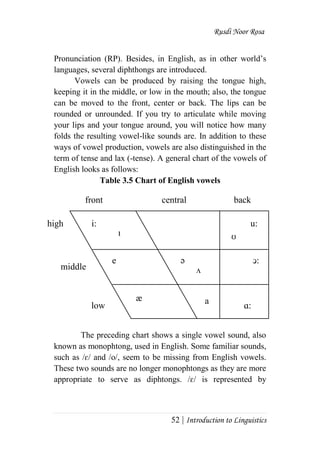
term of tense and lax (-tense). A general chart of the vowels of
English looks as follows:
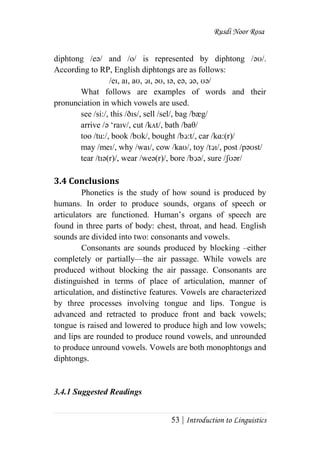
Table 3.5 Chart of English vowels
The preceding chart shows a single vowel sound, also
known as monophtong, used in English. Some familiar sounds,
such as /ɛ/ and /o/, seem to be missing from English vowels.
These two sounds are no longer monophtongs as they are more
appropriate to serve as diphtongs. /ɛ/ is represented by
æ
i:
ʌ
a
ә
u:
e ↄ:
ʊı
ɑ:
high
middle
low
front central back
Rusdi Noor Rosa
53 | Introduction to Linguistics
diphtong /eә/ and /o/ is represented by diphtong /әʊ/.
According to RP, English diphtongs are as follows:
/eı, aı, aʊ, ↄı, әʊ, ıә, eә, ↄә, ʊә/
What follows are examples of words and their
pronunciation in which vowels are used.
see /si:/, this /ðıs/, sell /sel/, bag /bæg/
arrive /ә ‗raıv/, cut /kʌt/, bath /baθ/
too /tu:/, book /bʊk/, bought /bↄ:t/, car /kɑ:(r)/
may /meı/, why /waı/, cow /kaʊ/, toy /tↄı/, post /pәʊst/
tear /tıә(r)/, wear /weә(r)/, bore /bↄә/, sure /ʃʊәr/
3.4 Conclusions
Phonetics is the study of how sound is produced by
humans. In order to produce sounds, organs of speech or
articulators are functioned. Human‘s organs of speech are
found in three parts of body: chest, throat, and head. English
sounds are divided into two: consonants and vowels.
Consonants are sounds produced by blocking –either
completely or partially—the air passage. While vowels are
produced without blocking the air passage. Consonants are
distinguished in terms of place of articulation, manner of
articulation, and distinctive features. Vowels are characterized
by three processes involving tongue and lips. Tongue is
advanced and retracted to produce front and back vowels;
tongue is raised and lowered to produce high and low vowels;
and lips are rounded to produce round vowels, and unrounded
to produce unround vowels. Vowels are both monophtongs and
diphtongs.
3.4.1 Suggested Readings
Rusdi Noor Rosa
54 | Introduction to Linguistics
Crane, L. Ben et al. 1981.An Introduction to Linguistics.
Boston: Little, Brown and Company.
Fromkin, V.A. and R. Rodman. 1988. An Introduction to
Language. New York: Holt, Rinehart and Winston.
Gleason, J.B., and N.B. Ratner. 1998. Psycholinguistics. New
York: Harcourt Brace College Publishers.
Lass, R. 1994. Phonology: An Introduction to Basic Concepts.
Cambridge: Cambridge University Press.
Mc Mahon, A. 2002. An Introduction to English Phonology.
Edinburgh: Edinburgh University Press.
3.4.2 Questions for Discussions
1. How do you define phonetics?
2. What are the differences between consonant and vowel?
3. How are fricative consonants produced? Give examples.
4. List classifications of consonants based on place of
articulation. Elaborate your answers by providing
examples.
5. Complete the sentences by choosing one of the following
features: [+continuant], [+sonorant], [+anterior],
[-coronal], [-consonantal].
a. The labiodental, interdental, and alveolar are
……………..
Rusdi Noor Rosa
55 | Introduction to Linguistics
b. The interdental, alveolar, post-alveolar, and palatal are
…………
c. The bilabial, labiodental, and velar are
…………………….
d. The lateral and semivowel are ………………..
e. The nasal, lateral, and semivowel are ………………..
Rusdi Noor Rosa
56 | Introduction to Linguistics
4.
PHONOLOGY
4.0 Introduction
Previous chapter was mainly concerned with matters
of phonetics – the comparatively straightforward study of
describing the sounds that we use in speaking. When we talk
about how phonemes function in language, and the relationship
among the different phonemes, we are studying a related but
different subject that we call phonology.
Phonology deals with the function of sounds within a
language. Let us have a close look at these functions. Every
language has a precisely defined set of sounds. This set
consists of the so-called distinctive sounds. The system of the
speech sounds and their usage is defined as duality of
patterning: with a given set of components, we may construct
an unlimited number of new arrangements of the components.
In other words, our language provides us with a limited set of
sounds, but we can arrange these to ever new utterances.
Crane et al. (1981:72) say that phonology is the study
of how sounds are organized and how they function in
language. Phonology is divided into two concentrations:
structuralist phonology and transformational-generative
phonology. Structuralist phonology focuses only on the
structure of sound. It recognizes three major independent
phonological levels: morphophonemes, phonemes, and
phonetic representation (the last two levels are discussed in
this book). Transformational-generative phonology, on the
other hand, focuses on series of rules that directly relate
underlying representations to observed phonetic
representations. The central mechanisms in transformational
Rusdi Noor Rosa
57 | Introduction to Linguistics
generative phonology are underlying representations and
phonological rules.
4.1 Phonemes and allophones
By calling a sound distinctive, we refer to its capability
of changing the meaning of a word. Naturally, single sounds
cannot carry any meaning. ―b‖ or ―p‖, for example, are
meaningless utterances. But when several distinct sounds are
assembled to a word, each of them suddenly contributes to a
meaning. And by exchanging individual distinct sounds, we
may change this meaning. We call these sounds phonemes, the
smallest distinctive elements of a language. Phonemes have no
meanings but they can distinguish the meanings when they are
combined into a larger unit of a language (i.e. word).
Čermák (2001) translated in Bičan (2005)
characterizes a phoneme in the following manner: (i) a
phoneme is the minimal non-semantic (or ―subsemantic‖) unit
of the system, yet functional, capable of distinguishing the
meaning (i.e. in combination with others in upper levels); (ii)
the ability of the phoneme to distinguish the meaning is
understood as minimal and it is sufficient if it is realized at
least between two words (minimal contrast); from the
functional point of view this ability is understood as distinctive
function; and (iii) a phoneme is a functional unit defined by a
bundle of distinctive features, is of the twofold kind, segmental
and suprasegmental; both are of the abstract nature.
The idea mentioned above indicates that the key point
of defining phoneme is its ―distinctive function‖. The
distinctive function of the phoneme is likewise easy to
understand: it is a minimal unit with capability of
distinguishing the meaning between at least two words.
Rusdi Noor Rosa
58 | Introduction to Linguistics
Compare two words which differ only by one sound, e.g.,
―pin‖ and ―bin‖. By replacing the beginning consonants, the
meaning of the word changes. We call such pairs minimal
pairs. Minimal pair is two words that (i) have the same number
of segments, (ii) have only one different segment, and (iii)
have different meaning. The test we just performed to locate
the phonemes is called Commutation Test. The phonemes
thereby discerned are then put within slashes, such as /p/, /b/,
for phonological transcription. These are, of course, ideal units
of the sound system of a language. They should not be
confused with the sounds of actual utterances examined by
phonetics. Phonetics tries to differentiate among the sounds
with the highest possible degree of accuracy. It does so without
regard for the influence of a sound may have on the meaning
of an utterance.
However, not all sounds of a language are necessarily
distinctive sounds. Let‘s take the Indonesian word ―kemana
(where)‖, for example, which is pronounced either [kәmᴧnᴧ]
or [kæmᴧnᴧ]. Although there are obviously different sounds in
the pair, the meaning does not change. Thus, /ә/ and /æ/ are not
phonemes in the Indonesian language. We call this
phenomenon free variation. The two sounds can be referred to
as allophones. These sounds are merely variations in
pronunciation of the same phoneme and do not change the
meaning of the word. Nevertheless, these two different sounds,
―/ә/ and /æ/‖, may act as phonemes in another language such as
English. Let‘s take the pair of words ―were‖ and ―where‖ as
the example. These words are respectively pronounced [wә(r)]
and [wæ(r)]. Different sounds in this pair reslt in different
meaning which; therefore, belong to phonemes. By using these
Rusdi Noor Rosa
59 | Introduction to Linguistics
two examples, a conclusion may be drawn: phonemes in one
language may not be phonemes in another language.
Free variation can also be found in various dialects of
the same language. In this case, the different pronunciations of
words throughout a country do not change the meaning of
those words. Compare the English and American
pronunciations of ―dance‖: [dɑ:ns] versus [dæns]. Although
there are different sounds in the pair, the meaning does not
change. Thus, /ɑ:/ and /æ/ are not phonemes in this case.
Another example of sounds which are not phonemes
are those which occur in complementary distribution. A
phoneme is called to have complementary distribution when it
occupies different position in words. This means that where
one sound of the pair occurs, the other cannot. An example for
complementary distribution are the aspirated, unaspirated, and
unreleased sounds of /p/. Aspirated sounds are those which
contain audible puff of the air. When the voiceless stops (/p/,
/t/, and /k/) begin the word and are followed by stressed vowel,
there is likely to be an audible puff of the air following the
release. The initial consonant as in ―pill‖ is aspirated. The
initial consonant in ―pacific‖ is unaspirated. The final
consonant as in ―sheep‖ is unreleased. The respective
transcriptions would be [ph
il], [pæsi:fik], and [ʃi:p-
] where [h
]
indicates aspiration and [-
] indicates unreleased. Aspirated [ph
],
as can be seen in this example, occurs before the stressed
vowel; [p-
] takes place in the final position of the word. [ph
],
[p], and [p-
] are only allophones of the same phoneme /p/.
Another example of the occurence of complementary
distribution is in the pronunciation of /æ/ in ―back‖ and ―bag‖.
Everybody will find it difficult to identify the difference in
vowel length. As it is known, English has a very general
Rusdi Noor Rosa
60 | Introduction to Linguistics
pattern of lengthening vowels before voiced consonants. That
is, the allophone of a vowel phoneme before a voiced
consonant will be produced longer than the allophone of the
same vowel phoneme before a voiceless consonant. We can
represent the pattern of occurrence (distribution) of these two
allophones of the phoneme /æ/ as the following phonological
rule: When the phoneme /æ/ occurs before a voiceless
consonant, it is pronounced as its allophone [æ]; when it
occurs before a voicedconsonant it is pronounced as its
allophone [æ:]. It means that /æ/ is pronounced longer only
before a voiced consonant, but in another environment, it is
not.
Nasalized vowels can also contribute to the occurence
of complementary distribution. Note that the phoneme /u:/ in
―tool‖ and ―tone‖ is pronounced differently – even though,
sometimes, we are anware of this difference. /u:/ is pronounced
[ũ:] when it is followed by nasal sound /n/, but this cannot
occur before other consonants. In fact, the rule is much more
general than this, because it is applied to all vowels and all
nasals. Therefore, a general statement can be issued: In
English, all vowels are nasalized when they occur before nasal
consonants. This generalization should be made because one
of the objectives in studying a language is to be able to
describe the sound patterns, i.e., to be able to specify, in as the
most general terms as possible, the phonetic environments in
which each allophone occurs.
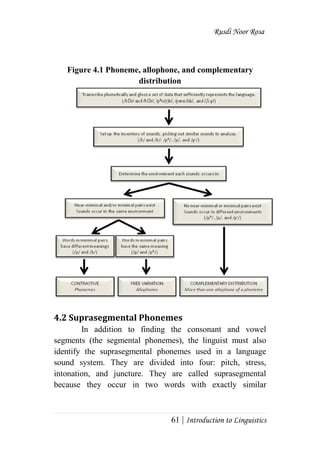
As mentioned earlier, we can use a minimal pair to
determine whether a sound is a phoneme, an allophone, or a
complementary distribution. How a minimal pair works to
classify such variations of sounds is illstrated in the figure 4.1.
Rusdi Noor Rosa
61 | Introduction to Linguistics
Figure 4.1 Phoneme, allophone, and complementary
distribution
4.2 Suprasegmental Phonemes
In addition to finding the consonant and vowel
segments (the segmental phonemes), the linguist must also
identify the suprasegmental phonemes used in a language
sound system. They are divided into four: pitch, stress,
intonation, and juncture. They are called suprasegmental
because they occur in two words with exactly similar
Rusdi Noor Rosa
62 | Introduction to Linguistics
segments; instead, they are imposed on the segmented
phonemes. Unlike minimal pair that must contain two words
with one different segment, suprasegmental phoneme occurs in
pair of words without any different segments. Pitch and stress
may occur in a single word or a sentence, while intonation can
only be found in a sentence.
4.2.1 Pitch
Pitch can be defined as a degree of highness or
lowness of a sound. In linguistics glossary, it is defined as the
difference in the relative vibration frequency of the human
voice that contributes to the total meaning of speech. As it may
contribute to the total meaning of a word or a speech, it may be
categorized as a phoneme. Pitch is not necessearily distinctive
sound in all of languages. In English, for example, pitch is not
considered as a phoneme as it does not distinguish meaning.
Unlike English, Chinese includes pitch as a phoneme as it can
distinguish meaning. For example, if you say /ʧu/ with a high
level of pitch, it means ―pig‖; but if you say /ʧu/ with a low
level of pitch, it means ―lord‖. Therefore, for people who
began to study Chinese, they tend to produce misleading
utterance. Instead of saying ―Forgive me, Lord‖; they say
―Forgive me, Pig‖.
4.2.2 Stress
Stress can be translated as emphasis. In scientific term,
stress is the degree of loudness given to some syllables in
relation to others. Stress can also be defined as the emphasis
placed on the sound or syllable spoken most forcefully in a
word or phrase. All of languages use stress; however, some of
them do not put stress as a phoneme. The proper use of stress
Rusdi Noor Rosa
63 | Introduction to Linguistics
can indicate the fluency of performing a particular language. In
English, stress is considered as a phoneme as it may
distinguish meaning. Study these pairs:
Phonemic transcription Noun Verb
/impo:t/ ʹimport imʹport
/insens/ ʹincense inʹcense
/insᴧlt/ ʹinsult inʹsult
In these pairs, the different position of stress causes different
meaning.
There are two kinds of stress in English: fixed stress
and variable stress. It is called a fixed stress as it will always
be put in the same place wherever and whenever the word is
used. Fixed stress is further divided into two types: prominent
stress and weak stress. This stress is found in the word with
more than one syllable. Variable stress, on the other hand, is
found in the word with one syllable. All of words with one
syllable do have stress when they stand alone; however, when
they are put into a sentence, their presence depends on the
emphasis of the sentence; that is why they are called variable
stress.
The use of variable stress in a sentence depends on the
importance of a particular word. The more important a word is
in a sentence the stronger its stress is. These four sentences
place variable stress in different position. Identify the meaning
produced by each.
a. I ʹnever gave him that ʹbook
b. I ʹnever gave him ʹthat book
c. I ʹnever gave ʹhim that book
d. ʹI ʹnever gave him that book
Rusdi Noor Rosa
64 | Introduction to Linguistics
Consider the meaning of each sentence: (a) I ever gave
him another thing, but not the book; (b) I ever gave him a
book, but not that one; (c) I ever gave that book to someone
else; but not to him; and (d) Someone has ever given him that
book, but I never did.
4.2.3 Intonation
Intonation is the rise or the fall of voice produced by
someone while speaking. In English, intonation is included as
a phoneme since different intonation used by the speaker in
delivering their message will affect the meaning of his/her
utterance. There are four kinds of intonation: rising intonation,
falling intonation, dipping intonation, and peaking intonation.
Rising intonation means the voice increases over time, and is
commonly symbolized []. It usually indicates questioning or
seeking the truth of a particular information. Falling intonation
means the voice decreases with time, and is commonly
symbolized []. It usually gives an impression of finality: no
more idea to be said. Dipping intonation means ―falls and then
rises‖ and is commonly symbolized []. It usually shows
limited agreement, response with reservation, offering choice,
uncertainty, or doubt. Peaking intonation means ―rises and
then falls‖, and is commonly symbolized []. It is used to
convey strong feelings of approval, disapproval or surprise.
The statement ―You are a doctor‖, for example, demonstrates
how the use of rising and falling intonation results in different.
(a) [Budi is a doctor]
(b) [Budi is a doctor]
Rusdi Noor Rosa
65 | Introduction to Linguistics
Sentence (a) demonstrates the use of rising intonation
that carries meaning of questioning. The speaker questions or
seeks the information whether Budi is a doctor or not.
Meanwhile, sentence (b) demonstrates the use of falling
intonation. The sentence contains information that has been
complete.
4.2.4 Juncture
Juncture is a joining or a joint; it is a type of
connection or pause we get between syllables or words. In
addition, it is also a point or line in which two bodies are
joined: it is used to refer to the manner of transition from one
vowel or consonant to another. In English, for example,
syllables may be connected together very closely without
pause (close juncture) or very loosely (open juncture); so that
there seems to be a pause between them in pronunciation. The
two types of juncture can be illustrated by the pair; night rate
/nait + reit/ (+ is used for open juncture) and nitrate /naitreit/.
The other examples can be seen below:
(a) a maze /ә + meiz/ amaze /әmeiz/
(b) an aim /әn + eim/ a name /ә + neim/
4.3 Rules of phonology
The idea of a rule is central to transformational-
generative theory. Generative phonology, in short, was the
creation of Noam Chomsky and Morris Halle, both to be
professors in the Department of Modern Languages and
Linguistics at the Massachusetts Institute of Technology
(MIT). Their work became known to linguists outside of MIT
proper through aseries of publications, including most notably
Rusdi Noor Rosa
66 | Introduction to Linguistics
Halle‘s Phonology in generative grammar (1962), Chomsky‘s
Current Issues in Linguistic Theory (1964), Chomsky and
Halle‘s Some controversial questions in phonological theory
(1965), and Chomsky and Halle‘s The Sound Pattern of
English (1968).
There were four central and distinctive tenets of the
research program presented in SPE (quoted in Goldsmith and
Lacks, 2011):
 First, the goal of the working phonologist was to develop
fully explicit, algorithmic phonologies which generate the
surface forms of a language and only those. In case of
multiple accounts of the same data – an unavoidable
situation – formal simplicity was to be used to choose
among the accounts, once a satisfactory means had been
established for measuring formal simplicity. In the
meantime, considerable thought and effort should be
given to determining what these measures of formal
simplicity were to be. The centrality of this notion of
simplicity is made explicitly in SPE in several places, and
its effects are virtually everywhere.
 Second, the explicit phonologies developed should
employ derivational means (that is, sequential, processual
analyses) to generate the forms of a language. The
observed forms that the linguist wishes to account for are
to be the output of a sequence of phonological rules which
act upon an underlying form. Linguists had already begun
to employ explanations which included the ordering of
phonological rules, but generative phonology took the
position that derivations were widely used in the
phonologies of natural languages.
Rusdi Noor Rosa
67 | Introduction to Linguistics
 Third, the phonological representations used were linear
sequences of matrices of feature values. No structure
beyond the linear structure of these matrices or segments
was included; in particular, there were no syllables
included in the model. Segments – phones – were to be
represented as bundles of binary features, in a fashion
very similar in character to what had been proposed by
Jakobson (1956), much of that in collaboration with Halle.
 Finally, discovering deep rule ordering was a high priority
of the theory, in the following sense. For each pair of
rules, one would attempt to determine that one and only
one ordering of the rules (that) was consistent with the
data, and one attempted to establish that a total ordering
of the rules could be established which was consistent
with each pairwise ordering empirically established. For
example, if a language has a phonological rule that
lengthens vowels before voiced consonants (which would
be written V → [+long]/ ___ [C,+voice]), and a rule that
voices intervocalic obstruents ([−sonorant] →
[+voice]/V___V), then the language must also contain a
statement as to which of those two rules applies ―before‖
the other, because the predictions of the grammar would
vary depending on this rule ordering.
The ideas mentioned above suggest the existence of a
rule that can be used to describe the phenomena taking place in
the language sound system. A rule is an operational statement
in which some linguistic entity is modified, resulting in a new
linguistic entity. Rules may add elements, remove elements, or
change elements. They are theoretical statements on the part of
the linguist, who is attempting to demonstrate that there is
Rusdi Noor Rosa
68 | Introduction to Linguistics
order in linguistic phenomena, that linguistic patterns are
systematic.
Phonological rules may add, delete, or change
phonological elements. A phonological derivation is an
operation that begins with an underlying representation and,
through the application of a set of specific rules, yields the
actual sound the speaker produces.
The representation of a phonological rule has the general
appearance:
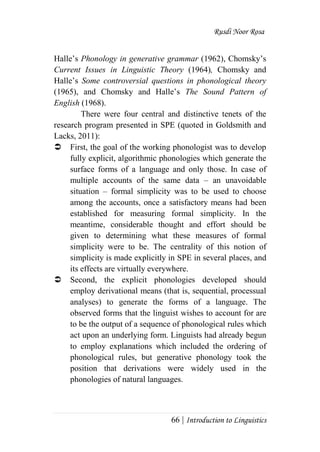
A → B/C
The A in this rule represents that which is going to be changed
by the rule. Keep in mind that a segment in both underlying
and phonetic representation is actually a bundle of distinctive
features such as [+voice], [-anterior], [+coronal], [-nasal]; thus,
a symbol like A may represent a single phonological feature or
a set of phonological features. The arrow (→) in the rules
means ―change to‖. The B in the rule represents the new form.
The slash mark separates the rule ―A changes to B‖ from the
phonological environments or conditions under which the rule
operate, here symbolized by C. This rule may be thus read ―A
changes to B under condition C‖. However, one important
thing that should be remembered, this rule can only operate in
regular condition, as a language may have irregularities.
Conditions are normally written before or after a
horizontal line; that is
A → B/___ C
This formula shows that the segment being changed occurs
before the condition C, or
A → B/C ___
This formula shows that the segment being changed occurs
after the condition C.
Rusdi Noor Rosa
69 | Introduction to Linguistics
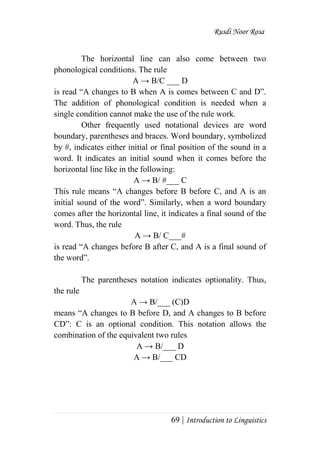
The horizontal line can also come between two
phonological conditions. The rule
A → B/C ___ D
is read ―A changes to B when A is comes between C and D‖.
The addition of phonological condition is needed when a
single condition cannot make the use of the rule work.
Other frequently used notational devices are word
boundary, parentheses and braces. Word boundary, symbolized
by #, indicates either initial or final position of the sound in a
word. It indicates an initial sound when it comes before the
horizontal line like in the following:
A → B/ #___ C
This rule means ―A changes before B before C, and A is an
initial sound of the word‖. Similarly, when a word boundary
comes after the horizontal line, it indicates a final sound of the
word. Thus, the rule
A → B/ C___#
is read ―A changes before B after C, and A is a final sound of
the word‖.
The parentheses notation indicates optionality. Thus,
the rule
A → B/___ (C)D
means ―A changes to B before D, and A changes to B before
CD‖: C is an optional condition. This notation allows the
combination of the equivalent two rules
A → B/___ D
A → B/___ CD
Rusdi Noor Rosa
70 | Introduction to Linguistics
The braces notation indicates that a rule applies under
two or more conditions. To combine the two rules:
A → B/C ___
A → B/D ___
we write
____
which may be read: ―A changes to B following C, and A
changes to B following D‖.
These rules are used in three phonological processes,
namely segment addition, segment deletion, and segment
change rules.
4.3.1 Segment addition rules
Sometimes, features are added to phonemes when they
occur in a specific phonetic context. We have already looked at
aspirated and unaspirated occurences of stops like /p/. At the
beginning of words as in ―pill‖, /p/ is aspirated. The feature of
aspiration is hence added because /p/ is a sound at the
beginning of a word, and the following sound is a stressed
vowel. In other phonetic contexts, the feature of aspiration is
not added. The rule can be formulated as follows:
[p]→[ph
]/ #___ [V (+stress)]
The rule is, thus, read ―p is added by aspirated sound (h
) when
it is at the beginning of the word (#), and followed by a
stressed vowel‖. If distinctive feature, as the formal feature of
the rule, is used, the rule is then formulated:







D
C
BA
Rusdi Noor Rosa
71 | Introduction to Linguistics
4.3.2 Segmentdeletion rules
Phonological rules of a language may result in the
deletion of segments from a phoneme sequence. A good
example for this rule is English, where the sound /k/ is deleted
when it begins a word and precedes nasals. The rule can be
formulated as follows:
[k] →[∅]/ ___ [n]
So, the sound k in these words is deleted: know, knife, knee,
etc. If distinctive feature, as the formal feature of the rule, is
used, the rule is then formulated:
On the left-hand side of the arrow are the features needed to
uniquely specify /k/ among the consonants; that is, no other
consonants have the features [-voice], [-anterior], and [-
coronal]. The symbols ―→‖ and ―∅‖ mean that ―/k/ changes to
nothing‖, or ―/k/ is deleted‖. The word boundary ―#‖ following
the slash means the initial position of the word. The horizontal
line ―___‖ following the word boundary mark refers to the
position of k; namely, before a segment that is [n].
Rusdi Noor Rosa
72 | Introduction to Linguistics
4.3.3 Segment-change rules
Phonological rules of a language may result in the
change of segments from a phoneme sequence. In English,
there are some prefixes indicating negative meanings. One of
them is prefix in- which can appear in various sounds: [in-],
[im-], and [iŋ]. Let us take one of them; that is [im-]. Various
words such as in+balance, in+proper, in+moral show the
change of sound [n] to [m] whenever n precedes [b], [p], and
[m]. The rule can be formulated as follows:
On the left-hand side of the arrow are the features needed to
uniquely specify /n/ among the consonants; that is, no other
consonants has the features [+nasal], [+anterior], and
[+coronal]. The symbol ―→‖ means ―change to‖. On the right-
side of the arrow is the result of sound change which has the
features [+nasal], [+anterior], but [-coronal]. These features
specify /m/ among the consonants. The horizontal line ―___‖
following the slash mark refers to the position of /n/; namely,
before a segment that is [+anterior], [-coronal], and
[+consonantal] that specify b, p, and m.
The variety of phonological conditions, the ones
coming after the slash, is determined by whether the conditions
have already specified the use of the rule. Let‘s take the word
―desire‘ as an example. The letter ―s‖ in that word is
pronounced /ʒ/ as it is situated between two vowels. Then, we
may write the rule:








































lconsonanta
coronal
anterior
coronal
anterior
nasal
coronal
anterior
nasal
____
Rusdi Noor Rosa
73 | Introduction to Linguistics
However, this rule doees not work for other similar
cases such as in ―buses‖ and ―passing‖, in which ―s‖ is
pronounced /s/. For this case, a number of conditions must be
added. The best way to do is by specifying vowel features that
can make this rule work. The vowel feature that can be added
here is [-low] which means that /s/ will change to /ʒ/ if the
vowels have ―low‖ feature. Thus, the rule can be formulated
like the following:
4.4 Conclusions
Structural phonologists championed the phoneme, an
abstract phonological unit consisting of a class of real sounds
called allophones. Phonemes are primarily determined by
investigating minimal pair. A variation of sound that does not
change the meaning is called allophone. When one sound has
more than one allophone, the sound is said to be in
complementary distribution.
Transformational-generative phonologists established
a more abstract level of phonology that consists of underlying
representation which is related to phonetic representations by a
system of rules that follow the form A → B/C. These rules
may add, delete, or change phonological elements.
Transformational-generative phonology is a universal theory of
phonology that is applicable to individual languages. However,
these rules are applicable only for regularities.
Rusdi Noor Rosa
74 | Introduction to Linguistics
4.4.1 Suggested Readings
Chomsky, N. 1964. Current Issues in Linguistic Theory. The
Hague: Mouton.
Chomsky, N. and M. Halle. 1965. ―Some controversial
questions in phonological theory‖. Journal of
Linguistics 1. pp. 97–138.
Chomsky, N. and M. Halle. 1968. The Sound Pattern
ofEnglish. New York: Harper and Row.
Crane, L. Ben et al. 1981. An Introduction to Linguistics.
Boston: Little, Brown and Company.
Goldsmith, J. and B. Laks. 2011. ―Generative phonology: its
origins, its principles, and its successors‖. Cambridge
History of Linguistics. (ed. by Waugh, L & J. Joseph).
Jakobson, R and M. Halle. 1956. Fundamentals of language.
The Hague: Mouton & Co., Printers
Lass, R. 1984. Phonology: An Introduction to Basic Concepts.
Cambridge: Cambridge University Press.
Fromkin, V. and R. Rodman. 1988. An Introduction to
Language. New York: Holt, Rinehart and Winston.
Halle, M. 1962. Phonology in generative grammar. Word 18.
pp. 54–72.
Rusdi Noor Rosa
75 | Introduction to Linguistics
4.4.2 Questions for Discussions
1. How is phonology defined? What makes phonology
different from phonetics?
2. Which of the following pairs of words are minimal pairs?
a. thin – than d. write – right
b. bat – bats e. famous – fabulous
c. cut – put f. cap – map
3. Describe the following terms. It is suggested to provide an
example for each.
a. phoneme
b. allophone
c. complementary distribution
4. What sounds are presented by the italicized letters in the
following words? Provide an allophonic (narrow)
transcription.
a. spirit d. sing
b. cab e. skip
c. bed
5. What are the differences between segmental phoneme and
suprasegmental phoneme?
6. Show the various meaning of the following sentences
through different variable stress.
a. He always puts his bag here
b. She never asked me to leave
7. Write rules that express the following:
a. A sound[n] becomes [ŋ] when it precedes [k]
b. A consonant [g] is deleted when it precedes [h]

Phonetics and phonology

  • 2.
    Rusdi Noor Rosa 34| Introduction to Linguistics
  • 3.
    Rusdi Noor Rosa 35| Introduction to Linguistics 3. PHONETICS 3.0 Introduction An obvious way of beginning an analysis of spoken language is by studying its sounds which is called phonetics (Crane et al., 1981:57). Phonetics is a branch of linguistics that studies the material aspects of speech sounds. What is meant by ―material aspect‖? And what other features exist which characterize sounds? Well, material aspects of sounds are those aspects that make for the physical production, transportation and comprehension of the sound. Another aspect of a sound is its function within a language. The function of sounds is, however, examined by another linguistic discipline, namely phonology. Please take note of the fact though that this represents the European (including the English) categorization of these linguistic disciplines and that Americans follow a different convention. Americans use the term ―phonology‖ to refer to our understanding of both phonetics and phonology. They refer to what we call ―phonetics‖ also as ―phonetics‖, but refer to what Europeans call ―phonology‖ as ―phonemics‖. So if you ever come across the American terminology, do not be confused. In any way, in this textbook we will stick to the European terms. The modern alphabet does not suffice to transcribe all sounds on a one-to-one basis. There are many instances though, when we need an internationally comprehensible code for the detailed transcription of sounds, such as in linguistic research, as well as in foreign language teaching. A special alphabet devised by the International Phonetic Association
  • 4.
    Rusdi Noor Rosa 36| Introduction to Linguistics (IPA) is then used. Phonetic characters refer to the actual utterance of a sound. In phonetic writing, the symbols for these sounds are put within brackets, such as: [θ]. Back to phonetics, we stated above that there are three different physical aspects of a sound. These are the articulatory aspect of the speaker, the acoustic aspect of the channel, and the auditory aspect of the hearer.  Articulatory phonetics researches where and how sounds are originated and thus carries out physiological studies of the respiratory tract, trying to locate precisely at which location and in which manner a sound is produced.  Acoustic phonetics examines the length, frequency and pitch of sounds. Special instruments are required to measure and analyze the sounds while they travel via the channel.  Auditory phonetics studies what happens inside the ear and brain when sounds are finally received. It also interested in our ability to identify and differentiate sounds. 3.1 How speech is produced Everyday, we always speak to other people without any consciousness why we are able to produce the sound of utterances. How and where sounds are produced within our vocal tracts determines the acoustic properties of those sounds. Gleason and Ratner (1998:113) noted three major systems for speech production: (1) the vocal tract, (2) the larynx, and (3) the subglottal system. Let us first identify the body parts that are involved in speech production. Figure 3.1 is a diagram of most of the
  • 5.
    Rusdi Noor Rosa 37| Introduction to Linguistics organs used in speech production that shows the places of articulation for English consonants. Starting at the bottom of figure 3.1, we can see the glottis, which is part of the larynx. The larynx contains vocal folds, and the glottis is the opening between the vocal folds where the folds meet when they vibrate to produce voice or phonation. We can also see the pharynx, the nasal cavity, and the various parts of the oral cavity. These include the uvula, the velum (or soft palate), the hard palate, the alveolar ridge, tongue, teeth, and lips. The area from the larynx to the lips is called the vocal tract. The subglottal system includes the lungs and associated muscles needed for inhalation and exhalation and the trachea or the windpipe. The subglottal system provides the air support for speech, which is produced on exhalation. Vowels and consonants are produced differently. The major difference is that consonants are produced with more articulatory movement and more constriction – narrowing in a location in the vocal tract – than are vowels.
  • 6.
    Rusdi Noor Rosa 38| Introduction to Linguistics Figure 3.1. A schematic drawing of the vocal tract Places of articulation: 1, bilabial; 2, labiodental; 3, dental or interdental; 4, alveolar; 5, palatoalveolar; 6, palatal; 7, velar; 8, uvular; 9, glottal. Source: An introduction to Language (4th ed.) Fromkin, V. and Rodman, R. (1988:36) Lip 21 9 8 7 6 5 4 3 Hard palateAlveolar ridge NASAL CAVITY Velum (soft palate) Uvula Epiglotis BackFront Lip Teeth TONGUE Glottis
  • 7.
    Rusdi Noor Rosa 39| Introduction to Linguistics The larynx is in the neck; it has several parts, as can be seen in figure 3.2. Its main structure is made of cartilage, a material which is similar to bone but less hard. The larynx‘s structure is made of two large cartilages. These are hollow and are attached to the top of the trachea; when we breathe, the air passes through the trachea and larynx. The front of the larynx comes to a point and we can feel this point at the front of our neck – especially for men. This point is commonly known as the Adam‘s Apple. Figure 3.2. The larynx Inside the box made by these two cartilages are the vocal folds which were previously known as vocal cords. They are two thick flaps of muscle rather like a pair of lips. Figure 3.3 shows the most important parts of vocal folds. At the front, the vocal folds are joined together and fixed to the inside of the thyroid cartilage. At the back they are attached to a pair of thyroid cartilage tracheal rings cricoid cartilage
  • 8.
    Rusdi Noor Rosa 40| Introduction to Linguistics small cartilages called the arytenoid cartilages so that if the arytenoid cartilages move, the vocal folds will move too. Figure 3.3. The inside of the larynx seen from above The arytenoid cartilages are attached to the top of the circoid cartilage but they can move the vocal folds apart or together. The movement can be seen in figure 3.4. This movement is commonly called glottis, the opening between the vocal folds. If the vocal folds are apart, we say that the glottis is open (Figure 3.4b); the glottis is said closed when the vocal folds are joined together (Figure 3.4a). Figure 3.4. Arytenoid cartilages causing closing and opening of the glottis a. b. Vocal folds Arytenoid cartilages front
  • 9.
    Rusdi Noor Rosa 41| Introduction to Linguistics The movement of closing and opening of the glottis seems quite simple; however, this movement can, in fact, produce a very complex range of changes in the vocald folds and their positions. These changes are often important in speech as they help humans to produce varieties of consonant sounds. The two movements above are developed into more different positions of vocal folds. 3.1.1 Wide apart The vocal folds are wide apart for normal breathing and usually during voiceless consonants like p, f, s. Figure 3.5. Wide apart 3.1.2 Narrow glottis If air is passed through the glottis when it is narrowed, the result is a fricative sound for which the symbol used is h. The sound is not very different from a widespread vowel. It is called a voiceless glottal fricative. The sound ahahahahaha can be an appropriate example of narrow glottis. Figure 3.6. Narrow glottis
  • 10.
    Rusdi Noor Rosa 42| Introduction to Linguistics 3.1.3 Position for vocal fold vibration When the edges of vocal folds are touching each other, or nearly touching, air passing through the glottis will usually cause vibration. Air is pressed up from the lungs and this air pushes the vocal folds apart so that a little air escapes. As the air flows quickly past the edges of the vocal folds, the folds are brought together again. This opening and closing movement happens very rapidly and is repeated regularly, averaging roughly between two and three hundred times per second in a woman‘s voice and about half that rate in adult men‘s. Figure 3.7. Position for vocal fold vibration 3.1.4 Vocal folds tightly closed The vocal folds can be firmly pressed together so that air cannot pass between them. When this happens in speech we call it a glottal stop or glottal plosive, for which the symbol ―Ɂ‖ is used. Figure 3.8. Vocal folds tightly closed
  • 11.
    Rusdi Noor Rosa 43| Introduction to Linguistics 3.2 Articulatory phonetics - consonants Sounds in language are divided into two broad classifications: consonants and vowels. Both constitute larger structures of language, including words, phrases, clauses, sentences, and so on. The main difference between the two relies on the presence of the obstacle in releasing the air passage. Consonants are produced by blocking the air passage either completely or partially; vowels, on the other hand, are produced by releasing the air passage without any obstacles. Consonants are discussed earlier as they have more complicated way of production. Generally, consonants are different in terms of place and manner of articulation. Place of articulation classifies consonants based on the organs of speech involved in the production of consonants. Meanwhile, manner of articulation identifies consonants based on the way of organizing the air passage. Nevertheless, it is impossible to classify consonants based only on place of articulation without the involvement of manner of articulation, and vice versa. Both are integrated whenever every single of consonant sound is produced. 3.2.1 Place of articulation Place of articulation refers to the horizontal relationship between organs of speech, also known as articulators. Articulators are both active and passive. Active articulator is the one which is frequently involved in producing consonant sounds. Passive articulator is less involved but typically gives its name to consonant classification viewed from place of articulation. What follows is classification of consonants based on place of articulation.
  • 12.
    Rusdi Noor Rosa 44| Introduction to Linguistics  Bilabials are consonants that are articulated by pressing the lips, like [m].  Labiodentals are consonants articulated by bringing the lower lip to the upper teeth, like [f]. As the lower lip experiences some movement, it is categorized as active articulator and the upper teeth are passive because they do not show any movement. Nevertheless, the name is taken from the combination of the two articulators.  Interdentals or Dentals are the sounds at the beginning of ―thin‖ and ―then‖, in IPA: [θ] and [ð]. In order to articulate these, the tongue must be pressed between the teeth.  Alveolars are consonants articulated by raising the tip of the tongue to thealveolar ridge (a linguistic term for teeth ridge), like [d]. The name of the group, alveolar, is taken from the passive articulator, alveolar ridge.  Post-alveolars are consonants articulated by raising the tip of the tongue to the space between alveolar ridge and hard palate. They are neither alveolar as the tongue position is not in the area of alveolar ridge nor palatal as the tongue fails to reach the exact area of hard palate. Sounds [ʧ], [ʤ], and [r] are examples of post-alveolars.  Palatals as in the middle of the word ―wash‖ are produced by the contact of the front part of the tongue with the hard palate just behind the alveolar ridge. An example is [ʃ].  Velars are sounds which are articulated by raising the back of the tongue to the soft palate, linguistically known as velum. An example is [g].
  • 13.
    Rusdi Noor Rosa 45| Introduction to Linguistics  Glottals are produced by involving the glottis in which the vocal cords or vocal folds are widely open. The classification of consonants based on place of articulation can be shown in the following table. Table 3.1 Consonants based on place of articulation Place of articulation Active articulator Passive articulator Examples Bilabial Lower lip Upper lip b, p, m, w Labiodental Lower lip Upper teeth f, v Interdental Tongue tip Teeth θ, ð Alveolar Tongue tip Alveolar ridge t, d, s, z, n, l Post-alveolar Tongue blade Between alveolar ridge and hard palate ʧ, ʤ, r Palatal Tongue front Hard palate ʃ, ʒ, j Velar Tongue back Soft palate/Velum k, g, ŋ Glottal Vocal cords Vocal cords h 3.2.2 Manner of articulation Another fundamental distinction of consonants is made between so-called manner of articulation. If place of articulation focuses on horizontal relationship between articulators, manner of articulation refers to vertical relationship between the active and passive articulators, i.e. the distance between them. In other words, manner of articulation refers to how articulators manage the release of air passage. When the articulators are pressed together, the air passage is completely blocked and cause the air pressure to build up behind the blockage. When the blockage is opened,
  • 14.
    Rusdi Noor Rosa 46| Introduction to Linguistics the air is released in rush, the sounds which are produced through this way are called stops, also known as plossives, e.g. [t]. But, when the blockage is kept and the air is released through the nose, we call the resulting consonant is a nasal, as in [m]. When the articulators are closed together, but without complete closure, the air passage is forced to go through the narrow space of articulators. This action results in friction, a sound turbulance. As the sound produced is followed by the presence of friction, the sound is named fricative. Other sounds that are followed by friction are affricates. However, they are different from fricatives in the way that the sounds, in the beginning of production, must have a complete closure of articulators. This means that the air passage is blocked before it is released through narrow space of articulators, such as in [ʧ]. These sounds are also known as a result of fricative-stop combination. The other two types – liquids and glides – let the air passage go freely through oral cavity. However, the exact manner of articulation is obviously different. Liquids, also known as laterals, block force the air passage to go through each side of the oral cavity. Some part of the tongue that is pressed onto the alveolar ridege blocks the the middle part of the oral cavity. Meanwhile, liquids, also known as semi- vowels, shape the articulators wide apart and let the air flow out freely. It seems that they resemble vowels in the manner of ―free release without blocking‖; however, the involvement of articulators, such as lips and front tongue make themselves consonants. The classification of consonants based on manner of articulation can be shown in the following table.
  • 15.
    Rusdi Noor Rosa 47| Introduction to Linguistics Table 3.2 Consonants based on manner of articulation Manner of articulation Air Passage Examples Stop Comple closure and release in rush p, b, t, d, k, g Fricative Incomplete closure and release through narrow space of articulators f, v, θ, ð, s, z, ʃ, ʒ, r, h Affricate Complete closure and release through narrow space of articulators ʧ, ʤ Nasal Complete closure and release through nasal cavity m, n, ŋ Liquid Free release through each side of oral cavity l Glide Free release almost no obstacles w, j The two classifications of consonant sounds are combined in the following table to see how they are similar or different in the way of production. This will also show how some sounds are similar in the place of articulation but different in the manner of articulation, or vice versa.
  • 16.
    Rusdi Noor Rosa 48| Introduction to Linguistics Table 3.3. English consonants Stop Affricate Fricative Nasal Liquid Glide BILABIAL p, b _ _ m _ w _ LABIO- DENTAL _ _ f, v _ _ _ DENTAL _ θ, ð _ ALVEOLAR t, d s,z n_ l _ _ POST- ALVEOLAR _ ʧ, ʤ r _ _ _ PALATAL _ __ ʃ, ʒ_ _ _ j VELAR k, g _ ŋ _ _ GLOTTAL _ _ h _ _ _ 3.2.3 Distinctive Features Looking at a chart of consonants in Table 3.3, it seems that some consonants, such as /p/ and /b/ are pronounced in the same way. In fact, it is impossible to produce different sounds through similar place and manner of articulation. Therefore, there must be specific features that can distinguish one sound from another. These features are known as distinctive features. These features show that all segments or sounds must be characterizable in terms of some unique combination of features. There are three requirements in the use of distinctive features: 1. The features should be capable of characterizing natural segment classes. 2. The features should be capable of describing all segmental contrasts in the world‘s languages. 3. The features should be definable in phonetic terms.
  • 17.
    Rusdi Noor Rosa 49| Introduction to Linguistics The first type of distinctive features is anterior. It belongs to a group of place features as it characterizes certain consonants by referring to their place of articulation. Anterior distinguishes between sounds produced in the front of the mouth and other sounds. The front of the mouth includes lips, teeth, and alveolar ridge; therefore, all sounds which are produced by involving these speech organs belong to anterior. The other feature that refers to the place of articulation is coronal. Unlike anterior, coronal distinguishes between sounds produced by involving the front of the tongue and other sounds. The front of the tongue is involving such sounds as dentals, alveolar, post-alveolar, and palatal. Furthermore, types of distinctive features can also be seen from the use of manner of articulation, known as manner features. The first type is continuant. This feature characterizes the sounds in which there is free airflow through the oral cavity. In other words, after the sounds are produced, the airflow must still be let free. Next is nasal which distinguishes between sounds produced through nasal cavity and other sounds. Another type of manner features is strident. This feature characterizes the sounds in which there is a friction (hiss sound). The friction is a result of forcing the air passage through narrow space of articulators. Besides, the features can also be seen from consonantal features that are divided into two types. The first type, consonantal, distinguishes between sounds produced with the presence of blockage in the air passage and other sounds. All of consonants must be consonantal, except /w/ and /j/. The second type, voice, characterizes the sounds produced cause the vibration in the vocal cords from other sounds. The
  • 18.
    Rusdi Noor Rosa 50| Introduction to Linguistics other sounds, the ones that do not cause vibration in the vocal cords, are known as voiceless. The last type of distinctive features is seen from the major class features. Sonorant is the only type of major class features. It distinguishes glides, liquids and nasal from stops and fricatives. This feature shows a clear formant pattern of sounds. The following table shows the classification of consonants based on their distinctive features. Table 3.4. Chart of Distinctive Features b ʧ d f g h ʒ ʤ k l m n ŋ Consonantal + + + + + + + + + + + + + Continuant - - - + - - + - - + - - - Sonorant - - - - - - - - - + + + + Strident - + - + - - + + - - - - - Voiced + - + - + - + + - + + + + Anterior + - + + - - - - - + + + - Coronal - + + - - - + + - + - + - Nasals - - - - - - - - - - + + + p r s ʃ t θ ð v w j z Consonantal + + + + + + + + - - + Continuant - + + + - + + + + + + Sonorant - - - - - - - - + + - Strident - + + + - - - + - - + Voiced - + - - - - + + + + + Anterior + - + - + + + + + - + Coronal - + + + + + + - - + + Nasals - - - - - - - - - - -
  • 19.
    Rusdi Noor Rosa 51| Introduction to Linguistics By using the distinctive features, each of consonants can be described, and the description is, of course, different from one another. Look at how some consonants are described below. m = p = The number of features needed to describe a sound is various, depending on whether those features have already represented a single sound. Nevertheless, every sound certainly needs more than one distinctive feature to be described. 3.3 Articulatory phonetics - vowels In contrast to consonants, where manner and place of articulation serve as descriptive categories, vowels are differentiated by their position of the tongue and the lips. These categories are indicative of the different ways in which the two sounds are produced - while consonants are produced with the help of many organs, vowels depend only on the position of the tongue and the lips. The positioning the tongue and the lips allow for a great amount of variation, enabling us to voice many more vowels than the familiar five vowels a, e, i, o, u. English has more than a dozen different vowels, varied into different dialects. Nevertheless, in this book, the classification of vowels presented is based on Received
  • 20.
    Rusdi Noor Rosa 52| Introduction to Linguistics Pronunciation (RP). Besides, in English, as in other world‘s languages, several diphthongs are introduced. Vowels can be produced by raising the tongue high, keeping it in the middle, or low in the mouth; also, the tongue can be moved to the front, center or back. The lips can be rounded or unrounded. If you try to articulate while moving your lips and your tongue around, you will notice how many folds the resulting vowel-like sounds are. In addition to these ways of vowel production, vowels are also distinguished in the term of tense and lax (-tense). A general chart of the vowels of English looks as follows: Table 3.5 Chart of English vowels The preceding chart shows a single vowel sound, also known as monophtong, used in English. Some familiar sounds, such as /ɛ/ and /o/, seem to be missing from English vowels. These two sounds are no longer monophtongs as they are more appropriate to serve as diphtongs. /ɛ/ is represented by æ i: ʌ a ә u: e ↄ: ʊı ɑ: high middle low front central back
  • 21.
    Rusdi Noor Rosa 53| Introduction to Linguistics diphtong /eә/ and /o/ is represented by diphtong /әʊ/. According to RP, English diphtongs are as follows: /eı, aı, aʊ, ↄı, әʊ, ıә, eә, ↄә, ʊә/ What follows are examples of words and their pronunciation in which vowels are used. see /si:/, this /ðıs/, sell /sel/, bag /bæg/ arrive /ә ‗raıv/, cut /kʌt/, bath /baθ/ too /tu:/, book /bʊk/, bought /bↄ:t/, car /kɑ:(r)/ may /meı/, why /waı/, cow /kaʊ/, toy /tↄı/, post /pәʊst/ tear /tıә(r)/, wear /weә(r)/, bore /bↄә/, sure /ʃʊәr/ 3.4 Conclusions Phonetics is the study of how sound is produced by humans. In order to produce sounds, organs of speech or articulators are functioned. Human‘s organs of speech are found in three parts of body: chest, throat, and head. English sounds are divided into two: consonants and vowels. Consonants are sounds produced by blocking –either completely or partially—the air passage. While vowels are produced without blocking the air passage. Consonants are distinguished in terms of place of articulation, manner of articulation, and distinctive features. Vowels are characterized by three processes involving tongue and lips. Tongue is advanced and retracted to produce front and back vowels; tongue is raised and lowered to produce high and low vowels; and lips are rounded to produce round vowels, and unrounded to produce unround vowels. Vowels are both monophtongs and diphtongs. 3.4.1 Suggested Readings
  • 22.
    Rusdi Noor Rosa 54| Introduction to Linguistics Crane, L. Ben et al. 1981.An Introduction to Linguistics. Boston: Little, Brown and Company. Fromkin, V.A. and R. Rodman. 1988. An Introduction to Language. New York: Holt, Rinehart and Winston. Gleason, J.B., and N.B. Ratner. 1998. Psycholinguistics. New York: Harcourt Brace College Publishers. Lass, R. 1994. Phonology: An Introduction to Basic Concepts. Cambridge: Cambridge University Press. Mc Mahon, A. 2002. An Introduction to English Phonology. Edinburgh: Edinburgh University Press. 3.4.2 Questions for Discussions 1. How do you define phonetics? 2. What are the differences between consonant and vowel? 3. How are fricative consonants produced? Give examples. 4. List classifications of consonants based on place of articulation. Elaborate your answers by providing examples. 5. Complete the sentences by choosing one of the following features: [+continuant], [+sonorant], [+anterior], [-coronal], [-consonantal]. a. The labiodental, interdental, and alveolar are ……………..
  • 23.
    Rusdi Noor Rosa 55| Introduction to Linguistics b. The interdental, alveolar, post-alveolar, and palatal are ………… c. The bilabial, labiodental, and velar are ……………………. d. The lateral and semivowel are ……………….. e. The nasal, lateral, and semivowel are ………………..
  • 24.
    Rusdi Noor Rosa 56| Introduction to Linguistics 4. PHONOLOGY 4.0 Introduction Previous chapter was mainly concerned with matters of phonetics – the comparatively straightforward study of describing the sounds that we use in speaking. When we talk about how phonemes function in language, and the relationship among the different phonemes, we are studying a related but different subject that we call phonology. Phonology deals with the function of sounds within a language. Let us have a close look at these functions. Every language has a precisely defined set of sounds. This set consists of the so-called distinctive sounds. The system of the speech sounds and their usage is defined as duality of patterning: with a given set of components, we may construct an unlimited number of new arrangements of the components. In other words, our language provides us with a limited set of sounds, but we can arrange these to ever new utterances. Crane et al. (1981:72) say that phonology is the study of how sounds are organized and how they function in language. Phonology is divided into two concentrations: structuralist phonology and transformational-generative phonology. Structuralist phonology focuses only on the structure of sound. It recognizes three major independent phonological levels: morphophonemes, phonemes, and phonetic representation (the last two levels are discussed in this book). Transformational-generative phonology, on the other hand, focuses on series of rules that directly relate underlying representations to observed phonetic representations. The central mechanisms in transformational
  • 25.
    Rusdi Noor Rosa 57| Introduction to Linguistics generative phonology are underlying representations and phonological rules. 4.1 Phonemes and allophones By calling a sound distinctive, we refer to its capability of changing the meaning of a word. Naturally, single sounds cannot carry any meaning. ―b‖ or ―p‖, for example, are meaningless utterances. But when several distinct sounds are assembled to a word, each of them suddenly contributes to a meaning. And by exchanging individual distinct sounds, we may change this meaning. We call these sounds phonemes, the smallest distinctive elements of a language. Phonemes have no meanings but they can distinguish the meanings when they are combined into a larger unit of a language (i.e. word). Čermák (2001) translated in Bičan (2005) characterizes a phoneme in the following manner: (i) a phoneme is the minimal non-semantic (or ―subsemantic‖) unit of the system, yet functional, capable of distinguishing the meaning (i.e. in combination with others in upper levels); (ii) the ability of the phoneme to distinguish the meaning is understood as minimal and it is sufficient if it is realized at least between two words (minimal contrast); from the functional point of view this ability is understood as distinctive function; and (iii) a phoneme is a functional unit defined by a bundle of distinctive features, is of the twofold kind, segmental and suprasegmental; both are of the abstract nature. The idea mentioned above indicates that the key point of defining phoneme is its ―distinctive function‖. The distinctive function of the phoneme is likewise easy to understand: it is a minimal unit with capability of distinguishing the meaning between at least two words.
  • 26.
    Rusdi Noor Rosa 58| Introduction to Linguistics Compare two words which differ only by one sound, e.g., ―pin‖ and ―bin‖. By replacing the beginning consonants, the meaning of the word changes. We call such pairs minimal pairs. Minimal pair is two words that (i) have the same number of segments, (ii) have only one different segment, and (iii) have different meaning. The test we just performed to locate the phonemes is called Commutation Test. The phonemes thereby discerned are then put within slashes, such as /p/, /b/, for phonological transcription. These are, of course, ideal units of the sound system of a language. They should not be confused with the sounds of actual utterances examined by phonetics. Phonetics tries to differentiate among the sounds with the highest possible degree of accuracy. It does so without regard for the influence of a sound may have on the meaning of an utterance. However, not all sounds of a language are necessarily distinctive sounds. Let‘s take the Indonesian word ―kemana (where)‖, for example, which is pronounced either [kәmᴧnᴧ] or [kæmᴧnᴧ]. Although there are obviously different sounds in the pair, the meaning does not change. Thus, /ә/ and /æ/ are not phonemes in the Indonesian language. We call this phenomenon free variation. The two sounds can be referred to as allophones. These sounds are merely variations in pronunciation of the same phoneme and do not change the meaning of the word. Nevertheless, these two different sounds, ―/ә/ and /æ/‖, may act as phonemes in another language such as English. Let‘s take the pair of words ―were‖ and ―where‖ as the example. These words are respectively pronounced [wә(r)] and [wæ(r)]. Different sounds in this pair reslt in different meaning which; therefore, belong to phonemes. By using these
  • 27.
    Rusdi Noor Rosa 59| Introduction to Linguistics two examples, a conclusion may be drawn: phonemes in one language may not be phonemes in another language. Free variation can also be found in various dialects of the same language. In this case, the different pronunciations of words throughout a country do not change the meaning of those words. Compare the English and American pronunciations of ―dance‖: [dɑ:ns] versus [dæns]. Although there are different sounds in the pair, the meaning does not change. Thus, /ɑ:/ and /æ/ are not phonemes in this case. Another example of sounds which are not phonemes are those which occur in complementary distribution. A phoneme is called to have complementary distribution when it occupies different position in words. This means that where one sound of the pair occurs, the other cannot. An example for complementary distribution are the aspirated, unaspirated, and unreleased sounds of /p/. Aspirated sounds are those which contain audible puff of the air. When the voiceless stops (/p/, /t/, and /k/) begin the word and are followed by stressed vowel, there is likely to be an audible puff of the air following the release. The initial consonant as in ―pill‖ is aspirated. The initial consonant in ―pacific‖ is unaspirated. The final consonant as in ―sheep‖ is unreleased. The respective transcriptions would be [ph il], [pæsi:fik], and [ʃi:p- ] where [h ] indicates aspiration and [- ] indicates unreleased. Aspirated [ph ], as can be seen in this example, occurs before the stressed vowel; [p- ] takes place in the final position of the word. [ph ], [p], and [p- ] are only allophones of the same phoneme /p/. Another example of the occurence of complementary distribution is in the pronunciation of /æ/ in ―back‖ and ―bag‖. Everybody will find it difficult to identify the difference in vowel length. As it is known, English has a very general
  • 28.
    Rusdi Noor Rosa 60| Introduction to Linguistics pattern of lengthening vowels before voiced consonants. That is, the allophone of a vowel phoneme before a voiced consonant will be produced longer than the allophone of the same vowel phoneme before a voiceless consonant. We can represent the pattern of occurrence (distribution) of these two allophones of the phoneme /æ/ as the following phonological rule: When the phoneme /æ/ occurs before a voiceless consonant, it is pronounced as its allophone [æ]; when it occurs before a voicedconsonant it is pronounced as its allophone [æ:]. It means that /æ/ is pronounced longer only before a voiced consonant, but in another environment, it is not. Nasalized vowels can also contribute to the occurence of complementary distribution. Note that the phoneme /u:/ in ―tool‖ and ―tone‖ is pronounced differently – even though, sometimes, we are anware of this difference. /u:/ is pronounced [ũ:] when it is followed by nasal sound /n/, but this cannot occur before other consonants. In fact, the rule is much more general than this, because it is applied to all vowels and all nasals. Therefore, a general statement can be issued: In English, all vowels are nasalized when they occur before nasal consonants. This generalization should be made because one of the objectives in studying a language is to be able to describe the sound patterns, i.e., to be able to specify, in as the most general terms as possible, the phonetic environments in which each allophone occurs. As mentioned earlier, we can use a minimal pair to determine whether a sound is a phoneme, an allophone, or a complementary distribution. How a minimal pair works to classify such variations of sounds is illstrated in the figure 4.1.
  • 29.
    Rusdi Noor Rosa 61| Introduction to Linguistics Figure 4.1 Phoneme, allophone, and complementary distribution 4.2 Suprasegmental Phonemes In addition to finding the consonant and vowel segments (the segmental phonemes), the linguist must also identify the suprasegmental phonemes used in a language sound system. They are divided into four: pitch, stress, intonation, and juncture. They are called suprasegmental because they occur in two words with exactly similar
  • 30.
    Rusdi Noor Rosa 62| Introduction to Linguistics segments; instead, they are imposed on the segmented phonemes. Unlike minimal pair that must contain two words with one different segment, suprasegmental phoneme occurs in pair of words without any different segments. Pitch and stress may occur in a single word or a sentence, while intonation can only be found in a sentence. 4.2.1 Pitch Pitch can be defined as a degree of highness or lowness of a sound. In linguistics glossary, it is defined as the difference in the relative vibration frequency of the human voice that contributes to the total meaning of speech. As it may contribute to the total meaning of a word or a speech, it may be categorized as a phoneme. Pitch is not necessearily distinctive sound in all of languages. In English, for example, pitch is not considered as a phoneme as it does not distinguish meaning. Unlike English, Chinese includes pitch as a phoneme as it can distinguish meaning. For example, if you say /ʧu/ with a high level of pitch, it means ―pig‖; but if you say /ʧu/ with a low level of pitch, it means ―lord‖. Therefore, for people who began to study Chinese, they tend to produce misleading utterance. Instead of saying ―Forgive me, Lord‖; they say ―Forgive me, Pig‖. 4.2.2 Stress Stress can be translated as emphasis. In scientific term, stress is the degree of loudness given to some syllables in relation to others. Stress can also be defined as the emphasis placed on the sound or syllable spoken most forcefully in a word or phrase. All of languages use stress; however, some of them do not put stress as a phoneme. The proper use of stress
  • 31.
    Rusdi Noor Rosa 63| Introduction to Linguistics can indicate the fluency of performing a particular language. In English, stress is considered as a phoneme as it may distinguish meaning. Study these pairs: Phonemic transcription Noun Verb /impo:t/ ʹimport imʹport /insens/ ʹincense inʹcense /insᴧlt/ ʹinsult inʹsult In these pairs, the different position of stress causes different meaning. There are two kinds of stress in English: fixed stress and variable stress. It is called a fixed stress as it will always be put in the same place wherever and whenever the word is used. Fixed stress is further divided into two types: prominent stress and weak stress. This stress is found in the word with more than one syllable. Variable stress, on the other hand, is found in the word with one syllable. All of words with one syllable do have stress when they stand alone; however, when they are put into a sentence, their presence depends on the emphasis of the sentence; that is why they are called variable stress. The use of variable stress in a sentence depends on the importance of a particular word. The more important a word is in a sentence the stronger its stress is. These four sentences place variable stress in different position. Identify the meaning produced by each. a. I ʹnever gave him that ʹbook b. I ʹnever gave him ʹthat book c. I ʹnever gave ʹhim that book d. ʹI ʹnever gave him that book
  • 32.
    Rusdi Noor Rosa 64| Introduction to Linguistics Consider the meaning of each sentence: (a) I ever gave him another thing, but not the book; (b) I ever gave him a book, but not that one; (c) I ever gave that book to someone else; but not to him; and (d) Someone has ever given him that book, but I never did. 4.2.3 Intonation Intonation is the rise or the fall of voice produced by someone while speaking. In English, intonation is included as a phoneme since different intonation used by the speaker in delivering their message will affect the meaning of his/her utterance. There are four kinds of intonation: rising intonation, falling intonation, dipping intonation, and peaking intonation. Rising intonation means the voice increases over time, and is commonly symbolized []. It usually indicates questioning or seeking the truth of a particular information. Falling intonation means the voice decreases with time, and is commonly symbolized []. It usually gives an impression of finality: no more idea to be said. Dipping intonation means ―falls and then rises‖ and is commonly symbolized []. It usually shows limited agreement, response with reservation, offering choice, uncertainty, or doubt. Peaking intonation means ―rises and then falls‖, and is commonly symbolized []. It is used to convey strong feelings of approval, disapproval or surprise. The statement ―You are a doctor‖, for example, demonstrates how the use of rising and falling intonation results in different. (a) [Budi is a doctor] (b) [Budi is a doctor]
  • 33.
    Rusdi Noor Rosa 65| Introduction to Linguistics Sentence (a) demonstrates the use of rising intonation that carries meaning of questioning. The speaker questions or seeks the information whether Budi is a doctor or not. Meanwhile, sentence (b) demonstrates the use of falling intonation. The sentence contains information that has been complete. 4.2.4 Juncture Juncture is a joining or a joint; it is a type of connection or pause we get between syllables or words. In addition, it is also a point or line in which two bodies are joined: it is used to refer to the manner of transition from one vowel or consonant to another. In English, for example, syllables may be connected together very closely without pause (close juncture) or very loosely (open juncture); so that there seems to be a pause between them in pronunciation. The two types of juncture can be illustrated by the pair; night rate /nait + reit/ (+ is used for open juncture) and nitrate /naitreit/. The other examples can be seen below: (a) a maze /ә + meiz/ amaze /әmeiz/ (b) an aim /әn + eim/ a name /ә + neim/ 4.3 Rules of phonology The idea of a rule is central to transformational- generative theory. Generative phonology, in short, was the creation of Noam Chomsky and Morris Halle, both to be professors in the Department of Modern Languages and Linguistics at the Massachusetts Institute of Technology (MIT). Their work became known to linguists outside of MIT proper through aseries of publications, including most notably
  • 34.
    Rusdi Noor Rosa 66| Introduction to Linguistics Halle‘s Phonology in generative grammar (1962), Chomsky‘s Current Issues in Linguistic Theory (1964), Chomsky and Halle‘s Some controversial questions in phonological theory (1965), and Chomsky and Halle‘s The Sound Pattern of English (1968). There were four central and distinctive tenets of the research program presented in SPE (quoted in Goldsmith and Lacks, 2011):  First, the goal of the working phonologist was to develop fully explicit, algorithmic phonologies which generate the surface forms of a language and only those. In case of multiple accounts of the same data – an unavoidable situation – formal simplicity was to be used to choose among the accounts, once a satisfactory means had been established for measuring formal simplicity. In the meantime, considerable thought and effort should be given to determining what these measures of formal simplicity were to be. The centrality of this notion of simplicity is made explicitly in SPE in several places, and its effects are virtually everywhere.  Second, the explicit phonologies developed should employ derivational means (that is, sequential, processual analyses) to generate the forms of a language. The observed forms that the linguist wishes to account for are to be the output of a sequence of phonological rules which act upon an underlying form. Linguists had already begun to employ explanations which included the ordering of phonological rules, but generative phonology took the position that derivations were widely used in the phonologies of natural languages.
  • 35.
    Rusdi Noor Rosa 67| Introduction to Linguistics  Third, the phonological representations used were linear sequences of matrices of feature values. No structure beyond the linear structure of these matrices or segments was included; in particular, there were no syllables included in the model. Segments – phones – were to be represented as bundles of binary features, in a fashion very similar in character to what had been proposed by Jakobson (1956), much of that in collaboration with Halle.  Finally, discovering deep rule ordering was a high priority of the theory, in the following sense. For each pair of rules, one would attempt to determine that one and only one ordering of the rules (that) was consistent with the data, and one attempted to establish that a total ordering of the rules could be established which was consistent with each pairwise ordering empirically established. For example, if a language has a phonological rule that lengthens vowels before voiced consonants (which would be written V → [+long]/ ___ [C,+voice]), and a rule that voices intervocalic obstruents ([−sonorant] → [+voice]/V___V), then the language must also contain a statement as to which of those two rules applies ―before‖ the other, because the predictions of the grammar would vary depending on this rule ordering. The ideas mentioned above suggest the existence of a rule that can be used to describe the phenomena taking place in the language sound system. A rule is an operational statement in which some linguistic entity is modified, resulting in a new linguistic entity. Rules may add elements, remove elements, or change elements. They are theoretical statements on the part of the linguist, who is attempting to demonstrate that there is
  • 36.
    Rusdi Noor Rosa 68| Introduction to Linguistics order in linguistic phenomena, that linguistic patterns are systematic. Phonological rules may add, delete, or change phonological elements. A phonological derivation is an operation that begins with an underlying representation and, through the application of a set of specific rules, yields the actual sound the speaker produces. The representation of a phonological rule has the general appearance: A → B/C The A in this rule represents that which is going to be changed by the rule. Keep in mind that a segment in both underlying and phonetic representation is actually a bundle of distinctive features such as [+voice], [-anterior], [+coronal], [-nasal]; thus, a symbol like A may represent a single phonological feature or a set of phonological features. The arrow (→) in the rules means ―change to‖. The B in the rule represents the new form. The slash mark separates the rule ―A changes to B‖ from the phonological environments or conditions under which the rule operate, here symbolized by C. This rule may be thus read ―A changes to B under condition C‖. However, one important thing that should be remembered, this rule can only operate in regular condition, as a language may have irregularities. Conditions are normally written before or after a horizontal line; that is A → B/___ C This formula shows that the segment being changed occurs before the condition C, or A → B/C ___ This formula shows that the segment being changed occurs after the condition C.
  • 37.
    Rusdi Noor Rosa 69| Introduction to Linguistics The horizontal line can also come between two phonological conditions. The rule A → B/C ___ D is read ―A changes to B when A is comes between C and D‖. The addition of phonological condition is needed when a single condition cannot make the use of the rule work. Other frequently used notational devices are word boundary, parentheses and braces. Word boundary, symbolized by #, indicates either initial or final position of the sound in a word. It indicates an initial sound when it comes before the horizontal line like in the following: A → B/ #___ C This rule means ―A changes before B before C, and A is an initial sound of the word‖. Similarly, when a word boundary comes after the horizontal line, it indicates a final sound of the word. Thus, the rule A → B/ C___# is read ―A changes before B after C, and A is a final sound of the word‖. The parentheses notation indicates optionality. Thus, the rule A → B/___ (C)D means ―A changes to B before D, and A changes to B before CD‖: C is an optional condition. This notation allows the combination of the equivalent two rules A → B/___ D A → B/___ CD
  • 38.
    Rusdi Noor Rosa 70| Introduction to Linguistics The braces notation indicates that a rule applies under two or more conditions. To combine the two rules: A → B/C ___ A → B/D ___ we write ____ which may be read: ―A changes to B following C, and A changes to B following D‖. These rules are used in three phonological processes, namely segment addition, segment deletion, and segment change rules. 4.3.1 Segment addition rules Sometimes, features are added to phonemes when they occur in a specific phonetic context. We have already looked at aspirated and unaspirated occurences of stops like /p/. At the beginning of words as in ―pill‖, /p/ is aspirated. The feature of aspiration is hence added because /p/ is a sound at the beginning of a word, and the following sound is a stressed vowel. In other phonetic contexts, the feature of aspiration is not added. The rule can be formulated as follows: [p]→[ph ]/ #___ [V (+stress)] The rule is, thus, read ―p is added by aspirated sound (h ) when it is at the beginning of the word (#), and followed by a stressed vowel‖. If distinctive feature, as the formal feature of the rule, is used, the rule is then formulated:        D C BA
  • 39.
    Rusdi Noor Rosa 71| Introduction to Linguistics 4.3.2 Segmentdeletion rules Phonological rules of a language may result in the deletion of segments from a phoneme sequence. A good example for this rule is English, where the sound /k/ is deleted when it begins a word and precedes nasals. The rule can be formulated as follows: [k] →[∅]/ ___ [n] So, the sound k in these words is deleted: know, knife, knee, etc. If distinctive feature, as the formal feature of the rule, is used, the rule is then formulated: On the left-hand side of the arrow are the features needed to uniquely specify /k/ among the consonants; that is, no other consonants have the features [-voice], [-anterior], and [- coronal]. The symbols ―→‖ and ―∅‖ mean that ―/k/ changes to nothing‖, or ―/k/ is deleted‖. The word boundary ―#‖ following the slash means the initial position of the word. The horizontal line ―___‖ following the word boundary mark refers to the position of k; namely, before a segment that is [n].
  • 40.
    Rusdi Noor Rosa 72| Introduction to Linguistics 4.3.3 Segment-change rules Phonological rules of a language may result in the change of segments from a phoneme sequence. In English, there are some prefixes indicating negative meanings. One of them is prefix in- which can appear in various sounds: [in-], [im-], and [iŋ]. Let us take one of them; that is [im-]. Various words such as in+balance, in+proper, in+moral show the change of sound [n] to [m] whenever n precedes [b], [p], and [m]. The rule can be formulated as follows: On the left-hand side of the arrow are the features needed to uniquely specify /n/ among the consonants; that is, no other consonants has the features [+nasal], [+anterior], and [+coronal]. The symbol ―→‖ means ―change to‖. On the right- side of the arrow is the result of sound change which has the features [+nasal], [+anterior], but [-coronal]. These features specify /m/ among the consonants. The horizontal line ―___‖ following the slash mark refers to the position of /n/; namely, before a segment that is [+anterior], [-coronal], and [+consonantal] that specify b, p, and m. The variety of phonological conditions, the ones coming after the slash, is determined by whether the conditions have already specified the use of the rule. Let‘s take the word ―desire‘ as an example. The letter ―s‖ in that word is pronounced /ʒ/ as it is situated between two vowels. Then, we may write the rule:                                         lconsonanta coronal anterior coronal anterior nasal coronal anterior nasal ____
  • 41.
    Rusdi Noor Rosa 73| Introduction to Linguistics However, this rule doees not work for other similar cases such as in ―buses‖ and ―passing‖, in which ―s‖ is pronounced /s/. For this case, a number of conditions must be added. The best way to do is by specifying vowel features that can make this rule work. The vowel feature that can be added here is [-low] which means that /s/ will change to /ʒ/ if the vowels have ―low‖ feature. Thus, the rule can be formulated like the following: 4.4 Conclusions Structural phonologists championed the phoneme, an abstract phonological unit consisting of a class of real sounds called allophones. Phonemes are primarily determined by investigating minimal pair. A variation of sound that does not change the meaning is called allophone. When one sound has more than one allophone, the sound is said to be in complementary distribution. Transformational-generative phonologists established a more abstract level of phonology that consists of underlying representation which is related to phonetic representations by a system of rules that follow the form A → B/C. These rules may add, delete, or change phonological elements. Transformational-generative phonology is a universal theory of phonology that is applicable to individual languages. However, these rules are applicable only for regularities.
  • 42.
    Rusdi Noor Rosa 74| Introduction to Linguistics 4.4.1 Suggested Readings Chomsky, N. 1964. Current Issues in Linguistic Theory. The Hague: Mouton. Chomsky, N. and M. Halle. 1965. ―Some controversial questions in phonological theory‖. Journal of Linguistics 1. pp. 97–138. Chomsky, N. and M. Halle. 1968. The Sound Pattern ofEnglish. New York: Harper and Row. Crane, L. Ben et al. 1981. An Introduction to Linguistics. Boston: Little, Brown and Company. Goldsmith, J. and B. Laks. 2011. ―Generative phonology: its origins, its principles, and its successors‖. Cambridge History of Linguistics. (ed. by Waugh, L & J. Joseph). Jakobson, R and M. Halle. 1956. Fundamentals of language. The Hague: Mouton & Co., Printers Lass, R. 1984. Phonology: An Introduction to Basic Concepts. Cambridge: Cambridge University Press. Fromkin, V. and R. Rodman. 1988. An Introduction to Language. New York: Holt, Rinehart and Winston. Halle, M. 1962. Phonology in generative grammar. Word 18. pp. 54–72.
  • 43.
    Rusdi Noor Rosa 75| Introduction to Linguistics 4.4.2 Questions for Discussions 1. How is phonology defined? What makes phonology different from phonetics? 2. Which of the following pairs of words are minimal pairs? a. thin – than d. write – right b. bat – bats e. famous – fabulous c. cut – put f. cap – map 3. Describe the following terms. It is suggested to provide an example for each. a. phoneme b. allophone c. complementary distribution 4. What sounds are presented by the italicized letters in the following words? Provide an allophonic (narrow) transcription. a. spirit d. sing b. cab e. skip c. bed 5. What are the differences between segmental phoneme and suprasegmental phoneme? 6. Show the various meaning of the following sentences through different variable stress. a. He always puts his bag here b. She never asked me to leave 7. Write rules that express the following: a. A sound[n] becomes [ŋ] when it precedes [k] b. A consonant [g] is deleted when it precedes [h]