Khandoker Mufakkher Hossain
English Literature
Linguistics
is concerned
with:
1-The structure
of language
Phonetics
Phonology
Morphology
Syntax
Semantics
Pragmatics
2-Other
Perspectives On
Language
Historical Linguistics
Sociolinguistics
Psycholinguistics
Dialectology
Computational Linguistics
Psycholinguistics and
neurolinguistics
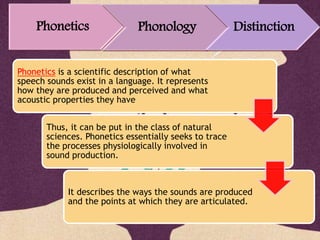
Phonetics is a scientific description of what
speech sounds exist in a language. It represents
how they are produced and perceived and what
acoustic properties they have
Thus, it can be put in the class of natural
sciences. Phonetics essentially seeks to trace
the processes physiologically involved in
sound production.
It describes the ways the sounds are produced
and the points at which they are articulated.
Phonetics Phonology Distinction
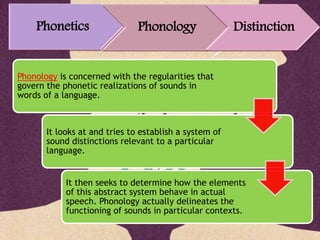
Phonology is concerned with the regularities that
govern the phonetic realizations of sounds in
words of a language.
It looks at and tries to establish a system of
sound distinctions relevant to a particular
language.
It then seeks to determine how the elements
of this abstract system behave in actual
speech. Phonology actually delineates the
functioning of sounds in particular contexts.
Phonetics Phonology Distinction
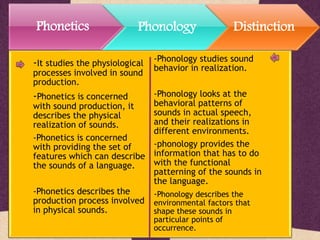
-It studies the physiological
processes involved in sound
production.
-Phonetics is concerned
with sound production, it
describes the physical
realization of sounds.
-Phonetics is concerned
with providing the set of
features which can describe
the sounds of a language.
-Phonetics describes the
production process involved
in physical sounds.
-Phonology studies sound
behavior in realization.
-Phonology looks at the
behavioral patterns of
sounds in actual speech,
and their realizations in
different environments.
-phonology provides the
information that has to do
with the functional
patterning of the sounds in
the language.
-Phonology describes the
environmental factors that
shape these sounds in
particular points of
occurrence.
• Branches of Phonetics
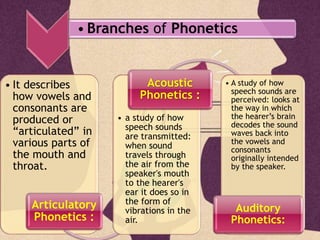
• It describes
how vowels and
consonants are
produced or
“articulated” in
various parts of
the mouth and
throat.
Articulatory
Phonetics :
• a study of how
speech sounds
are transmitted:
when sound
travels through
the air from the
speaker's mouth
to the hearer's
ear it does so in
the form of
vibrations in the
air.
Acoustic
Phonetics :
• A study of how
speech sounds are
perceived: looks at
the way in which
the hearer’s brain
decodes the sound
waves back into
the vowels and
consonants
originally intended
by the speaker.
Auditory
Phonetics:
• Branches of Phonetics
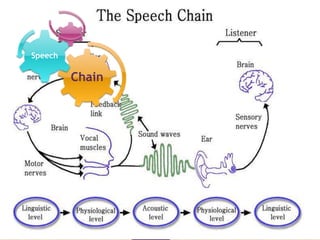
Linguistic
level
physiological
level
acoustic
level
Physiological
level
Linguistic
level
Chain
Speech
Chain
Speech
Speech
Organs
Speeach
Organs
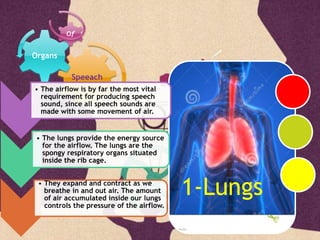
1-Lungs
• The airflow is by far the most vital
requirement for producing speech
sound, since all speech sounds are
made with some movement of air.
• The lungs provide the energy source
for the airflow. The lungs are the
spongy respiratory organs situated
inside the rib cage.
• They expand and contract as we
breathe in and out air. The amount
of air accumulated inside our lungs
controls the pressure of the airflow.
Speeach
Organs
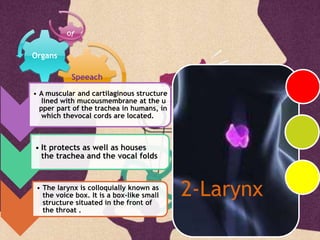
2-Larynx
• A muscular and cartilaginous structure
lined with mucousmembrane at the u
pper part of the trachea in humans, in
which thevocal cords are located.
• It protects as well as houses
the trachea and the vocal folds
• The larynx is colloquially known as
the voice box. It is a box-like small
structure situated in the front of
the throat .
Speech
Organs
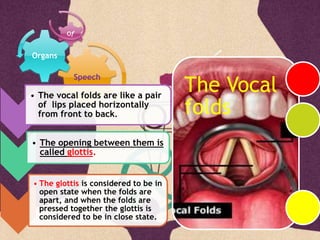
The Vocal
folds
• The vocal folds are like a pair
of lips placed horizontally
from front to back.
• The opening between them is
called glottis.
• The glottis is considered to be in
open state when the folds are
apart, and when the folds are
pressed together the glottis is
considered to be in close state.
The Vocal
folds
Speeach
Organs
Speeach
Organs
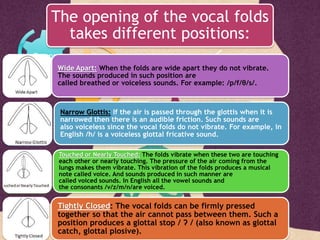
The opening of the vocal folds
takes different positions:
Wide Apart: When the folds are wide apart they do not vibrate.
The sounds produced in such position are
called breathed or voiceless sounds. For example: /p/f/θ/s/.
Narrow Glottis: If the air is passed through the glottis when it is
narrowed then there is an audible friction. Such sounds are
also voiceless since the vocal folds do not vibrate. For example, in
English /h/ is a voiceless glottal fricative sound.
Touched or Nearly Touched: The folds vibrate when these two are touching
each other or nearly touching. The pressure of the air coming from the
lungs makes them vibrate. This vibration of the folds produces a musical
note called voice. And sounds produced in such manner are
called voiced sounds. In English all the vowel sounds and
the consonants /v/z/m/n/are voiced.
Tightly Closed: The vocal folds can be firmly pressed
together so that the air cannot pass between them. Such a
position produces a glottal stop / ʔ / (also known as glottal
catch, glottal plosive).
Speeach
Organs
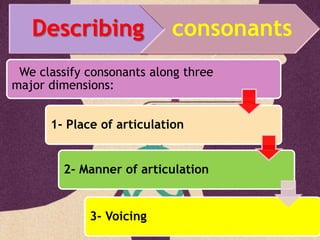
English Consonant Sounds
We classify consonants along three
major dimensions:
1- Place of articulation
2- Manner of articulation
3- Voicing
Describing consonants
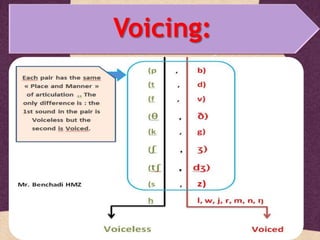
Voicing:
-Peter Roach, English Phonetics and
Phonology: A Practical Course, Cambridge
University Press, Fourth Edition.
Mike Davenport, Michael Davenport, S. J.
Hannahs,Introducing Phonetics and
Phonology
Philip Lieberman,Speech Physiology and
Acoustic Phonetics, Cambridge University
J.D .O'Connor, Cambridge University, Better
English Pronunciation
References
** Thank You **

Phonitics

  • 1.
  • 2.
    Linguistics is concerned with: 1-The structure oflanguage Phonetics Phonology Morphology Syntax Semantics Pragmatics 2-Other Perspectives On Language Historical Linguistics Sociolinguistics Psycholinguistics Dialectology Computational Linguistics Psycholinguistics and neurolinguistics
  • 3.
    Phonetics is ascientific description of what speech sounds exist in a language. It represents how they are produced and perceived and what acoustic properties they have Thus, it can be put in the class of natural sciences. Phonetics essentially seeks to trace the processes physiologically involved in sound production. It describes the ways the sounds are produced and the points at which they are articulated. Phonetics Phonology Distinction
  • 4.
    Phonology is concernedwith the regularities that govern the phonetic realizations of sounds in words of a language. It looks at and tries to establish a system of sound distinctions relevant to a particular language. It then seeks to determine how the elements of this abstract system behave in actual speech. Phonology actually delineates the functioning of sounds in particular contexts. Phonetics Phonology Distinction
  • 5.
    Phonetics Phonology Distinction -Itstudies the physiological processes involved in sound production. -Phonetics is concerned with sound production, it describes the physical realization of sounds. -Phonetics is concerned with providing the set of features which can describe the sounds of a language. -Phonetics describes the production process involved in physical sounds. -Phonology studies sound behavior in realization. -Phonology looks at the behavioral patterns of sounds in actual speech, and their realizations in different environments. -phonology provides the information that has to do with the functional patterning of the sounds in the language. -Phonology describes the environmental factors that shape these sounds in particular points of occurrence.
  • 6.
    • Branches ofPhonetics
  • 7.
    • It describes howvowels and consonants are produced or “articulated” in various parts of the mouth and throat. Articulatory Phonetics : • a study of how speech sounds are transmitted: when sound travels through the air from the speaker's mouth to the hearer's ear it does so in the form of vibrations in the air. Acoustic Phonetics : • A study of how speech sounds are perceived: looks at the way in which the hearer’s brain decodes the sound waves back into the vowels and consonants originally intended by the speaker. Auditory Phonetics: • Branches of Phonetics
  • 8.
  • 9.
  • 10.
  • 11.
    Speeach Organs 1-Lungs • The airflowis by far the most vital requirement for producing speech sound, since all speech sounds are made with some movement of air. • The lungs provide the energy source for the airflow. The lungs are the spongy respiratory organs situated inside the rib cage. • They expand and contract as we breathe in and out air. The amount of air accumulated inside our lungs controls the pressure of the airflow.
  • 12.
    Speeach Organs 2-Larynx • A muscularand cartilaginous structure lined with mucousmembrane at the u pper part of the trachea in humans, in which thevocal cords are located. • It protects as well as houses the trachea and the vocal folds • The larynx is colloquially known as the voice box. It is a box-like small structure situated in the front of the throat .
  • 13.
    Speech Organs The Vocal folds • Thevocal folds are like a pair of lips placed horizontally from front to back. • The opening between them is called glottis. • The glottis is considered to be in open state when the folds are apart, and when the folds are pressed together the glottis is considered to be in close state.
  • 14.
  • 15.
    Speeach Organs The opening ofthe vocal folds takes different positions: Wide Apart: When the folds are wide apart they do not vibrate. The sounds produced in such position are called breathed or voiceless sounds. For example: /p/f/θ/s/. Narrow Glottis: If the air is passed through the glottis when it is narrowed then there is an audible friction. Such sounds are also voiceless since the vocal folds do not vibrate. For example, in English /h/ is a voiceless glottal fricative sound. Touched or Nearly Touched: The folds vibrate when these two are touching each other or nearly touching. The pressure of the air coming from the lungs makes them vibrate. This vibration of the folds produces a musical note called voice. And sounds produced in such manner are called voiced sounds. In English all the vowel sounds and the consonants /v/z/m/n/are voiced. Tightly Closed: The vocal folds can be firmly pressed together so that the air cannot pass between them. Such a position produces a glottal stop / ʔ / (also known as glottal catch, glottal plosive).
  • 16.
  • 17.
  • 18.
    We classify consonantsalong three major dimensions: 1- Place of articulation 2- Manner of articulation 3- Voicing Describing consonants
  • 19.
  • 20.
  • 21.
    -Peter Roach, EnglishPhonetics and Phonology: A Practical Course, Cambridge University Press, Fourth Edition. Mike Davenport, Michael Davenport, S. J. Hannahs,Introducing Phonetics and Phonology Philip Lieberman,Speech Physiology and Acoustic Phonetics, Cambridge University J.D .O'Connor, Cambridge University, Better English Pronunciation References
  • 22.