PHONOLOGY
• What is the difference
between phonetics and
phonology?
• Phonetics relates to the sounds of
language, while phonology studies how
those sounds are put together to create
meaning.
PHONOLOGY
• phōnḗ - voice, sound
• Lógos - word, speech, subject of discussion
branch of linguistics concerned with the
systematic organization of sounds in
languages.
Goals of Phonology
1. To provide the complete phonemic inventory of a language.
2.To discover and formulate all the phonological processes and rules
of the language.
3. To ensure that the results of (1-2) are compatible with the results
of (1) for the same language as well as explaining, determining, and
having limited predictive powers about the phonetic description of
the language obtained in line with (1).
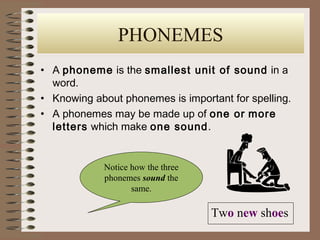
PHONEMES
• A phoneme is the smallest unit of sound in a
word.
• Knowing about phonemes is important for spelling.
• A phonemes may be made up of one or more
letters which make one sound.
Notice how the three
phonemes sound the
same.
Two new shoes
Examples
Here are examples of the phonemes /r/ and /l/
• rip
• lip
The phonemes /r/ and /l/ serve to
distinguish the word rip from the word lip.
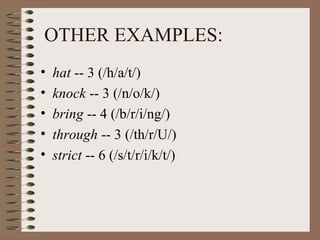
OTHER EXAMPLES:
• hat -- 3 (/h/a/t/)
• knock -- 3 (/n/o/k/)
• bring -- 4 (/b/r/i/ng/)
• through -- 3 (/th/r/U/)
• strict -- 6 (/s/t/r/i/k/t/)
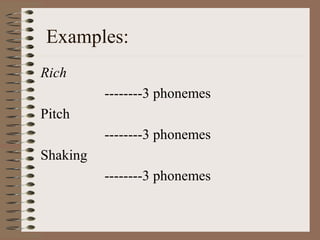
Examples:
Rich
--------3 phonemes
Pitch
--------3 phonemes
Shaking
--------3 phonemes
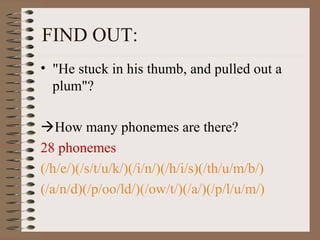
• "He stuck in his thumb, and pulled out a
plum"?
How many phonemes are there?
28 phonemes
(/h/e/)(/s/t/u/k/)(/i/n/)(/h/i/s)(/th/u/m/b/)
(/a/n/d)(/p/oo/ld/)(/ow/t/)(/a/)(/p/l/u/m/)
FIND OUT:
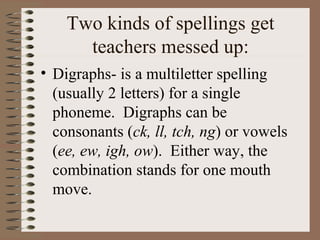
Two kinds of spellings get
teachers messed up:
• Digraphs- is a multiletter spelling
(usually 2 letters) for a single
phoneme. Digraphs can be
consonants (ck, ll, tch, ng) or vowels
(ee, ew, igh, ow). Either way, the
combination stands for one mouth
move.
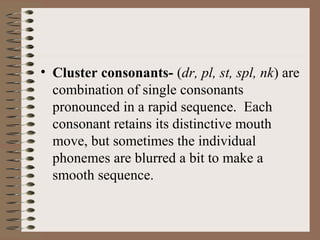
• Cluster consonants- (dr, pl, st, spl, nk) are
combination of single consonants
pronounced in a rapid sequence. Each
consonant retains its distinctive mouth
move, but sometimes the individual
phonemes are blurred a bit to make a
smooth sequence.
ALLOPHONES
• is one of a set of multiple possible
spoken sounds used to pronounce a
single phoneme.
• Examples (English) [p] and [pH] are
allophones of the phoneme /p/.
• [t] and [tH] are allophones of the phone
RULES OF
PRONUNCIATION
INTERNATIONAL
PHONETIC
ALPHABET
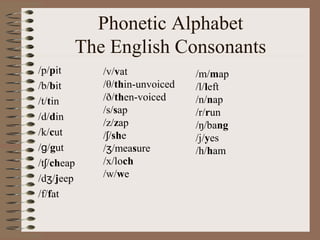
Phonetic Alphabet
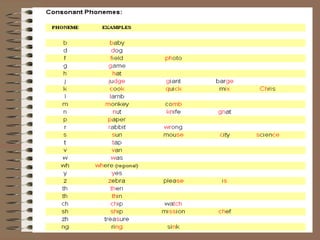
The English Consonants
/p/pit
/b/bit
/t/tin
/d/din
/k/cut
/ /ɡ gut
/t /ʃ cheap
/d /ʒ jeep
/f/fat
/v/vat
/θ/thin-unvoiced
/ð/then-voiced
/s/sap
/z/zap
/ /ʃ she
/ /meaʒ sure
/x/loch
/w/we
/m/map
/l/left
/n/nap
/r/run
/ŋ/bang
/j/yes
/h/ham
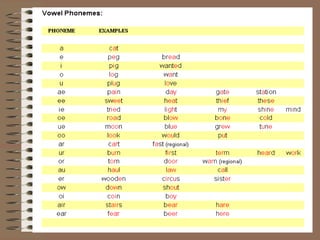
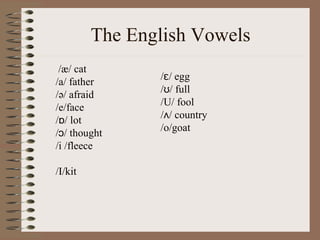
The English Vowels
/æ/ cat
/a/ father
/ə/ afraid
/e/face
/ / lotɒ
/ / thoughtɔ
/i /fleece
/I/kit
/ / eggɛ
/ / fullʊ
/U/ fool
/ / countryʌ
/o/goat
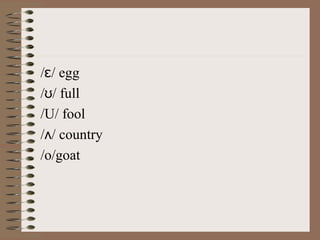
/ / eggɛ
/ / fullʊ
/U/ fool
/ / countryʌ
/o/goat
Transcription:
Ex.
Attend – [ə t n d ]ɛ
Word Stress
• is the relative emphasis that may be given
to certain syllables in a word, or to certain
words in a phrase or sentence.
Education is the most powerful weapon
which you can use to change the world.
-Nelson Mandela
Quiz
• Test I.
1. It is a branch of linguistics concerned with the
systematic organization of sounds in languages.
2. It is the smallest unit of sound in a word.
3. It is one of a set of multiple possible spoken
sounds used to pronounce a single phoneme.
4. It is the relative emphasis that may be given to
certain syllables in a word, or to certain words in
a phrase or sentence.
• Test II
• Count the Phonemes
1.Food
2. Chair
3. Table
4. Computer
• Test III
Transcribe the following.
1.Hammer
2.Father
3.Sick
4.Toss
• Test IV
• Indentify the word stress of the following.
1.Debris
2.Object (verb)
3.Present (noun)

Phonology

  • 1.
  • 2.
    • What isthe difference between phonetics and phonology?
  • 3.
    • Phonetics relatesto the sounds of language, while phonology studies how those sounds are put together to create meaning.
  • 4.
    PHONOLOGY • phōnḗ -voice, sound • Lógos - word, speech, subject of discussion branch of linguistics concerned with the systematic organization of sounds in languages.
  • 5.
    Goals of Phonology 1.To provide the complete phonemic inventory of a language. 2.To discover and formulate all the phonological processes and rules of the language. 3. To ensure that the results of (1-2) are compatible with the results of (1) for the same language as well as explaining, determining, and having limited predictive powers about the phonetic description of the language obtained in line with (1).
  • 6.
    PHONEMES • A phonemeis the smallest unit of sound in a word. • Knowing about phonemes is important for spelling. • A phonemes may be made up of one or more letters which make one sound. Notice how the three phonemes sound the same. Two new shoes
  • 9.
    Examples Here are examplesof the phonemes /r/ and /l/ • rip • lip The phonemes /r/ and /l/ serve to distinguish the word rip from the word lip.
  • 10.
    OTHER EXAMPLES: • hat-- 3 (/h/a/t/) • knock -- 3 (/n/o/k/) • bring -- 4 (/b/r/i/ng/) • through -- 3 (/th/r/U/) • strict -- 6 (/s/t/r/i/k/t/)
  • 11.
  • 12.
    • "He stuckin his thumb, and pulled out a plum"? How many phonemes are there? 28 phonemes (/h/e/)(/s/t/u/k/)(/i/n/)(/h/i/s)(/th/u/m/b/) (/a/n/d)(/p/oo/ld/)(/ow/t/)(/a/)(/p/l/u/m/) FIND OUT:
  • 13.
    Two kinds ofspellings get teachers messed up: • Digraphs- is a multiletter spelling (usually 2 letters) for a single phoneme. Digraphs can be consonants (ck, ll, tch, ng) or vowels (ee, ew, igh, ow). Either way, the combination stands for one mouth move.
  • 14.
    • Cluster consonants-(dr, pl, st, spl, nk) are combination of single consonants pronounced in a rapid sequence. Each consonant retains its distinctive mouth move, but sometimes the individual phonemes are blurred a bit to make a smooth sequence.
  • 15.
    ALLOPHONES • is oneof a set of multiple possible spoken sounds used to pronounce a single phoneme.
  • 16.
    • Examples (English)[p] and [pH] are allophones of the phoneme /p/. • [t] and [tH] are allophones of the phone
  • 17.
  • 19.
  • 20.
    Phonetic Alphabet The EnglishConsonants /p/pit /b/bit /t/tin /d/din /k/cut / /ɡ gut /t /ʃ cheap /d /ʒ jeep /f/fat /v/vat /θ/thin-unvoiced /ð/then-voiced /s/sap /z/zap / /ʃ she / /meaʒ sure /x/loch /w/we /m/map /l/left /n/nap /r/run /ŋ/bang /j/yes /h/ham
  • 21.
    The English Vowels /æ/cat /a/ father /ə/ afraid /e/face / / lotɒ / / thoughtɔ /i /fleece /I/kit / / eggɛ / / fullʊ /U/ fool / / countryʌ /o/goat
  • 22.
    / / eggɛ // fullʊ /U/ fool / / countryʌ /o/goat
  • 23.
  • 24.
    Word Stress • isthe relative emphasis that may be given to certain syllables in a word, or to certain words in a phrase or sentence.
  • 25.
    Education is themost powerful weapon which you can use to change the world. -Nelson Mandela
  • 26.
    Quiz • Test I. 1.It is a branch of linguistics concerned with the systematic organization of sounds in languages. 2. It is the smallest unit of sound in a word. 3. It is one of a set of multiple possible spoken sounds used to pronounce a single phoneme. 4. It is the relative emphasis that may be given to certain syllables in a word, or to certain words in a phrase or sentence.
  • 27.
    • Test II •Count the Phonemes 1.Food 2. Chair 3. Table 4. Computer
  • 28.
    • Test III Transcribethe following. 1.Hammer 2.Father 3.Sick 4.Toss
  • 29.
    • Test IV •Indentify the word stress of the following. 1.Debris 2.Object (verb) 3.Present (noun)