International Journal of Sciences:
Basic and Applied Research
(IJSBAR)
ISSN 2307-4531
(Print & Online)
http://gssrr.org/index.php?journal=JournalOfBasicAndApplied
---------------------------------------------------------------------------------------------------------------------------
85
Metafunctional Shifts in the Translation of Student and
Professional Translators
Rusdi Noor Rosaa
*, T. Silvana Sinarb
, Zubaidah Ibrahim-Bellc
, Eddy Setiad
a,b,c,d
Linguistics Department, University of Sumatera Utara, Medan 20155, Indonesia
a
Email: rusdinoorrosa@yahoo.com, b
Email: tengkusilvana@usu.ac.id
c
Email: zubaidahbell@gmail.com, d
Email: eddy12457@yahoo.com
Abstract
The involvement of linguistics theories in translation studies in the recent years that becomes more and more
obvious since they can replace the intuition of the translator to solve their translation problem provides an
opportunity to explore the best translation practice. One of linguistics theories concerning with the translation
practice is systemic functional linguistics (SFL) which views grammar as a resource for making meaning. This
research focused on analyzing the translation product using an SFL metafunction theory involving student and
professional translators. In particular, this research aimed at finding out how the student translators and
professional translators shift transitivity, mood, and theme elements in the translation process. This research was
a qualitative research using a content analysis method. The participants of this research were 5 student
translators and 5 professional translators who were asked to translate two history texts composing of around
240-word long from English into Bahasa Indonesia. The readability of the source texts was measured with the
help of SMOG readability formula. The data were collected using Translog and retrospective questionnaire.
Based on the data analysis, it was found that (i) the professional translators did metafunctional shifts more
frequently than did the student translators; and (ii) the shifts done by the professional translators paid attention
to how the meaning is kept (inter-strata shifts), while the student translators concerned with the form of the
shifts (intra-strata shifts).
Keywords: metafunctional shift; professional translators; student translators; translation product.
-----------------------------------------------------------------------
* Corresponding author.
International Journal of Sciences: Basic and Applied Research (IJSBAR) (2017) Volume 35, No 2, pp 85-101
86
1. Introduction
In this high-technology era, the role of translation, undoubtedly, becomes higher and higher. People are
encountered with various kinds of texts written in different languages depending on which country or region the
information contained in the text comes from. Accurate translation is extremely needed as any single mistake in
translating texts results in different understanding and interpretation by target language readers. In addition, it is
obviously easy to understand the text written in a native language rather than in a foreign language. Based on
the researcher’s personal communication with Basil Hatim in 2015 [6], a professor in Arabic and Translation
Studies, reading in native language text provides the readers opportunity to grasp better information from the
text. Therefore, he suggested that, whenever possible, all of texts, particularly scientific texts, written in foreign
language should be translated into a native language.
However, translation is not an easy job because of, at least, two factors. The first factor is related to a translation
process that the translator must go through. Every translator experiences the so-called translation phases – pre-
drafting, drafting, and post-drafting – to yield a translation product. A translation process influences the result or
the product of translation; therefore, a well-managed translation process can be an indicator of a good translation
product. Different translators may go through different process depending on which process they feel more
comfortable in doing their task.
The second factor is related to a translation product. Translation is not merely a word-by-word transfer from a
source language (SL) to a target language (TL); rather, it involves a transfer of all aspects of the SL to the TL.
As [1: 2] points out that translation is a complex dichotomous and cumulative process that involves a host of
activities drawing upon other disciplines related to language, writing, linguistics and culture. This implies that a
translator must have good competence in both SL and TL. Competence here should be seen as a competence in
linguistic and cultural aspects in both languages.
Every language has different written language characteristics either in terms of text types, structures, and
lexicogrammatical features. The main problem of a translation product can be seen from the interference of the
SL to the TL. Sometimes, the target text (TT) follows the structure of a certain text type of the source text (ST).
This will lead to a serious problem to the target language because text type is related to cultural context, and it is
impossible that a TL culture is completely similar to an SL culture. For example, when translating English
exposition text into Bahasa Indonesia, some translators tend to follow the structure of English exposition text in
the TT. This will lead to a serious problem as Bahasa Indonesia will lose its identity as an independent language
that has its own structure determined through its culture. English has affected the structure of Bahasa Indonesia
because of translation problem. For example, the word ‘terdiri’ (consist), according to Pedoman Umum Ejaan
Bahasa Indonesia yang Disempurnakan (the General Guidelines of Enhanced Indonesian Spelling), must
collocate the preposition ‘atas’ (on) [35: 81]. However, in many text books, nowadays, it can be seen that the
word collocates the preposition ‘dari’ (of), which is the effect of the interference of English collocation in
translation.
Undoubtedly, as translation is a branch of applied linguistics [7], every translator should have good linguistics
International Journal of Sciences: Basic and Applied Research (IJSBAR) (2017) Volume 35, No 2, pp 85-101
87
knowledge because translation is not only a matter of vocabulary, grammar also plays a large and important role
[31: 36]; [10: 88]. The involvement of linguistics theories in translation studies in the recent years that becomes
more and more obvious since they can replace the intuition of the translator to solve their translation problem
provides an opportunity to explore the best translation practice. One of linguistics theories concerning with the
meaning is systemic functional linguistics (SFL) which views grammar as a resource for making meaning. As
Hatim [6: 10] argues that SFL can be considered a viable and valid contribution to a textual practice like that of
translation, whose products are “meaningful records of communicative events”. In addition, SFL examines what
people actually ‘do’ with language with reference to what they ‘could’ do, in terms of choices among systems
[21: 40].
Using linguistics knowledge, particularly an SFL theory, in translation is, perhaps, one of the factors
distinguishing professional translators from student translators, but this is not the only difference between them.
Previous studies have been conducted on the different characters between student translators and professional
translators in translation process (cf. [29]; [30]; [39]; [3]). Most of their works focused on the difference
between operational pauses taken by student and professional translators in several phases of translation process.
Only did [29] focus on both translation process and product. They used a quantitative to measure the correlation
between the translation process and the quality of the translation product produced by the student and
professional translators. This research, on the other hand, used a qualitative method focusing on analyzing the
translation product using an SFL metafunction theory involving student and professional translators.
2. Review of Related Literature
2.1 Translation Studies and SFL Theory
The term ‘translation studies’ was coined by the scholar J.S. Holmes, an Amsterdam-based lecturer and literary
translator, in his well-known paper, “The Name and Nature of Translation Studies”, originally presented in 1972
to the translation section of the Third International Congress of Applied Linguistics in Copenhagen, but
published and widely read only as of 1988. As [27] points out, although initially focusing on literary translation,
TS is now understood to refer to the academic discipline concerned with the study of translation at large,
including literary and nonliterary translation [27: 277]. In addition, [33] affirmed that at the end of the Eighties,
TS had included the whole spectrum of language, whether literary, ‘ordinary’ or ‘general language’, or
‘language for special purposes’ [33: 3].
In its development, according to [6] and [32], there is an interconnection between theory and practice because
the practice of translation without a theoretical background tends toward a purely subjective exercise, and a
theory of translation without a link to practice is simply an abstraction. This is one of Halliday’s main
contributions to linguistics, i.e. his desire to build bridges between linguistic theory and professional practice as
(quoted from [11: 347]). When dealing with translation, it is firmly believed that such need is even stronger, and
proficiency in two languages, the SL and the TL, is obviously not sufficient to become a competent translator.
Many people have proficiency in two languages, but they are not certainly able to translate well.
International Journal of Sciences: Basic and Applied Research (IJSBAR) (2017) Volume 35, No 2, pp 85-101
88
Responding to Halliday’s idea of translation as both theory and profession, [12: 3] collected opinions from
layman who described the connection between academic translation and professional translation like chalk and
cheese. A chalk is used to describe that translation is “not real work” because translating simply means changing
the words and sentences from one language into another, while a cheese describes that translations are clearly
outrageously overpriced. He partly agreed with such opinion when translations are done by incompetence or
non-professional translators who might know nothing about the subject. However, in the professional practice of
translations, competent translators should have good knowledge on the subject being translated, and this is not
cheap. In addition, they have to plan the translation time into the work schedule, find the references, and solve
any complexity and difficulty encountered in the whole process of translating; again, this is not cheap.
To sum up, since translation emerged as the academic discipline, known as translation studies, it has attracted
the scholars to make it scientific through researches, journal articles, and books. Even in its development,
translation studies have come into a professional area, the combination of linguistic theory and professional
practice. As a profession, translation should be done based on a certain theory as a replacement of the
translator’s intuition.
2.2 SFL Language Metafunctions
As mentioned earlier, SFL, as one of the linguistics theories concerning with meaning, perceives meaning as the
fundamental component of language when he observes that all languages are organized around two main kinds
of meaning, the ‘ideational’ or reflective, and the ‘interpersonal’ or active [23: xiii]. He further adds one more
kind of meaning, i.e. ‘textual’ meaning. These three kinds of meaning are called language metafunctions. The
first type of meaning, according to Halliday, is intended “to understand the environment” of language use, the
second type is intended “to act on the others in it”, while the third type is intended “to effectively organized a
clause” [23].
2.2.1 Ideational Metafunction
[25: 30] use the term construing experience to describe ideational metafunction because the ideational
metafunction construes the world of phenomena, with an emphasis on the ‘constructional’ aspect of this
interpretive activity, i.e. the creation of structure in the flux of experience. Ideational metafunction in a clause is
realized in a transitivity system. Transitivity is a major component in experiential function of the clause dealing
with the transmission of ideas, representing processes or experiences including actions, events, processes of
consciousness and relations [22: 53]. By examining the transitivity patterns in text, we can explain how the field
of situation is being constructed, i.e. we can describe what is being talked about and how shifts are achieved in
the field [26: 203].
Every text, including translated text, certainly contains ideational meaning realized through transitivity
elements: process, participant, and circumstance. Process is central to transitivity [18: 54] without which there
will never be a clause. Process refers to a semantic verb (doing, happening, feeling, sensing, saying, behaving,
and existing) and anything that it expresses like event, relation, physical, mental or emotional state [20: 159].
International Journal of Sciences: Basic and Applied Research (IJSBAR) (2017) Volume 35, No 2, pp 85-101
89
When sorted in the semantic system of the clause, processes are classified into material, relational, mental,
verbal, behavioral, and existential processes [18: 54]. Each of the processes takes its own unique set of
participants depending on the type of process. The other transitivity element, circumstance, can be divided into 7
broad categories. Circumstance answers such questions as ‘when’, ‘where’, ‘why’, ‘how’, etc. Circumstances
include a circumstance of time, place, manner, cause, accompaniment, matter, and role [18: 52-53).
2.2.2 Interpersonal Metafunction
Interpersonal metafunction is the interactional mode of language representing speaker-and addressee-oriented
meanings [24: 175]. It includes speaker assessment as well as meanings oriented towards regulating the
behavior of the addressee and his/her role in the communicative situation. Interpersonal metafunction sees
language as “a resource for enacting roles and relations between speaker and addressees as meaning” [9: 126].
Interpersonal metafunction in a clause realized in a mood system which is composed of two elements: mood and
residue. Mood is composed of subject and finite. The ‘subject’ is the element in terms of which the clause can
be negotiated, while the ‘finite’ makes a clause negotiable by coding it as positive or negative in polarity and by
grounding it, either in terms of time or in terms of modality [17: 61]. In addition to subject and finite, a mood
may also be composed of a modal adjunct which adds meaning related to the mood element including polarity
and modality, temporality and intensity. Meanwhile, the rest of the clause in interpersonal metafunction belongs
to a residue which is composed of a predicator and/or a complement and/or an adjunct.
2.2.3 Textual Metafunction
A primary concern of textual metafunction is the formation of text, i.e. the linking together of what would
otherwise be disjointed ‘chunks’ of meaning into a cohesive flow [24: 175]. Textual metafunction in a clause is
realized in theme and rheme; in other words, theme and rheme are the realizations of how our experiential,
logical, and interpersonal meanings are organized. Different organization of ideas in a clause influences its
thematic meaning. The clauses “John climbed the mountain” and “The mountain was climbed by John”, for
example, show similar experiential and interpersonal meanings; that is, both show that “John” is the actor, the
action process is “climb”, and “mountain” is a goal; however they have different thematic meaning as they
demonstrate different order of the constituents in the clause: “John” and “mountain”. The example suggests that
the position of the constituents contributes to different focus of the clause.
There are only two positions of constituents recognized in a clause: the first part and the last part. The first part
of a clause is known as theme. Halliday [22: 39] says that theme is the starting point for the message that
informs what the clause is going to be about. In addition, [17: 21-22] define theme as the point of departure of
clause as message which possesses the initial position in the clause. The definition suggests that the first part of
the clause has the most influential factor to the rest of the message in a clause. Putting the same word in
different position of a clause influences the way the readers comprehend the message in the clause.
Meanwhile, the last part of a clause is called rheme. [38: 275] says that rheme is the part of the clause in which
the theme is developed. Furthermore, [17: 21-22] categorized rheme as the elements of clause that follows the
International Journal of Sciences: Basic and Applied Research (IJSBAR) (2017) Volume 35, No 2, pp 85-101
90
theme where the presentation moves after the point of departure. Once the theme of a clause is identified, the
rheme can be easily recognized. The rheme contains the information that controls the development of the theme.
2.3 Metafunctional Shift in Translation
Etymologically, ‘shift’ means ‘change’ or ‘turn’. In the context of translation, shift can be understood as
changes occurring in a translation process that may involve lexicon, structure, or style changes. An actual
definition of shift in translation is proposed by Catford [16: 73] who defines translation shifts as departures from
formal correspondence in the process of going from the source language (SL) to the target language (TL). In
other words, translation shift occurs if a translational equivalent is not a formal correspondent, a term referring
to a source oriented translation [13;16]. In this research, the shifts are seen from an SFL point of view. [8: 106-
110] puts translation shifts into four classifications: (i) shifts may either take place either in the grammatical
zone or in the lexical zone, or it may take place along the cline, which therefore constitutes a shift in delicacy.
Shifts in delicacy are relevant primarily in the lexical zone of the cline [2: 136]; (ii) shifts may either be intra-
metafunctional (ST and TT item belong to the same metafunction) or inter-metafunctional, i.e. involving a shift
from one metafunction to another; (iii) shifts may occur along the paradigmatic axis (intra-systemic shifts) or
along the syntagmatic axis; and (iv) shifts may be confined to the same rank (intra-rank shifts) or constitute a
movement between ranks (inter-rank shifts). Among the four classifications of shifts proposed by [8], this
research focused its analysis on metafunctional shifts.
3. Methodology
This research was a qualitative research using a content analysis method to deeply study the metafunctional
shifts in the translated texts. The participants of this research were student translators (hereinafter called student)
and professional translators (hereinafter called professional). 5 students of Master Degree Program of
Linguistics Department majoring translation studies at the University of Sumatera Utara and 5 professional
translators with more than five years professional experience on translation were taken as the participant of this
research. The participants were asked to translate two texts from English into Bahasa Indonesia. The texts
translated were history texts composed of around 240-word long. The source texts were entitled ‘Early History
of Yellowstone National Park’ downloaded from http://www.nezperce.com/yelpark9.html and ‘The Palace of
Westminster’ downloaded from http://www.famous-historic-buildings.org.uk/united_kingdom_25.html. In order
to confirm its readability, the source texts were measured with the help of SMOG readability formula. Based on
the formula, the first text had the following scores: (i) Flesch Reading Ease score was 49.4; (ii) Flesch-Kincaid
Grade Level was 10.9; (iii) the Coleman-Liau Index was 13; and (iv) the SMOG Index was 11.4. Meanwhile,
the readability of the second text was: (i) Flesch Reading Ease score was 47.6; (ii) Flesch-Kincaid Grade Level
was 10.6; (iii) the Coleman-Liau Index was 12; and (iv) the SMOG Index was 11.3. The data were collected
using Translog and retrospective questionnaire.
4. Findings and Discussions
Based on the data analysis, it was found that professionals did metafunctional shifts much more frequently than
International Journal of Sciences: Basic and Applied Research (IJSBAR) (2017) Volume 35, No 2, pp 85-101
91
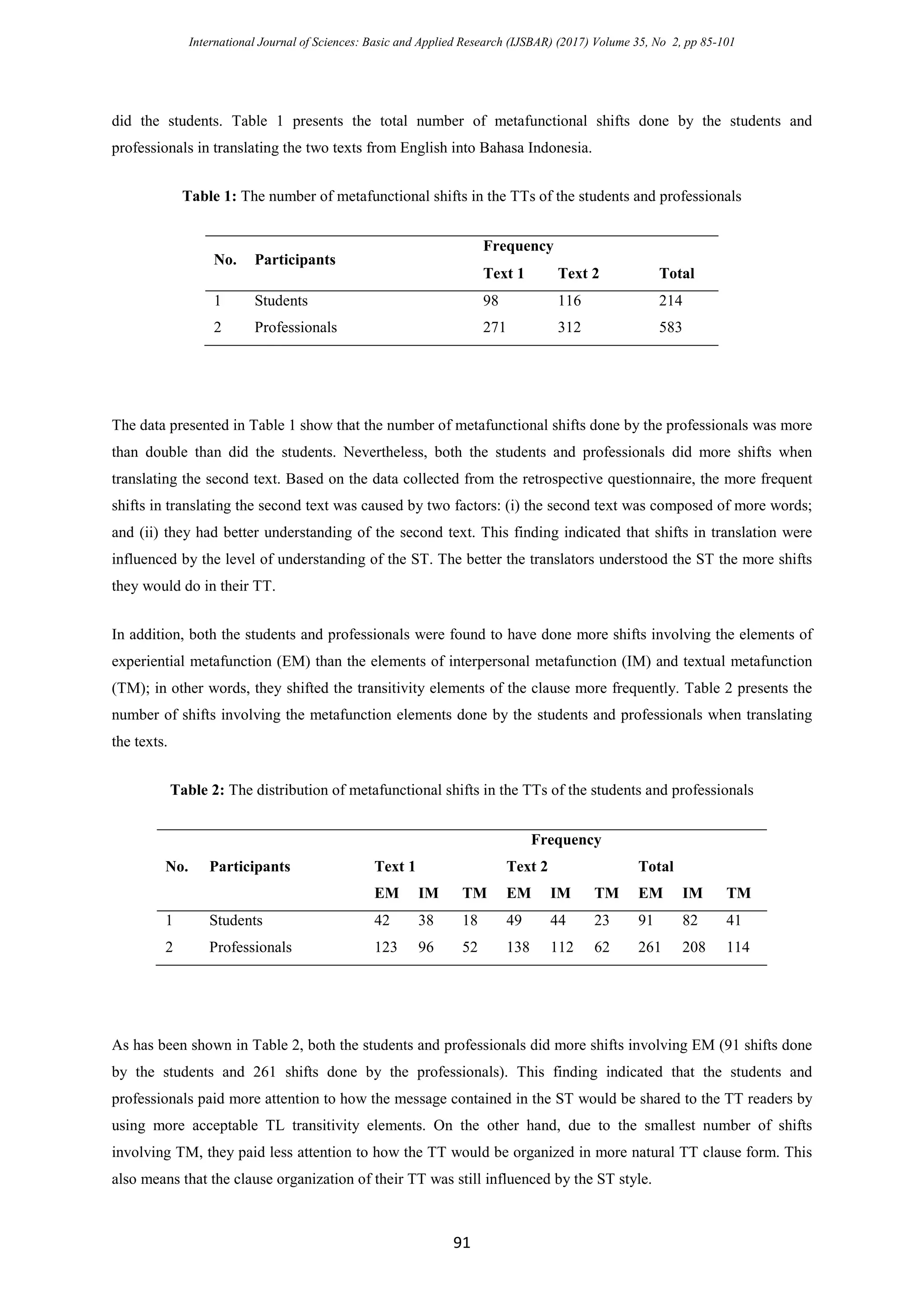
did the students. Table 1 presents the total number of metafunctional shifts done by the students and
professionals in translating the two texts from English into Bahasa Indonesia.
Table 1: The number of metafunctional shifts in the TTs of the students and professionals
No. Participants
Frequency
Text 1 Text 2 Total
1 Students 98 116 214
2 Professionals 271 312 583
The data presented in Table 1 show that the number of metafunctional shifts done by the professionals was more
than double than did the students. Nevertheless, both the students and professionals did more shifts when
translating the second text. Based on the data collected from the retrospective questionnaire, the more frequent
shifts in translating the second text was caused by two factors: (i) the second text was composed of more words;
and (ii) they had better understanding of the second text. This finding indicated that shifts in translation were
influenced by the level of understanding of the ST. The better the translators understood the ST the more shifts
they would do in their TT.
In addition, both the students and professionals were found to have done more shifts involving the elements of
experiential metafunction (EM) than the elements of interpersonal metafunction (IM) and textual metafunction
(TM); in other words, they shifted the transitivity elements of the clause more frequently. Table 2 presents the
number of shifts involving the metafunction elements done by the students and professionals when translating
the texts.
Table 2: The distribution of metafunctional shifts in the TTs of the students and professionals
No. Participants
Frequency
Text 1 Text 2 Total
EM IM TM EM IM TM EM IM TM
1 Students 42 38 18 49 44 23 91 82 41
2 Professionals 123 96 52 138 112 62 261 208 114
As has been shown in Table 2, both the students and professionals did more shifts involving EM (91 shifts done
by the students and 261 shifts done by the professionals). This finding indicated that the students and
professionals paid more attention to how the message contained in the ST would be shared to the TT readers by
using more acceptable TL transitivity elements. On the other hand, due to the smallest number of shifts
involving TM, they paid less attention to how the TT would be organized in more natural TT clause form. This
also means that the clause organization of their TT was still influenced by the ST style.
International Journal of Sciences: Basic and Applied Research (IJSBAR) (2017) Volume 35, No 2, pp 85-101
92
Referring to the data displayed in Table 2, the average number of shifts involving the elements of each of
language metafunctions done by the students and professionals is summarized in Figure 1.
Figure 1: The average number of shifts done by the students and professionals
The data presented in Figure 1 show that the students did shifts involving EM on the average of 9 times in each
of the texts, and did shifts involving IM and TM 8 times and 4 times respectively. Meanwhile, the professionals
did metafunctional shifts much more frequently. On average, they did 26 times of shifts involving EM, 21 times
involving IM, and 11 times involving TM in each of the TTs. The frequent metafunctional shifts done by the
professionals indicate their reluctance to follow or imitate the language style and structure of the ST. In addition,
the frequent shifts can also serve as the indicator of naturalness of the TT; in other words, the professionals try
to make their TT as natural as possible. This finding supports Catford [16] who argues that shifts in translation
process show translator’s awareness in finding the necessity of deviating from the source language form. This
idea also suggests that a good translation should have its own style, showing its independence over the ST style.
Furthermore, as has been shown in Figure 1, from the total number of shifts involving IM done by the students
and professionals, it was found that the students did 9 types of shifts, while the professionals did 12 types of
shifts. The shifts involving IM done by the students include shifts (i) from a process to another process; (ii) from
a process to a participant; (iii) from a circumstance to a participant; (iv) from a clause to a participant; (v) from a
first participant to a second participant; (vi) from a participant to a circumstance; (vii) from a participant to a
clause; (viii) from a participant to a process; and (ix) from a circumstance to an embedded clause. Meanwhile,
the professionals did shifts involving IM in terms of shifts: (i) from a process to another process; (ii) from a
circumstance to a participant; (iii) from a circumstance to a clause; (iv) from a clause to a circumstance; (v)
from a clause to a participant; (vi) from a participant to a circumstance; (vii) from a second participant to a first
participant; (viii) from a third participant to a second participant; (ix) from a process to a participant; (x) from a
participant to a process; (xi) from a circumstance to a process; and (xii) from a process to a circumstance. This
finding indicates that all of the transitivity elements (process, participant, circumstance) might shift one another
in the TT; none of the transitivity elements was unchangeable. Of the total number of types of shifts involving
IM, it was found that a shift from a process to another process was the type of shift most frequently done by
0
5
10
15
20
25
30
EM
IM
TM
9
8
4
26
21
11
Students Professionals
International Journal of Sciences: Basic and Applied Research (IJSBAR) (2017) Volume 35, No 2, pp 85-101
93
both the students and professionals. This happened because a process is a central of a clause without which there
will never be a clause. As [18: 54] argue that process is central to transitivity.
Besides, this research also found that material process dominated the type of process used by both the students
and professionals in their TTs. The frequency and the type of process used by the students and professionals in
their TTs are presented in Figure 2.
Figure 2: The type of process used in the students and professionals’ TTs
The finding presented in Figure 2 reveals that one of the characteristics of Indonesian history text is the frequent
use of material process. This is in line with the nature of history text itself as it belongs to a recount text whose
social function is to retell something that happened in the past and to tell a series of past event [5: 14]; [18: 120];
[34: 224]. A material process is a process of doing and happening which is in line with the social function of a
recount text.
In terms of shifts involving IM, this research found 11 types of shifts done by the students and 15 types of shifts
done by the professionals. The shifts involving IM done by the students include shifts: (i) from an adjunct to a
complement; (ii) from a clause to a subject; (iii) from a complement to a subject; (iv) from a predicator to a
subject; (v) from a subject to a clause; (vi) from a subject to a predicator; (vii) from a subject to an adjunct; (viii)
from a finite to an adjunct; (ix) from a finite to an adjunct; (x) from a complement to a predicator; and (xi) from
a predicator to a complement. Meanwhile, the professionals did shifts involving IM in term of shifts: (i) from an
adjunct to a complement; (ii) from a clause to an adjunct; (iii) from a clause to a subject; (iv) from a subject to
an adjunct; (v) from a complement to a subject; (vi) from a predicator to a subject; (vii) from a finite to another
finite; (viii) from a finite to a mood adjunct; (ix) from a complement to a predicator; (x) from a complement to
an adjunct; (xi) from a complement to a mood adjunct; (xii) from an adjunct to a predicator; (xiii) from a
predicator to a complement; (xiv) from a predicator to an adjunct; and (xv) from an adjunct to a subject. This
finding indicates that all of the mood and residue elements might shift one another in the TT.
In addition, in their TTs, it was found that in Bahasa Indonesia, circumstance of time (e.g. ‘sekarang’, ‘dahulu’,
‘nantinya’, etc.) can serve as a secondary tense marker which, therefore, is included in the mood element. In
0
20
40
60
80
100
120
43
105
18
0 0 0 7 5
International Journal of Sciences: Basic and Applied Research (IJSBAR) (2017) Volume 35, No 2, pp 85-101
94
Bahasa Indonesia, a primary tense is integrated to the process of the clause for the absence of Indonesian
explicit primary tense marker. As circumstance of time belongs to adjunct according to interpersonal
metafunction theory, it can be categorized as mood adjunct.
This finding adds the elements of mood adjunct that have been mentioned by [38,25] who categorized the
elements of mood adjunct into six: probability, usuality, obligation, obviousness, intensity, and polarity.
Furthermore, it was also found that the students focused on doing shifts involving IM at the level of words; in
other words, they focused on forms because most of the shifts involving IM focused on shifting the mood and
residue elements. They almost paid no attention to shifts in the clause structure, i.e. shifting the clause mood
system. Only once did they shifted the clause mood system, i.e. the shift from a modality to a primary tense. The
clause in (1b) is an example of the TT clause containing the shift from a modality to a primary tense done by the
student.
Table (1a)
The widely-used trail would become known as the Bannock Trail.
Subject Finite Predicator Complement
Mood Residue
Table (1b)
Jalan luas yang dilintasi tersebut dikenal kemudian sebagai Bannock Trail.
Subject Finite Predicator Adjunct Complement
Mood Residue
The ST clause in (1a) used modality expression represented by the modal ‘would’. However, the TT clause in
(1b) did not contain any modality meaning because the finite operator was a primary tense. The student shifted
the ST modality meaning to the TT adjunct ‘kemudian’ indicating sequence of process. From the interpersonal
metafunction point of view, this shift did affect the meaning of the message exchanged. Modality contained the
meaning beyond the meaning carried out by a primary tense; therefore, deleting it would reduce the original
message contained in the ST.
Meanwhile, in addition to shifts in mood and residue elements, the professionals also shifted the clause mood
system frequently which was grouped into 4 types: (i) from a modality to a secondary tense; (ii) the shifts from a
primary tense to a modality; (iii) from a primary tense to a secondary tense; and (iv) from a positive polarity to a
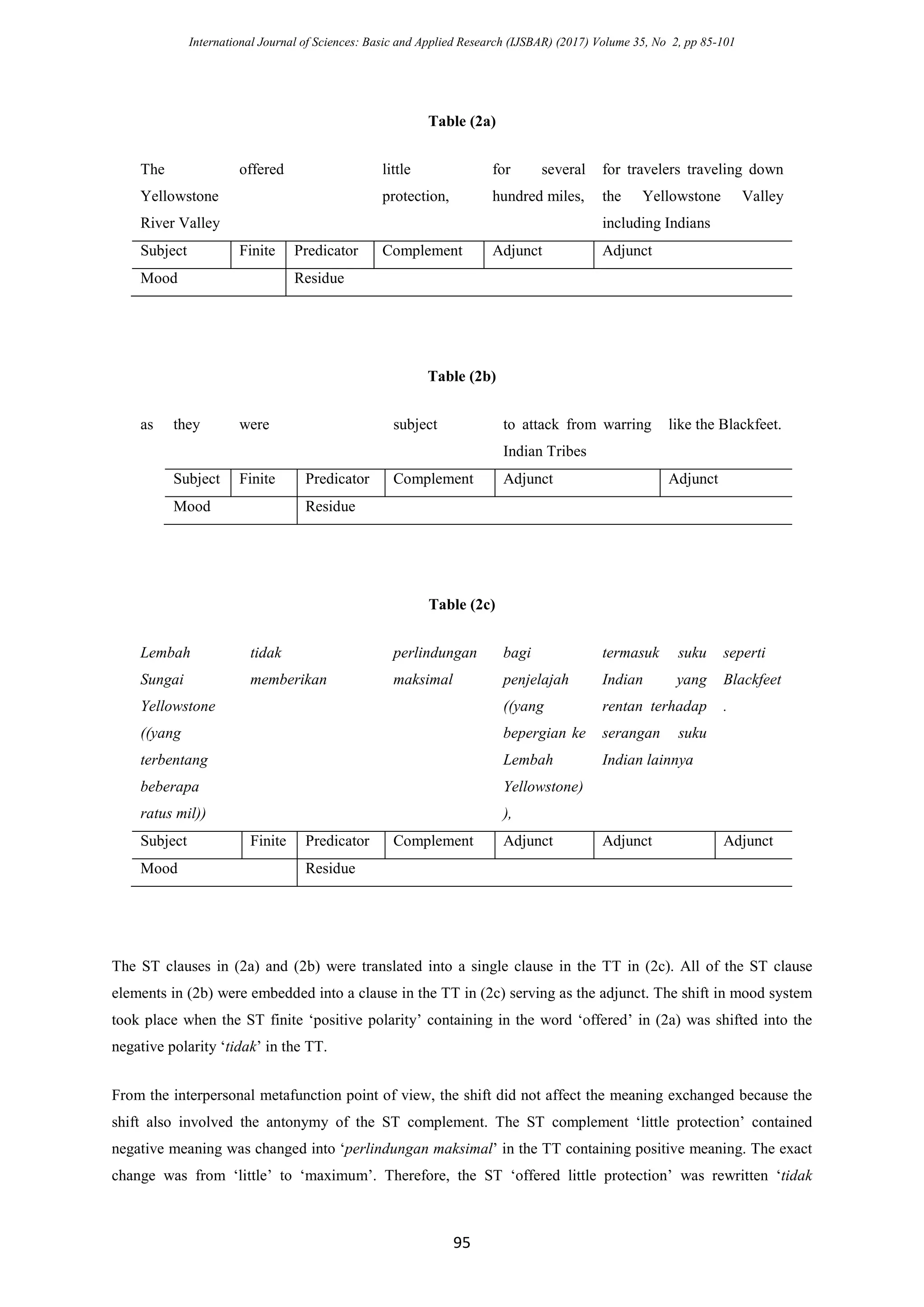
negative polarity. The clause in (2c) is an example of the TT clause containing the shift from a primary tense to
a modality done by the professional.
International Journal of Sciences: Basic and Applied Research (IJSBAR) (2017) Volume 35, No 2, pp 85-101
95
Table (2a)
The
Yellowstone
River Valley
offered little
protection,
for several
hundred miles,
for travelers traveling down
the Yellowstone Valley
including Indians
Subject Finite Predicator Complement Adjunct Adjunct
Mood Residue
Table (2b)
as they were subject to attack from warring
Indian Tribes
like the Blackfeet.
Subject Finite Predicator Complement Adjunct Adjunct
Mood Residue
Table (2c)
Lembah
Sungai
Yellowstone
((yang
terbentang
beberapa
ratus mil))
tidak
memberikan
perlindungan
maksimal
bagi
penjelajah
((yang
bepergian ke
Lembah
Yellowstone)
),
termasuk suku
Indian yang
rentan terhadap
serangan suku
Indian lainnya
seperti
Blackfeet
.
Subject Finite Predicator Complement Adjunct Adjunct Adjunct
Mood Residue
The ST clauses in (2a) and (2b) were translated into a single clause in the TT in (2c). All of the ST clause
elements in (2b) were embedded into a clause in the TT in (2c) serving as the adjunct. The shift in mood system
took place when the ST finite ‘positive polarity’ containing in the word ‘offered’ in (2a) was shifted into the
negative polarity ‘tidak’ in the TT.
From the interpersonal metafunction point of view, the shift did not affect the meaning exchanged because the
shift also involved the antonymy of the ST complement. The ST complement ‘little protection’ contained
negative meaning was changed into ‘perlindungan maksimal’ in the TT containing positive meaning. The exact
change was from ‘little’ to ‘maximum’. Therefore, the ST ‘offered little protection’ was rewritten ‘tidak
International Journal of Sciences: Basic and Applied Research (IJSBAR) (2017) Volume 35, No 2, pp 85-101
96
memberikan perlindungan maksimal’ in the TT which was equivalent to ‘did not offer maximum protection’ in
English. The decision to shift from positive to negative polarity done by the professional was acceptable
because, even though the TT was constructed in different mood system with the ST, the meaning conveyed in
the TT kept the original meaning of the ST.
In terms of shifts involving TM, this research found 6 types of shifts done by the students and 12 types of shifts
done by the professionals. The shifts involving TM done by the students include shifts (i) from a multiple theme
to a simple theme; (ii) from a clause to a theme; (iii) from a theme to a clause; (iv) from a theme to a rheme; (v)
from a rheme to a theme; and (vi) from a simple theme to a multiple theme. Meanwhile, the professionals did
shifts involving TM in terms of shifts (i) from a rheme to a clause; (ii) from a theme to a rheme, (iii) from a
rheme to a theme; (iv) from a multiple theme to a simple theme; (v) from a clause to a theme; (vi) from a clause
to a rheme; (vii) from a simple theme to a multiple theme; (viii) from a simple marked theme to a multiple
unmarked theme; (ix) from a simple unmarked theme to a multiple marked theme; (x) from an elliptical theme
to an explicit theme; (xi) from a marked theme to un unmarked theme; and (xii) from an unmarked theme to a
marked theme. Like the shifts involving EM and IM, all of the theme and rheme elements might shift one
another, but the most frequent one was a shift from rheme to theme.
In relation to type of theme, it was found that topical theme was the most frequent type of theme used in the TT
of the students and professionals as displayed in Figure 3.
Figure 3: Types of theme in the students and professionals’ TT
As presented in Figure 3, while topical theme was the type of theme most frequently used by the students and
professionals, interpersonal theme was not used at all. The absence of interpersonal theme was caused by the
absence of dialogue in the texts. This finding was in line with [14] who found that topical theme was the most
dominant type of theme used in the opinion section texts of The Jakarta Post. Furthermore, they also found that
topical theme was used in every theme unit of the clause. Meanwhile, this research found that several clauses
did not use topical theme explicitly. The term “explicit” was used in this research because topical theme should
have been found in every clause realized either in participants, processes or circumstances. In contrast to
“explicit” topical theme, several clauses used “implict” topical theme. The term “implict” was used in this
0
20
40
60
80
100
Topical Interpersonal Textual
90
0
34
86
0
44
Students Professionals
International Journal of Sciences: Basic and Applied Research (IJSBAR) (2017) Volume 35, No 2, pp 85-101
97
research to show that topical themes were both explicit and implicit. This was also used to emphasize that a
topical theme was the theme type that had to be used in every clause of a history text.
The data presented in Figure 3 also show that professionals used textual themes more frequently than did the
students. As textual themes were used in a clause complex, this finding shows that the professionals had larger
number of clause complex than the students. In addition, the frequent use of textual themes also indicated the
ability of showing the flow of the ideas in the TT, i.e. how one idea was related to others.
In addition, this research also found the students’ tendency to follow the language style of the ST. Even though
they did frequent shifts, the shifts mostly focused on the clause level, shifting the position of the clause
elements. As a result, the textual organization of the TT followed the ST style. Besides, their TTs failed to
reflect the characteristics of the TL style which was, certainly, different from the SL style. This finding was
particularly related to the characteristics of markedness and unmarkedness of theme in the TL. One of the
characteristics of themes in Bahasa Indonesia was once mentioned by [36: 64] who argued that in Indonesian
exposition texts, unmarked themes were usually used to indicate the writer’s agreement with the issue presented,
while marked themes were usually used to indicate the writer’s disagreement. This was the lack of the students’
TTs as they failed to make their TTs independent, highlighting its own characteristics.
On the other hand, the professionals were found to have been able to show the characteristics of the TL through
their TTs. It was found that, in textual shifts, they did shifts from a rheme to a theme most frequently. This
means that they made their own thematic progressions which were different from the thematic progression used
in the ST. Thematic progression is related to the essence of information contained in the theme and rheme [38];
[15]. Themes contain old information, while rhemes contain new information [25]; [38]. Therefore, by
frequently shifting the rheme into the theme, translators have shown that they had tried to show the distance of
their TT from the ST style.
In terms of thematic progression, this research found the characteristics of the thematic progression in
Indonesian text; however, this finding is limited only to a history text, in accordance with the type of the text
discussed in this research. It was found that the Indonesian history text was characterized by the frequent use of
hypertheme progression and constant continuous theme progression. These two types of thematic progression
were frequently used because a history text focused on the theme of the clause introduced in earlier parts of the
text. The other themes of the clauses would usually be the similar theme or the smaller parts of the theme. This
was in line with the characteristics of thematic progression in Spanish history text. In his research, [4] found the
greater use of constant continuous theme progression in Spanish history texts.
That this research found the frequent use of hypertheme progression and constant continuous theme progression
in a history text would be different from the research done for other text types. [37] found that simple linear
progression was the type of thematic progression most frequently used in an exposition text. He also mentioned
that an exposition text should highlight a dynamic progression of the ideas because it needs a large number of
arguments, and to keep the arguments cohesive was by the use of a simple linear progression [37: 7].
International Journal of Sciences: Basic and Applied Research (IJSBAR) (2017) Volume 35, No 2, pp 85-101
98
The other finding of this research supporting the professionals’ effort in making their TT away from the ST style
was the frequent shifts in terms of a shift from multiple theme to simple theme, or vice versa. This was related to
joining the ST clauses into a TT clause or breaking up the ST clause into TT clauses. Therefore, the number of
clauses in the ST would be different from the number of clauses in the TT. In addition, the frequent shifts in
simple-multiple themes also showed the professionals’ effort to keep cohesiveness of the TT on its own style as
mentioned by [19].
To keep the cohesiveness of the TT, this research also found that the students and professionals frequently
shifted the new theme progression to other types of thematic progression. The use of a new theme progression
failed to show the relation of the clause with another previous clause. By shifting it into either of other types of
thematic progression, the text became more cohesive because the relation between the clause and the previous
clause was clear. [28,19] found that the brand new theme (new theme progression) was one of the problems
faced by inexperienced writers.
In addition, the best shift decision done by the students and professionals was when they shifted a new theme
progression to another type of thematic progression. It was found that the ST contained three clauses in which a
new theme progression was used. However, in each of the TT produced by the students and professionals, there
was only one clause in which new theme progression was found. This finding means that the students and
professionals had been aware of such problems and anticipated them through shifts in thematic progressions.
The simple-multiple theme shifts were also related to nominalization and denominalization applied by the
professionals. In this research, the professionals were found to have done more nominalization than
denominalization, meaning that they preferred to translate the ST clause as the phrase in the TT rather than to
translate the ST phrase as the clause in the TT.
5. Conclusions, Limitaions and Recommendations
5.1 Conclusions
Both student and professional translators realized that shifts play an important role in translation; therefore, they
did metafunctional shifts in their TT, but the professional translators did more shifts. The shifts in ideational
metafunctions were dominated by the shifts from a certain process to another process. The shifts in interpersonal
functions were dominated by the shifts involving the mood and residue elements, and there were a few shifts
involving the clause mood system. The shifts in textual functions were dominated by the shifts involving the
theme and rheme elements, and there were a few shifts involving thematic progressions.
5.2 Limitations
In conducting this study, several limitations were recorded. First, as this study was conducted in a classroom
setting where the participants might find it difficult to relax due to their awareness of being observed, the variety
of metafunctional shifts done by the participants might have been influenced. Second, as the process of data
collection involved Internet connection where the participants were allowed to use online resources in
International Journal of Sciences: Basic and Applied Research (IJSBAR) (2017) Volume 35, No 2, pp 85-101
99
translating the text; the metafunctional shifts in their TTs were influenced by their ability in managing online
resources.
5.3 Recommendations
Frequent metafunctional shifts indicate a necessity of deviating from the source language form; however most of
the shifts were done at the word level. Therefore, it is suggested to do metafunctional shifts at the clause level
because it is very difficult not to imitate the ST style when shifts are done at word level. In addition, a good
online resources management is required to arrive at the best practice of metafunctional shifts.
Acknowledgements
First and foremost, I am indebted to Prof. T. Silvana Sinar as my promotor and Dr. Zubaidah Ibrahim-Bell and
Dr. Eddy Setia as my co-promotors for their advice and support in completing my dissertation.
References
[1] A. Darwish. The Transfer Factor. Melbourne: Writescope. 2003.
[2] A. Hill-Madsen. “Derivation and Transformation: Strategies in Lay-oriented Intralingual Translation.”
A Doctoral Thesis. Aarhus, Denmark: Aarhus University. 2014.
[3] A. L. Jakobsen. “Translation Drafting by Professional Translators and by Translation Students.” In G.
Hansen (Ed.), Empirical Translation Studies. Process and product. Copenhagen: Samfundslitteratur, pp.
191-204. 2002.
[4] A. M. McCabe. “Theme and thematic patterns in Spanish and English history texts.” Unpublished PhD
Dissertation. Birmingham: Aston University. 1999.
[5] B. Derewianka. Exploring How Texts Work. Sydney: Primary English Teaching Association. 1990.
[6] B. Hatim. Teaching and Researching Translation. Harlow: Pearson Education. 2001
[7] C. A. Ferguson & R. Morgan. “Selected Readings in Applied Linguistics.” Linguistic Reporter, Vol.
1(2), pp. 1-4. 1959.
[8] C. M. I. M. Matthiessen. “The environments of translation.” In E. Steiner & C. Yallop (Eds), Exploring
Translation and Multilingual Text Production: Beyond Content. Berlin/New York: Morton de Gruyter,
pp. 41-124. 2001.
[9] C. M. I. M. Matthiessen, K. Teruya & M. Lam. Key terms in systemic functional linguistics. London
and New York: Continuum. 2010.
International Journal of Sciences: Basic and Applied Research (IJSBAR) (2017) Volume 35, No 2, pp 85-101
100
[10] C. T. Torsello. “Grammatica e traduzione.” In G. Cortese (Ed.), Tradurre i linguaggi settoriali. Torino:
Edizioni Libreria Cortina, pp. 87-119. 1996.
[11] C. Yallop. “The practice and theory of translation”. In R. Steele & T. Threadgold (Eds.), Language
Topics: Essays in Honour of Michael Halliday, Vol. 1, Amsterdam: John Benjamins, pp. 347-351.
1987.
[12] D. Gouadec. Translation as a Profession. Amsterdam/Philadelphia: John Benjamins Publishing
Company. 2007.
[13] E. Nida. Toward a Science of Translating. Leiden: E.J. Brill. 1964
[14] F. A. Marfuaty & R. Wahyudi. “An analysis of thematic progression patterns: Opinion section texts of
The Jakarta Post.” International Journal of Language Studies, Vol. 9(3), pp. 109-130. 2015.
[15] F. Danes. “Functional sentence perspective and the organization of the text.” In F. Danes, (ed.), Papers
on Functional Sentence Persepctive. Prague: Academia /The Hague: Mouton, pp. 106-128. 1974.
[16] J. C. Catford. A Linguistic Theory of Translation. Oxford: Oxford University Press. 1965.
[17] J. R. Martin, C. M. I. M. Matthiessen & C. Painter. Deploying functional grammar. Beijing:
Commercial Press. 1997.
[18] L. Gerot & P. Wignell. Making Sense of Functional Grammar. Sydney: Gerd Stabler. 1994.
[19] L. Wang. “Theme and Rheme in the Thematic Organization of Text: Implications for Teaching
Academic Writing.” The Asian EFL Journal Quarterly, Vol 9(1), pp. 164-176. 2007.
[20] M. A. K. Halliday. System and Function in Language: Selected Papers. Edited by G. R. Kress.
London: Oxford University Press. 1976.
[21] M. A. K. Halliday. Language as Social Semiotic: the Social Interpretation of Language and Meaning.
London: Arnold. 1978.
[22] M. A. K. Halliday. An Introduction to Functional Grammar. London: Arnold. 1985
[23] M. A. K. Halliday. An Introduction to Functional Grammar, 2nd Edition. London: Arnold. 1994
[24] M. A. K. Halliday. “Language structure and language function.: In J. Webster (Ed.), On Grammar: The
Collected Works of M. A. K. Halliday. Vol. 1. London: Continuum, pp. 173-195. 2002.
[25] M. A. K. Halliday & C. M. I. M.Matthiessen. An introduction to functional grammar. 3th edition.
London and New York: Routledge. 2004.
International Journal of Sciences: Basic and Applied Research (IJSBAR) (2017) Volume 35, No 2, pp 85-101
101
[26] M. Alaei & S. Ahangari. “A Study of Ideational Metafunction in Joseph Conrad’s Heart of Darkness”:
A Critical Discourse Analysis. English Language Teaching, Vol. 9(4), pp. 203-213. 2016.
[27] M. Baker. (Ed.). The Routledge Encyclopedia of Translation Studies. London: Routledge. 1998.
[28] M. Bloor & T. Bloor. “Given and new information in the thematic organization of text: An application
to the teaching of academic writing.” Occasional Papers in Systemic Linguistics, Vol. 6, pp. 33-43.
1992.
[29] M. Carl & M. Buch-Kromann. “Correlating Translation Product and Translation Process Data of
Professional and Student Translators.” Paper presented at Annual Conference of the European
Association for Machine Translation, Saint-Raphaël, France. 2010.
[30] M. Carl, L. Lacruz, M. Yamada, & A. Aizawa.” Measuring the translation process.” Proceedings of the
NLP 2016 (Language Processing Society 22nd Annual Meeting), Sendai (Japan), March 7-10, pp. 957-
960. 2016.
[31] M. Manfredi. Translating Text and Context: Translation Studies and Systemic Functional Linguistics.
Vol. 1 Translation Theory. Bologna: Centro di Studi Linguistico-Culturali (CeSLiC). 2008.
[32] M. Manfredi. Translating Text and Context: Translation Studies and Systemic Functional Linguistics.
Vol. II From Theory to Practice. Bologna: Centro di Studi Linguistico-Culturali (CeSLiC). 2014
[33] M. Snell-Hornby. Translation Studies: An Integrated Approach. Amsterdam: Benjamins. 1988.
[34] P. Knapp & M. Watkins. Genre, Text, Grammar: Technologies for Teaching and Assessing Writing.
Sydney: University of New South Wales Press. 2005.
[35] Pusat Pembinaan Dan Pengembangan Bahasa Depdikbud RI. Pedoman Umum Ejaan Bahasa Indonesia
yang Disempurnakan. 3rd Edition. Jakarta: Pusat Bahasa, Departemen Pendidikan Nasional RI. 2000.
[36] R. N. Rosa. “Analisis fungsi tekstual alam surat kabar harian Haluan.” Lingua Didaktika, Vol. 1(1), pp.
56-65. 2007a.
[37] R. N. Rosa. “Thematic progression as a means to keep cohesion in exposition text.” Jurnal Bahasa dan
Seni, Vol. 8(2), pp. 1-10. 2007b.
[38] S. Eggins. An Introduction to Systemic Functional Linguistics. London: Pinter. 1994.
[39] S. Gopferich. “The translation of instructive texts from a cognitive perspective: Novices and
professionals compared.” In S. Gopferich, F. Alves, & I. M. Mees (Eds.), New Approaches in
Translation Process Research. Copenhagen Studies in Language 39. Copenhagen: Samfundslitteratur,
pp. 5-52. 2010.

Metafunctional shifts in the Translation of Student and Professional Translators

  • 1.
    International Journal ofSciences: Basic and Applied Research (IJSBAR) ISSN 2307-4531 (Print & Online) http://gssrr.org/index.php?journal=JournalOfBasicAndApplied --------------------------------------------------------------------------------------------------------------------------- 85 Metafunctional Shifts in the Translation of Student and Professional Translators Rusdi Noor Rosaa *, T. Silvana Sinarb , Zubaidah Ibrahim-Bellc , Eddy Setiad a,b,c,d Linguistics Department, University of Sumatera Utara, Medan 20155, Indonesia a Email: rusdinoorrosa@yahoo.com, b Email: tengkusilvana@usu.ac.id c Email: zubaidahbell@gmail.com, d Email: eddy12457@yahoo.com Abstract The involvement of linguistics theories in translation studies in the recent years that becomes more and more obvious since they can replace the intuition of the translator to solve their translation problem provides an opportunity to explore the best translation practice. One of linguistics theories concerning with the translation practice is systemic functional linguistics (SFL) which views grammar as a resource for making meaning. This research focused on analyzing the translation product using an SFL metafunction theory involving student and professional translators. In particular, this research aimed at finding out how the student translators and professional translators shift transitivity, mood, and theme elements in the translation process. This research was a qualitative research using a content analysis method. The participants of this research were 5 student translators and 5 professional translators who were asked to translate two history texts composing of around 240-word long from English into Bahasa Indonesia. The readability of the source texts was measured with the help of SMOG readability formula. The data were collected using Translog and retrospective questionnaire. Based on the data analysis, it was found that (i) the professional translators did metafunctional shifts more frequently than did the student translators; and (ii) the shifts done by the professional translators paid attention to how the meaning is kept (inter-strata shifts), while the student translators concerned with the form of the shifts (intra-strata shifts). Keywords: metafunctional shift; professional translators; student translators; translation product. ----------------------------------------------------------------------- * Corresponding author.
  • 2.
    International Journal ofSciences: Basic and Applied Research (IJSBAR) (2017) Volume 35, No 2, pp 85-101 86 1. Introduction In this high-technology era, the role of translation, undoubtedly, becomes higher and higher. People are encountered with various kinds of texts written in different languages depending on which country or region the information contained in the text comes from. Accurate translation is extremely needed as any single mistake in translating texts results in different understanding and interpretation by target language readers. In addition, it is obviously easy to understand the text written in a native language rather than in a foreign language. Based on the researcher’s personal communication with Basil Hatim in 2015 [6], a professor in Arabic and Translation Studies, reading in native language text provides the readers opportunity to grasp better information from the text. Therefore, he suggested that, whenever possible, all of texts, particularly scientific texts, written in foreign language should be translated into a native language. However, translation is not an easy job because of, at least, two factors. The first factor is related to a translation process that the translator must go through. Every translator experiences the so-called translation phases – pre- drafting, drafting, and post-drafting – to yield a translation product. A translation process influences the result or the product of translation; therefore, a well-managed translation process can be an indicator of a good translation product. Different translators may go through different process depending on which process they feel more comfortable in doing their task. The second factor is related to a translation product. Translation is not merely a word-by-word transfer from a source language (SL) to a target language (TL); rather, it involves a transfer of all aspects of the SL to the TL. As [1: 2] points out that translation is a complex dichotomous and cumulative process that involves a host of activities drawing upon other disciplines related to language, writing, linguistics and culture. This implies that a translator must have good competence in both SL and TL. Competence here should be seen as a competence in linguistic and cultural aspects in both languages. Every language has different written language characteristics either in terms of text types, structures, and lexicogrammatical features. The main problem of a translation product can be seen from the interference of the SL to the TL. Sometimes, the target text (TT) follows the structure of a certain text type of the source text (ST). This will lead to a serious problem to the target language because text type is related to cultural context, and it is impossible that a TL culture is completely similar to an SL culture. For example, when translating English exposition text into Bahasa Indonesia, some translators tend to follow the structure of English exposition text in the TT. This will lead to a serious problem as Bahasa Indonesia will lose its identity as an independent language that has its own structure determined through its culture. English has affected the structure of Bahasa Indonesia because of translation problem. For example, the word ‘terdiri’ (consist), according to Pedoman Umum Ejaan Bahasa Indonesia yang Disempurnakan (the General Guidelines of Enhanced Indonesian Spelling), must collocate the preposition ‘atas’ (on) [35: 81]. However, in many text books, nowadays, it can be seen that the word collocates the preposition ‘dari’ (of), which is the effect of the interference of English collocation in translation. Undoubtedly, as translation is a branch of applied linguistics [7], every translator should have good linguistics
  • 3.
    International Journal ofSciences: Basic and Applied Research (IJSBAR) (2017) Volume 35, No 2, pp 85-101 87 knowledge because translation is not only a matter of vocabulary, grammar also plays a large and important role [31: 36]; [10: 88]. The involvement of linguistics theories in translation studies in the recent years that becomes more and more obvious since they can replace the intuition of the translator to solve their translation problem provides an opportunity to explore the best translation practice. One of linguistics theories concerning with the meaning is systemic functional linguistics (SFL) which views grammar as a resource for making meaning. As Hatim [6: 10] argues that SFL can be considered a viable and valid contribution to a textual practice like that of translation, whose products are “meaningful records of communicative events”. In addition, SFL examines what people actually ‘do’ with language with reference to what they ‘could’ do, in terms of choices among systems [21: 40]. Using linguistics knowledge, particularly an SFL theory, in translation is, perhaps, one of the factors distinguishing professional translators from student translators, but this is not the only difference between them. Previous studies have been conducted on the different characters between student translators and professional translators in translation process (cf. [29]; [30]; [39]; [3]). Most of their works focused on the difference between operational pauses taken by student and professional translators in several phases of translation process. Only did [29] focus on both translation process and product. They used a quantitative to measure the correlation between the translation process and the quality of the translation product produced by the student and professional translators. This research, on the other hand, used a qualitative method focusing on analyzing the translation product using an SFL metafunction theory involving student and professional translators. 2. Review of Related Literature 2.1 Translation Studies and SFL Theory The term ‘translation studies’ was coined by the scholar J.S. Holmes, an Amsterdam-based lecturer and literary translator, in his well-known paper, “The Name and Nature of Translation Studies”, originally presented in 1972 to the translation section of the Third International Congress of Applied Linguistics in Copenhagen, but published and widely read only as of 1988. As [27] points out, although initially focusing on literary translation, TS is now understood to refer to the academic discipline concerned with the study of translation at large, including literary and nonliterary translation [27: 277]. In addition, [33] affirmed that at the end of the Eighties, TS had included the whole spectrum of language, whether literary, ‘ordinary’ or ‘general language’, or ‘language for special purposes’ [33: 3]. In its development, according to [6] and [32], there is an interconnection between theory and practice because the practice of translation without a theoretical background tends toward a purely subjective exercise, and a theory of translation without a link to practice is simply an abstraction. This is one of Halliday’s main contributions to linguistics, i.e. his desire to build bridges between linguistic theory and professional practice as (quoted from [11: 347]). When dealing with translation, it is firmly believed that such need is even stronger, and proficiency in two languages, the SL and the TL, is obviously not sufficient to become a competent translator. Many people have proficiency in two languages, but they are not certainly able to translate well.
  • 4.
    International Journal ofSciences: Basic and Applied Research (IJSBAR) (2017) Volume 35, No 2, pp 85-101 88 Responding to Halliday’s idea of translation as both theory and profession, [12: 3] collected opinions from layman who described the connection between academic translation and professional translation like chalk and cheese. A chalk is used to describe that translation is “not real work” because translating simply means changing the words and sentences from one language into another, while a cheese describes that translations are clearly outrageously overpriced. He partly agreed with such opinion when translations are done by incompetence or non-professional translators who might know nothing about the subject. However, in the professional practice of translations, competent translators should have good knowledge on the subject being translated, and this is not cheap. In addition, they have to plan the translation time into the work schedule, find the references, and solve any complexity and difficulty encountered in the whole process of translating; again, this is not cheap. To sum up, since translation emerged as the academic discipline, known as translation studies, it has attracted the scholars to make it scientific through researches, journal articles, and books. Even in its development, translation studies have come into a professional area, the combination of linguistic theory and professional practice. As a profession, translation should be done based on a certain theory as a replacement of the translator’s intuition. 2.2 SFL Language Metafunctions As mentioned earlier, SFL, as one of the linguistics theories concerning with meaning, perceives meaning as the fundamental component of language when he observes that all languages are organized around two main kinds of meaning, the ‘ideational’ or reflective, and the ‘interpersonal’ or active [23: xiii]. He further adds one more kind of meaning, i.e. ‘textual’ meaning. These three kinds of meaning are called language metafunctions. The first type of meaning, according to Halliday, is intended “to understand the environment” of language use, the second type is intended “to act on the others in it”, while the third type is intended “to effectively organized a clause” [23]. 2.2.1 Ideational Metafunction [25: 30] use the term construing experience to describe ideational metafunction because the ideational metafunction construes the world of phenomena, with an emphasis on the ‘constructional’ aspect of this interpretive activity, i.e. the creation of structure in the flux of experience. Ideational metafunction in a clause is realized in a transitivity system. Transitivity is a major component in experiential function of the clause dealing with the transmission of ideas, representing processes or experiences including actions, events, processes of consciousness and relations [22: 53]. By examining the transitivity patterns in text, we can explain how the field of situation is being constructed, i.e. we can describe what is being talked about and how shifts are achieved in the field [26: 203]. Every text, including translated text, certainly contains ideational meaning realized through transitivity elements: process, participant, and circumstance. Process is central to transitivity [18: 54] without which there will never be a clause. Process refers to a semantic verb (doing, happening, feeling, sensing, saying, behaving, and existing) and anything that it expresses like event, relation, physical, mental or emotional state [20: 159].
  • 5.
    International Journal ofSciences: Basic and Applied Research (IJSBAR) (2017) Volume 35, No 2, pp 85-101 89 When sorted in the semantic system of the clause, processes are classified into material, relational, mental, verbal, behavioral, and existential processes [18: 54]. Each of the processes takes its own unique set of participants depending on the type of process. The other transitivity element, circumstance, can be divided into 7 broad categories. Circumstance answers such questions as ‘when’, ‘where’, ‘why’, ‘how’, etc. Circumstances include a circumstance of time, place, manner, cause, accompaniment, matter, and role [18: 52-53). 2.2.2 Interpersonal Metafunction Interpersonal metafunction is the interactional mode of language representing speaker-and addressee-oriented meanings [24: 175]. It includes speaker assessment as well as meanings oriented towards regulating the behavior of the addressee and his/her role in the communicative situation. Interpersonal metafunction sees language as “a resource for enacting roles and relations between speaker and addressees as meaning” [9: 126]. Interpersonal metafunction in a clause realized in a mood system which is composed of two elements: mood and residue. Mood is composed of subject and finite. The ‘subject’ is the element in terms of which the clause can be negotiated, while the ‘finite’ makes a clause negotiable by coding it as positive or negative in polarity and by grounding it, either in terms of time or in terms of modality [17: 61]. In addition to subject and finite, a mood may also be composed of a modal adjunct which adds meaning related to the mood element including polarity and modality, temporality and intensity. Meanwhile, the rest of the clause in interpersonal metafunction belongs to a residue which is composed of a predicator and/or a complement and/or an adjunct. 2.2.3 Textual Metafunction A primary concern of textual metafunction is the formation of text, i.e. the linking together of what would otherwise be disjointed ‘chunks’ of meaning into a cohesive flow [24: 175]. Textual metafunction in a clause is realized in theme and rheme; in other words, theme and rheme are the realizations of how our experiential, logical, and interpersonal meanings are organized. Different organization of ideas in a clause influences its thematic meaning. The clauses “John climbed the mountain” and “The mountain was climbed by John”, for example, show similar experiential and interpersonal meanings; that is, both show that “John” is the actor, the action process is “climb”, and “mountain” is a goal; however they have different thematic meaning as they demonstrate different order of the constituents in the clause: “John” and “mountain”. The example suggests that the position of the constituents contributes to different focus of the clause. There are only two positions of constituents recognized in a clause: the first part and the last part. The first part of a clause is known as theme. Halliday [22: 39] says that theme is the starting point for the message that informs what the clause is going to be about. In addition, [17: 21-22] define theme as the point of departure of clause as message which possesses the initial position in the clause. The definition suggests that the first part of the clause has the most influential factor to the rest of the message in a clause. Putting the same word in different position of a clause influences the way the readers comprehend the message in the clause. Meanwhile, the last part of a clause is called rheme. [38: 275] says that rheme is the part of the clause in which the theme is developed. Furthermore, [17: 21-22] categorized rheme as the elements of clause that follows the
  • 6.
    International Journal ofSciences: Basic and Applied Research (IJSBAR) (2017) Volume 35, No 2, pp 85-101 90 theme where the presentation moves after the point of departure. Once the theme of a clause is identified, the rheme can be easily recognized. The rheme contains the information that controls the development of the theme. 2.3 Metafunctional Shift in Translation Etymologically, ‘shift’ means ‘change’ or ‘turn’. In the context of translation, shift can be understood as changes occurring in a translation process that may involve lexicon, structure, or style changes. An actual definition of shift in translation is proposed by Catford [16: 73] who defines translation shifts as departures from formal correspondence in the process of going from the source language (SL) to the target language (TL). In other words, translation shift occurs if a translational equivalent is not a formal correspondent, a term referring to a source oriented translation [13;16]. In this research, the shifts are seen from an SFL point of view. [8: 106- 110] puts translation shifts into four classifications: (i) shifts may either take place either in the grammatical zone or in the lexical zone, or it may take place along the cline, which therefore constitutes a shift in delicacy. Shifts in delicacy are relevant primarily in the lexical zone of the cline [2: 136]; (ii) shifts may either be intra- metafunctional (ST and TT item belong to the same metafunction) or inter-metafunctional, i.e. involving a shift from one metafunction to another; (iii) shifts may occur along the paradigmatic axis (intra-systemic shifts) or along the syntagmatic axis; and (iv) shifts may be confined to the same rank (intra-rank shifts) or constitute a movement between ranks (inter-rank shifts). Among the four classifications of shifts proposed by [8], this research focused its analysis on metafunctional shifts. 3. Methodology This research was a qualitative research using a content analysis method to deeply study the metafunctional shifts in the translated texts. The participants of this research were student translators (hereinafter called student) and professional translators (hereinafter called professional). 5 students of Master Degree Program of Linguistics Department majoring translation studies at the University of Sumatera Utara and 5 professional translators with more than five years professional experience on translation were taken as the participant of this research. The participants were asked to translate two texts from English into Bahasa Indonesia. The texts translated were history texts composed of around 240-word long. The source texts were entitled ‘Early History of Yellowstone National Park’ downloaded from http://www.nezperce.com/yelpark9.html and ‘The Palace of Westminster’ downloaded from http://www.famous-historic-buildings.org.uk/united_kingdom_25.html. In order to confirm its readability, the source texts were measured with the help of SMOG readability formula. Based on the formula, the first text had the following scores: (i) Flesch Reading Ease score was 49.4; (ii) Flesch-Kincaid Grade Level was 10.9; (iii) the Coleman-Liau Index was 13; and (iv) the SMOG Index was 11.4. Meanwhile, the readability of the second text was: (i) Flesch Reading Ease score was 47.6; (ii) Flesch-Kincaid Grade Level was 10.6; (iii) the Coleman-Liau Index was 12; and (iv) the SMOG Index was 11.3. The data were collected using Translog and retrospective questionnaire. 4. Findings and Discussions Based on the data analysis, it was found that professionals did metafunctional shifts much more frequently than
  • 7.
    International Journal ofSciences: Basic and Applied Research (IJSBAR) (2017) Volume 35, No 2, pp 85-101 91 did the students. Table 1 presents the total number of metafunctional shifts done by the students and professionals in translating the two texts from English into Bahasa Indonesia. Table 1: The number of metafunctional shifts in the TTs of the students and professionals No. Participants Frequency Text 1 Text 2 Total 1 Students 98 116 214 2 Professionals 271 312 583 The data presented in Table 1 show that the number of metafunctional shifts done by the professionals was more than double than did the students. Nevertheless, both the students and professionals did more shifts when translating the second text. Based on the data collected from the retrospective questionnaire, the more frequent shifts in translating the second text was caused by two factors: (i) the second text was composed of more words; and (ii) they had better understanding of the second text. This finding indicated that shifts in translation were influenced by the level of understanding of the ST. The better the translators understood the ST the more shifts they would do in their TT. In addition, both the students and professionals were found to have done more shifts involving the elements of experiential metafunction (EM) than the elements of interpersonal metafunction (IM) and textual metafunction (TM); in other words, they shifted the transitivity elements of the clause more frequently. Table 2 presents the number of shifts involving the metafunction elements done by the students and professionals when translating the texts. Table 2: The distribution of metafunctional shifts in the TTs of the students and professionals No. Participants Frequency Text 1 Text 2 Total EM IM TM EM IM TM EM IM TM 1 Students 42 38 18 49 44 23 91 82 41 2 Professionals 123 96 52 138 112 62 261 208 114 As has been shown in Table 2, both the students and professionals did more shifts involving EM (91 shifts done by the students and 261 shifts done by the professionals). This finding indicated that the students and professionals paid more attention to how the message contained in the ST would be shared to the TT readers by using more acceptable TL transitivity elements. On the other hand, due to the smallest number of shifts involving TM, they paid less attention to how the TT would be organized in more natural TT clause form. This also means that the clause organization of their TT was still influenced by the ST style.
  • 8.
    International Journal ofSciences: Basic and Applied Research (IJSBAR) (2017) Volume 35, No 2, pp 85-101 92 Referring to the data displayed in Table 2, the average number of shifts involving the elements of each of language metafunctions done by the students and professionals is summarized in Figure 1. Figure 1: The average number of shifts done by the students and professionals The data presented in Figure 1 show that the students did shifts involving EM on the average of 9 times in each of the texts, and did shifts involving IM and TM 8 times and 4 times respectively. Meanwhile, the professionals did metafunctional shifts much more frequently. On average, they did 26 times of shifts involving EM, 21 times involving IM, and 11 times involving TM in each of the TTs. The frequent metafunctional shifts done by the professionals indicate their reluctance to follow or imitate the language style and structure of the ST. In addition, the frequent shifts can also serve as the indicator of naturalness of the TT; in other words, the professionals try to make their TT as natural as possible. This finding supports Catford [16] who argues that shifts in translation process show translator’s awareness in finding the necessity of deviating from the source language form. This idea also suggests that a good translation should have its own style, showing its independence over the ST style. Furthermore, as has been shown in Figure 1, from the total number of shifts involving IM done by the students and professionals, it was found that the students did 9 types of shifts, while the professionals did 12 types of shifts. The shifts involving IM done by the students include shifts (i) from a process to another process; (ii) from a process to a participant; (iii) from a circumstance to a participant; (iv) from a clause to a participant; (v) from a first participant to a second participant; (vi) from a participant to a circumstance; (vii) from a participant to a clause; (viii) from a participant to a process; and (ix) from a circumstance to an embedded clause. Meanwhile, the professionals did shifts involving IM in terms of shifts: (i) from a process to another process; (ii) from a circumstance to a participant; (iii) from a circumstance to a clause; (iv) from a clause to a circumstance; (v) from a clause to a participant; (vi) from a participant to a circumstance; (vii) from a second participant to a first participant; (viii) from a third participant to a second participant; (ix) from a process to a participant; (x) from a participant to a process; (xi) from a circumstance to a process; and (xii) from a process to a circumstance. This finding indicates that all of the transitivity elements (process, participant, circumstance) might shift one another in the TT; none of the transitivity elements was unchangeable. Of the total number of types of shifts involving IM, it was found that a shift from a process to another process was the type of shift most frequently done by 0 5 10 15 20 25 30 EM IM TM 9 8 4 26 21 11 Students Professionals
  • 9.
    International Journal ofSciences: Basic and Applied Research (IJSBAR) (2017) Volume 35, No 2, pp 85-101 93 both the students and professionals. This happened because a process is a central of a clause without which there will never be a clause. As [18: 54] argue that process is central to transitivity. Besides, this research also found that material process dominated the type of process used by both the students and professionals in their TTs. The frequency and the type of process used by the students and professionals in their TTs are presented in Figure 2. Figure 2: The type of process used in the students and professionals’ TTs The finding presented in Figure 2 reveals that one of the characteristics of Indonesian history text is the frequent use of material process. This is in line with the nature of history text itself as it belongs to a recount text whose social function is to retell something that happened in the past and to tell a series of past event [5: 14]; [18: 120]; [34: 224]. A material process is a process of doing and happening which is in line with the social function of a recount text. In terms of shifts involving IM, this research found 11 types of shifts done by the students and 15 types of shifts done by the professionals. The shifts involving IM done by the students include shifts: (i) from an adjunct to a complement; (ii) from a clause to a subject; (iii) from a complement to a subject; (iv) from a predicator to a subject; (v) from a subject to a clause; (vi) from a subject to a predicator; (vii) from a subject to an adjunct; (viii) from a finite to an adjunct; (ix) from a finite to an adjunct; (x) from a complement to a predicator; and (xi) from a predicator to a complement. Meanwhile, the professionals did shifts involving IM in term of shifts: (i) from an adjunct to a complement; (ii) from a clause to an adjunct; (iii) from a clause to a subject; (iv) from a subject to an adjunct; (v) from a complement to a subject; (vi) from a predicator to a subject; (vii) from a finite to another finite; (viii) from a finite to a mood adjunct; (ix) from a complement to a predicator; (x) from a complement to an adjunct; (xi) from a complement to a mood adjunct; (xii) from an adjunct to a predicator; (xiii) from a predicator to a complement; (xiv) from a predicator to an adjunct; and (xv) from an adjunct to a subject. This finding indicates that all of the mood and residue elements might shift one another in the TT. In addition, in their TTs, it was found that in Bahasa Indonesia, circumstance of time (e.g. ‘sekarang’, ‘dahulu’, ‘nantinya’, etc.) can serve as a secondary tense marker which, therefore, is included in the mood element. In 0 20 40 60 80 100 120 43 105 18 0 0 0 7 5
  • 10.
    International Journal ofSciences: Basic and Applied Research (IJSBAR) (2017) Volume 35, No 2, pp 85-101 94 Bahasa Indonesia, a primary tense is integrated to the process of the clause for the absence of Indonesian explicit primary tense marker. As circumstance of time belongs to adjunct according to interpersonal metafunction theory, it can be categorized as mood adjunct. This finding adds the elements of mood adjunct that have been mentioned by [38,25] who categorized the elements of mood adjunct into six: probability, usuality, obligation, obviousness, intensity, and polarity. Furthermore, it was also found that the students focused on doing shifts involving IM at the level of words; in other words, they focused on forms because most of the shifts involving IM focused on shifting the mood and residue elements. They almost paid no attention to shifts in the clause structure, i.e. shifting the clause mood system. Only once did they shifted the clause mood system, i.e. the shift from a modality to a primary tense. The clause in (1b) is an example of the TT clause containing the shift from a modality to a primary tense done by the student. Table (1a) The widely-used trail would become known as the Bannock Trail. Subject Finite Predicator Complement Mood Residue Table (1b) Jalan luas yang dilintasi tersebut dikenal kemudian sebagai Bannock Trail. Subject Finite Predicator Adjunct Complement Mood Residue The ST clause in (1a) used modality expression represented by the modal ‘would’. However, the TT clause in (1b) did not contain any modality meaning because the finite operator was a primary tense. The student shifted the ST modality meaning to the TT adjunct ‘kemudian’ indicating sequence of process. From the interpersonal metafunction point of view, this shift did affect the meaning of the message exchanged. Modality contained the meaning beyond the meaning carried out by a primary tense; therefore, deleting it would reduce the original message contained in the ST. Meanwhile, in addition to shifts in mood and residue elements, the professionals also shifted the clause mood system frequently which was grouped into 4 types: (i) from a modality to a secondary tense; (ii) the shifts from a primary tense to a modality; (iii) from a primary tense to a secondary tense; and (iv) from a positive polarity to a negative polarity. The clause in (2c) is an example of the TT clause containing the shift from a primary tense to a modality done by the professional.
  • 11.
    International Journal ofSciences: Basic and Applied Research (IJSBAR) (2017) Volume 35, No 2, pp 85-101 95 Table (2a) The Yellowstone River Valley offered little protection, for several hundred miles, for travelers traveling down the Yellowstone Valley including Indians Subject Finite Predicator Complement Adjunct Adjunct Mood Residue Table (2b) as they were subject to attack from warring Indian Tribes like the Blackfeet. Subject Finite Predicator Complement Adjunct Adjunct Mood Residue Table (2c) Lembah Sungai Yellowstone ((yang terbentang beberapa ratus mil)) tidak memberikan perlindungan maksimal bagi penjelajah ((yang bepergian ke Lembah Yellowstone) ), termasuk suku Indian yang rentan terhadap serangan suku Indian lainnya seperti Blackfeet . Subject Finite Predicator Complement Adjunct Adjunct Adjunct Mood Residue The ST clauses in (2a) and (2b) were translated into a single clause in the TT in (2c). All of the ST clause elements in (2b) were embedded into a clause in the TT in (2c) serving as the adjunct. The shift in mood system took place when the ST finite ‘positive polarity’ containing in the word ‘offered’ in (2a) was shifted into the negative polarity ‘tidak’ in the TT. From the interpersonal metafunction point of view, the shift did not affect the meaning exchanged because the shift also involved the antonymy of the ST complement. The ST complement ‘little protection’ contained negative meaning was changed into ‘perlindungan maksimal’ in the TT containing positive meaning. The exact change was from ‘little’ to ‘maximum’. Therefore, the ST ‘offered little protection’ was rewritten ‘tidak
  • 12.
    International Journal ofSciences: Basic and Applied Research (IJSBAR) (2017) Volume 35, No 2, pp 85-101 96 memberikan perlindungan maksimal’ in the TT which was equivalent to ‘did not offer maximum protection’ in English. The decision to shift from positive to negative polarity done by the professional was acceptable because, even though the TT was constructed in different mood system with the ST, the meaning conveyed in the TT kept the original meaning of the ST. In terms of shifts involving TM, this research found 6 types of shifts done by the students and 12 types of shifts done by the professionals. The shifts involving TM done by the students include shifts (i) from a multiple theme to a simple theme; (ii) from a clause to a theme; (iii) from a theme to a clause; (iv) from a theme to a rheme; (v) from a rheme to a theme; and (vi) from a simple theme to a multiple theme. Meanwhile, the professionals did shifts involving TM in terms of shifts (i) from a rheme to a clause; (ii) from a theme to a rheme, (iii) from a rheme to a theme; (iv) from a multiple theme to a simple theme; (v) from a clause to a theme; (vi) from a clause to a rheme; (vii) from a simple theme to a multiple theme; (viii) from a simple marked theme to a multiple unmarked theme; (ix) from a simple unmarked theme to a multiple marked theme; (x) from an elliptical theme to an explicit theme; (xi) from a marked theme to un unmarked theme; and (xii) from an unmarked theme to a marked theme. Like the shifts involving EM and IM, all of the theme and rheme elements might shift one another, but the most frequent one was a shift from rheme to theme. In relation to type of theme, it was found that topical theme was the most frequent type of theme used in the TT of the students and professionals as displayed in Figure 3. Figure 3: Types of theme in the students and professionals’ TT As presented in Figure 3, while topical theme was the type of theme most frequently used by the students and professionals, interpersonal theme was not used at all. The absence of interpersonal theme was caused by the absence of dialogue in the texts. This finding was in line with [14] who found that topical theme was the most dominant type of theme used in the opinion section texts of The Jakarta Post. Furthermore, they also found that topical theme was used in every theme unit of the clause. Meanwhile, this research found that several clauses did not use topical theme explicitly. The term “explicit” was used in this research because topical theme should have been found in every clause realized either in participants, processes or circumstances. In contrast to “explicit” topical theme, several clauses used “implict” topical theme. The term “implict” was used in this 0 20 40 60 80 100 Topical Interpersonal Textual 90 0 34 86 0 44 Students Professionals
  • 13.
    International Journal ofSciences: Basic and Applied Research (IJSBAR) (2017) Volume 35, No 2, pp 85-101 97 research to show that topical themes were both explicit and implicit. This was also used to emphasize that a topical theme was the theme type that had to be used in every clause of a history text. The data presented in Figure 3 also show that professionals used textual themes more frequently than did the students. As textual themes were used in a clause complex, this finding shows that the professionals had larger number of clause complex than the students. In addition, the frequent use of textual themes also indicated the ability of showing the flow of the ideas in the TT, i.e. how one idea was related to others. In addition, this research also found the students’ tendency to follow the language style of the ST. Even though they did frequent shifts, the shifts mostly focused on the clause level, shifting the position of the clause elements. As a result, the textual organization of the TT followed the ST style. Besides, their TTs failed to reflect the characteristics of the TL style which was, certainly, different from the SL style. This finding was particularly related to the characteristics of markedness and unmarkedness of theme in the TL. One of the characteristics of themes in Bahasa Indonesia was once mentioned by [36: 64] who argued that in Indonesian exposition texts, unmarked themes were usually used to indicate the writer’s agreement with the issue presented, while marked themes were usually used to indicate the writer’s disagreement. This was the lack of the students’ TTs as they failed to make their TTs independent, highlighting its own characteristics. On the other hand, the professionals were found to have been able to show the characteristics of the TL through their TTs. It was found that, in textual shifts, they did shifts from a rheme to a theme most frequently. This means that they made their own thematic progressions which were different from the thematic progression used in the ST. Thematic progression is related to the essence of information contained in the theme and rheme [38]; [15]. Themes contain old information, while rhemes contain new information [25]; [38]. Therefore, by frequently shifting the rheme into the theme, translators have shown that they had tried to show the distance of their TT from the ST style. In terms of thematic progression, this research found the characteristics of the thematic progression in Indonesian text; however, this finding is limited only to a history text, in accordance with the type of the text discussed in this research. It was found that the Indonesian history text was characterized by the frequent use of hypertheme progression and constant continuous theme progression. These two types of thematic progression were frequently used because a history text focused on the theme of the clause introduced in earlier parts of the text. The other themes of the clauses would usually be the similar theme or the smaller parts of the theme. This was in line with the characteristics of thematic progression in Spanish history text. In his research, [4] found the greater use of constant continuous theme progression in Spanish history texts. That this research found the frequent use of hypertheme progression and constant continuous theme progression in a history text would be different from the research done for other text types. [37] found that simple linear progression was the type of thematic progression most frequently used in an exposition text. He also mentioned that an exposition text should highlight a dynamic progression of the ideas because it needs a large number of arguments, and to keep the arguments cohesive was by the use of a simple linear progression [37: 7].
  • 14.
    International Journal ofSciences: Basic and Applied Research (IJSBAR) (2017) Volume 35, No 2, pp 85-101 98 The other finding of this research supporting the professionals’ effort in making their TT away from the ST style was the frequent shifts in terms of a shift from multiple theme to simple theme, or vice versa. This was related to joining the ST clauses into a TT clause or breaking up the ST clause into TT clauses. Therefore, the number of clauses in the ST would be different from the number of clauses in the TT. In addition, the frequent shifts in simple-multiple themes also showed the professionals’ effort to keep cohesiveness of the TT on its own style as mentioned by [19]. To keep the cohesiveness of the TT, this research also found that the students and professionals frequently shifted the new theme progression to other types of thematic progression. The use of a new theme progression failed to show the relation of the clause with another previous clause. By shifting it into either of other types of thematic progression, the text became more cohesive because the relation between the clause and the previous clause was clear. [28,19] found that the brand new theme (new theme progression) was one of the problems faced by inexperienced writers. In addition, the best shift decision done by the students and professionals was when they shifted a new theme progression to another type of thematic progression. It was found that the ST contained three clauses in which a new theme progression was used. However, in each of the TT produced by the students and professionals, there was only one clause in which new theme progression was found. This finding means that the students and professionals had been aware of such problems and anticipated them through shifts in thematic progressions. The simple-multiple theme shifts were also related to nominalization and denominalization applied by the professionals. In this research, the professionals were found to have done more nominalization than denominalization, meaning that they preferred to translate the ST clause as the phrase in the TT rather than to translate the ST phrase as the clause in the TT. 5. Conclusions, Limitaions and Recommendations 5.1 Conclusions Both student and professional translators realized that shifts play an important role in translation; therefore, they did metafunctional shifts in their TT, but the professional translators did more shifts. The shifts in ideational metafunctions were dominated by the shifts from a certain process to another process. The shifts in interpersonal functions were dominated by the shifts involving the mood and residue elements, and there were a few shifts involving the clause mood system. The shifts in textual functions were dominated by the shifts involving the theme and rheme elements, and there were a few shifts involving thematic progressions. 5.2 Limitations In conducting this study, several limitations were recorded. First, as this study was conducted in a classroom setting where the participants might find it difficult to relax due to their awareness of being observed, the variety of metafunctional shifts done by the participants might have been influenced. Second, as the process of data collection involved Internet connection where the participants were allowed to use online resources in
  • 15.
    International Journal ofSciences: Basic and Applied Research (IJSBAR) (2017) Volume 35, No 2, pp 85-101 99 translating the text; the metafunctional shifts in their TTs were influenced by their ability in managing online resources. 5.3 Recommendations Frequent metafunctional shifts indicate a necessity of deviating from the source language form; however most of the shifts were done at the word level. Therefore, it is suggested to do metafunctional shifts at the clause level because it is very difficult not to imitate the ST style when shifts are done at word level. In addition, a good online resources management is required to arrive at the best practice of metafunctional shifts. Acknowledgements First and foremost, I am indebted to Prof. T. Silvana Sinar as my promotor and Dr. Zubaidah Ibrahim-Bell and Dr. Eddy Setia as my co-promotors for their advice and support in completing my dissertation. References [1] A. Darwish. The Transfer Factor. Melbourne: Writescope. 2003. [2] A. Hill-Madsen. “Derivation and Transformation: Strategies in Lay-oriented Intralingual Translation.” A Doctoral Thesis. Aarhus, Denmark: Aarhus University. 2014. [3] A. L. Jakobsen. “Translation Drafting by Professional Translators and by Translation Students.” In G. Hansen (Ed.), Empirical Translation Studies. Process and product. Copenhagen: Samfundslitteratur, pp. 191-204. 2002. [4] A. M. McCabe. “Theme and thematic patterns in Spanish and English history texts.” Unpublished PhD Dissertation. Birmingham: Aston University. 1999. [5] B. Derewianka. Exploring How Texts Work. Sydney: Primary English Teaching Association. 1990. [6] B. Hatim. Teaching and Researching Translation. Harlow: Pearson Education. 2001 [7] C. A. Ferguson & R. Morgan. “Selected Readings in Applied Linguistics.” Linguistic Reporter, Vol. 1(2), pp. 1-4. 1959. [8] C. M. I. M. Matthiessen. “The environments of translation.” In E. Steiner & C. Yallop (Eds), Exploring Translation and Multilingual Text Production: Beyond Content. Berlin/New York: Morton de Gruyter, pp. 41-124. 2001. [9] C. M. I. M. Matthiessen, K. Teruya & M. Lam. Key terms in systemic functional linguistics. London and New York: Continuum. 2010.
  • 16.
    International Journal ofSciences: Basic and Applied Research (IJSBAR) (2017) Volume 35, No 2, pp 85-101 100 [10] C. T. Torsello. “Grammatica e traduzione.” In G. Cortese (Ed.), Tradurre i linguaggi settoriali. Torino: Edizioni Libreria Cortina, pp. 87-119. 1996. [11] C. Yallop. “The practice and theory of translation”. In R. Steele & T. Threadgold (Eds.), Language Topics: Essays in Honour of Michael Halliday, Vol. 1, Amsterdam: John Benjamins, pp. 347-351. 1987. [12] D. Gouadec. Translation as a Profession. Amsterdam/Philadelphia: John Benjamins Publishing Company. 2007. [13] E. Nida. Toward a Science of Translating. Leiden: E.J. Brill. 1964 [14] F. A. Marfuaty & R. Wahyudi. “An analysis of thematic progression patterns: Opinion section texts of The Jakarta Post.” International Journal of Language Studies, Vol. 9(3), pp. 109-130. 2015. [15] F. Danes. “Functional sentence perspective and the organization of the text.” In F. Danes, (ed.), Papers on Functional Sentence Persepctive. Prague: Academia /The Hague: Mouton, pp. 106-128. 1974. [16] J. C. Catford. A Linguistic Theory of Translation. Oxford: Oxford University Press. 1965. [17] J. R. Martin, C. M. I. M. Matthiessen & C. Painter. Deploying functional grammar. Beijing: Commercial Press. 1997. [18] L. Gerot & P. Wignell. Making Sense of Functional Grammar. Sydney: Gerd Stabler. 1994. [19] L. Wang. “Theme and Rheme in the Thematic Organization of Text: Implications for Teaching Academic Writing.” The Asian EFL Journal Quarterly, Vol 9(1), pp. 164-176. 2007. [20] M. A. K. Halliday. System and Function in Language: Selected Papers. Edited by G. R. Kress. London: Oxford University Press. 1976. [21] M. A. K. Halliday. Language as Social Semiotic: the Social Interpretation of Language and Meaning. London: Arnold. 1978. [22] M. A. K. Halliday. An Introduction to Functional Grammar. London: Arnold. 1985 [23] M. A. K. Halliday. An Introduction to Functional Grammar, 2nd Edition. London: Arnold. 1994 [24] M. A. K. Halliday. “Language structure and language function.: In J. Webster (Ed.), On Grammar: The Collected Works of M. A. K. Halliday. Vol. 1. London: Continuum, pp. 173-195. 2002. [25] M. A. K. Halliday & C. M. I. M.Matthiessen. An introduction to functional grammar. 3th edition. London and New York: Routledge. 2004.
  • 17.
    International Journal ofSciences: Basic and Applied Research (IJSBAR) (2017) Volume 35, No 2, pp 85-101 101 [26] M. Alaei & S. Ahangari. “A Study of Ideational Metafunction in Joseph Conrad’s Heart of Darkness”: A Critical Discourse Analysis. English Language Teaching, Vol. 9(4), pp. 203-213. 2016. [27] M. Baker. (Ed.). The Routledge Encyclopedia of Translation Studies. London: Routledge. 1998. [28] M. Bloor & T. Bloor. “Given and new information in the thematic organization of text: An application to the teaching of academic writing.” Occasional Papers in Systemic Linguistics, Vol. 6, pp. 33-43. 1992. [29] M. Carl & M. Buch-Kromann. “Correlating Translation Product and Translation Process Data of Professional and Student Translators.” Paper presented at Annual Conference of the European Association for Machine Translation, Saint-Raphaël, France. 2010. [30] M. Carl, L. Lacruz, M. Yamada, & A. Aizawa.” Measuring the translation process.” Proceedings of the NLP 2016 (Language Processing Society 22nd Annual Meeting), Sendai (Japan), March 7-10, pp. 957- 960. 2016. [31] M. Manfredi. Translating Text and Context: Translation Studies and Systemic Functional Linguistics. Vol. 1 Translation Theory. Bologna: Centro di Studi Linguistico-Culturali (CeSLiC). 2008. [32] M. Manfredi. Translating Text and Context: Translation Studies and Systemic Functional Linguistics. Vol. II From Theory to Practice. Bologna: Centro di Studi Linguistico-Culturali (CeSLiC). 2014 [33] M. Snell-Hornby. Translation Studies: An Integrated Approach. Amsterdam: Benjamins. 1988. [34] P. Knapp & M. Watkins. Genre, Text, Grammar: Technologies for Teaching and Assessing Writing. Sydney: University of New South Wales Press. 2005. [35] Pusat Pembinaan Dan Pengembangan Bahasa Depdikbud RI. Pedoman Umum Ejaan Bahasa Indonesia yang Disempurnakan. 3rd Edition. Jakarta: Pusat Bahasa, Departemen Pendidikan Nasional RI. 2000. [36] R. N. Rosa. “Analisis fungsi tekstual alam surat kabar harian Haluan.” Lingua Didaktika, Vol. 1(1), pp. 56-65. 2007a. [37] R. N. Rosa. “Thematic progression as a means to keep cohesion in exposition text.” Jurnal Bahasa dan Seni, Vol. 8(2), pp. 1-10. 2007b. [38] S. Eggins. An Introduction to Systemic Functional Linguistics. London: Pinter. 1994. [39] S. Gopferich. “The translation of instructive texts from a cognitive perspective: Novices and professionals compared.” In S. Gopferich, F. Alves, & I. M. Mees (Eds.), New Approaches in Translation Process Research. Copenhagen Studies in Language 39. Copenhagen: Samfundslitteratur, pp. 5-52. 2010.