2) INNATISM: IT’S ALL IN YOUR
           MIND

Chomsky (1959) argues that behaviorism
 cannot provide sufficient explanations for
   children’s language acquisition for the
             following reasons:
Chomsky (1959) argues that
  behaviorism cannot provide
   sufficient explanations for
children’s language acquisition
   for the following reasons:
–Children come to know more
    about the structure of their
   language than they could be
 expected to learn on the basis of
the samples of language they hear.
– The language children are exposed to
    includes false starts, incomplete
 sentences and slips of the tongue, and
  yet they learn to distinguish between
    grammatical and ungrammatical
                sentences.
       – Children are by no means
 systematically corrected or instructed
          on language by parents.
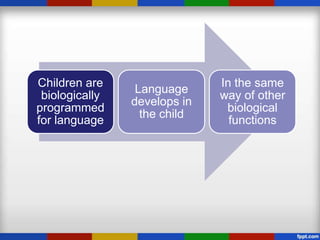
Children are                  In the same
                 Language
 biologically                 way of other
                develops in
programmed                     biological
                  the child
for language                    functions
language     learning to
acquisition      walk.
LAD: LANGUAGE ACQUISITION
   DEVICE ( or BLACK BOX)
– It contains all and only the principles which are
  universal to all human languages
            (i.e.. Universal Grammar – UG).
If children are pre-
   equipped with UG.


What they have to learn is


The ways in which their
own language make use
  of those principles
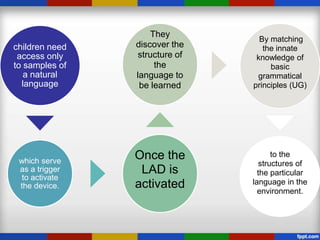
They
                                  By matching
children need   discover the       the innate
 access only     structure of    knowledge of
to samples of        the             basic
   a natural    language to      grammatical
  language       be learned     principles (UG)


 which serve
                Once the              to the
                                  structures of
 as a trigger    LAD is           the particular
  to activate
 the device.    activated       language in the
                                  environment.
CONCLUSION

• Children’s acquisition of grammatical rules
   is guided by principles of an innate UG
      which could apply to all languages.

   • Children “know” certain things of the
     language just by being exposed to a
          limited number of samples.
Evidence used to support Chomsky’s
         innatist position:


           Virtually all children
successfully learn their native language
              at a time in life
   when they would not be expected
 to learn anything else so complicated
     (i.e. biologically programmed).
–Language is separate from
    other aspects of cognitive
           developments
(e.g., creativity and social grace)
and may be located in a different
       “module" of the brain.
The language children are
exposed to does not contain
           examples
of all the linguistic rules and
            patterns.
Animals cannot learn
to manipulate a symbol system
       as complicated as
      the natural language
   of a 3- or 4-year-old child.
Children acquire grammatical

 rules without getting explicit

          instruction.
The biological basis for the innatist
               position:

 The Critical Period Hypothesis (CPH) –Lenneberg:
• There is a specific and limited time period
  (i.e., “critical period”) for the LAD to work
                    successfully.

        • Only when it is stimulated
             at the right time
ONLY BY
               STRONG
                           PUBERTY

Two versions
                        AFTER PUBERTY
                        IT WILL BE MORE
               WEAK
                         DIFFICULT AND
                          INCOMPLETE
Virtually every child learns language on a
    similar schedule in spite of different
               environments.

 – Three case studies of abnormal language
   development - evidence of the CPH
    •Victor – a boy of about 12 years old
     (1799)
    •Genie – a girl of 13 years old (1970)
    •Deaf signers (native signers, early
     learners, vs. late learners)

First language acquisition (innatism)

  • 1.
    2) INNATISM: IT’SALL IN YOUR MIND Chomsky (1959) argues that behaviorism cannot provide sufficient explanations for children’s language acquisition for the following reasons:
  • 2.
    Chomsky (1959) arguesthat behaviorism cannot provide sufficient explanations for children’s language acquisition for the following reasons:
  • 3.
    –Children come toknow more about the structure of their language than they could be expected to learn on the basis of the samples of language they hear.
  • 4.
    – The languagechildren are exposed to includes false starts, incomplete sentences and slips of the tongue, and yet they learn to distinguish between grammatical and ungrammatical sentences. – Children are by no means systematically corrected or instructed on language by parents.
  • 5.
    Children are In the same Language biologically way of other develops in programmed biological the child for language functions
  • 6.
    language learning to acquisition walk.
  • 7.
    LAD: LANGUAGE ACQUISITION DEVICE ( or BLACK BOX) – It contains all and only the principles which are universal to all human languages (i.e.. Universal Grammar – UG).
  • 8.
    If children arepre- equipped with UG. What they have to learn is The ways in which their own language make use of those principles
  • 9.
    They By matching children need discover the the innate access only structure of knowledge of to samples of the basic a natural language to grammatical language be learned principles (UG) which serve Once the to the structures of as a trigger LAD is the particular to activate the device. activated language in the environment.
  • 10.
    CONCLUSION • Children’s acquisitionof grammatical rules is guided by principles of an innate UG which could apply to all languages. • Children “know” certain things of the language just by being exposed to a limited number of samples.
  • 11.
    Evidence used tosupport Chomsky’s innatist position: Virtually all children successfully learn their native language at a time in life when they would not be expected to learn anything else so complicated (i.e. biologically programmed).
  • 12.
    –Language is separatefrom other aspects of cognitive developments (e.g., creativity and social grace) and may be located in a different “module" of the brain.
  • 13.
    The language childrenare exposed to does not contain examples of all the linguistic rules and patterns.
  • 14.
    Animals cannot learn tomanipulate a symbol system as complicated as the natural language of a 3- or 4-year-old child.
  • 15.
    Children acquire grammatical rules without getting explicit instruction.
  • 16.
    The biological basisfor the innatist position: The Critical Period Hypothesis (CPH) –Lenneberg: • There is a specific and limited time period (i.e., “critical period”) for the LAD to work successfully. • Only when it is stimulated at the right time
  • 17.
    ONLY BY STRONG PUBERTY Two versions AFTER PUBERTY IT WILL BE MORE WEAK DIFFICULT AND INCOMPLETE
  • 18.
    Virtually every childlearns language on a similar schedule in spite of different environments. – Three case studies of abnormal language development - evidence of the CPH •Victor – a boy of about 12 years old (1799) •Genie – a girl of 13 years old (1970) •Deaf signers (native signers, early learners, vs. late learners)