Key Issues in SLA
Issue 1 What is the initial state?
Starting point for L2 learners
What they bring to the task of SLA
2 basic positions on initial state
1) The learner transfers all properties of L1 to the task
of SLA (L1= initial state hypothesis )
2) The learner begins with “Universal of Language”
and does not transfer anything from L1 to L2
Under no scenario does any theory or framework believe that
the learner comes to the task of acquisition as a “blank slate.”
Everyone believes something is there at the beginning of SLA;
the question is what.
Note!
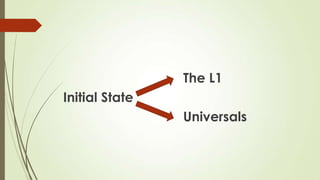
The L1
Initial State
Universals
L1 = Initial state
 from the very beginning, all the properties of the L1 are
transferred into SLA (e.g., Schwartz & Sprouse, 1996).
 the learner assumes (unconsciously) that the L2 is just like
the L1. This is commonly referred to as full transfer.
 The job of the learner subsequently is to replace L1
properties with appropriate L2 properties. Within one theory
(Universal Grammar) this is often called “parameter
resetting”
Principle Vs. Parameter
The notion of these two term is related to the UG which was
proposed by Noam Chomsky. . a theory which claims to
account for the grammatical competence of every adult no
matter what language he or she speaks. It claims that every
speaker knows a set of principles which apply to all languages
and also a set of parameters that can vary from one language
to another, but only within certain limits.
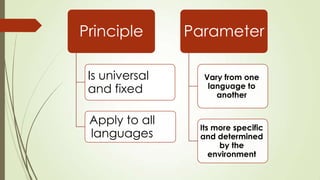
Principle
Is universal
and fixed
Apply to all
languages
Parameter
Vary from one
language to
another
Its more specific
and determined
by the
environment
Driving a car…….???!!!
In all countries you may not be allowed to drive a car
unless you have a driving license so having driving
license is principle on the other hand say in the US
drivers drive from right side and in the UK they drive
from the left side so this would be a parameter varying
from one country to another.
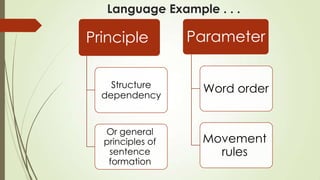
Language Example . . .
Principle
Structure
dependency
Or general
principles of
sentence
formation
Parameter
Word order
Movement
rules
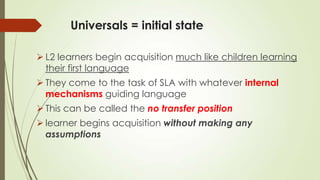
Universals = initial state
 L2 learners begin acquisition much like children learning
their first language
 They come to the task of SLA with whatever internal
mechanisms guiding language
 This can be called the no transfer position
 learner begins acquisition without making any
assumptions
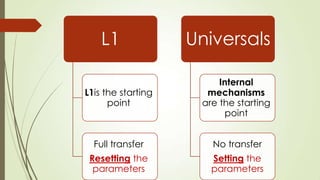
L1
L1is the starting
point
Full transfer
theResetting
parameters
Universals
Internal
mechanisms
are the starting
point
No transfer
theSetting
parameters
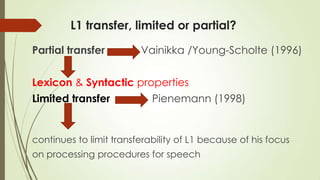
L1 transfer, limited or partial?
Partial transfer Vainikka /Young-Scholte (1996)
Lexicon & Syntactic properties
Limited transfer Pienemann (1998)
continues to limit transferability of L1 because of his focus
on processing procedures for speech
Assessment
Based on the published literature to date, it
seems that the L1 = initial state position is more
widely accepted and appears to have the most
empirical support.
Key issues in 2nd language acquisition

Key issues in 2nd language acquisition

  • 1.
  • 2.
    Issue 1 Whatis the initial state? Starting point for L2 learners What they bring to the task of SLA
  • 3.
    2 basic positionson initial state 1) The learner transfers all properties of L1 to the task of SLA (L1= initial state hypothesis ) 2) The learner begins with “Universal of Language” and does not transfer anything from L1 to L2
  • 4.
    Under no scenariodoes any theory or framework believe that the learner comes to the task of acquisition as a “blank slate.” Everyone believes something is there at the beginning of SLA; the question is what. Note!
  • 5.
  • 6.
    L1 = Initialstate  from the very beginning, all the properties of the L1 are transferred into SLA (e.g., Schwartz & Sprouse, 1996).  the learner assumes (unconsciously) that the L2 is just like the L1. This is commonly referred to as full transfer.  The job of the learner subsequently is to replace L1 properties with appropriate L2 properties. Within one theory (Universal Grammar) this is often called “parameter resetting”
  • 7.
    Principle Vs. Parameter Thenotion of these two term is related to the UG which was proposed by Noam Chomsky. . a theory which claims to account for the grammatical competence of every adult no matter what language he or she speaks. It claims that every speaker knows a set of principles which apply to all languages and also a set of parameters that can vary from one language to another, but only within certain limits.
  • 8.
    Principle Is universal and fixed Applyto all languages Parameter Vary from one language to another Its more specific and determined by the environment
  • 9.
    Driving a car…….???!!! Inall countries you may not be allowed to drive a car unless you have a driving license so having driving license is principle on the other hand say in the US drivers drive from right side and in the UK they drive from the left side so this would be a parameter varying from one country to another.
  • 10.
    Language Example .. . Principle Structure dependency Or general principles of sentence formation Parameter Word order Movement rules
  • 11.
    Universals = initialstate  L2 learners begin acquisition much like children learning their first language  They come to the task of SLA with whatever internal mechanisms guiding language  This can be called the no transfer position  learner begins acquisition without making any assumptions
  • 12.
    L1 L1is the starting point Fulltransfer theResetting parameters Universals Internal mechanisms are the starting point No transfer theSetting parameters
  • 13.
    L1 transfer, limitedor partial? Partial transfer Vainikka /Young-Scholte (1996) Lexicon & Syntactic properties Limited transfer Pienemann (1998) continues to limit transferability of L1 because of his focus on processing procedures for speech
  • 14.
    Assessment Based on thepublished literature to date, it seems that the L1 = initial state position is more widely accepted and appears to have the most empirical support.