LANGUAGE CHANGE
Languages change for a variety of reasons.
― Large-scale shifts - response to social,
economic and political pressures.
― History records - language change fueled by
invasions, colonization and migration.
Language can change dramatically if enough
users alter the way they speak it.
How does language change?
Routes to language change.
Changes can take originate in:
• Language learning.
• Language contact.
• Social differentiation.
• Natural processes in usage.
Language learning: Language is transformed as it is transmitted from
one generation to the next. Each individual must re-create a
grammar and lexicon based on input received from parents, older
siblings and other members of the speech community.
Language contact: Migration, conquest and trade bring speakers of
one language into contact with speakers of another language
Social differentiation: Social groups adopt distinctive norms of dress,
adornment, gesture and so forth. Linguistic distinctiveness -
vocabulary (slang or jargon), pronunciation, morphological
processes, syntactic constructions, and so on.
Natural processes in usage: Rapid or casual speech naturally
produces processes such as:
Assimilation, dissimilation, syncope and apocope.
Types of language change:
Language is always changing evolving, and
adapting to the needs of its users…
– Space.
– Social group.
– Time.
Agents of Change
Before a language can change, speakers must adopt
new words, sentence structures and sounds, to spread
them through the community and transmit them to
the next generation.
David Lightfoo
“CHILDREN”
Process of learning the language of previous generations, they
internalize it differently and propagate a different variation of that
language.
Types of change:
• Sound
• Vocabulary
• Semantic
Sound Change
– Change in phonological system – harder but
interesting.
– “Great Vowel Shift” - 500 years ago - modified
vowel pronunciation dramatically.
– This shift represents the biggest difference -
Middle and Modern English.
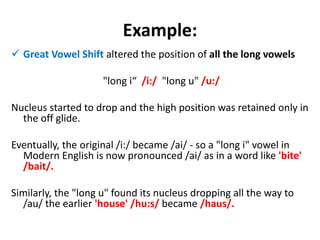
Example:
 Great Vowel Shift altered the position of all the long vowels
"long i“ /i:/ "long u" /u:/
Nucleus started to drop and the high position was retained only in
the off glide.
Eventually, the original /i:/ became /ai/ - so a "long i" vowel in
Modern English is now pronounced /ai/ as in a word like 'bite'
/bait/.
Similarly, the "long u" found its nucleus dropping all the way to
/au/ the earlier 'house' /hu:s/ became /haus/.
Pronunciation of Schwa
The words adultery, century, cursory, delivery, desultory, elementary,
every, factory, nursery, slavery.
All words which are spelt with -ary, -ery, -oryor ,-ury are
pronounced somewhat as if they rhymed with furry.
The vowel preceding r is called schwa - a short indeterminate sound -
phonetically as [ə] - er (British English) or uh (American English).
In practice the schwa was not always pronounced.
It was usually omitted in common words such as ev(e)ry, fact(o)ry,
nurs(e)ry - spelt evry, factry, nursry - two syllables only.
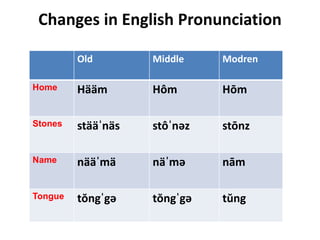
Changes in English Pronunciation
Old Middle Modren
Home Hääm Hôm Hōm
Stones stääˈnäs stôˈnəz stōnz
Name nääˈmä näˈmə nām
Tongue tŏngˈgə tŏngˈgə tŭng
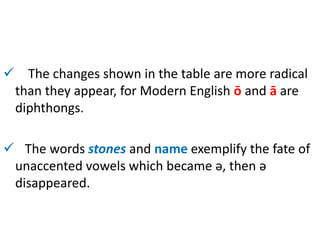
 The changes shown in the table are more radical
than they appear, for Modern English ō and ā are
diphthongs.
 The words stones and name exemplify the fate of
unaccented vowels which became ə, then ə
disappeared.
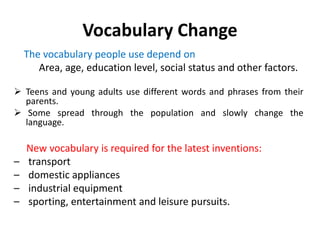
Vocabulary Change
The vocabulary people use depend on
Area, age, education level, social status and other factors.
 Teens and young adults use different words and phrases from their
parents.
 Some spread through the population and slowly change the
language.
New vocabulary is required for the latest inventions:
– transport
– domestic appliances
– industrial equipment
– sporting, entertainment and leisure pursuits.
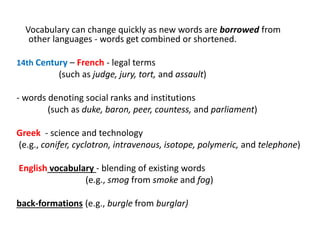
Vocabulary can change quickly as new words are borrowed from
other languages - words get combined or shortened.
14th Century – French - legal terms
(such as judge, jury, tort, and assault)
- words denoting social ranks and institutions
(such as duke, baron, peer, countess, and parliament)
Greek - science and technology
(e.g., conifer, cyclotron, intravenous, isotope, polymeric, and telephone)
English vocabulary - blending of existing words
(e.g., smog from smoke and fog)
back-formations (e.g., burgle from burglar)
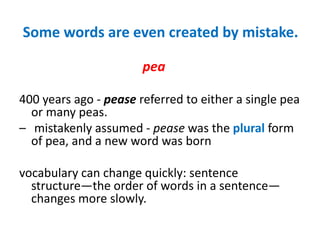
Some words are even created by mistake.
pea
400 years ago - pease referred to either a single pea
or many peas.
– mistakenly assumed - pease was the plural form
of pea, and a new word was born
vocabulary can change quickly: sentence
structure—the order of words in a sentence—
changes more slowly.
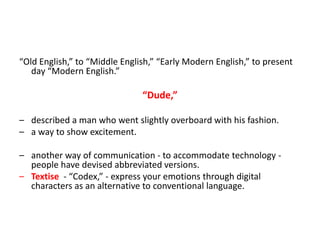
“Old English,” to “Middle English,” “Early Modern English,” to present
day “Modern English.”
“Dude,”
– described a man who went slightly overboard with his fashion.
– a way to show excitement.
– another way of communication - to accommodate technology -
people have devised abbreviated versions.
– Textise - “Codex,” - express your emotions through digital
characters as an alternative to conventional language.
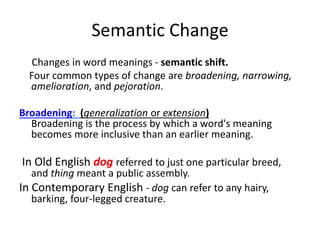
Semantic Change
Changes in word meanings - semantic shift.
Four common types of change are broadening, narrowing,
amelioration, and pejoration.
Broadening: (generalization or extension)
Broadening is the process by which a word's meaning
becomes more inclusive than an earlier meaning.
In Old English dog referred to just one particular breed,
and thing meant a public assembly.
In Contemporary English - dog can refer to any hairy,
barking, four-legged creature.
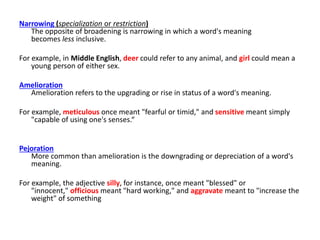
Narrowing (specialization or restriction)
The opposite of broadening is narrowing in which a word's meaning
becomes less inclusive.
For example, in Middle English, deer could refer to any animal, and girl could mean a
young person of either sex.
Amelioration
Amelioration refers to the upgrading or rise in status of a word's meaning.
For example, meticulous once meant "fearful or timid," and sensitive meant simply
"capable of using one's senses.“
Pejoration
More common than amelioration is the downgrading or depreciation of a word's
meaning.
For example, the adjective silly, for instance, once meant "blessed" or
"innocent," officious meant "hard working," and aggravate meant to "increase the
weight" of something
Conclusion
– Frequently, the needs of speakers drive language change.
– New technologies, industries, products and experiences simply
require new words.
– By using new and emerging terms, we all drive language change.
– But the unique way that individuals speak also fuels language
change.
– That’s because no two individuals use a language in exactly the
same way.

Language change )

  • 1.
  • 2.
    Languages change fora variety of reasons. ― Large-scale shifts - response to social, economic and political pressures. ― History records - language change fueled by invasions, colonization and migration. Language can change dramatically if enough users alter the way they speak it.
  • 3.
    How does languagechange? Routes to language change. Changes can take originate in: • Language learning. • Language contact. • Social differentiation. • Natural processes in usage.
  • 4.
    Language learning: Languageis transformed as it is transmitted from one generation to the next. Each individual must re-create a grammar and lexicon based on input received from parents, older siblings and other members of the speech community. Language contact: Migration, conquest and trade bring speakers of one language into contact with speakers of another language Social differentiation: Social groups adopt distinctive norms of dress, adornment, gesture and so forth. Linguistic distinctiveness - vocabulary (slang or jargon), pronunciation, morphological processes, syntactic constructions, and so on. Natural processes in usage: Rapid or casual speech naturally produces processes such as: Assimilation, dissimilation, syncope and apocope.
  • 5.
    Types of languagechange: Language is always changing evolving, and adapting to the needs of its users… – Space. – Social group. – Time.
  • 6.
    Agents of Change Beforea language can change, speakers must adopt new words, sentence structures and sounds, to spread them through the community and transmit them to the next generation. David Lightfoo “CHILDREN” Process of learning the language of previous generations, they internalize it differently and propagate a different variation of that language.
  • 7.
    Types of change: •Sound • Vocabulary • Semantic
  • 8.
    Sound Change – Changein phonological system – harder but interesting. – “Great Vowel Shift” - 500 years ago - modified vowel pronunciation dramatically. – This shift represents the biggest difference - Middle and Modern English.
  • 9.
    Example:  Great VowelShift altered the position of all the long vowels "long i“ /i:/ "long u" /u:/ Nucleus started to drop and the high position was retained only in the off glide. Eventually, the original /i:/ became /ai/ - so a "long i" vowel in Modern English is now pronounced /ai/ as in a word like 'bite' /bait/. Similarly, the "long u" found its nucleus dropping all the way to /au/ the earlier 'house' /hu:s/ became /haus/.
  • 10.
    Pronunciation of Schwa Thewords adultery, century, cursory, delivery, desultory, elementary, every, factory, nursery, slavery. All words which are spelt with -ary, -ery, -oryor ,-ury are pronounced somewhat as if they rhymed with furry. The vowel preceding r is called schwa - a short indeterminate sound - phonetically as [ə] - er (British English) or uh (American English). In practice the schwa was not always pronounced. It was usually omitted in common words such as ev(e)ry, fact(o)ry, nurs(e)ry - spelt evry, factry, nursry - two syllables only.
  • 11.
    Changes in EnglishPronunciation Old Middle Modren Home Hääm Hôm Hōm Stones stääˈnäs stôˈnəz stōnz Name nääˈmä näˈmə nām Tongue tŏngˈgə tŏngˈgə tŭng
  • 12.
     The changesshown in the table are more radical than they appear, for Modern English ō and ā are diphthongs.  The words stones and name exemplify the fate of unaccented vowels which became ə, then ə disappeared.
  • 13.
    Vocabulary Change The vocabularypeople use depend on Area, age, education level, social status and other factors.  Teens and young adults use different words and phrases from their parents.  Some spread through the population and slowly change the language. New vocabulary is required for the latest inventions: – transport – domestic appliances – industrial equipment – sporting, entertainment and leisure pursuits.
  • 14.
    Vocabulary can changequickly as new words are borrowed from other languages - words get combined or shortened. 14th Century – French - legal terms (such as judge, jury, tort, and assault) - words denoting social ranks and institutions (such as duke, baron, peer, countess, and parliament) Greek - science and technology (e.g., conifer, cyclotron, intravenous, isotope, polymeric, and telephone) English vocabulary - blending of existing words (e.g., smog from smoke and fog) back-formations (e.g., burgle from burglar)
  • 15.
    Some words areeven created by mistake. pea 400 years ago - pease referred to either a single pea or many peas. – mistakenly assumed - pease was the plural form of pea, and a new word was born vocabulary can change quickly: sentence structure—the order of words in a sentence— changes more slowly.
  • 16.
    “Old English,” to“Middle English,” “Early Modern English,” to present day “Modern English.” “Dude,” – described a man who went slightly overboard with his fashion. – a way to show excitement. – another way of communication - to accommodate technology - people have devised abbreviated versions. – Textise - “Codex,” - express your emotions through digital characters as an alternative to conventional language.
  • 17.
    Semantic Change Changes inword meanings - semantic shift. Four common types of change are broadening, narrowing, amelioration, and pejoration. Broadening: (generalization or extension) Broadening is the process by which a word's meaning becomes more inclusive than an earlier meaning. In Old English dog referred to just one particular breed, and thing meant a public assembly. In Contemporary English - dog can refer to any hairy, barking, four-legged creature.
  • 18.
    Narrowing (specialization orrestriction) The opposite of broadening is narrowing in which a word's meaning becomes less inclusive. For example, in Middle English, deer could refer to any animal, and girl could mean a young person of either sex. Amelioration Amelioration refers to the upgrading or rise in status of a word's meaning. For example, meticulous once meant "fearful or timid," and sensitive meant simply "capable of using one's senses.“ Pejoration More common than amelioration is the downgrading or depreciation of a word's meaning. For example, the adjective silly, for instance, once meant "blessed" or "innocent," officious meant "hard working," and aggravate meant to "increase the weight" of something
  • 19.
    Conclusion – Frequently, theneeds of speakers drive language change. – New technologies, industries, products and experiences simply require new words. – By using new and emerging terms, we all drive language change. – But the unique way that individuals speak also fuels language change. – That’s because no two individuals use a language in exactly the same way.