STRUCTURAL
SYLLABUS
At the end of this lesson, you will be able to:
 Enumerate the characteristics of a
structural syllabus.
 Distinguish a structural syllabus from all
other types through its key feature of
“syntheticity”
 Evaluate the pros and cons of a structural
syllabus
 Understand the place of structural syllabus
relative to the teaching and learning of
language.
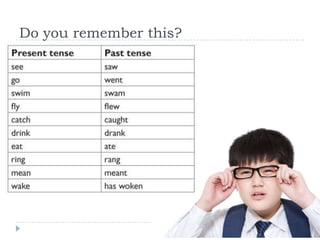
Do you remember this?
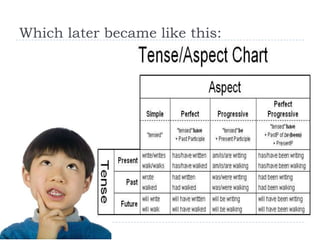
Which later became like this:
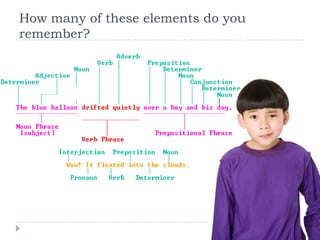
How many of these elements do you
remember?
This is an example of a
STRUCTURAL SYLLABUS
are a product of this syllabus.
So, what is a
Structural Syllabus?
 (a.k.a. Grammatical Syllabus, Formal Syllabus,
Traditional Syllabus, or Synthetic Syllabus)
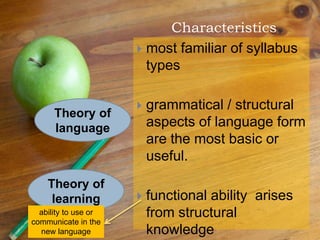
Characteristics
 most familiar of syllabus
types
 grammatical / structural
aspects of language form
are the most basic or
useful.
 functional ability arises
from structural
knowledge
Theory of
learning
Theory of
language
ability to use or
communicate in the
new language
What can we find in a structural
syllabus?
language form / grammatical
form
traditional, Latin-based,
descriptive/prescriptive
grammatical classification
and terminology
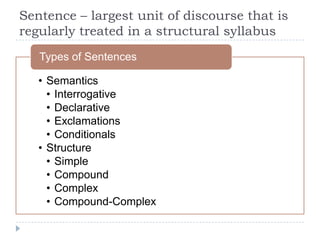
Sentence – largest unit of discourse that is
regularly treated in a structural syllabus
• Semantics
• Interrogative
• Declarative
• Exclamations
• Conditionals
• Structure
• Simple
• Compound
• Complex
• Compound-Complex
Types of Sentences
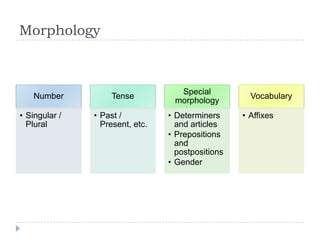
Morphology
Number
• Singular /
Plural
Tense
• Past /
Present, etc.
Special
morphology
• Determiners
and articles
• Prepositions
and
postpositions
• Gender
Vocabulary
• Affixes
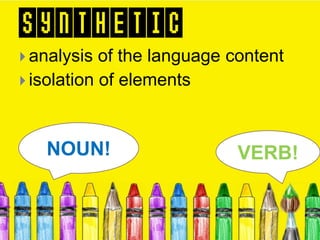
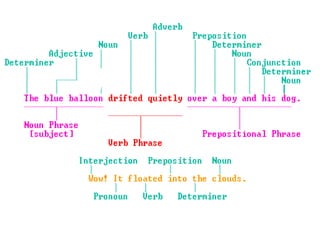
SYNTHETIC
 analysis of the language content
 isolation of elements
VERB!NOUN!
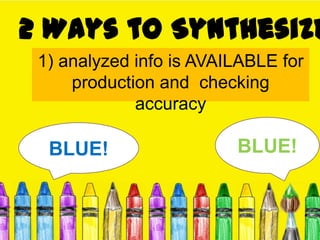
2 Ways to Synthesize
1) analyzed info is AVAILABLE for
production and checking
accuracy
BLUE!BLUE!
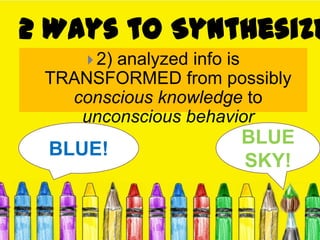
2 Ways to Synthesize
 2) analyzed info is
TRANSFORMED from possibly
conscious knowledge to
unconscious behavior
BLUE
SKY!
BLUE!
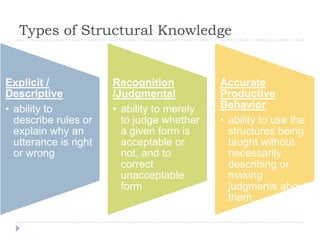
Types of Structural Knowledge
Explicit /
Descriptive
• ability to
describe rules or
explain why an
utterance is right
or wrong
Recognition
/Judgmental
• ability to merely
to judge whether
a given form is
acceptable or
not, and to
correct
unacceptable
form
Accurate
Productive
Behavior
• ability to use the
structures being
taught without
necessarily
describing or
making
judgments about
them.
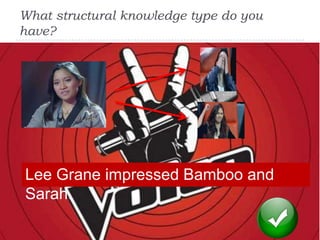
What structural knowledge type do you
have?
Lee Grane impressed Bamboo and
Sarah.
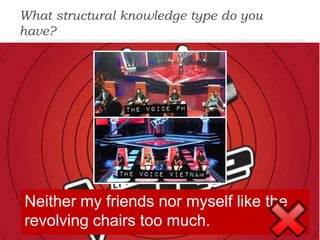
What structural knowledge type do you
have?
Neither my friends nor myself like the
revolving chairs too much.
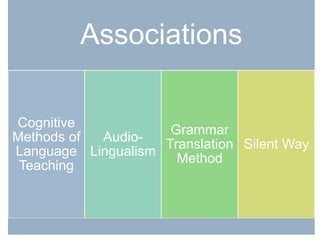
Associations
Cognitive
Methods of
Language
Teaching
Audio-
Lingualism
Grammar
Translation
Method
Silent Way
Audio-Lingualism
3,333
Grammar Translation
 Pang-ilang pangulo si Noynoy Aquino?
 1. How many presidents were
there before President Noynoy
Aquino?
 2. Which/What number does
Noynoy Aquino come in the
list/order of Philippine
presidents?
 3. What is Noynoy Aquino's
ordinal place in the line up of all
Selection of
Content
vs.
Sequencing
(Which is harder?)
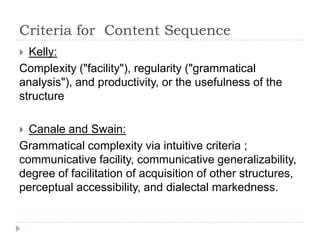
Criteria for Content Sequence
 Kelly:
Complexity ("facility"), regularity ("grammatical
analysis"), and productivity, or the usefulness of the
structure
 Canale and Swain:
Grammatical complexity via intuitive criteria ;
communicative facility, communicative generalizability,
degree of facilitation of acquisition of other structures,
perceptual accessibility, and dialectal markedness.
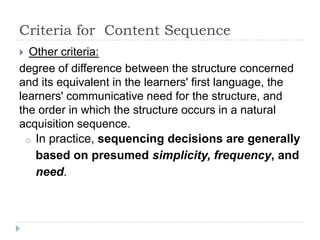
Criteria for Content Sequence
 Other criteria:
degree of difference between the structure concerned
and its equivalent in the learners' first language, the
learners' communicative need for the structure, and
the order in which the structure occurs in a natural
acquisition sequence.
o In practice, sequencing decisions are generally
based on presumed simplicity, frequency, and
need.
Master at initial presentation
or
Learn via spiraling?
LEARNING THEORY:
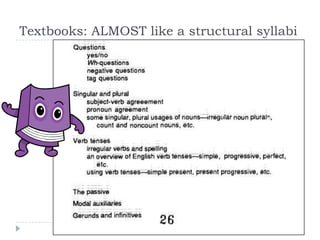
Textbooks: ALMOST like a structural syllabi
Positive Characteristics
1) It’s the most general
component of
communicative
competence.
Positive Characteristics
2) Familiarity
Positive Characteristics
3) It’s relatively easy
to describe
Positive Characteristics
4) It’s the most
measurable of the
components of
communicative
competence.
Positive Characteristics
5) Prevents later
fossilization or
cessation of learning.
Positive Characteristics
6) Serves as basis for
learner to Monitor,
check, and self-correct
(Krashen’s Monitor
/Acquisition Theory)
Positive Characteristics
7) Offers basis for
teachers or others to
provide learners with
feedback on the
accuracy of their
production
Positive Characteristics
8) Value- and culture-
free.
Negative
Characteristics
1. Lack of usability,
applicability, or transferability
of structural knowledge.
Negative
Characteristics
2. Misleading:
Learning a language
vs.
Learning facts or information about
a language.
Negative
Characteristics
3. Strictly structural syllabi
prevent students from producing
structures they have not been
taught.
Applications
Low
transferability
limited
application to
language
instruction
that aims for
functional use
Passive structural
knowledge
Improved second language
accuracy
Monitoring role
Geographical, cultural, or
political limitations
Applications
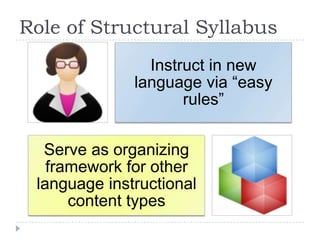
Role of Structural Syllabus
Instruct in new
language via “easy
rules”
Serve as organizing
framework for other
language instructional
content types
QUESTIONS?

Structural Syllabus Design