Linguistics Descriptive Linguistics and Culture
Communication Most animals have some form of communication Definition: Ability of one organism to trigger another Counterexample: Bouncer tosses out unruly patron Counterexample: Sun’s rays wakens sleeper Entails stimulus and response
Overview of Linguistics Biological Roots of Language: Brain and Articulatory System Descriptive Linguistics: Phones and Phonemes Descriptive Linguistics: Morphology and Syntax Language and Animal Communication Language and Culture
The International Phonetic Alphabet How many vowels are there in English? Our written language is not entirely phonetic The letter a could be pronounced as [æ] in bat Or how about [e] as in bated breath? Or try [a] as in bah or “say ah” We have 12 vowels That means in linguistics we need 12 symbols to transcribe them
The IPA: How It Works First, there are  phones , any speech sound The IPA ideally assigns one symbol to a sound So [a] is used for “ah,” [e] for “bated,” [æ] for “bat” Square brackets are used to enclose phones If the sounds carry a language, they are known as  phonemes  (more shortly) These are enclosed in slashes (//), e.g. /a/
A Sample Set of Phones and Phonemes We will use a sample of six  consonants  known as  stops: [p], [b], [t], [d], [k], and [g] First, we have to look at some preliminaries: The speech mechanism (brain, lungs, larynx, and oral cavity) Then how speech is articulated
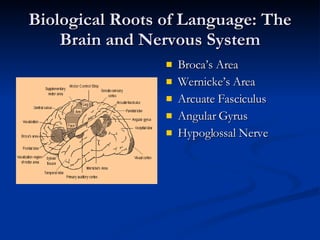
Biological Roots of Language: The Brain and Nervous System Broca’s Area Wernicke’s Area Arcuate Fasciculus Angular Gyrus Hypoglossal Nerve
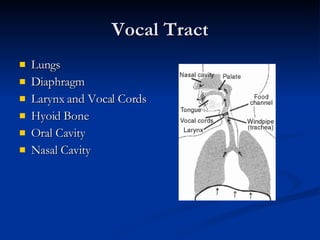
Vocal Tract Lungs Diaphragm  Larynx and Vocal Cords Hyoid Bone Oral Cavity Nasal Cavity
Articulatory Phonetics When we utter any sound, we  articulate We position our tongue or other speech part in certain ways When we speak, we use Points of articulation : Speech parts in upper half of mouth Articulators:  Speech parts in lower half of mouth
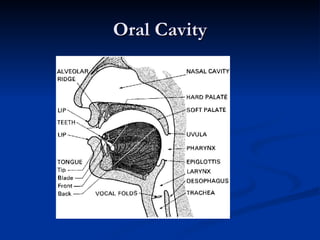
Oral Cavity
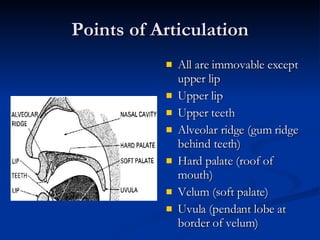
Points of Articulation All are immovable except upper lip Upper lip Upper teeth Alveolar ridge (gum ridge behind teeth) Hard palate (roof of mouth) Velum (soft palate) Uvula (pendant lobe at border of velum)
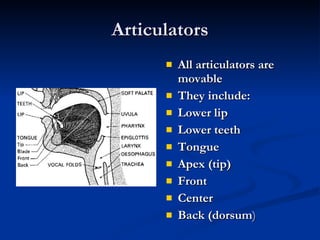
Articulators All articulators are movable They include: Lower lip Lower teeth Tongue Apex (tip) Front Center  Back (dorsum )
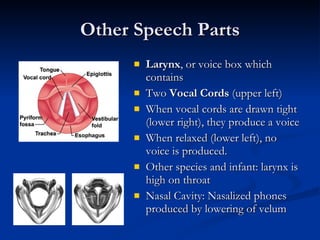
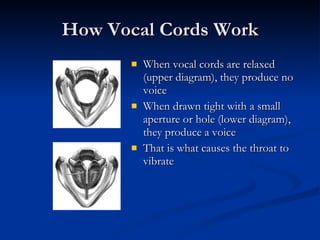
Other Speech Parts Larynx , or voice box which contains Two  Vocal Cords  (upper left) When vocal cords are drawn tight (lower right), they produce a voice When relaxed (lower left), no voice is produced. Other species and infant: larynx is high on throat Nasal Cavity: Nasalized phones produced by lowering of velum
Position of Articulation For  consonants , position of articulator relative to point of articulation For vowels, resonant sounds created by position of tongue (high, mid, or low) lip shape (rounded or unrounded Consonants include: Stops (momentary stop of air stream) Fricatives or Spirants (constricted passage of air) Others, such as laterals, nasals, et al.
Positions of Articulation: Stops  A  stop  is formed when an articulator touches a point of articulation  halting the air stream momentarily A stop is named By naming the  articulator  first Then naming the  point of articulation Examples: labio-labial, apico-alveolar, and dorso-velar stops
Bilabial Stops Upper lip is pressed against lower lip Labio- describes the lower lip (articulator) Labial describes the upper lip (point of articulation_ Called  bilabial stop  for short Example: [p] as in [pın] or pin
Apico-Alveolar Stops Tip (apex) of tongue presses against gum ridge (alveolar ridge) behind upper teeth Apico describes apex of tongue (articulator) Alveolar describes alveolar ridge (point of articulation) Example: [t] as in tın] or tin
Dorso-Velar Stops Back (dorsum) of tongue presses against soft palate (velum) Dorso describes dorsal part of tongue (articulator) Velar describes velum (point of articulation) Example: [k] as in [kın] or kin
Contrasting Sounds Across the board,  [p] contrasts with [t] [t] contrasts with [k] [p] contrasts with [k] But there are  two bilabial stops: [p] and [b] apico-alveolar stops: [t] and [d] dorso-velar stops [k] and [g] Why? What’s going on?
Voiced and Voiceless Stops One set of stops is voiceless or unvoiced Namely [p], [t], and [k] The other set of stops is voiced [b] the bilabial voiced stop [d] the voiced apico-alveolar stop [t] the voiced dorso-velar stop A small experiment
How Vocal Cords Work When vocal cords are relaxed (upper diagram), they produce no voice When drawn tight with a small aperture or hole (lower diagram), they produce a voice That is what causes the throat to vibrate
Summing up Voicing involves tightening of vocal cords to produce a sound When unvoiced phones are uttered, the vocal cords are relaxed Voiced sounds contrast with unvoiced sounds voiced [b] contrasts with unvoiced [p] voiced [d] contrasts with unvoiced [t] voiced [g] contrasts with unvoiced [k]
Structural Duality I: Phonemes The sounds we described are also  phonemes Definition: The smallest significant unit of speech Significance: the speaker  can hear the difference. We can hear the difference between [bın] and [pın], [dın] and [tın], and [gın] and [kın]
Minimal Pairs [bın] and [pın]: what’s the difference? [tın] and [dın]: same question [gın] and [kın]: Again, what differs? Short answer: the speech  environment  is identical Only the stops differ the [-ın] utterance is identical
Summary of Phonemic Stops in English Notice that: English doesn’t have all possible stops: labiodental, interdental, or palatal  We do have labio-dental fricatives {f], [v] and interdental ones [ θ ] and [ð] The Russians have a palatal shop [t j ]. There are numerous others in the world’s languages
Allophones Another example: key and ski Another experiment: what’s the difference? The differences [k’] in key [k’i] is  aspirated [ k ־ ] in ski [sk ־ i] is  unaspirated In English, [k’] and [k ־ ] never form minimal pairs Therefore, [k’] and [k ־ ] are  allophones
Allophones of Phonemes Definition: Variations of the same phoneme Our example: [k’] and [k ־ ] are allophones of the phoneme /k/  Notation: Slash marks (//) indicate phoneme Square brackets ([]) indicates phone (and allophone)
Allophones in One Language: Phonemes in Another Old Sanskrit (from which Hindi and Urdu are derived): [k’il] and [k ־ il] form minimal pairs [k’il]: “parched grain” [k ־ il]: “small nail”l [-il] is identical as for speech environment Therefore, /k’/ and /k ־ / are phonemes in Old Sanskrit Every language has its own phonemes
Phonemes as Structural Duality I Note diagram on board [b] contrasts with [d] which contrasts with [g] [p] contrasts with [t] which contrasts with [k] All the voiced stops contrast with unvoiced ones: [b] with [p], [d] with [t] and [g] with [k] So we have a structure
Structural Duality II: Morphemes and Syntax Once the phonemes are identified: They must be arranged for meaning Morphemes and Syntax Morphemes: The smallest  meaningful  unit of speech Syntax: Rules and principles of phrase and sentence construction Grammar: Entire formal structure of a language’s morphemes and syntax
Morphemes Morphology:  Study of morphemes and their construction into words Types of morphemes Free morphemes:  Morphemes that can stand unattached in a language: cat Bound morphemes:  Morphemes that cannot stand unattached in a language: cat s Inflectional bound morphemes : those that change number or tense, but not meaning: e.g., cat, cat s Derivational bound morphemes:  those that change the meaning : e.g., part, part y
Allomorphs Allomorphs:  Variants of a morpheme Examples: plurals of dogs, cats, horses Others: tooth/teeth; sheep/sheep Morphophonemics : Study of allomorphs
Syntax: Parts of Speech Describes rules and principles of phrase and sentence construction. Parts of speech are similar to those in high school grammar Noun:  Word referring to a person, place, or thing Pronoun:  Word that replaces a noun or other pronoun Verb:  Action word
Syntax: More Parts of Speech Adjective:  Word that modifies nouns Adverb:  Word that modifies a verb, an adjective, and another adverbs Preposition:  Word that indicates a relation between an object in time, space, or logic to the rest of a sentence Conjunction : Word connecting words or groups of words Interjection:  Word that expresses feelings, but usually not part of a sentence.
Syntax and Word Order Word order (sentence, verb, object) vary by language: Subject (S):  The thing or person of what a sentence is about Predicate (V):  Phrase that says something about the subject; always include the verb Verb (O):  Action word that forms the main part of the predicate Object:  The person or thing affected by the verb  In English, the word order is typically S-V-O In Spanish, the word order is sometimes V-S-O Other languages have other word orders
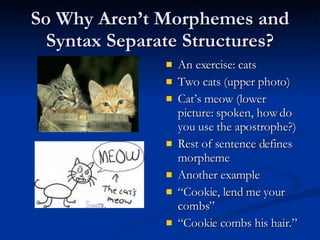
So Why Aren’t Morphemes and Syntax Separate Structures? An exercise: cats Two cats (upper photo) Cat’s meow (lower picture: spoken, how do you use the apostrophe?) Rest of sentence defines morpheme Another example “ Cookie, lend me your combs” “ Cookie combs his hair.”
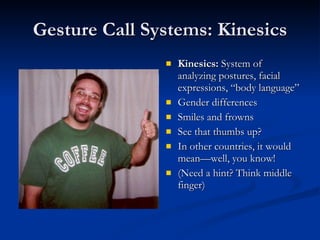
Gesture Call Systems: Kinesics Kinesics:  System of analyzing postures, facial expressions, “body language” Gender differences Smiles and frowns See that thumbs up? In other countries, it would mean—well, you know! (Need a hint? Think middle finger)
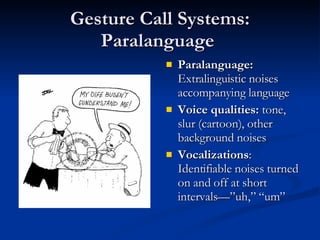
Gesture Call Systems: Paralanguage  Paralanguage:  Extralinguistic noises accompanying language  Voice qualities:  tone, slur (cartoon), other background noises Vocalizations : Identifiable noises turned on and off at short intervals—”uh,” “um”
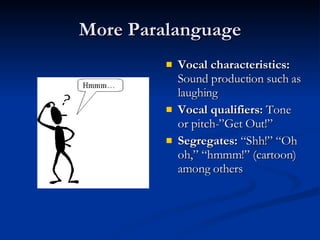
More Paralanguage Vocal characteristics:   Sound production such as laughing Vocal qualifiers:  Tone or pitch-”Get Out!” Segregates:  “Shh!” “Oh oh,” “hmmm!” (cartoon) among others
Linguistic Change Language Family Group of languages descended from a single ancestral language Example: Indo-European is descended from Proto-Indo-European Glottochronology Technique of reconstructing past language Core vocabulary:  Comparing words common to all languages
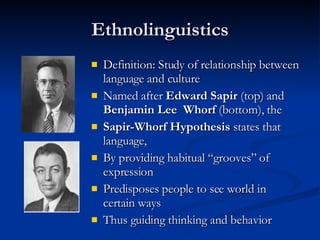
Ethnolinguistics Definition: Study of relationship between language and culture Named after  Edward Sapir  (top) and  Benjamin Lee  Whorf  (bottom), the Sapir-Whorf Hypothesis  states that   language, By providing habitual “grooves” of expression Predisposes people to see world in certain ways Thus guiding thinking and behavior
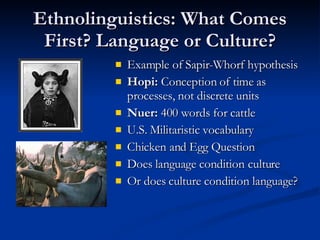
Ethnolinguistics: What Comes First? Language or Culture? Example of Sapir-Whorf hypothesis Hopi:  Conception of time as processes, not discrete units Nuer:  400 words for cattle U.S. Militaristic vocabulary Chicken and Egg Question Does language condition culture Or does culture condition language?
Ethnolinguistics: Some Areas of Research Kinship terms: Father or Mother may be extended to uncles and aunts. Gender Meaning of “I’m sorry” Social dialects Example: so-called Ebonics (Afro-American) Regional differences: Beijing vs. Canton
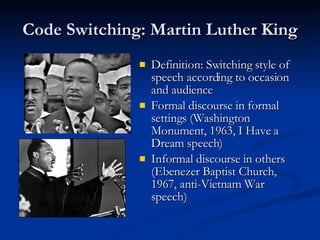
Code Switching: Martin Luther King Definition: Switching style of speech according to occasion and audience Formal discourse in formal settings (Washington Monument, 1963, I Have a Dream speech) Informal discourse in others (Ebenezer Baptist Church, 1967, anti-Vietnam War speech)
Language Origins Comparison of communication attributes was first step Chimpanzee communication: calls and gestures Indirect evidence Reconstructed anatomy: hyoid bone Endocasts indicating size of cerebrum Control language among others Size indirect indication
Features of Language Shared with Other Species Arbitrariness Productivity Interchangeability Displacement Specialization Cultural Transmission
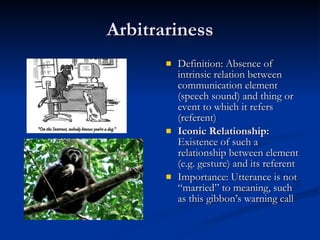
Arbitrariness Definition: Absence of intrinsic relation between communication element (speech sound) and thing or event to which it refers (referent) Iconic Relationship:  Existence of such a relationship between element (e.g. gesture) and its referent Importance: Utterance is not “married” to meaning, such as this gibbon’s warning call
Arbitrariness (Examples) Example [k], [æ], and [t] are not meaningful in and of themselves Meaning emerges when sounds are combined: [kæt] “cat” has one meaning (feline, the one who caught a mouse) [tæk] “tack” has another (small nail) [ækt] “act” has a third (dog and pony show) Even then, this string is language specific (English), not intrinsic
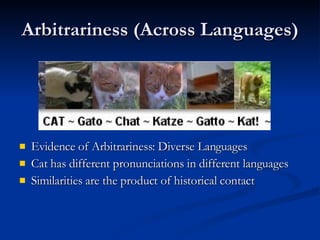
Arbitrariness (Across Languages) Evidence of Arbitrariness: Diverse Languages Cat has different pronunciations in different languages Similarities are the product of historical contact
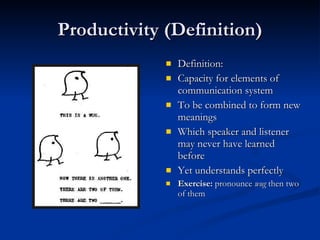
Productivity (Definition) Definition: Capacity for elements of communication system To be combined to form new meanings Which speaker and listener may never have learned before Yet understands perfectly Exercise:  pronounce  wug  then two of them
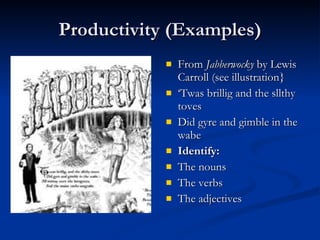
Productivity (Examples) From  Jabberwocky  by Lewis Carroll (see illustration} ‘ Twas brillig and the sllthy toves Did gyre and gimble in the wabe Identify: The nouns The verbs The adjectives
Productivity (Conclusion) Language drills English: I am, you are. . . Spanish: Yo soy, tu eres. . . Other species: Bee dance Variations indicate location, direction, and amount of nectar source Speed: proximity or distance of source Angle of body: direction Amount of pollen: amount at source
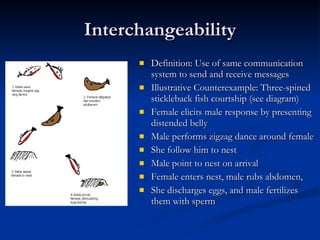
Interchangeability Definition: Use of same communication system to send and receive messages Illustrative Counterexample: Three-spined stickleback fish courtship (see diagram) Female elicits male response by presenting distended belly Male performs zigzag dance around female She follow him to nest Male point to nest on arrival Female enters nest, male rubs abdomen,  She discharges eggs, and male fertilizes them with sperm
Displacement (Definition) Ability to refer to things and events not present, nonvisible, intangible, or nonexistent Not present: Golden Gate Bridge in San Francisco Not visible: Termites in sealed mound Intangible: math equations, square roots Nonexistent: dragons, unicorns
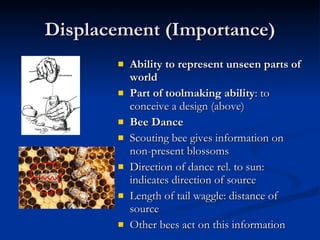
Displacement (Importance) Ability to represent unseen parts of world   Part of toolmaking ability : to conceive a design (above) Bee Dance Scouting bee gives information on non-present blossoms Direction of dance rel. to sun: indicates direction of source Length of tail waggle: distance of source Other bees act on this information
Cultural Transmission Learning of an element of communication (speech sound, gestures) Bees and stickleback acquire behavior genetically Dogs learn by conditioning, do not pass learning on Chimpanzees do learn by imitation and pass it on: e.g., termite fishing.
Specialization Definition: Ability to transmit message with minimal physical effort Language is most specialized communication system Examples of unspecialized communication Chimpanzee displays Bee dance Stickleback courtship
Conclusion Language is basis of culture Knowledge of linguistics is prerequisite Descriptive Linguistics Language and Society Culture can condition language Chicken-egg question remains One more technique: content analysis of language

Linguistics

  • 1.
  • 2.
    Communication Most animalshave some form of communication Definition: Ability of one organism to trigger another Counterexample: Bouncer tosses out unruly patron Counterexample: Sun’s rays wakens sleeper Entails stimulus and response
  • 3.
    Overview of LinguisticsBiological Roots of Language: Brain and Articulatory System Descriptive Linguistics: Phones and Phonemes Descriptive Linguistics: Morphology and Syntax Language and Animal Communication Language and Culture
  • 4.
    The International PhoneticAlphabet How many vowels are there in English? Our written language is not entirely phonetic The letter a could be pronounced as [æ] in bat Or how about [e] as in bated breath? Or try [a] as in bah or “say ah” We have 12 vowels That means in linguistics we need 12 symbols to transcribe them
  • 5.
    The IPA: HowIt Works First, there are phones , any speech sound The IPA ideally assigns one symbol to a sound So [a] is used for “ah,” [e] for “bated,” [æ] for “bat” Square brackets are used to enclose phones If the sounds carry a language, they are known as phonemes (more shortly) These are enclosed in slashes (//), e.g. /a/
  • 6.
    A Sample Setof Phones and Phonemes We will use a sample of six consonants known as stops: [p], [b], [t], [d], [k], and [g] First, we have to look at some preliminaries: The speech mechanism (brain, lungs, larynx, and oral cavity) Then how speech is articulated
  • 7.
    Biological Roots ofLanguage: The Brain and Nervous System Broca’s Area Wernicke’s Area Arcuate Fasciculus Angular Gyrus Hypoglossal Nerve
  • 8.
    Vocal Tract LungsDiaphragm Larynx and Vocal Cords Hyoid Bone Oral Cavity Nasal Cavity
  • 9.
    Articulatory Phonetics Whenwe utter any sound, we articulate We position our tongue or other speech part in certain ways When we speak, we use Points of articulation : Speech parts in upper half of mouth Articulators: Speech parts in lower half of mouth
  • 10.
  • 11.
    Points of ArticulationAll are immovable except upper lip Upper lip Upper teeth Alveolar ridge (gum ridge behind teeth) Hard palate (roof of mouth) Velum (soft palate) Uvula (pendant lobe at border of velum)
  • 12.
    Articulators All articulatorsare movable They include: Lower lip Lower teeth Tongue Apex (tip) Front Center Back (dorsum )
  • 13.
    Other Speech PartsLarynx , or voice box which contains Two Vocal Cords (upper left) When vocal cords are drawn tight (lower right), they produce a voice When relaxed (lower left), no voice is produced. Other species and infant: larynx is high on throat Nasal Cavity: Nasalized phones produced by lowering of velum
  • 14.
    Position of ArticulationFor consonants , position of articulator relative to point of articulation For vowels, resonant sounds created by position of tongue (high, mid, or low) lip shape (rounded or unrounded Consonants include: Stops (momentary stop of air stream) Fricatives or Spirants (constricted passage of air) Others, such as laterals, nasals, et al.
  • 15.
    Positions of Articulation:Stops A stop is formed when an articulator touches a point of articulation halting the air stream momentarily A stop is named By naming the articulator first Then naming the point of articulation Examples: labio-labial, apico-alveolar, and dorso-velar stops
  • 16.
    Bilabial Stops Upperlip is pressed against lower lip Labio- describes the lower lip (articulator) Labial describes the upper lip (point of articulation_ Called bilabial stop for short Example: [p] as in [pın] or pin
  • 17.
    Apico-Alveolar Stops Tip(apex) of tongue presses against gum ridge (alveolar ridge) behind upper teeth Apico describes apex of tongue (articulator) Alveolar describes alveolar ridge (point of articulation) Example: [t] as in tın] or tin
  • 18.
    Dorso-Velar Stops Back(dorsum) of tongue presses against soft palate (velum) Dorso describes dorsal part of tongue (articulator) Velar describes velum (point of articulation) Example: [k] as in [kın] or kin
  • 19.
    Contrasting Sounds Acrossthe board, [p] contrasts with [t] [t] contrasts with [k] [p] contrasts with [k] But there are two bilabial stops: [p] and [b] apico-alveolar stops: [t] and [d] dorso-velar stops [k] and [g] Why? What’s going on?
  • 20.
    Voiced and VoicelessStops One set of stops is voiceless or unvoiced Namely [p], [t], and [k] The other set of stops is voiced [b] the bilabial voiced stop [d] the voiced apico-alveolar stop [t] the voiced dorso-velar stop A small experiment
  • 21.
    How Vocal CordsWork When vocal cords are relaxed (upper diagram), they produce no voice When drawn tight with a small aperture or hole (lower diagram), they produce a voice That is what causes the throat to vibrate
  • 22.
    Summing up Voicinginvolves tightening of vocal cords to produce a sound When unvoiced phones are uttered, the vocal cords are relaxed Voiced sounds contrast with unvoiced sounds voiced [b] contrasts with unvoiced [p] voiced [d] contrasts with unvoiced [t] voiced [g] contrasts with unvoiced [k]
  • 23.
    Structural Duality I:Phonemes The sounds we described are also phonemes Definition: The smallest significant unit of speech Significance: the speaker can hear the difference. We can hear the difference between [bın] and [pın], [dın] and [tın], and [gın] and [kın]
  • 24.
    Minimal Pairs [bın]and [pın]: what’s the difference? [tın] and [dın]: same question [gın] and [kın]: Again, what differs? Short answer: the speech environment is identical Only the stops differ the [-ın] utterance is identical
  • 25.
    Summary of PhonemicStops in English Notice that: English doesn’t have all possible stops: labiodental, interdental, or palatal We do have labio-dental fricatives {f], [v] and interdental ones [ θ ] and [ð] The Russians have a palatal shop [t j ]. There are numerous others in the world’s languages
  • 26.
    Allophones Another example:key and ski Another experiment: what’s the difference? The differences [k’] in key [k’i] is aspirated [ k ־ ] in ski [sk ־ i] is unaspirated In English, [k’] and [k ־ ] never form minimal pairs Therefore, [k’] and [k ־ ] are allophones
  • 27.
    Allophones of PhonemesDefinition: Variations of the same phoneme Our example: [k’] and [k ־ ] are allophones of the phoneme /k/ Notation: Slash marks (//) indicate phoneme Square brackets ([]) indicates phone (and allophone)
  • 28.
    Allophones in OneLanguage: Phonemes in Another Old Sanskrit (from which Hindi and Urdu are derived): [k’il] and [k ־ il] form minimal pairs [k’il]: “parched grain” [k ־ il]: “small nail”l [-il] is identical as for speech environment Therefore, /k’/ and /k ־ / are phonemes in Old Sanskrit Every language has its own phonemes
  • 29.
    Phonemes as StructuralDuality I Note diagram on board [b] contrasts with [d] which contrasts with [g] [p] contrasts with [t] which contrasts with [k] All the voiced stops contrast with unvoiced ones: [b] with [p], [d] with [t] and [g] with [k] So we have a structure
  • 30.
    Structural Duality II:Morphemes and Syntax Once the phonemes are identified: They must be arranged for meaning Morphemes and Syntax Morphemes: The smallest meaningful unit of speech Syntax: Rules and principles of phrase and sentence construction Grammar: Entire formal structure of a language’s morphemes and syntax
  • 31.
    Morphemes Morphology: Study of morphemes and their construction into words Types of morphemes Free morphemes: Morphemes that can stand unattached in a language: cat Bound morphemes: Morphemes that cannot stand unattached in a language: cat s Inflectional bound morphemes : those that change number or tense, but not meaning: e.g., cat, cat s Derivational bound morphemes: those that change the meaning : e.g., part, part y
  • 32.
    Allomorphs Allomorphs: Variants of a morpheme Examples: plurals of dogs, cats, horses Others: tooth/teeth; sheep/sheep Morphophonemics : Study of allomorphs
  • 33.
    Syntax: Parts ofSpeech Describes rules and principles of phrase and sentence construction. Parts of speech are similar to those in high school grammar Noun: Word referring to a person, place, or thing Pronoun: Word that replaces a noun or other pronoun Verb: Action word
  • 34.
    Syntax: More Partsof Speech Adjective: Word that modifies nouns Adverb: Word that modifies a verb, an adjective, and another adverbs Preposition: Word that indicates a relation between an object in time, space, or logic to the rest of a sentence Conjunction : Word connecting words or groups of words Interjection: Word that expresses feelings, but usually not part of a sentence.
  • 35.
    Syntax and WordOrder Word order (sentence, verb, object) vary by language: Subject (S): The thing or person of what a sentence is about Predicate (V): Phrase that says something about the subject; always include the verb Verb (O): Action word that forms the main part of the predicate Object: The person or thing affected by the verb In English, the word order is typically S-V-O In Spanish, the word order is sometimes V-S-O Other languages have other word orders
  • 36.
    So Why Aren’tMorphemes and Syntax Separate Structures? An exercise: cats Two cats (upper photo) Cat’s meow (lower picture: spoken, how do you use the apostrophe?) Rest of sentence defines morpheme Another example “ Cookie, lend me your combs” “ Cookie combs his hair.”
  • 37.
    Gesture Call Systems:Kinesics Kinesics: System of analyzing postures, facial expressions, “body language” Gender differences Smiles and frowns See that thumbs up? In other countries, it would mean—well, you know! (Need a hint? Think middle finger)
  • 38.
    Gesture Call Systems:Paralanguage Paralanguage: Extralinguistic noises accompanying language Voice qualities: tone, slur (cartoon), other background noises Vocalizations : Identifiable noises turned on and off at short intervals—”uh,” “um”
  • 39.
    More Paralanguage Vocalcharacteristics: Sound production such as laughing Vocal qualifiers: Tone or pitch-”Get Out!” Segregates: “Shh!” “Oh oh,” “hmmm!” (cartoon) among others
  • 40.
    Linguistic Change LanguageFamily Group of languages descended from a single ancestral language Example: Indo-European is descended from Proto-Indo-European Glottochronology Technique of reconstructing past language Core vocabulary: Comparing words common to all languages
  • 41.
    Ethnolinguistics Definition: Studyof relationship between language and culture Named after Edward Sapir (top) and Benjamin Lee Whorf (bottom), the Sapir-Whorf Hypothesis states that language, By providing habitual “grooves” of expression Predisposes people to see world in certain ways Thus guiding thinking and behavior
  • 42.
    Ethnolinguistics: What ComesFirst? Language or Culture? Example of Sapir-Whorf hypothesis Hopi: Conception of time as processes, not discrete units Nuer: 400 words for cattle U.S. Militaristic vocabulary Chicken and Egg Question Does language condition culture Or does culture condition language?
  • 43.
    Ethnolinguistics: Some Areasof Research Kinship terms: Father or Mother may be extended to uncles and aunts. Gender Meaning of “I’m sorry” Social dialects Example: so-called Ebonics (Afro-American) Regional differences: Beijing vs. Canton
  • 44.
    Code Switching: MartinLuther King Definition: Switching style of speech according to occasion and audience Formal discourse in formal settings (Washington Monument, 1963, I Have a Dream speech) Informal discourse in others (Ebenezer Baptist Church, 1967, anti-Vietnam War speech)
  • 45.
    Language Origins Comparisonof communication attributes was first step Chimpanzee communication: calls and gestures Indirect evidence Reconstructed anatomy: hyoid bone Endocasts indicating size of cerebrum Control language among others Size indirect indication
  • 46.
    Features of LanguageShared with Other Species Arbitrariness Productivity Interchangeability Displacement Specialization Cultural Transmission
  • 47.
    Arbitrariness Definition: Absenceof intrinsic relation between communication element (speech sound) and thing or event to which it refers (referent) Iconic Relationship: Existence of such a relationship between element (e.g. gesture) and its referent Importance: Utterance is not “married” to meaning, such as this gibbon’s warning call
  • 48.
    Arbitrariness (Examples) Example[k], [æ], and [t] are not meaningful in and of themselves Meaning emerges when sounds are combined: [kæt] “cat” has one meaning (feline, the one who caught a mouse) [tæk] “tack” has another (small nail) [ækt] “act” has a third (dog and pony show) Even then, this string is language specific (English), not intrinsic
  • 49.
    Arbitrariness (Across Languages)Evidence of Arbitrariness: Diverse Languages Cat has different pronunciations in different languages Similarities are the product of historical contact
  • 50.
    Productivity (Definition) Definition:Capacity for elements of communication system To be combined to form new meanings Which speaker and listener may never have learned before Yet understands perfectly Exercise: pronounce wug then two of them
  • 51.
    Productivity (Examples) From Jabberwocky by Lewis Carroll (see illustration} ‘ Twas brillig and the sllthy toves Did gyre and gimble in the wabe Identify: The nouns The verbs The adjectives
  • 52.
    Productivity (Conclusion) Languagedrills English: I am, you are. . . Spanish: Yo soy, tu eres. . . Other species: Bee dance Variations indicate location, direction, and amount of nectar source Speed: proximity or distance of source Angle of body: direction Amount of pollen: amount at source
  • 53.
    Interchangeability Definition: Useof same communication system to send and receive messages Illustrative Counterexample: Three-spined stickleback fish courtship (see diagram) Female elicits male response by presenting distended belly Male performs zigzag dance around female She follow him to nest Male point to nest on arrival Female enters nest, male rubs abdomen, She discharges eggs, and male fertilizes them with sperm
  • 54.
    Displacement (Definition) Abilityto refer to things and events not present, nonvisible, intangible, or nonexistent Not present: Golden Gate Bridge in San Francisco Not visible: Termites in sealed mound Intangible: math equations, square roots Nonexistent: dragons, unicorns
  • 55.
    Displacement (Importance) Abilityto represent unseen parts of world Part of toolmaking ability : to conceive a design (above) Bee Dance Scouting bee gives information on non-present blossoms Direction of dance rel. to sun: indicates direction of source Length of tail waggle: distance of source Other bees act on this information
  • 56.
    Cultural Transmission Learningof an element of communication (speech sound, gestures) Bees and stickleback acquire behavior genetically Dogs learn by conditioning, do not pass learning on Chimpanzees do learn by imitation and pass it on: e.g., termite fishing.
  • 57.
    Specialization Definition: Abilityto transmit message with minimal physical effort Language is most specialized communication system Examples of unspecialized communication Chimpanzee displays Bee dance Stickleback courtship
  • 58.
    Conclusion Language isbasis of culture Knowledge of linguistics is prerequisite Descriptive Linguistics Language and Society Culture can condition language Chicken-egg question remains One more technique: content analysis of language