B. Transcribe the following sentences 
Campers: Nature's way of feeding mosquitoes. 
Why is "abbreviation" such a long word? 
I took an IQ test and the results were negative. 
I used to think I was indecisive, but now I'm not sure. 
C. Read the following 
1. ˈtiːtʃə: ˈwɒt də ju kɔːl ə ˈpɜːsən huː kiːps ɒn ˈtɔːkɪŋ wen ˈpiːpəl ə 
nəʊ ˈlɒŋɡər ˈɪntrəstɪd | 
ˈstjuːdnt: ə ˈtiːtʃə 
2. dæd : sʌn, ju ˈbetə pɑːs ðɪs ɪɡˈzæm ɔː ˈrɑːðə fəˈɡet ðət ˈaɪ əm jə 
ˈfɑːðə 
sʌn: ʃʊə dæd. wɒtˈevə 
faɪv ˈaʊəz ˈleɪtə 
dæd: haʊz jər ɪɡˈzæm 
sʌn: huː ðə hel ə ju
LECTURE 1 
1. Phonetics vs. Phonology 
2. Speech Organs 
3. How are speech sounds produced? 
4. Consonants vs. Vowels 
5. Basic Concepts & Definitions
Phonetics 
• The study of human speech 
sounds 
• Describes how sounds are 
produced (articulatory 
phonetics) 
Phonology 
• The study of how sounds 
are organised and used in 
natural languages 
• Studies how these sounds 
combine and how they 
change in combination
A. Nasal cavity 
B. Vocal cords 
C. Tongue root 
D. Lips – labial 
E. Tongue tip 
F. Pharynx – pharyngeal 
G. Oral cavity 
H. Tongue back 
I. Teeth – dental 
J. Tongue blade 
K. Hard Palate – palatal 
L. Tongue front 
M. Alveolar ridge – alveolar 
N. Uvula – uvular 
O. Velum – Velar (solf 
palate) 
P. Larynx 
Q. Nostrils 
R. Glottis 
S. Epiglottis
1. L. Alveolar ridge – alveolar 
2. A. Nostrils 
3. D. Lips – labial 
4. A. Nasal cavity 
5. G. Oral cavity 
6. I. Teeth – dental 
7. K. Hard Palate – palatal 
8. J.Tongue tip 
E. Tongue blade 
L. Tongue front 
H Tongue back 
C. Tongue root 
9. B. Vocal cords 
10. F. Pharynx – pharyngeal 
11. R. Glottis 
12. O. Velum – Velar (solf palate) 
13. N. Uvula 
14. S. Epiglottis 
15. P. Larynx
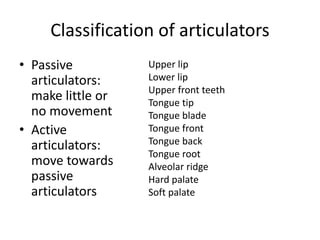
Classification of articulators 
• Passive 
articulators: 
make little or 
no movement 
• Active 
articulators: 
move towards 
passive 
articulators 
Upper lip 
Lower lip 
Upper front teeth 
Tongue tip 
Tongue blade 
Tongue front 
Tongue back 
Tongue root 
Alveolar ridge 
Hard palate 
Soft palate
Classification of articulators 
• Passive 
articulators: 
make little or 
no movement 
• Active 
articulators: 
move towards 
passive 
articulators 
Alveolar ridge 
Hard palate 
Soft palate 
Upper front teeth 
Upper lip 
Lower lip 
Tongue tip 
Tongue blade 
Tongue front 
Tongue back 
Tongue root
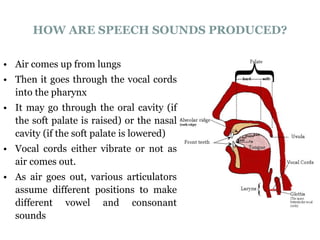
HOW ARE SPEECH SOUNDS PRODUCED? 
• Air comes up from lungs 
• Then it goes through the vocal cords 
into the pharynx 
• It may go through the oral cavity (if 
the soft palate is raised) or the nasal 
cavity (if the soft palate is lowered) 
• Vocal cords either vibrate or not as 
air comes out. 
• As air goes out, various articulators 
assume different positions to make 
different vowel and consonant 
sounds
THE VOCAL CORDS 
• Vocal cords are 
pressed together, 
so they vibrate 
• Vocal cords are 
pulled apart, so 
they do not vibrate
The glottis
THE PHARYNX 
• A tube which begins just 
above the larynx. It is behind 
the tongue and reaches up 
towards the nasal cavity. 
• At its top the pharynx is 
divided into two: the back of 
the mouth & the beginning 
of the way through nasal 
cavity.
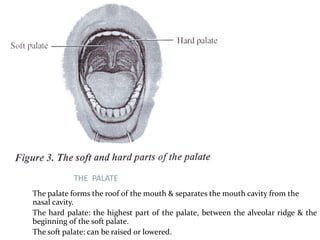
THE PALATE 
The palate forms the roof of the mouth & separates the mouth cavity from the 
nasal cavity. 
The hard palate: the highest part of the palate, between the alveolar ridge & the 
beginning of the soft palate. 
The soft palate: can be raised or lowered.
POSITIONS OF THE SOFT PALATE 
The soft palate is 
raised 
The soft palate is 
lowered
SPEECH ORGANS (cont.) 
 The alveolar ridge: between top front teeth & the hard 
palate (the part of the gums immediately behind the 
upper front teeth) 
 The tongue: an important articulator & can be moved 
into many different places & different shapes. 
 The teeth: at the front of the mouth, immediately behind 
the lips. 
 The lips: important in speech: can be pressed together; 
the lower lip can be drawn inward & slightly upwards to 
touch the upper front teeth; or they can be kept apart 
either flat or with different amounts of rounding.
The Tongue
HOW ARE SPEECH SOUNDS PRODUCED? 
1. How are oral sound produced? 
In the process of making 
sounds, at the uvula if the soft 
palate is raised, blocking off the 
nasal tract, the airstream can 
only go into oral cavity and go 
out of the mouth, then we have 
oral sounds. 
e.g. /g/,/s/,// 
2. How are nasal sounds 
produced? 
In the process of making 
sounds, if the air-stream is 
blocked somewhere in the oral 
cavity but the soft palate is 
lowered so that air-stream can 
get into the nasal tract and get 
out through the nostrils, then 
we have nasal sounds. 
e.g. /m/, /n/, /ŋ/
HOW ARE SPEECH SOUNDS PRODUCED? 
5. How are voiced sounds produced? 
When we are producing sounds, the air-stream goes through 
the vocal cords. If the vocal cords come together, obstructing 
the air-stream, the air-stream cannot get out through them 
freely and it makes them vibrate, then we have voiced sounds. 
e.g. /d/, /v/, /m/ 
6. Howare voiceless sounds produced? 
When we are making sounds, the air-stream goes through the 
vocal cords. If the vocal cords come apart, they are open. The 
air-stream can go out through them freely and it does not 
make them vibrate, then we have voiceless sounds. 
e.g. /s/, /t/, /∫/
ENGLISH SOUND SYSTEM 
17-Sep-14 
24 
consonants 
20 vowels 
44 
phonemes
HOW ARE SPEECH SOUNDS PRODUCED? 
3. How are consonant sounds produced? 
When we are making sounds, it two articulators come together, 
obstructing the air-stream and the air-stream cannot get out 
freely, we have consonant sounds. 
e.g. /k/, /f/, /b/, /m/ 
4. How are vowel sounds produced? 
When we are making sounds, if there is no obstruction to the 
flow of air as it passes from the larynx to the lips and the air can 
get out freely, the we have vowel sounds. 
e.g. /…./, /з/, /æ/, /I/
exercises 
1. Give the terms corresponding to the definitions 
- The top, curved horizonal airspace of the vocal 
tract: 
- A short flat stretch just above and behind the 
upper teeth: 
- Airspace of the vocal tract between uvula and the 
larynx: 
- The hard, bony surface of the roof of the mouth: 
- Non-bony roof part of the roof of the mouth 
behind the hard palate: 
- The two bands or folds inside the larynx:
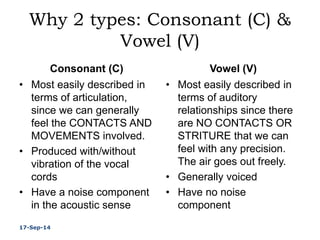
Why 2 types: Consonant (C) & 
Vowel (V) 
Consonant (C) Vowel (V) 
17-Sep-14
Why 2 types: Consonant (C) & 
Vowel (V) 
Consonant (C) 
• Most easily described in 
terms of articulation, 
since we can generally 
feel the CONTACTS AND 
MOVEMENTS involved. 
• Produced with/without 
vibration of the vocal 
cords 
• Have a noise component 
in the acoustic sense 
Vowel (V) 
• Most easily described in 
terms of auditory 
relationships since there 
are NO CONTACTS OR 
STRITURE that we can 
feel with any precision. 
The air goes out freely. 
• Generally voiced 
• Have no noise 
component 
17-Sep-14
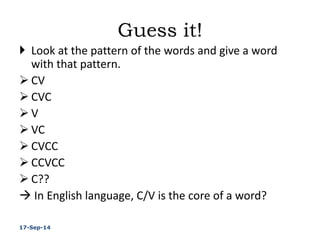
Guess it! 
 Look at the pattern of the words and give a word 
with that pattern. 
 CV 
 CVC 
 V 
 VC 
 CVCC 
 CCVCC 
 C?? 
 In English language, C/V is the core of a word? 
17-Sep-14
Questions for the next session 
• What are consonants? 
• How are consonants in English described 
and classified?

Speech organ1

  • 2.
    B. Transcribe thefollowing sentences Campers: Nature's way of feeding mosquitoes. Why is "abbreviation" such a long word? I took an IQ test and the results were negative. I used to think I was indecisive, but now I'm not sure. C. Read the following 1. ˈtiːtʃə: ˈwɒt də ju kɔːl ə ˈpɜːsən huː kiːps ɒn ˈtɔːkɪŋ wen ˈpiːpəl ə nəʊ ˈlɒŋɡər ˈɪntrəstɪd | ˈstjuːdnt: ə ˈtiːtʃə 2. dæd : sʌn, ju ˈbetə pɑːs ðɪs ɪɡˈzæm ɔː ˈrɑːðə fəˈɡet ðət ˈaɪ əm jə ˈfɑːðə sʌn: ʃʊə dæd. wɒtˈevə faɪv ˈaʊəz ˈleɪtə dæd: haʊz jər ɪɡˈzæm sʌn: huː ðə hel ə ju
  • 3.
    LECTURE 1 1.Phonetics vs. Phonology 2. Speech Organs 3. How are speech sounds produced? 4. Consonants vs. Vowels 5. Basic Concepts & Definitions
  • 4.
    Phonetics • Thestudy of human speech sounds • Describes how sounds are produced (articulatory phonetics) Phonology • The study of how sounds are organised and used in natural languages • Studies how these sounds combine and how they change in combination
  • 5.
    A. Nasal cavity B. Vocal cords C. Tongue root D. Lips – labial E. Tongue tip F. Pharynx – pharyngeal G. Oral cavity H. Tongue back I. Teeth – dental J. Tongue blade K. Hard Palate – palatal L. Tongue front M. Alveolar ridge – alveolar N. Uvula – uvular O. Velum – Velar (solf palate) P. Larynx Q. Nostrils R. Glottis S. Epiglottis
  • 6.
    1. L. Alveolarridge – alveolar 2. A. Nostrils 3. D. Lips – labial 4. A. Nasal cavity 5. G. Oral cavity 6. I. Teeth – dental 7. K. Hard Palate – palatal 8. J.Tongue tip E. Tongue blade L. Tongue front H Tongue back C. Tongue root 9. B. Vocal cords 10. F. Pharynx – pharyngeal 11. R. Glottis 12. O. Velum – Velar (solf palate) 13. N. Uvula 14. S. Epiglottis 15. P. Larynx
  • 7.
    Classification of articulators • Passive articulators: make little or no movement • Active articulators: move towards passive articulators Upper lip Lower lip Upper front teeth Tongue tip Tongue blade Tongue front Tongue back Tongue root Alveolar ridge Hard palate Soft palate
  • 8.
    Classification of articulators • Passive articulators: make little or no movement • Active articulators: move towards passive articulators Alveolar ridge Hard palate Soft palate Upper front teeth Upper lip Lower lip Tongue tip Tongue blade Tongue front Tongue back Tongue root
  • 9.
    HOW ARE SPEECHSOUNDS PRODUCED? • Air comes up from lungs • Then it goes through the vocal cords into the pharynx • It may go through the oral cavity (if the soft palate is raised) or the nasal cavity (if the soft palate is lowered) • Vocal cords either vibrate or not as air comes out. • As air goes out, various articulators assume different positions to make different vowel and consonant sounds
  • 10.
    THE VOCAL CORDS • Vocal cords are pressed together, so they vibrate • Vocal cords are pulled apart, so they do not vibrate
  • 11.
  • 12.
    THE PHARYNX •A tube which begins just above the larynx. It is behind the tongue and reaches up towards the nasal cavity. • At its top the pharynx is divided into two: the back of the mouth & the beginning of the way through nasal cavity.
  • 13.
    THE PALATE Thepalate forms the roof of the mouth & separates the mouth cavity from the nasal cavity. The hard palate: the highest part of the palate, between the alveolar ridge & the beginning of the soft palate. The soft palate: can be raised or lowered.
  • 14.
    POSITIONS OF THESOFT PALATE The soft palate is raised The soft palate is lowered
  • 15.
    SPEECH ORGANS (cont.)  The alveolar ridge: between top front teeth & the hard palate (the part of the gums immediately behind the upper front teeth)  The tongue: an important articulator & can be moved into many different places & different shapes.  The teeth: at the front of the mouth, immediately behind the lips.  The lips: important in speech: can be pressed together; the lower lip can be drawn inward & slightly upwards to touch the upper front teeth; or they can be kept apart either flat or with different amounts of rounding.
  • 16.
  • 17.
    HOW ARE SPEECHSOUNDS PRODUCED? 1. How are oral sound produced? In the process of making sounds, at the uvula if the soft palate is raised, blocking off the nasal tract, the airstream can only go into oral cavity and go out of the mouth, then we have oral sounds. e.g. /g/,/s/,// 2. How are nasal sounds produced? In the process of making sounds, if the air-stream is blocked somewhere in the oral cavity but the soft palate is lowered so that air-stream can get into the nasal tract and get out through the nostrils, then we have nasal sounds. e.g. /m/, /n/, /ŋ/
  • 18.
    HOW ARE SPEECHSOUNDS PRODUCED? 5. How are voiced sounds produced? When we are producing sounds, the air-stream goes through the vocal cords. If the vocal cords come together, obstructing the air-stream, the air-stream cannot get out through them freely and it makes them vibrate, then we have voiced sounds. e.g. /d/, /v/, /m/ 6. Howare voiceless sounds produced? When we are making sounds, the air-stream goes through the vocal cords. If the vocal cords come apart, they are open. The air-stream can go out through them freely and it does not make them vibrate, then we have voiceless sounds. e.g. /s/, /t/, /∫/
  • 19.
    ENGLISH SOUND SYSTEM 17-Sep-14 24 consonants 20 vowels 44 phonemes
  • 20.
    HOW ARE SPEECHSOUNDS PRODUCED? 3. How are consonant sounds produced? When we are making sounds, it two articulators come together, obstructing the air-stream and the air-stream cannot get out freely, we have consonant sounds. e.g. /k/, /f/, /b/, /m/ 4. How are vowel sounds produced? When we are making sounds, if there is no obstruction to the flow of air as it passes from the larynx to the lips and the air can get out freely, the we have vowel sounds. e.g. /…./, /з/, /æ/, /I/
  • 21.
    exercises 1. Givethe terms corresponding to the definitions - The top, curved horizonal airspace of the vocal tract: - A short flat stretch just above and behind the upper teeth: - Airspace of the vocal tract between uvula and the larynx: - The hard, bony surface of the roof of the mouth: - Non-bony roof part of the roof of the mouth behind the hard palate: - The two bands or folds inside the larynx:
  • 22.
    Why 2 types:Consonant (C) & Vowel (V) Consonant (C) Vowel (V) 17-Sep-14
  • 23.
    Why 2 types:Consonant (C) & Vowel (V) Consonant (C) • Most easily described in terms of articulation, since we can generally feel the CONTACTS AND MOVEMENTS involved. • Produced with/without vibration of the vocal cords • Have a noise component in the acoustic sense Vowel (V) • Most easily described in terms of auditory relationships since there are NO CONTACTS OR STRITURE that we can feel with any precision. The air goes out freely. • Generally voiced • Have no noise component 17-Sep-14
  • 24.
    Guess it! Look at the pattern of the words and give a word with that pattern.  CV  CVC  V  VC  CVCC  CCVCC  C??  In English language, C/V is the core of a word? 17-Sep-14
  • 25.
    Questions for thenext session • What are consonants? • How are consonants in English described and classified?