“In The Name Of Allah Who Is Most
Bonteous And Merciful”
• Phonology is the scientific study of the
sound system and patterns of a language.
• It is based on a theory of what every
speaker of a language unconsciously
knows about sound patterns of that
language.
• Provide examples..
cont.,
• We think of the [t] sound in the following words to
be the same:
- tar
- star
- writer
- eighth
 Phonemes:
 The minimal meaningful speech sound
of unit.
A phoneme is the minimal distinctive
Phonemes are written between slashes
e.g. /t/
 Phonemes function contrastively
e.g. /f/ and /v/
fat vat
fine vine
 Phones are: phonetic units and appear
in square brackets.
 We can have several versions of one
phoneme. These are allophones of one
phoneme.
e.g. /t/ 1 phone [tʰ] tar
phoneme
1 phone [ ] writer
1phone [ ] eighth
Allophones
 How do we test phonemes?
We test phonemes by pairs and sets of words.
 Minimal pair:
When two words are identical in form except for a
contrast in one phoneme occurring in the same
position, then the two words are described a
minimal pair.
e.g. bat vs. fat
bat vs. bet
 Minimal sets:
When a group of words can be
differentiated by changing one
phoneme in the same position in the
word, then we have a minimal set.
e.g. feat
fit
fat
fate
foot
 The Scientific study of Speech sound of a
language in general is phonatics.
 Phonotactics are the permitted
arrangements of sounds in a a language
are part of the every speaker’s
phonological knowledge.
 Accidental gaps in the vocabulary of
english……
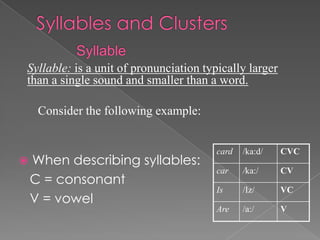
 When describing syllables:
C = consonant
V = vowel
Syllable: is a unit of pronunciation typically larger
than a single sound and smaller than a word.
CVC/ka:d/card
CV/ka:/car
VC/Iz/Is
V/a:/Are
Consider the following example:
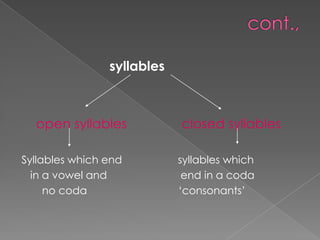
syllables
open syllables closed syllables
Syllables which end syllables which
in a vowel and end in a coda
no coda ‘consonants’
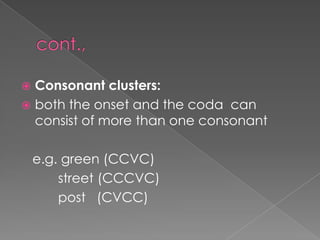
 Consonant clusters:
 both the onset and the coda can
consist of more than one consonant
e.g. green (CCVC)
street (CCCVC)
post (CVCC)
 The process of making one sound almost
at the same time as the next is called co-
articulation.
 We have been describing the
production of speech in slow motion.
 On the contrary, our speech is fast and
spontaneous.
 Our articulators move very quickly from
one sound to another without stopping.
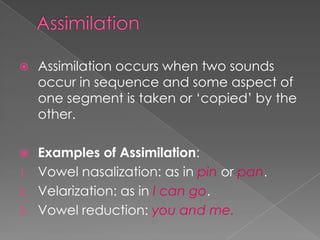
 Assimilation occurs when two sounds
occur in sequence and some aspect of
one segment is taken or ‘copied’ by the
other.
 Examples of Assimilation:
1. Vowel nasalization: as in pin or pan.
2. Velarization: as in I can go.
3. Vowel reduction: you and me.
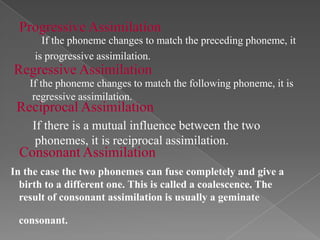
If the phoneme changes to match the preceding phoneme, it
is progressive assimilation.
If the phoneme changes to match the following phoneme, it is
regressive assimilation.
If there is a mutual influence between the two
phonemes, it is reciprocal assimilation.
In the case the two phonemes can fuse completely and give a
birth to a different one. This is called a coalescence. The
result of consonant assimilation is usually a geminate
consonant.
 Elision is the process of not pronouncing
a sound segment that might be present
in the deliberately careful
pronunciation.
 Examples of elision:
1. You and me
2. Friendship
3. aspects
We have studied about the
Phonology
Phonemes
Phones & Allophones
Minimal pairs & Sets
Phonotectics
Syllables & Clusters
Co-articulations
Assimilation & Elision
Chapter # 6- Sound patterns of language

Chapter # 6- Sound patterns of language

  • 1.
    “In The NameOf Allah Who Is Most Bonteous And Merciful”
  • 3.
    • Phonology isthe scientific study of the sound system and patterns of a language. • It is based on a theory of what every speaker of a language unconsciously knows about sound patterns of that language. • Provide examples..
  • 4.
    cont., • We thinkof the [t] sound in the following words to be the same: - tar - star - writer - eighth
  • 5.
     Phonemes:  Theminimal meaningful speech sound of unit. A phoneme is the minimal distinctive Phonemes are written between slashes e.g. /t/  Phonemes function contrastively e.g. /f/ and /v/ fat vat fine vine
  • 6.
     Phones are:phonetic units and appear in square brackets.  We can have several versions of one phoneme. These are allophones of one phoneme. e.g. /t/ 1 phone [tʰ] tar phoneme 1 phone [ ] writer 1phone [ ] eighth Allophones
  • 7.
     How dowe test phonemes? We test phonemes by pairs and sets of words.  Minimal pair: When two words are identical in form except for a contrast in one phoneme occurring in the same position, then the two words are described a minimal pair. e.g. bat vs. fat bat vs. bet
  • 8.
     Minimal sets: Whena group of words can be differentiated by changing one phoneme in the same position in the word, then we have a minimal set. e.g. feat fit fat fate foot
  • 9.
     The Scientificstudy of Speech sound of a language in general is phonatics.  Phonotactics are the permitted arrangements of sounds in a a language are part of the every speaker’s phonological knowledge.  Accidental gaps in the vocabulary of english……
  • 10.
     When describingsyllables: C = consonant V = vowel Syllable: is a unit of pronunciation typically larger than a single sound and smaller than a word. CVC/ka:d/card CV/ka:/car VC/Iz/Is V/a:/Are Consider the following example:
  • 11.
    syllables open syllables closedsyllables Syllables which end syllables which in a vowel and end in a coda no coda ‘consonants’
  • 12.
     Consonant clusters: both the onset and the coda can consist of more than one consonant e.g. green (CCVC) street (CCCVC) post (CVCC)
  • 13.
     The processof making one sound almost at the same time as the next is called co- articulation.  We have been describing the production of speech in slow motion.  On the contrary, our speech is fast and spontaneous.  Our articulators move very quickly from one sound to another without stopping.
  • 14.
     Assimilation occurswhen two sounds occur in sequence and some aspect of one segment is taken or ‘copied’ by the other.  Examples of Assimilation: 1. Vowel nasalization: as in pin or pan. 2. Velarization: as in I can go. 3. Vowel reduction: you and me.
  • 15.
    If the phonemechanges to match the preceding phoneme, it is progressive assimilation. If the phoneme changes to match the following phoneme, it is regressive assimilation. If there is a mutual influence between the two phonemes, it is reciprocal assimilation. In the case the two phonemes can fuse completely and give a birth to a different one. This is called a coalescence. The result of consonant assimilation is usually a geminate consonant.
  • 16.
     Elision isthe process of not pronouncing a sound segment that might be present in the deliberately careful pronunciation.  Examples of elision: 1. You and me 2. Friendship 3. aspects
  • 17.
    We have studiedabout the Phonology Phonemes Phones & Allophones Minimal pairs & Sets Phonotectics Syllables & Clusters Co-articulations Assimilation & Elision