1
PHONETICS & PHONOLOGY
1
Aisha Koukab
Lecturer in English
Deptt. of Social Sciences & Humanities
University of Agriculture,
Faisalabad.
OVERVIEW
 What is Phonetics and Phonology ?
 Branches of Phonetics
 Phonetics vs. Phonology
 IPA
 Speech Organs
 Place of articulation
 Manner of articulation
PHONETICS
 The word “ Phone” means sound and “tics”
means scientific or systematic study of
something. So we can say that Phonetics
means scientific or systematic study of
human speech sounds.
 Phonetics is general study of all human
speech sounds and how they are produced,
transmitted and received.
BRANCHES OF PHONETICS
 The study of phonetics can be divided into
three main branches.
1. Articulatory Phonetics(How sounds are
produced?)
2. Auditory Phonetics(How sounds are
received?)
3. Acoustic Phonetics(How sounds are
transmitted?)
ARTICULATORY PHONETICS
It is concerned with the positions and
movements of the lips, tongue, and other
speech organs in producing speech. It
analyses how the various speech sounds are
articulated by vocal organs.
AUDITORY PHONETICS
 Auditory Phonetics is the study of hearing
and the perception of speech sounds.
ACOUSTIC PHONETICS
 This branch of phonetics is concerned with
the properties of sound waves.
 It studies the physical properties of speech
sounds as transmitted between the mouth
and ear.
PHONOLOGY
 Phonology is a broader study of major
speech sounds and their organization in a
particular language.
DIFFERENCE BETWEEN PHONETICS & PHONOLOGY
THE DIFFERENCE BETWEEN PHONETICS & PHONOLOGY IS
THAT OF GENERALITY AND PARTICULARITY.
PHONETICS PHONOLOGY
 Phonetics deals with
production,
transmission and
reception of all human
speech sounds in
general with no
particular reference to
any one language.
 Phonology deals
with the ways those
sounds are
organized in a
particular language.
It is sub-category of
phonetics.
WHY THE STUDY OF PHONETICS IS IMPORTANT?
 A knowledge of Phonetics is a must for a learner
of the English language. This knowledge
enables him/her:
1. To give a true description of sounds of English
and how they are made.
2. To point out the mistakes in leaner’s
pronunciation and help them learn the correct
form.
3. To differentiate sounds of English from those of
the mother tongue.
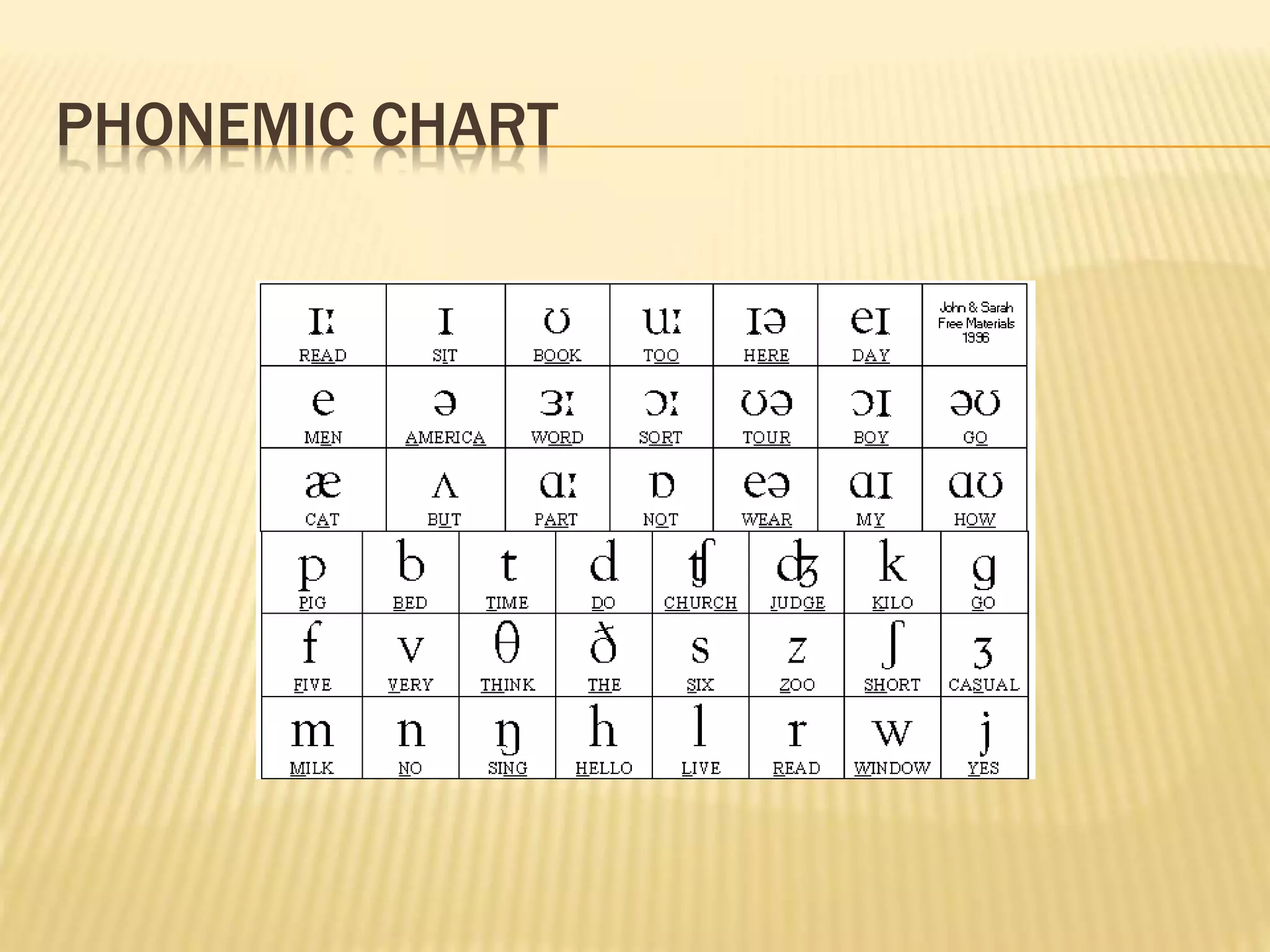
IPA
 Definition: The most widely used system for
representing the sounds of any language.
 A reproduction of the latest version of the
International Phonetic Alphabet (2005) is
available at the website of the International
Phonetic Association.
SPEECH ORGANS
 Besides a brain (and the knowledge of the
language), what do you need to use the
spoken language?
 These are the speech organs.
SPEECH ORGANS THAT BELONG TO THE
ARTICULATORY SYSTEM
Lips
- they serve for creating different sounds -
mainly the labial, bilabial (e.g. /p/, /b/, /m/,
/hw/, and /w/) and labio-dental consonant
sounds (e. g. /f/ and /v/ - and thus create an
important part of the speech apparatus.
Upper Lip
Lower Lip
TEETH
- teeth
- Small whitish structures found in jaws
responsible for creating sounds mainly
the labio-dental (e.g. /f/ and /v/and lingua-
dental (e.g. /ð/and /θ/)
Teeth
tongue
- with its wide variety of possible movements,
it assists in forming the sounds of speech.
TONGUE
Back
Middle(Dorsum)
Front(Blade)
Tip(Apex)
Alveolar ridge
- hard ridge behind the upper front teeth. It is
between the roof of the mouth and the upper
teeth.
 For the sound /s/, air from the lungs passes
continuously through the mouth, but the
tongue is raised sufficiently close to the
alveolar ridge (the section of the upper jaw
containing the tooth sockets) to cause friction
as it partially blocks the air that passes.
Alveolar Ridge
Hard palate
 a thin horizontal bony plate of the skull,
located in the roof of the mouth.
 the interaction between the tongue and the
hard palate is essential in the formation of
certain speech sounds, notably /t/, /d/, and
/j/.
Hard Palate
Velum(soft palate)
- it should have holes forming that function
during speech to separate the oral cavity
(mouth) from the nose, in order to produce
the oral speech sounds. If this separation is
incomplete, air escapes through the nose
during speech and the speech is perceived
as hyper nasal.
Velum or Soft
Palate
Uvula
- it functions in tandem with the back of the
throat, the palate, and air coming up from the
lungs to create a number of guttural and
other sounds.
- In many languages, it closes to prevent air
escaping through the nose when making
some sounds.
Uvula
Glottis
 combination of vocal folds and space in
between the folds
 as the vocal folds vibrate, the resulting
vibration produces a “buzzing” quality to the
speech called voice or voicing or
pronunciation.
 sound production involving only the glottis is
called glottal. Example is the sound /h/.
Glottis
Alveolar ridge
SPEECH ORGANS
Upper lip
Lower lip
Teeth
Hard Palate
Soft Palate
Uvula
Back
Middle(Dorsum)
Front(Blade)
Tip (Apex)
Glottis
ARTICULATION
 Voiceless: When the vocal folds are spread
apart, the air from the lungs passes between
them without obstruction. Sounds produced
in this way are described as voiceless.
Sounds such as S-S-S-S or F-F-F-F are
voiceless.
 Voiced: When the vocal folds are drawn
together, the air from the lungs repeatedly
pushes them apart as it passes through,
creating a vibration effect. Sounds produced
in this way are described as voiced. Sounds
such as Z-Z-Z-Z or V-V-V-V.
CLASSIFICATION OF ENGLISH SOUNDS
 The English Language sounds are classified
into two main streams:
1. Consonants
2. Vowels
Consonants:
A Consonant is a sound that is articulated with
complete or partial closure of the air stream by
constriction of speech organs.
 There are 24 consonants in English.
VOWELS
 Vowels are sounds in which there is no
obstruction in the flow of air as it passes from
the larynx to the lips.
PHONEMIC CHART
CONSONANTS SYMBOL CHART
Plosive
p b t
d k
ɡ
Fricative f v s z θ ð ʃ ʒ h
Nasal m n ŋ
Affricates tʃ dʒ
Lateral l
Approximant w r j
MANNER OF ARTICULATION
 Manner of articulation describes how the
tongue, lips, jaw, and other speech organs
are involved in making a sound. For
example, [t] and [s] are both voiceless
alveolar sounds. They differ in their manner
of articulation, that is, in the way they are
pronounced. The [t] sound is one of a set of
sounds called stops and the [s] sound is one
of a set called fricatives.
PLOSIVES
 There are six plosive consonants in English.
These are the sounds formed by means of a
complete closure of the air passage, which is
afterwards released suddenly.
These are given as followed:
/p/ /b/ /t/ /d/ /k/ /g/
pen bet tea dress kind good
ASPIRATION
 Aspiration is a period during which air
escapes through vocal cords, making a
sound like “h”.
 There are three plosives in English
Phonology which are aspirated when they
are pronounced as initial sounds in a word.
 They are symbolized as:
/ph/ /th/ /kh/
e.g. Pet /phet/ Tailor /theɪlə/ Cool /khu:l/
FRICATIVES
In production of Fricatives, articulators move towards
each other to make stricture or obstruction in flow of
air but air cannot be stopped completely and it
escapes through narrow passage with friction or
hissing sound.
Fricatives are 9 in number.
/f / /v/ /s/ /z/ /θ/ /ð/ /ʃ/ /ʒ/ /h/
Fine very song zeal through these sheet
treasure hay
NASAL
There are three nasal sounds in English.
These sounds are pronounced or uttered by
escaping the air (partially or completely)
through nasal cavity.
These are given as followed:
/m/ /n/ /ŋ/
Miss nine sing
Melancholy Naïve Finger
AFFRICATES
There are two affricate sounds in English.
These are the sounds formed by means of a
complete closure of the air passage which is
afterwards released slowly with friction.
/tʃ/
/dʒ/
Chair germ
LATERAL
There is only one sound in English. While
uttering this sound air escapes along the both
sides of the tongue.
/l/
Like, life, silly
APPROXIMANTS/SEMI-VOWELS
There are three semi-vowels. These sounds are
phonetically vowels and phonologically
consonants. Phonetically means their mechanism
of producing the sound is same as vowels
because there is no obstruction in flow of air.
But phonologically, they give sounds like
consonants.
/w/ /r/ /j/
Wine read young
PLACE OF ARTICULATION
The point where
a sound is
produced is
referred to as
its place of
articulation.
Symbols are
enclosed with
square brackets [
]
These are
sounds formed
using both upper
and lower lips.
The initial sounds
in the words pat,
bat, way and
mat are all
bilabials. They
are represented
by the symbols
[p] [b] [m] and
[w].
BILABIALS
LABIO-DENTAL
These are sounds
formed with the upper
teeth and the lower lip.
The initial sounds of the
words fat and vat and
the final sounds of safe
and save are
labiodentals. Symbols
are [f] [v]. The final
sound in the word
cough, and the initial
sound in photo, despite
the spelling differences,
are both pronounced as
[f].
DENTALS
These sounds are
formed with the
tongue tip behind
the upper front
teeth. The initial
sound of thin and
the final sound of
bath are both
dentals. The symbol
used for these
sounds are [θ], [ð],
e.g the, there, then
&thus
ALVEOLARS
These are sounds
formed with the front part
of the tongue on the
alveolar ridge, which is
the rough, bony ridge
immediately behind and
above the upper teeth.
The initial sounds in top,
dip, sit, zoo, nut, lap,
lit, and right are all
alveolars. The symbols
are– [t], [d], [s], [z], [n]
[l] [r]
PLATALS
Sounds produced
with the tongue and
the palate are called
palatals. The initial
sounds in the words
shout and child. [ʃ]
[ʧ]. So, the word
shoe-brush begins
and ends with the
palatal sound [ʃ] and
the word church
begins and ends
with the palatal
sound [ʧ].
VELARS
Sounds produced with
the back of the tongue
against the velum are
called velars.
Represented by the
symbol [k], [g] and [ŋ]
kid, kill go, gun, give,
sing and ringing also
the initial sound in car
and cold. Despite the
variety in spelling, this
[k] sound is both then
initial and final sound in
the words cook, kick
and coke.
GLOTTIS
There is one sound that
is produced without the
active use of the tongue
and other parts of the
mouth. It is the sound [h]
which occurs at the
beginning of have and
house. When the glottis
is open and there is no
manipulation of the air
passing out of the
mouth, the sound
produced is that
represented by [h].

Phonetics & Phonology Mine.pptx

  • 1.
  • 2.
    PHONETICS & PHONOLOGY 1 AishaKoukab Lecturer in English Deptt. of Social Sciences & Humanities University of Agriculture, Faisalabad.
  • 3.
    OVERVIEW  What isPhonetics and Phonology ?  Branches of Phonetics  Phonetics vs. Phonology  IPA  Speech Organs  Place of articulation  Manner of articulation
  • 4.
    PHONETICS  The word“ Phone” means sound and “tics” means scientific or systematic study of something. So we can say that Phonetics means scientific or systematic study of human speech sounds.  Phonetics is general study of all human speech sounds and how they are produced, transmitted and received.
  • 5.
    BRANCHES OF PHONETICS The study of phonetics can be divided into three main branches. 1. Articulatory Phonetics(How sounds are produced?) 2. Auditory Phonetics(How sounds are received?) 3. Acoustic Phonetics(How sounds are transmitted?)
  • 6.
    ARTICULATORY PHONETICS It isconcerned with the positions and movements of the lips, tongue, and other speech organs in producing speech. It analyses how the various speech sounds are articulated by vocal organs.
  • 7.
    AUDITORY PHONETICS  AuditoryPhonetics is the study of hearing and the perception of speech sounds.
  • 8.
    ACOUSTIC PHONETICS  Thisbranch of phonetics is concerned with the properties of sound waves.  It studies the physical properties of speech sounds as transmitted between the mouth and ear.
  • 9.
    PHONOLOGY  Phonology isa broader study of major speech sounds and their organization in a particular language.
  • 10.
    DIFFERENCE BETWEEN PHONETICS& PHONOLOGY THE DIFFERENCE BETWEEN PHONETICS & PHONOLOGY IS THAT OF GENERALITY AND PARTICULARITY. PHONETICS PHONOLOGY  Phonetics deals with production, transmission and reception of all human speech sounds in general with no particular reference to any one language.  Phonology deals with the ways those sounds are organized in a particular language. It is sub-category of phonetics.
  • 11.
    WHY THE STUDYOF PHONETICS IS IMPORTANT?  A knowledge of Phonetics is a must for a learner of the English language. This knowledge enables him/her: 1. To give a true description of sounds of English and how they are made. 2. To point out the mistakes in leaner’s pronunciation and help them learn the correct form. 3. To differentiate sounds of English from those of the mother tongue.
  • 12.
    IPA  Definition: Themost widely used system for representing the sounds of any language.  A reproduction of the latest version of the International Phonetic Alphabet (2005) is available at the website of the International Phonetic Association.
  • 13.
    SPEECH ORGANS  Besidesa brain (and the knowledge of the language), what do you need to use the spoken language?  These are the speech organs.
  • 14.
    SPEECH ORGANS THATBELONG TO THE ARTICULATORY SYSTEM Lips - they serve for creating different sounds - mainly the labial, bilabial (e.g. /p/, /b/, /m/, /hw/, and /w/) and labio-dental consonant sounds (e. g. /f/ and /v/ - and thus create an important part of the speech apparatus.
  • 15.
  • 16.
    TEETH - teeth - Smallwhitish structures found in jaws responsible for creating sounds mainly the labio-dental (e.g. /f/ and /v/and lingua- dental (e.g. /ð/and /θ/)
  • 17.
  • 18.
    tongue - with itswide variety of possible movements, it assists in forming the sounds of speech.
  • 19.
  • 20.
    Alveolar ridge - hardridge behind the upper front teeth. It is between the roof of the mouth and the upper teeth.
  • 21.
     For thesound /s/, air from the lungs passes continuously through the mouth, but the tongue is raised sufficiently close to the alveolar ridge (the section of the upper jaw containing the tooth sockets) to cause friction as it partially blocks the air that passes.
  • 22.
  • 23.
    Hard palate  athin horizontal bony plate of the skull, located in the roof of the mouth.  the interaction between the tongue and the hard palate is essential in the formation of certain speech sounds, notably /t/, /d/, and /j/.
  • 24.
  • 25.
    Velum(soft palate) - itshould have holes forming that function during speech to separate the oral cavity (mouth) from the nose, in order to produce the oral speech sounds. If this separation is incomplete, air escapes through the nose during speech and the speech is perceived as hyper nasal.
  • 26.
  • 27.
    Uvula - it functionsin tandem with the back of the throat, the palate, and air coming up from the lungs to create a number of guttural and other sounds. - In many languages, it closes to prevent air escaping through the nose when making some sounds.
  • 28.
  • 29.
    Glottis  combination ofvocal folds and space in between the folds  as the vocal folds vibrate, the resulting vibration produces a “buzzing” quality to the speech called voice or voicing or pronunciation.  sound production involving only the glottis is called glottal. Example is the sound /h/.
  • 30.
  • 31.
    Alveolar ridge SPEECH ORGANS Upperlip Lower lip Teeth Hard Palate Soft Palate Uvula Back Middle(Dorsum) Front(Blade) Tip (Apex) Glottis
  • 32.
    ARTICULATION  Voiceless: Whenthe vocal folds are spread apart, the air from the lungs passes between them without obstruction. Sounds produced in this way are described as voiceless. Sounds such as S-S-S-S or F-F-F-F are voiceless.  Voiced: When the vocal folds are drawn together, the air from the lungs repeatedly pushes them apart as it passes through, creating a vibration effect. Sounds produced in this way are described as voiced. Sounds such as Z-Z-Z-Z or V-V-V-V.
  • 33.
    CLASSIFICATION OF ENGLISHSOUNDS  The English Language sounds are classified into two main streams: 1. Consonants 2. Vowels Consonants: A Consonant is a sound that is articulated with complete or partial closure of the air stream by constriction of speech organs.  There are 24 consonants in English.
  • 34.
    VOWELS  Vowels aresounds in which there is no obstruction in the flow of air as it passes from the larynx to the lips.
  • 35.
  • 37.
    CONSONANTS SYMBOL CHART Plosive pb t d k ɡ Fricative f v s z θ ð ʃ ʒ h Nasal m n ŋ Affricates tʃ dʒ Lateral l Approximant w r j
  • 38.
    MANNER OF ARTICULATION Manner of articulation describes how the tongue, lips, jaw, and other speech organs are involved in making a sound. For example, [t] and [s] are both voiceless alveolar sounds. They differ in their manner of articulation, that is, in the way they are pronounced. The [t] sound is one of a set of sounds called stops and the [s] sound is one of a set called fricatives.
  • 39.
    PLOSIVES  There aresix plosive consonants in English. These are the sounds formed by means of a complete closure of the air passage, which is afterwards released suddenly. These are given as followed: /p/ /b/ /t/ /d/ /k/ /g/ pen bet tea dress kind good
  • 40.
    ASPIRATION  Aspiration isa period during which air escapes through vocal cords, making a sound like “h”.  There are three plosives in English Phonology which are aspirated when they are pronounced as initial sounds in a word.  They are symbolized as: /ph/ /th/ /kh/ e.g. Pet /phet/ Tailor /theɪlə/ Cool /khu:l/
  • 41.
    FRICATIVES In production ofFricatives, articulators move towards each other to make stricture or obstruction in flow of air but air cannot be stopped completely and it escapes through narrow passage with friction or hissing sound. Fricatives are 9 in number. /f / /v/ /s/ /z/ /θ/ /ð/ /ʃ/ /ʒ/ /h/ Fine very song zeal through these sheet treasure hay
  • 42.
    NASAL There are threenasal sounds in English. These sounds are pronounced or uttered by escaping the air (partially or completely) through nasal cavity. These are given as followed: /m/ /n/ /ŋ/ Miss nine sing Melancholy Naïve Finger
  • 43.
    AFFRICATES There are twoaffricate sounds in English. These are the sounds formed by means of a complete closure of the air passage which is afterwards released slowly with friction. /tʃ/ /dʒ/ Chair germ
  • 44.
    LATERAL There is onlyone sound in English. While uttering this sound air escapes along the both sides of the tongue. /l/ Like, life, silly
  • 45.
    APPROXIMANTS/SEMI-VOWELS There are threesemi-vowels. These sounds are phonetically vowels and phonologically consonants. Phonetically means their mechanism of producing the sound is same as vowels because there is no obstruction in flow of air. But phonologically, they give sounds like consonants. /w/ /r/ /j/ Wine read young
  • 46.
    PLACE OF ARTICULATION Thepoint where a sound is produced is referred to as its place of articulation. Symbols are enclosed with square brackets [ ]
  • 47.
    These are sounds formed usingboth upper and lower lips. The initial sounds in the words pat, bat, way and mat are all bilabials. They are represented by the symbols [p] [b] [m] and [w]. BILABIALS
  • 48.
    LABIO-DENTAL These are sounds formedwith the upper teeth and the lower lip. The initial sounds of the words fat and vat and the final sounds of safe and save are labiodentals. Symbols are [f] [v]. The final sound in the word cough, and the initial sound in photo, despite the spelling differences, are both pronounced as [f].
  • 49.
    DENTALS These sounds are formedwith the tongue tip behind the upper front teeth. The initial sound of thin and the final sound of bath are both dentals. The symbol used for these sounds are [θ], [ð], e.g the, there, then &thus
  • 50.
    ALVEOLARS These are sounds formedwith the front part of the tongue on the alveolar ridge, which is the rough, bony ridge immediately behind and above the upper teeth. The initial sounds in top, dip, sit, zoo, nut, lap, lit, and right are all alveolars. The symbols are– [t], [d], [s], [z], [n] [l] [r]
  • 51.
    PLATALS Sounds produced with thetongue and the palate are called palatals. The initial sounds in the words shout and child. [ʃ] [ʧ]. So, the word shoe-brush begins and ends with the palatal sound [ʃ] and the word church begins and ends with the palatal sound [ʧ].
  • 52.
    VELARS Sounds produced with theback of the tongue against the velum are called velars. Represented by the symbol [k], [g] and [ŋ] kid, kill go, gun, give, sing and ringing also the initial sound in car and cold. Despite the variety in spelling, this [k] sound is both then initial and final sound in the words cook, kick and coke.
  • 53.
    GLOTTIS There is onesound that is produced without the active use of the tongue and other parts of the mouth. It is the sound [h] which occurs at the beginning of have and house. When the glottis is open and there is no manipulation of the air passing out of the mouth, the sound produced is that represented by [h].