Downloaded 505 times
![Feature Systems
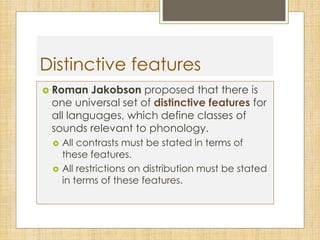
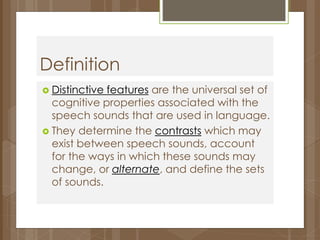
The formal development of distinctive feature
theory is due primarily to Roman Jakobson.
a) Only binary oppositions are accepted.[+/-]
b) Descriptions should be based on a minimum
number of DFs.
c) These are selected from a limited set of
universal DFs.
d) The DF values for the sounds of a language are
arranged as a matrix with +, – and 0 (not
relevant) values.](https://image.slidesharecdn.com/distinctivefeatures-141108110307-conversion-gate01/85/Distinctive-features-4-320.jpg)
![Major Class Features
The major class features are:
[consonantal] +obstruent; -vowels, glides
[sonorant]
[syllabic] +vowels; -consonants
They define major classes of sounds, such
as consonant and vowel, sonorant and
obstruent.](https://image.slidesharecdn.com/distinctivefeatures-141108110307-conversion-gate01/85/Distinctive-features-5-320.jpg)
![Laryngeal Features
The laryngeal features are:
[voice]
[spread glottis] +aspirated; -unaspirated
[constricted glottis] +glottal; -glottal
They define glottal state of sounds thus
classifying into voiced and voiceless,
aspirated and unaspirated.](https://image.slidesharecdn.com/distinctivefeatures-141108110307-conversion-gate01/85/Distinctive-features-6-320.jpg)
![Place Features
The place features are:
[Labial] +bilabial, labiodental
[Coronal] +dental, alveolar
[Dorsal] +palatal, velar
They specify the place of articulation.](https://image.slidesharecdn.com/distinctivefeatures-141108110307-conversion-gate01/85/Distinctive-features-7-320.jpg)
![Manner Features
The manner features are:
[Continuant] +no obstruction
[Nasal] +velum lowered
[Lateral] +laterals
[Delayed release] +affricates; -stops
They specify the manner of articulation.](https://image.slidesharecdn.com/distinctivefeatures-141108110307-conversion-gate01/85/Distinctive-features-8-320.jpg)
![Some consonant classes
[son] [cont] [del rel]
Plosives - - -
Affricates - - +
Fricatives - + +
Nasals + - -
Approximants + + -](https://image.slidesharecdn.com/distinctivefeatures-141108110307-conversion-gate01/85/Distinctive-features-9-320.jpg)
![Height Features
[high]: A sound is [+high] if it is produced
with the tongue body raised from neutral
(mid central) position; otherwise it is
[-high].
[low]: A sound is [+low] if it is produced
with the tongue body lowered from
neutral (mid central) position; otherwise it
is [-low].](https://image.slidesharecdn.com/distinctivefeatures-141108110307-conversion-gate01/85/Distinctive-features-10-320.jpg)
![Back Features
[back]: A sound is [+back] if it is produced
with the tongue is positioned far back as
possible in the mouth without creating a
constriction that would be classified as a
consonant; otherwise it is [-back].](https://image.slidesharecdn.com/distinctivefeatures-141108110307-conversion-gate01/85/Distinctive-features-11-320.jpg)




The document discusses Roman Jakobson's theory of distinctive features, which proposes a universal set of features that define phonological contrasts in all languages. It describes the major classes of features - consonantal, sonorant, syllabic - that define major sound classes like consonants and vowels. It also explains laryngeal features for voicing, place features for articulation point, manner features for production method, and height and backness features for vowels. The theory aims to classify all sounds of a language based on a minimal set of binary distinctive features.


