Phonetics:
Speech Sounds
Phonology
 the study of word-to-word relations in
  sentences; that is, how sound patterns are
  affected by the combination of words. For
  example, /g∂v/give and /h∂m/ him may
  combine to /g∂v∂m/ give him.
Phonology
 Phonology involves two studies:
 A. Phonetics: The study of the production,
  transmission, and reception of speech
  sound.
 B. Phonemic: the study of the sounds and
  sound patterns of a specific language
Three stages in speech chain
 The production of the message
 The transmission of the message
 The reception of the message
   Articulatory phonetics
   Acoustic phonetics
   Auditory phonetics
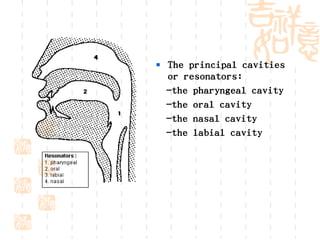
 The principal cavities
  or resonators:
  -the pharyngeal cavity
  -the oral cavity
  -the nasal cavity
  -the labial cavity
The Organ of Speech
 The jaw               The tongue
 The lips              The hard palate
 The teeth             The soft palate
 The teeth ridge       The uvula
  (alveolar ridge)      The larynx
 The vocal cords       The pharynx
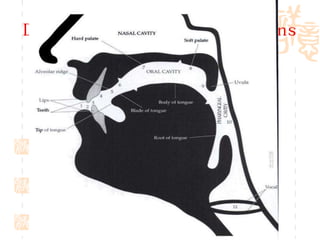
Diagram of the speech organs
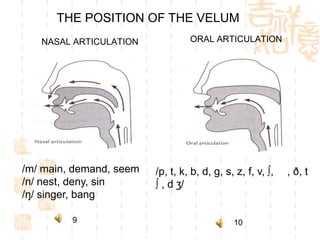
THE POSITION OF THE VELUM
   NASAL ARTICULATION             ORAL ARTICULATION


/m/ main, demand, seem   /p, t, k, b, d, g, s, z, f, v, ∫, , ð, t
/n/ nest, deny, sin      ∫ , d ʒ/
/ŋ/ singer, bang

         9                                    10
Definition of Consonants &Vowels
Consonants: the sounds in the production of
 which there is an obstruction of the air- stream
 at some point of the vocal tract .

Vowels: the sounds in the production of which
 no articulators come very close together and
 the air-stream passes through the vocal tract
 without obstruction.
Consonants
 The place of articulation
the manner of articulation.
(2)Place of Articulation

When describing the place of articulation,
what we usually consider is the place within
the vocal tract where the articulators form a
structure.
PLACE OR POINT OF ARTICULATION
                  Place of articulation                                         Examples

Bilabial using closing movement of both lips.                   /p, b, m/ as in pain, describe, main

Alveolar produced with the tongue tip on or near the tooth      / d, t, n, l/ as in to, do, new, and
ridge                                                           light
Labio – dental using the lower lip and the upper teeth.         /f, v/ as in rifle, value

Inter Dental the tongue tip i sused either between the teeth    /ð , ɵ/ as in thick, then
or close to the upper teeth.
Palato-alveolar the blade (or tip) of tongue is used just       /s, z/ as in seal, zeal
behind the alveolar ridge

Palatal the front of the tongue is raised close to the palate   /∫, t∫, ʒ, dʒ /as in chow, Jim,show,
                                                                beige.

Retroflex the trip of the tongue curls back to touch or         /r/ as in rye
nearmy the hard plate
Velar the back of the tongue is used againts the soft palate    /k, g, ŋ/ as in kite, go, and bang


Glottal the [h] word sound                                      /h/ as in house, who.
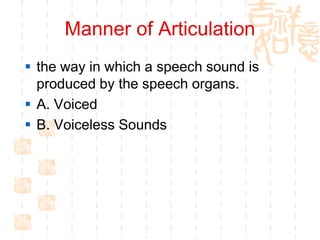
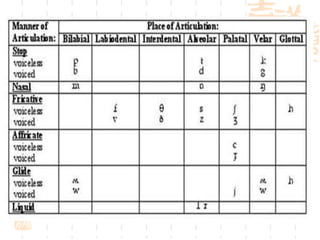
Manner of Articulation
 the way in which a speech sound is
  produced by the speech organs.
 A. Voiced
 B. Voiceless Sounds
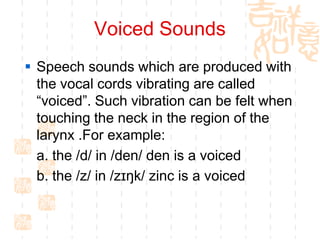
Voiced Sounds
 Speech sounds which are produced with
  the vocal cords vibrating are called
  “voiced”. Such vibration can be felt when
  touching the neck in the region of the
  larynx .For example:
  a. the /d/ in /den/ den is a voiced
  b. the /z/ in /zɪŋk/ zinc is a voiced
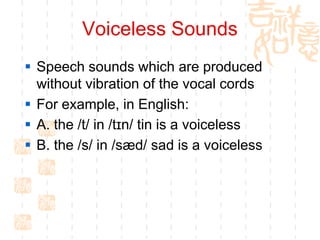
Voiceless Sounds
 Speech sounds which are produced
  without vibration of the vocal cords
 For example, in English:
 A. the /t/ in /tɪn/ tin is a voiceless
 B. the /s/ in /sæd/ sad is a voiceless
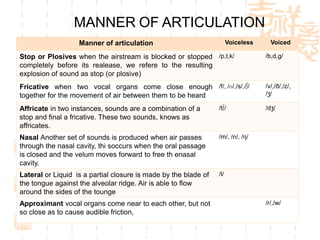
MANNER OF ARTICULATION
                   Manner of articulation                              Voiceless     Voiced

Stop or Plosives when the airstream is blocked or stopped /p,t,k/                  /b,d,g/
completely before its realease, we refere to the resulting
explosion of sound as stop (or plosive)
Fricative when two vocal organs come close enough /f/, /ɵ/,/s/,/∫/                 /v/,/ð/,/z/,
together for the movement of air between them to be heard                          /ʒ/

Affricate in two instances, sounds are a combination of a        /t∫/              /dʒ/
stop and final a fricative. These two sounds, knows as
affricates.
Nasal Another set of sounds is produced when air passes          /m/, /n/, /ŋ/
through the nasal cavity, thi soccurs when the oral passage
is closed and the velum moves forward to free th enasal
cavity.
Lateral or Liquid is a partial closure is made by the blade of   /l/
the tongue against the alveolar ridge. Air is able to flow
around the sides of the tounge
Approximant vocal organs come near to each other, but not                          /r/,/w/
so close as to cause audible friction,
Vowels
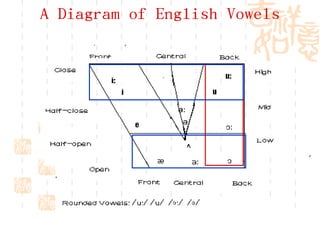
A Diagram of English Vowels
monophthong   e.g. [u]
diphthong     e.g. [au] [uə]
triphthong    e.g. [auə]
suprasegmentals
   stress
   pitch
   tone
   Intonation

       They relate to aspects of pronunciation
    that go beyond the production of individual
    segments.
Stress and pitch

[,u:nI'vɜ:sətI ]

Phonetics and phonology ppt

  • 1.
  • 2.
    Phonology  the studyof word-to-word relations in sentences; that is, how sound patterns are affected by the combination of words. For example, /g∂v/give and /h∂m/ him may combine to /g∂v∂m/ give him.
  • 3.
    Phonology  Phonology involvestwo studies:  A. Phonetics: The study of the production, transmission, and reception of speech sound.  B. Phonemic: the study of the sounds and sound patterns of a specific language
  • 4.
    Three stages inspeech chain  The production of the message  The transmission of the message  The reception of the message  Articulatory phonetics  Acoustic phonetics  Auditory phonetics
  • 5.
     The principalcavities or resonators: -the pharyngeal cavity -the oral cavity -the nasal cavity -the labial cavity
  • 6.
    The Organ ofSpeech  The jaw  The tongue  The lips  The hard palate  The teeth  The soft palate  The teeth ridge  The uvula (alveolar ridge)  The larynx  The vocal cords  The pharynx
  • 7.
    Diagram of thespeech organs
  • 8.
    THE POSITION OFTHE VELUM NASAL ARTICULATION ORAL ARTICULATION /m/ main, demand, seem /p, t, k, b, d, g, s, z, f, v, ∫, , ð, t /n/ nest, deny, sin ∫ , d ʒ/ /ŋ/ singer, bang 9 10
  • 9.
    Definition of Consonants&Vowels Consonants: the sounds in the production of which there is an obstruction of the air- stream at some point of the vocal tract . Vowels: the sounds in the production of which no articulators come very close together and the air-stream passes through the vocal tract without obstruction.
  • 10.
    Consonants The placeof articulation the manner of articulation.
  • 11.
    (2)Place of Articulation Whendescribing the place of articulation, what we usually consider is the place within the vocal tract where the articulators form a structure.
  • 12.
    PLACE OR POINTOF ARTICULATION Place of articulation Examples Bilabial using closing movement of both lips. /p, b, m/ as in pain, describe, main Alveolar produced with the tongue tip on or near the tooth / d, t, n, l/ as in to, do, new, and ridge light Labio – dental using the lower lip and the upper teeth. /f, v/ as in rifle, value Inter Dental the tongue tip i sused either between the teeth /ð , ɵ/ as in thick, then or close to the upper teeth. Palato-alveolar the blade (or tip) of tongue is used just /s, z/ as in seal, zeal behind the alveolar ridge Palatal the front of the tongue is raised close to the palate /∫, t∫, ʒ, dʒ /as in chow, Jim,show, beige. Retroflex the trip of the tongue curls back to touch or /r/ as in rye nearmy the hard plate Velar the back of the tongue is used againts the soft palate /k, g, ŋ/ as in kite, go, and bang Glottal the [h] word sound /h/ as in house, who.
  • 13.
    Manner of Articulation the way in which a speech sound is produced by the speech organs.  A. Voiced  B. Voiceless Sounds
  • 14.
    Voiced Sounds  Speechsounds which are produced with the vocal cords vibrating are called “voiced”. Such vibration can be felt when touching the neck in the region of the larynx .For example: a. the /d/ in /den/ den is a voiced b. the /z/ in /zɪŋk/ zinc is a voiced
  • 15.
    Voiceless Sounds  Speechsounds which are produced without vibration of the vocal cords  For example, in English:  A. the /t/ in /tɪn/ tin is a voiceless  B. the /s/ in /sæd/ sad is a voiceless
  • 16.
    MANNER OF ARTICULATION Manner of articulation Voiceless Voiced Stop or Plosives when the airstream is blocked or stopped /p,t,k/ /b,d,g/ completely before its realease, we refere to the resulting explosion of sound as stop (or plosive) Fricative when two vocal organs come close enough /f/, /ɵ/,/s/,/∫/ /v/,/ð/,/z/, together for the movement of air between them to be heard /ʒ/ Affricate in two instances, sounds are a combination of a /t∫/ /dʒ/ stop and final a fricative. These two sounds, knows as affricates. Nasal Another set of sounds is produced when air passes /m/, /n/, /ŋ/ through the nasal cavity, thi soccurs when the oral passage is closed and the velum moves forward to free th enasal cavity. Lateral or Liquid is a partial closure is made by the blade of /l/ the tongue against the alveolar ridge. Air is able to flow around the sides of the tounge Approximant vocal organs come near to each other, but not /r/,/w/ so close as to cause audible friction,
  • 18.
  • 19.
    A Diagram ofEnglish Vowels
  • 20.
    monophthong e.g. [u] diphthong e.g. [au] [uə] triphthong e.g. [auə]
  • 21.
    suprasegmentals  stress  pitch  tone  Intonation They relate to aspects of pronunciation that go beyond the production of individual segments.
  • 22.