







Phonetics
-from the greek
word phone meaning
sound or voice
-branch of linguistic
that comprises the study
oof the sounds and their
production.
Phonetics
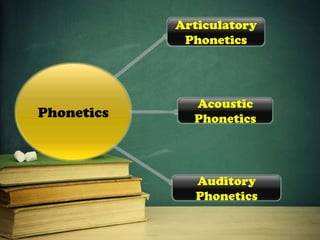
Articulatory
Phonetics
Acoustic
Phonetics
Auditory
Phonetics
Articulatory phonetics
-the study of the
production of speech by the
organs of speech by the
speaker.
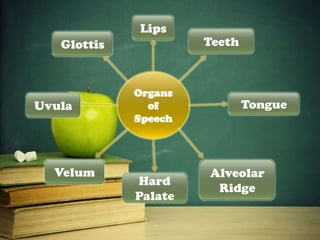
Organs
of
Speech
Lips
Teeth
Tongue
Alveolar
Ridge
Hard
Palate
Velum
Uvula
Glottis
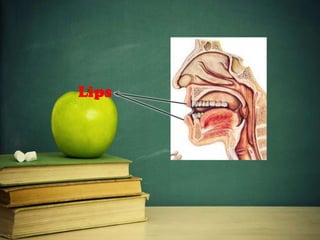
Lips
The upper lip and lower lip help
to produce bilabial sounds
/p, b, m/. If they are held
together, the sounds produced
in that position are bilabial
stops : / p, b/. If the lips are held
together, they produce
different vowels.
Lips
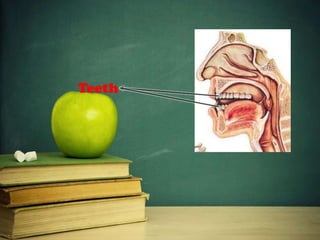
Teeth
The tip of the tongue helps to
produce /t, d, z, etc/. The
blade of the tongue helps to
produce /t∫, d, ∫, etc/. The
front of the tongue helps to
produce palatal sound /j/
and the back of the tongue
helps to produce /k, g/
sounds.
Teeth
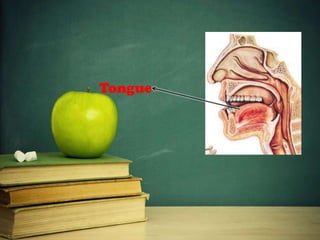
Tongue
-with its wide variety of
possible movements, it
assists in forming the
sounds of speech.
Tongue
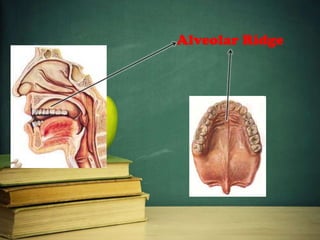
Alveolar Ridge
-hard ridge behind
upper front teeth. It is
between the roof of
the mouth and the
upper teeth.
Alveolar Ridge
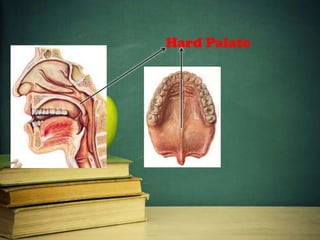
Hard Palate
-also known as the roof
of the mouth.
Hard Palate
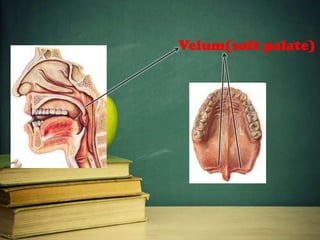
Velum
The soft palate is
movable, consisting of
muscle fibers sheathed in
mucous membrane. It is
responsible for closing off
the nasal passages during the
act of swallowing, and also
for closing off the airway.
Velum(soft palate)
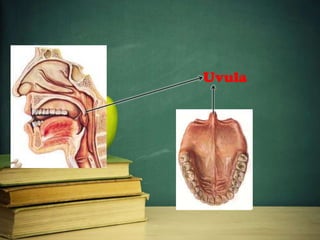
Uvula
-the loose hanging end of
the soft palate.
Uvula
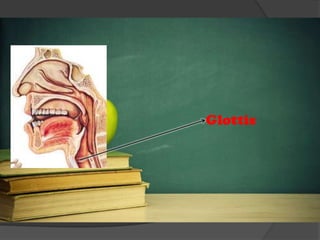
Glottis
- it assist in forming the
buzzing sounds ( g , ng ,j )
Glottis
Acoustic Phonetics
-Is a subfield
of phonetics which deals
with acoustic aspects
of speech sounds.
Auditory Phonetics
Is a subfield of
phonetics concerned
with the hearing of
speech sounds.
Phonetic
Transcription
-It is the visual
representation of
speech sounds. The most
common type of
phonetic transcription
uses a phonetic
alphabet is the
International Phonetic
Alphabet
IPA Vowels
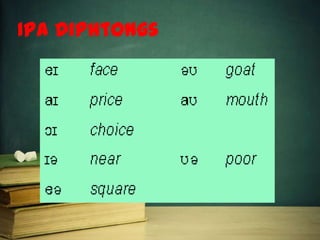
IPA Diphtongs
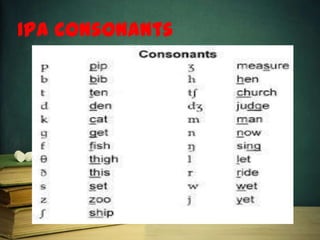
IPA Consonants
“θæŋk ju: !!!”

Phonetics powerpoint