Satika Hajar Rimayanti (16202241005)
Enggar Dwi Nugroho (16202241009)
Romulo Mulianto (16202241018)
Shilvia Intan Kusuma (16202241021)
PHONETICS
Introduction to Linguistic
Dosen Pembimbing: Siti Mukminatun S.S., M.Hum.
KEMENTRIAN RISET TEKNOLOGI DAN PENDIDIKAN TINGGI
UNIVERSITAS NEGERI YOGYAKARTA
Alamat: Jalan Kolombo No.1 Yogyakarta 55281
Telp. (0274)586186 Hunting, Fax (0274) 565500; Rektor Telp. (0274)512192
WR I Telp. / Fax : (0274) 561634, WR II Telp. Fax (0274) 548205; WR IV Telp.
(0274) 555782 Laman; http://www.uny.ac.id – email humas@uny.ac.id
WHAT IS PHONETICS?
• Phonetics is the study of speech sounds. (Fromkin,
2009:190)
• Phonetics - the branch of lingusitics by examining
the inventory and structure of the sounds of speech
which humans are capable of producing (Katamba,
1986:1)
• Traditionally, phonetics deals with measurable,
physical properties of speech sounds themselves,
i.e. precisely how the mouth produces certain
sounds, and the characteristics of the resulting
soundwaves. (Robert Kirchner)
There are three types of phonetics:
1. Acoustic phonetics: focuses on the physical
properties of sounds
2. Auditory phonetics : concerned with how
listeners perceive these sounds
3. Articulatory phonetics : the study of how the
vocal tract produces the sound of language
(adapted from Fromkin,2009)
Vowel and Consonant
Vowel
• Is a sound that needs an open air passage in the
mouth. The air passage can be modified in terms
of shape with different mouth and tongue shapes
producing different vowels.
( Todd, 1987:14)
Consonant
• Is formed when the air stream is restricted or
stopped at some point between the vocal cords
and the lips.
( Todd, 1989:14)
Example
Words :
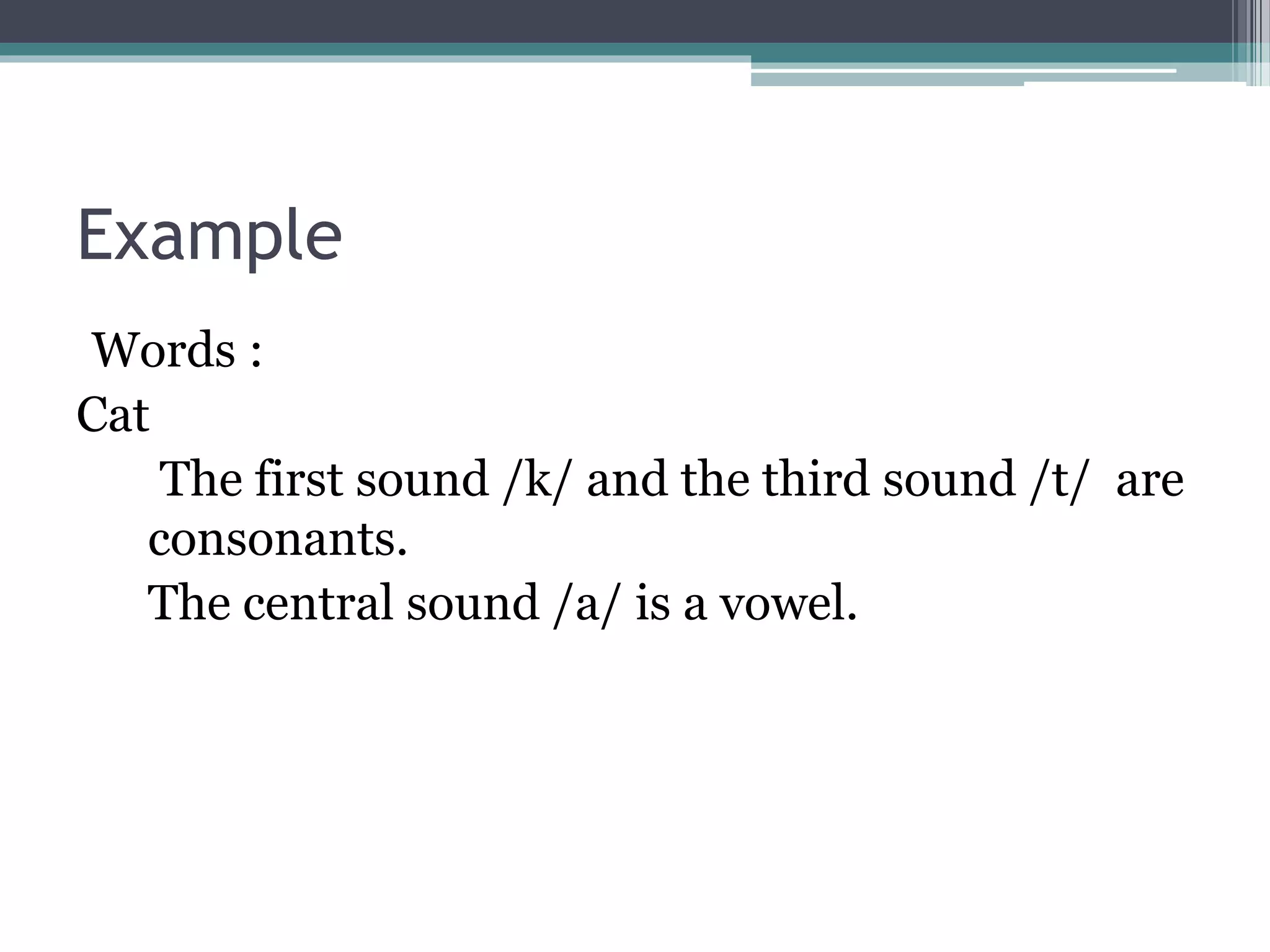
Cat
The first sound /k/ and the third sound /t/ are
consonants.
The central sound /a/ is a vowel.
Place of Articulation
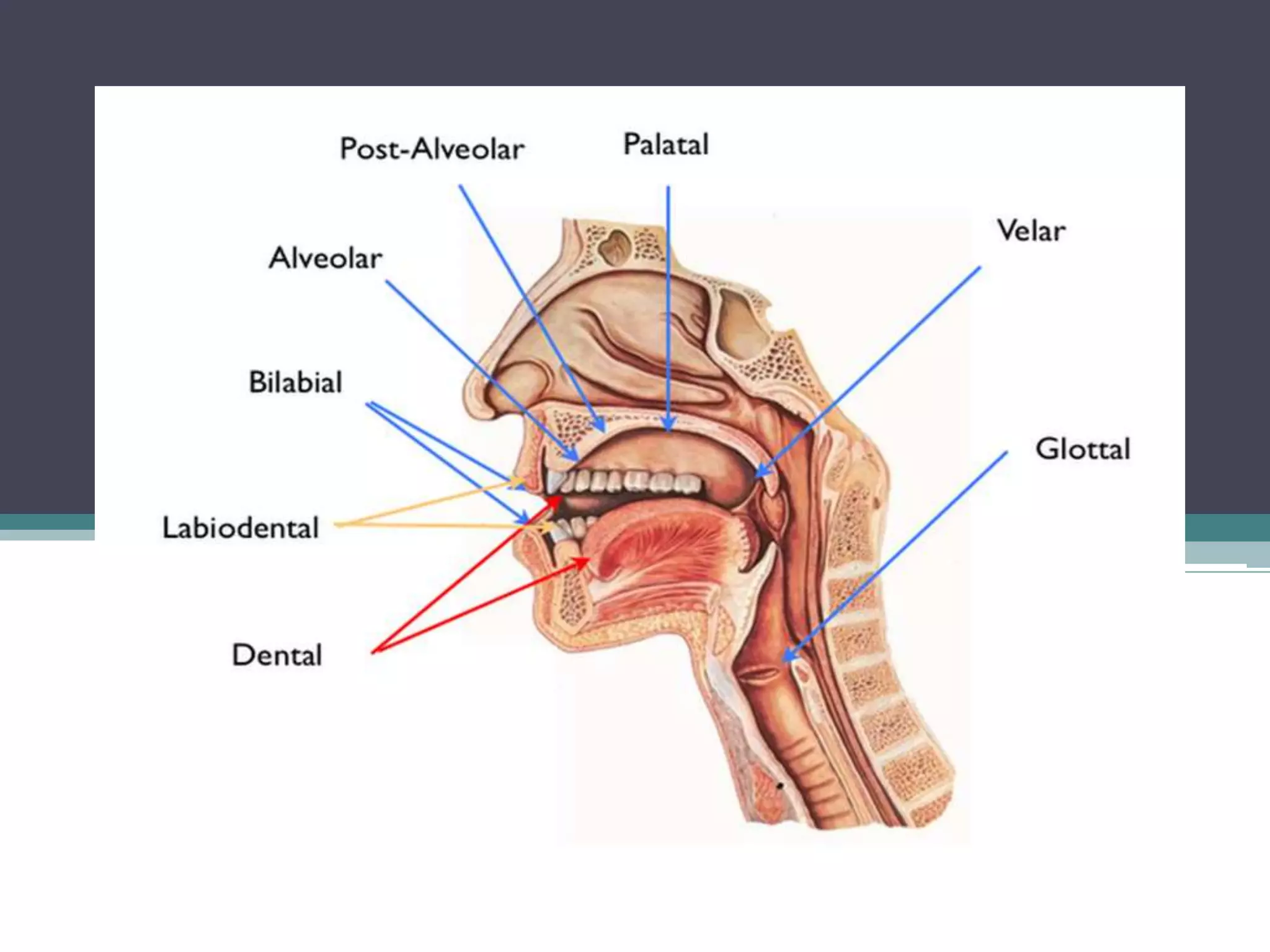
1. Bilabial [p] [b] [m]
Bilabial consonants occur when you block/constrict airflow out of the mouth by bringing
your lips together.
English contains the following three bilabial consonants:
o /p/ as in “purse” and “rap“
o /b/ as in “back” and “cab“
o /m/ as in “mad” and “clam“
2. Labiodental [f][v]
Labiodental consonants occur when you block/constrict airflow by curling your lower lip back
and raising it to touch your upper row of teeth.
English contains the following two labiodental sounds:
o /f/ as in “fro” and “calf“
o /v/ as in “vine” and “have”
3. Dental [θ] [ð]
Dental consonants occur when you block/constrict airflow by placing your
slimy tongue against your upper teeth.
English contains the following two labio-dental sounds:
o /θ/ as is “thick” and “bath“
o /ð/ as in “the” and “rather”
4. Alveolar [n] [t] [d] [s] [z] [l]
You create Alveolar consonants when you raise your tongue to the alveolar
ridge to block or constrict airflow.
The English alveolar consonants are as follows:
o /n/ as in “no” and “man“
o /t/ as in “tab” and “rat“
o /d/ as in “dip” and “bad“
o /s/ as in “suit” and “bus“
o /z/ as in “zit” and “jazz“
o /l/ as in “luck” and “fully
5. Palatal [ʃ] [ʒ] [tʃ] [dʒ]
When you retract your tongue back just a bit from the alveolar ridge, the
sounds change enough to be recognized as distinct consonants.
The palatal english consonants are as follows:
o /ʃ/ as in “shot” or “brash”
o /ʒ/ as in “vision” or “measure”
o /tʃ/ as in “chick” or “match”
o /dʒ/ as in “jam” or “badge“
6. Velar [k] [n] [ŋ]
You make Velar Consonants when you raise the back of your tongue to the
velum to block or restrict airflow.
English has the following velar consonants:
o /ŋ/ as in “going” and “uncle” (note that the ‘n sound’ in these words is NOT
made at the alveolar ridge, which is why it is distinct from /n/).
o /k/ as in “kite” and “back“
o /g/ as in “good” and “bug“
o /w/ as in “wet” and “howard”
7. Glottal [h] [?]
Glottal consonants aren’t actually consonants; they just play consonant roles in
the language.
In English, the following things happen at the glottis:
o /h/ as in “hi” and “Bahamas.”
o /?/ in the phrase “wha(t) time is it?” the /t/ in “what” is dropped and the
vowel sound before it is closed at the glottis.
(Fromkin 2009:195)
MANNER OF ARTICULATION
• The way in which the airstream is interfered with in
producing a consonant. (Francis Katamba, 1986:
4-8)
• The way the airstream is affected as it flows from
the lungs up and out of the mouth and nose.
(Victoria Fromkin, 2009:197)
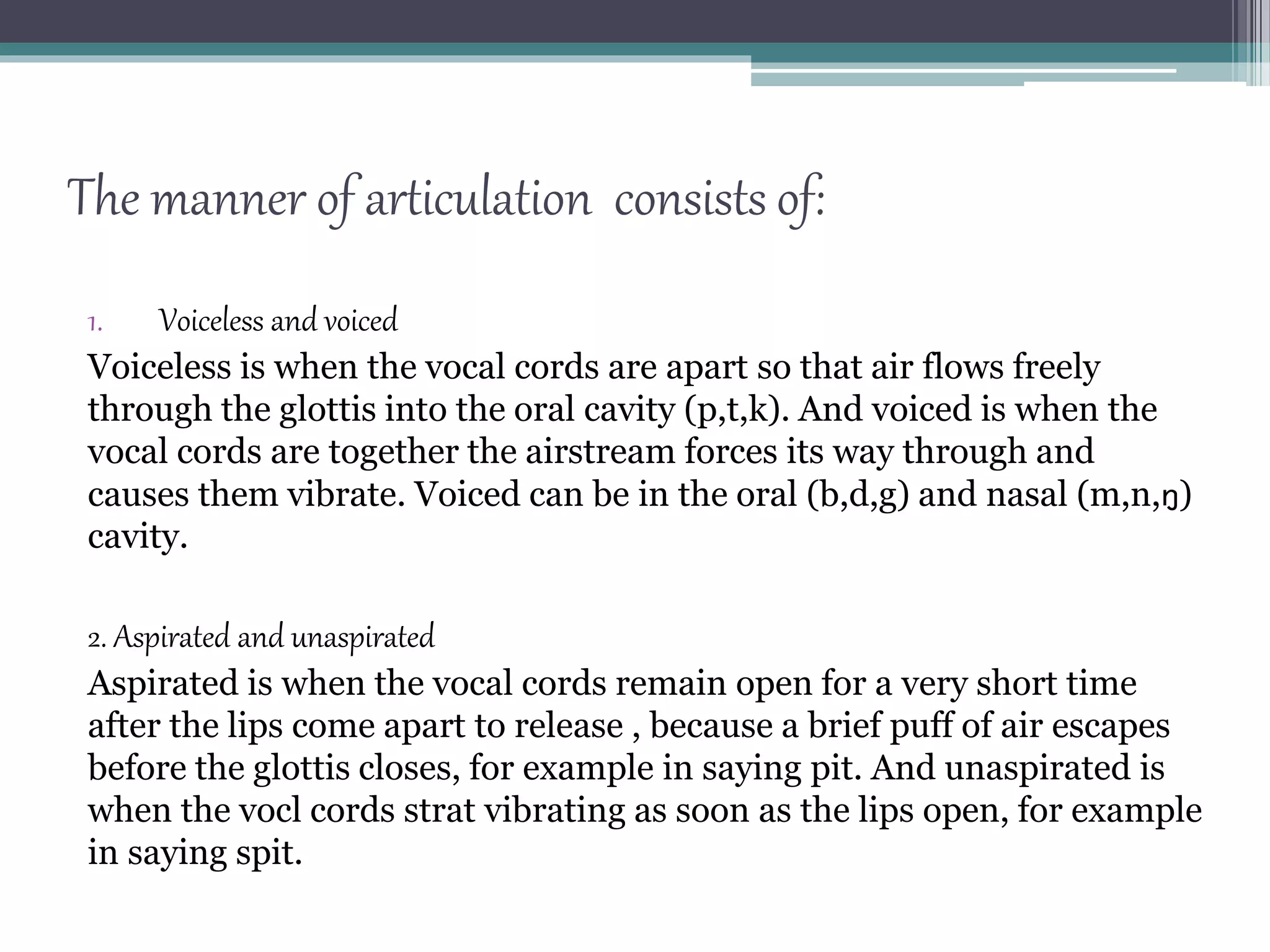
The manner of articulation consists of:
1. Voiceless and voiced
Voiceless is when the vocal cords are apart so that air flows freely
through the glottis into the oral cavity (p,t,k). And voiced is when the
vocal cords are together the airstream forces its way through and
causes them vibrate. Voiced can be in the oral (b,d,g) and nasal (m,n,ŋ)
cavity.
2. Aspirated and unaspirated
Aspirated is when the vocal cords remain open for a very short time
after the lips come apart to release , because a brief puff of air escapes
before the glottis closes, for example in saying pit. And unaspirated is
when the vocl cords strat vibrating as soon as the lips open, for example
in saying spit.
3. Nasal and oral
Nasal is the distinctive feature of nasal consonants is that you let air
out of your nose as you pronounce them. For example,the nasal
consonants [m] and [n] are quite common in languages. And oral is
when the sounds produced with velum up, blocking the air from
escaping through the nose.
4. Stop (p,b,m,t,d,n,k,g,?,ʧ,ʤ,ŋ)
Stops are consonants in which the airstream is completely blocked in the
oral cavity for a short period. All other sounds are continuants.
5. Fricative (f,v,s,z,h,y,x,θ,ð,ʒ,ʃ)
In the production of some continuants, the airflow is so severely
obstructed that it causes frication.
6. Affricatives (ʧ,ʤ )
These sounds are produced by a stop closure followed immediately by
a gradual release of the closure that produced an effect characteristic
of a fricative.
7. Liquids (l,r)
In the production of the sounds, there is some obstruction of the
airstream in the mouth, but not enough to cause any real construction
of friction.
8. Glides (j,w)
the sounds are prodeuced with little obstruction of the airstream. For
example in you [ju] and we [wi].
9. Approximants (w,j,r,l)
The sounds are the rticulators approximate a frictionalcloseness, but
no actual friction occurs. Approximants can be considered half way
between vowels and fricatives.When pronouncing an approximant,
the air flows smoothly through the vocal apparatus so that very little
friction is created.Here are two approximants in Standard American
English: [ɹ], epresented by the letter R and [j], represented by the
letter Y, usually.
10. . Trills
Trills are similar to taps, but instead of a single brief
burst at the place of articulation, it is a series of repeated
bursts.There are no trills in Standard American English, but if
you've ever heard some Spanish, you might have noticed that
some of their R's are trills.The classic example of the trill in
Spanish is found in the word carro. It is sometimes called the
rolled R and it is represented by [r].There are also other types
of trills. Below is an example of a trill using both lips.
11. Taps or Flaps
Taps are similar to plosives, but a tap is a single brief burst
with little accumulation of pressure at the place of articulation
which results in a contact time that is usually much less.Compared to
taps, more pressure is accumulated to produce plosives, which results
in a tendency for them to have longer contact time, especially before
the sound is actually produced.Standard American English does have a
tap consonant: [ɾ].It can be heard in words like bedding and pity.
Organ of Speech
• Sounds could not occur without air. The air
required for most sounds comes from the lungs
and thus egressive (going out). Certain sounds in
languages can, however, be made with air
sucked in through the mouth. Such sounds are
called ingressive (going in). Coming from the
lungs the air stream passes through the larynx,
which popularly referred to as the ‘Adam’s
Apple’.
(Todd,1987)
• Inside the larynx are two folds of ligament and tissue
which make up the vocal cords. These can, be held in five
positions as illustrated in the figure.
1. Wide open as in deep breathing.
2. Open position for voiceless sounds.
3. Cords coming together and loosely and vibrating, the
position for voiced sounds.
4. Narrowed cords used for whispering.
5. Closed is for plosive sounds.
(Todd, 1987)
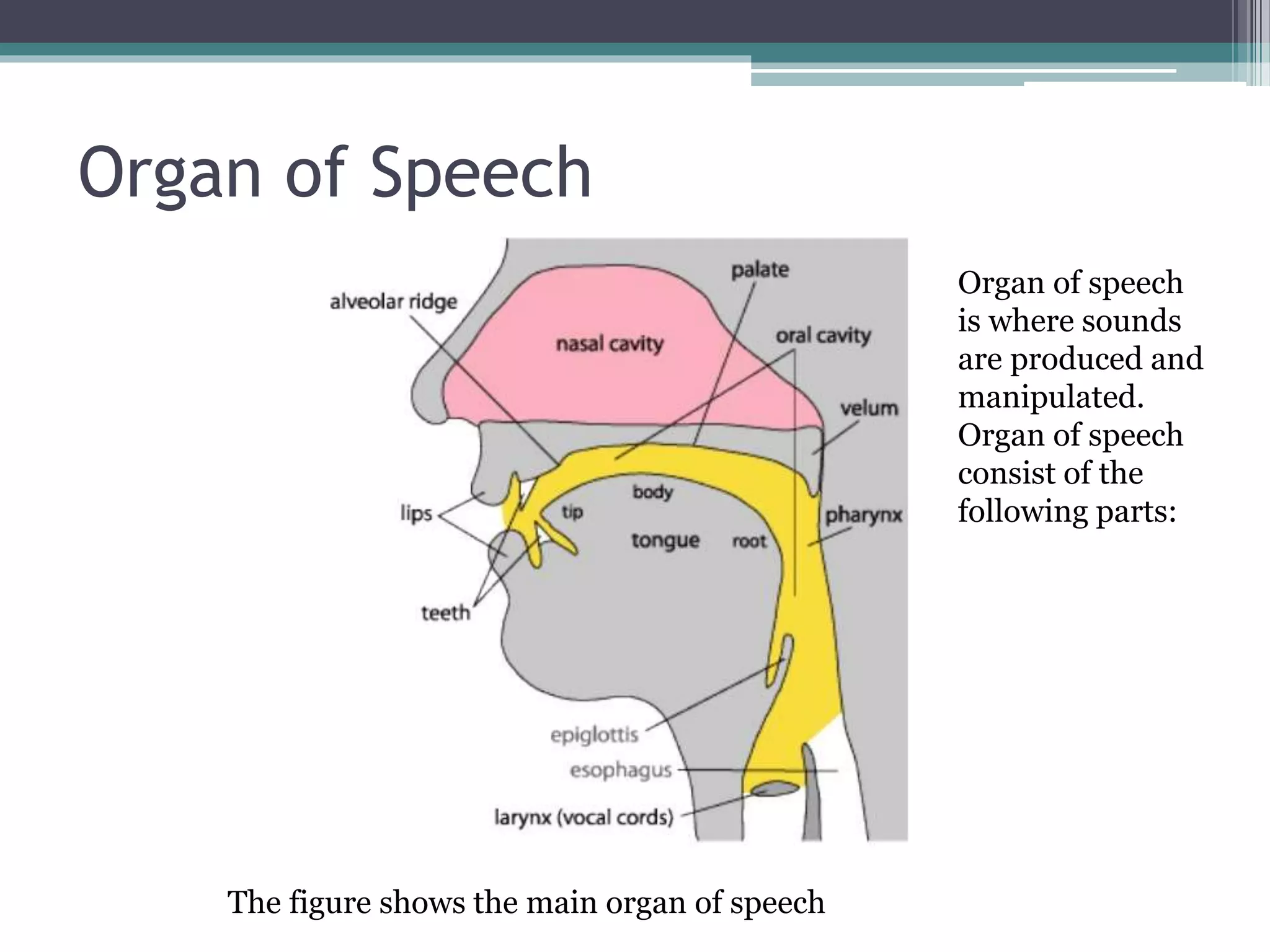
Organ of Speech
The figure shows the main organ of speech
Organ of speech
is where sounds
are produced and
manipulated.
Organ of speech
consist of the
following parts:
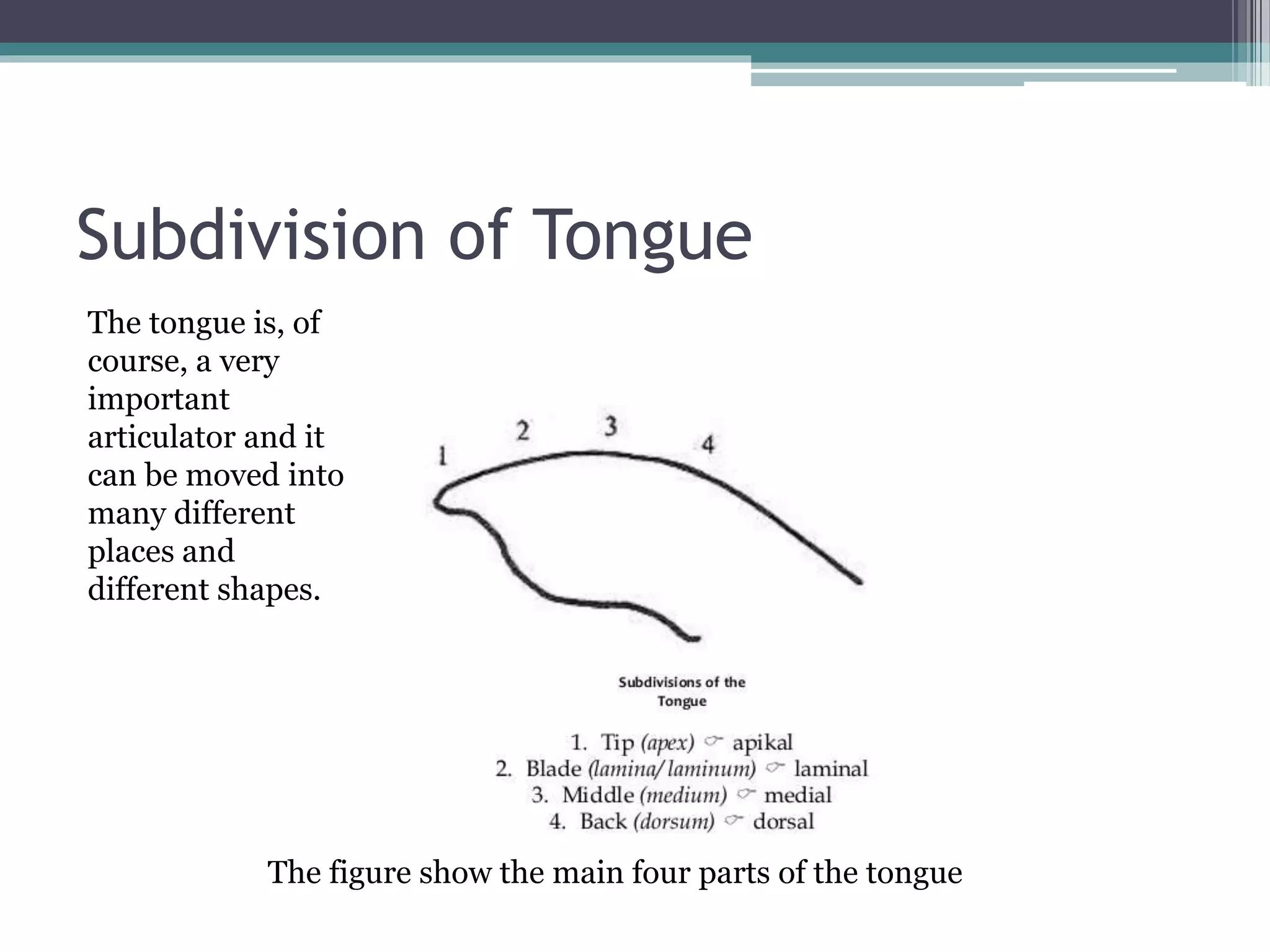
Subdivision of Tongue
The figure show the main four parts of the tongue
The tongue is, of
course, a very
important
articulator and it
can be moved into
many different
places and
different shapes.
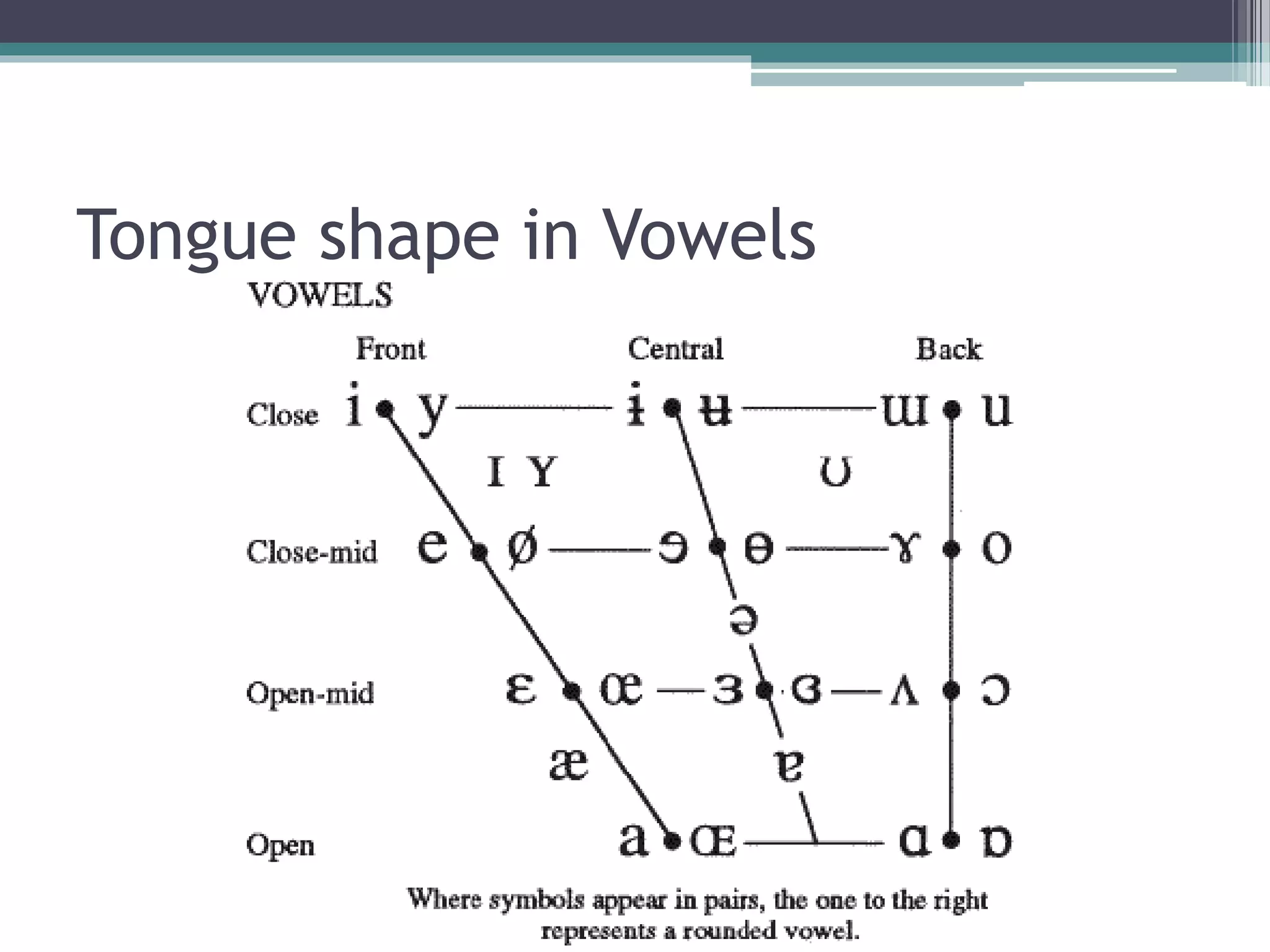
Tongue shape in Vowels
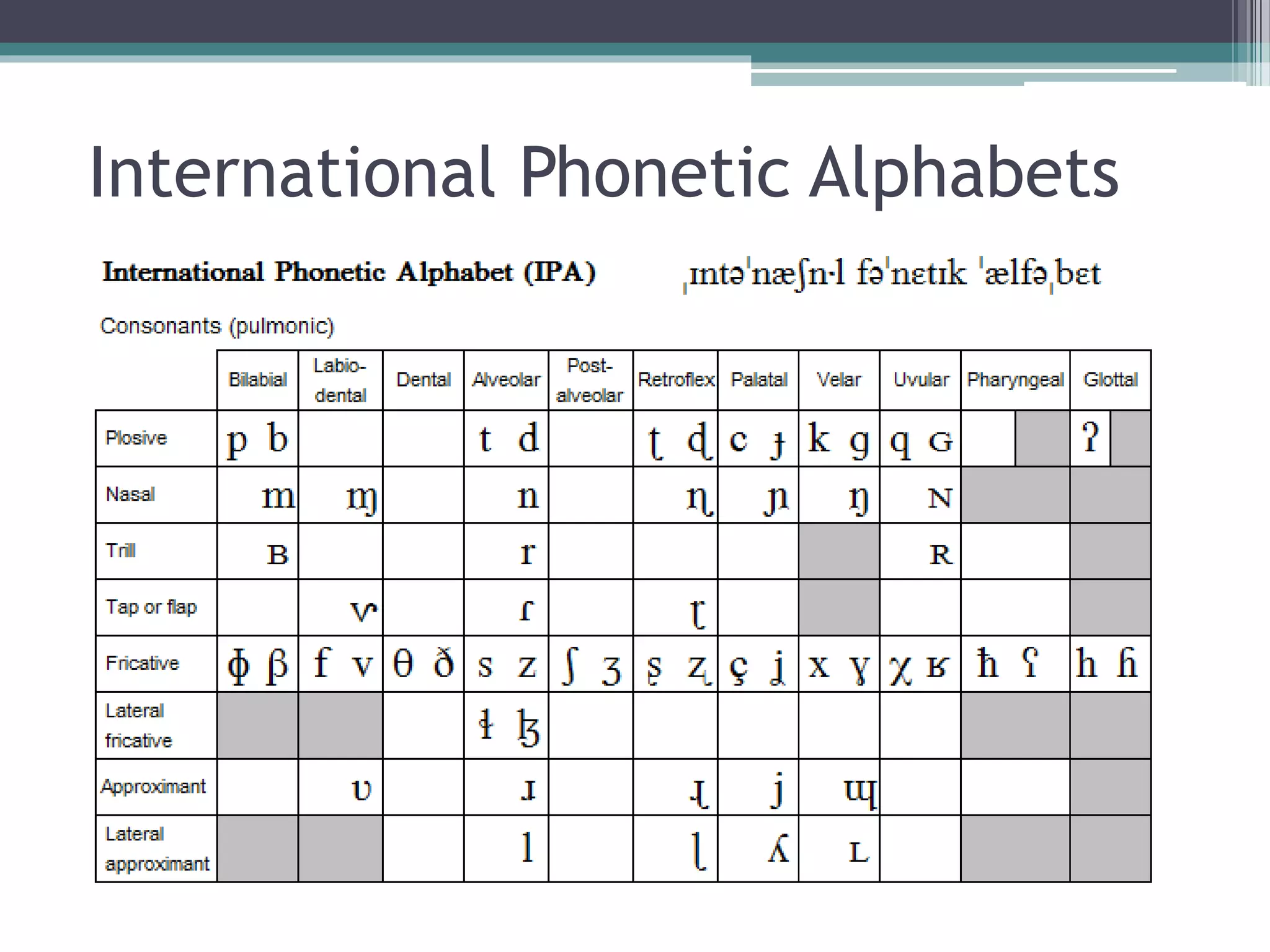
Internatioal Phonetic Alphabets
• The International Phonetic Alphabet (IPA) is
an alphabetic system of phonetic notation based
primarily on the Latin alphabet. It was devised
by the International Phonetic Association in the
late 19th century as a standardized
representation of the sounds of spoken language.
(Wikipedia)
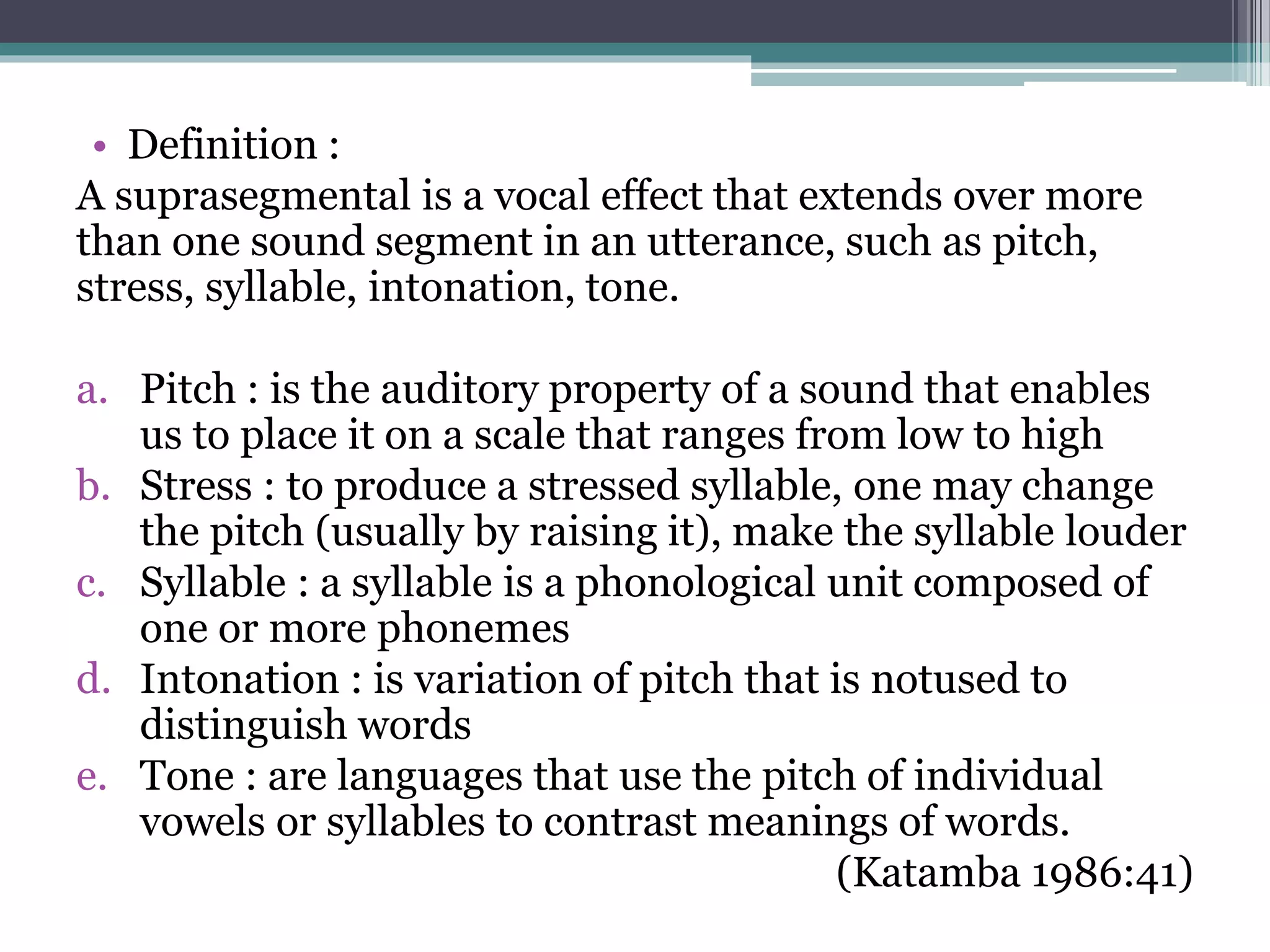
• Definition :
A suprasegmental is a vocal effect that extends over more
than one sound segment in an utterance, such as pitch,
stress, syllable, intonation, tone.
a. Pitch : is the auditory property of a sound that enables
us to place it on a scale that ranges from low to high
b. Stress : to produce a stressed syllable, one may change
the pitch (usually by raising it), make the syllable louder
c. Syllable : a syllable is a phonological unit composed of
one or more phonemes
d. Intonation : is variation of pitch that is notused to
distinguish words
e. Tone : are languages that use the pitch of individual
vowels or syllables to contrast meanings of words.
(Katamba 1986:41)
International Phonetic Alphabets
References
- Stabler, E. (2010): Leture Notes: Linguistics
- Fromkin, V. (2009): An Introduction to
Language. USA: Michael Rosenberg.
- Katamba, F. (1987): Contemporary Linguistics.
UK: Longman

Phonetics ( Introduction to Linguistics )

  • 1.
    Satika Hajar Rimayanti(16202241005) Enggar Dwi Nugroho (16202241009) Romulo Mulianto (16202241018) Shilvia Intan Kusuma (16202241021) PHONETICS Introduction to Linguistic Dosen Pembimbing: Siti Mukminatun S.S., M.Hum. KEMENTRIAN RISET TEKNOLOGI DAN PENDIDIKAN TINGGI UNIVERSITAS NEGERI YOGYAKARTA Alamat: Jalan Kolombo No.1 Yogyakarta 55281 Telp. (0274)586186 Hunting, Fax (0274) 565500; Rektor Telp. (0274)512192 WR I Telp. / Fax : (0274) 561634, WR II Telp. Fax (0274) 548205; WR IV Telp. (0274) 555782 Laman; http://www.uny.ac.id – email humas@uny.ac.id
  • 2.
    WHAT IS PHONETICS? •Phonetics is the study of speech sounds. (Fromkin, 2009:190) • Phonetics - the branch of lingusitics by examining the inventory and structure of the sounds of speech which humans are capable of producing (Katamba, 1986:1) • Traditionally, phonetics deals with measurable, physical properties of speech sounds themselves, i.e. precisely how the mouth produces certain sounds, and the characteristics of the resulting soundwaves. (Robert Kirchner)
  • 3.
    There are threetypes of phonetics: 1. Acoustic phonetics: focuses on the physical properties of sounds 2. Auditory phonetics : concerned with how listeners perceive these sounds 3. Articulatory phonetics : the study of how the vocal tract produces the sound of language (adapted from Fromkin,2009)
  • 4.
  • 5.
    Vowel • Is asound that needs an open air passage in the mouth. The air passage can be modified in terms of shape with different mouth and tongue shapes producing different vowels. ( Todd, 1987:14)
  • 6.
    Consonant • Is formedwhen the air stream is restricted or stopped at some point between the vocal cords and the lips. ( Todd, 1989:14)
  • 7.
    Example Words : Cat The firstsound /k/ and the third sound /t/ are consonants. The central sound /a/ is a vowel.
  • 8.
  • 10.
    1. Bilabial [p][b] [m] Bilabial consonants occur when you block/constrict airflow out of the mouth by bringing your lips together. English contains the following three bilabial consonants: o /p/ as in “purse” and “rap“ o /b/ as in “back” and “cab“ o /m/ as in “mad” and “clam“ 2. Labiodental [f][v] Labiodental consonants occur when you block/constrict airflow by curling your lower lip back and raising it to touch your upper row of teeth. English contains the following two labiodental sounds: o /f/ as in “fro” and “calf“ o /v/ as in “vine” and “have” 3. Dental [θ] [ð] Dental consonants occur when you block/constrict airflow by placing your slimy tongue against your upper teeth. English contains the following two labio-dental sounds: o /θ/ as is “thick” and “bath“ o /ð/ as in “the” and “rather”
  • 11.
    4. Alveolar [n][t] [d] [s] [z] [l] You create Alveolar consonants when you raise your tongue to the alveolar ridge to block or constrict airflow. The English alveolar consonants are as follows: o /n/ as in “no” and “man“ o /t/ as in “tab” and “rat“ o /d/ as in “dip” and “bad“ o /s/ as in “suit” and “bus“ o /z/ as in “zit” and “jazz“ o /l/ as in “luck” and “fully 5. Palatal [ʃ] [ʒ] [tʃ] [dʒ] When you retract your tongue back just a bit from the alveolar ridge, the sounds change enough to be recognized as distinct consonants. The palatal english consonants are as follows: o /ʃ/ as in “shot” or “brash” o /ʒ/ as in “vision” or “measure” o /tʃ/ as in “chick” or “match” o /dʒ/ as in “jam” or “badge“
  • 12.
    6. Velar [k][n] [ŋ] You make Velar Consonants when you raise the back of your tongue to the velum to block or restrict airflow. English has the following velar consonants: o /ŋ/ as in “going” and “uncle” (note that the ‘n sound’ in these words is NOT made at the alveolar ridge, which is why it is distinct from /n/). o /k/ as in “kite” and “back“ o /g/ as in “good” and “bug“ o /w/ as in “wet” and “howard” 7. Glottal [h] [?] Glottal consonants aren’t actually consonants; they just play consonant roles in the language. In English, the following things happen at the glottis: o /h/ as in “hi” and “Bahamas.” o /?/ in the phrase “wha(t) time is it?” the /t/ in “what” is dropped and the vowel sound before it is closed at the glottis. (Fromkin 2009:195)
  • 13.
    MANNER OF ARTICULATION •The way in which the airstream is interfered with in producing a consonant. (Francis Katamba, 1986: 4-8) • The way the airstream is affected as it flows from the lungs up and out of the mouth and nose. (Victoria Fromkin, 2009:197)
  • 14.
    The manner ofarticulation consists of: 1. Voiceless and voiced Voiceless is when the vocal cords are apart so that air flows freely through the glottis into the oral cavity (p,t,k). And voiced is when the vocal cords are together the airstream forces its way through and causes them vibrate. Voiced can be in the oral (b,d,g) and nasal (m,n,ŋ) cavity. 2. Aspirated and unaspirated Aspirated is when the vocal cords remain open for a very short time after the lips come apart to release , because a brief puff of air escapes before the glottis closes, for example in saying pit. And unaspirated is when the vocl cords strat vibrating as soon as the lips open, for example in saying spit.
  • 15.
    3. Nasal andoral Nasal is the distinctive feature of nasal consonants is that you let air out of your nose as you pronounce them. For example,the nasal consonants [m] and [n] are quite common in languages. And oral is when the sounds produced with velum up, blocking the air from escaping through the nose. 4. Stop (p,b,m,t,d,n,k,g,?,ʧ,ʤ,ŋ) Stops are consonants in which the airstream is completely blocked in the oral cavity for a short period. All other sounds are continuants. 5. Fricative (f,v,s,z,h,y,x,θ,ð,ʒ,ʃ) In the production of some continuants, the airflow is so severely obstructed that it causes frication. 6. Affricatives (ʧ,ʤ ) These sounds are produced by a stop closure followed immediately by a gradual release of the closure that produced an effect characteristic of a fricative.
  • 16.
    7. Liquids (l,r) Inthe production of the sounds, there is some obstruction of the airstream in the mouth, but not enough to cause any real construction of friction. 8. Glides (j,w) the sounds are prodeuced with little obstruction of the airstream. For example in you [ju] and we [wi]. 9. Approximants (w,j,r,l) The sounds are the rticulators approximate a frictionalcloseness, but no actual friction occurs. Approximants can be considered half way between vowels and fricatives.When pronouncing an approximant, the air flows smoothly through the vocal apparatus so that very little friction is created.Here are two approximants in Standard American English: [ɹ], epresented by the letter R and [j], represented by the letter Y, usually.
  • 17.
    10. . Trills Trillsare similar to taps, but instead of a single brief burst at the place of articulation, it is a series of repeated bursts.There are no trills in Standard American English, but if you've ever heard some Spanish, you might have noticed that some of their R's are trills.The classic example of the trill in Spanish is found in the word carro. It is sometimes called the rolled R and it is represented by [r].There are also other types of trills. Below is an example of a trill using both lips. 11. Taps or Flaps Taps are similar to plosives, but a tap is a single brief burst with little accumulation of pressure at the place of articulation which results in a contact time that is usually much less.Compared to taps, more pressure is accumulated to produce plosives, which results in a tendency for them to have longer contact time, especially before the sound is actually produced.Standard American English does have a tap consonant: [ɾ].It can be heard in words like bedding and pity.
  • 18.
    Organ of Speech •Sounds could not occur without air. The air required for most sounds comes from the lungs and thus egressive (going out). Certain sounds in languages can, however, be made with air sucked in through the mouth. Such sounds are called ingressive (going in). Coming from the lungs the air stream passes through the larynx, which popularly referred to as the ‘Adam’s Apple’. (Todd,1987)
  • 19.
    • Inside thelarynx are two folds of ligament and tissue which make up the vocal cords. These can, be held in five positions as illustrated in the figure. 1. Wide open as in deep breathing. 2. Open position for voiceless sounds. 3. Cords coming together and loosely and vibrating, the position for voiced sounds. 4. Narrowed cords used for whispering. 5. Closed is for plosive sounds. (Todd, 1987)
  • 20.
    Organ of Speech Thefigure shows the main organ of speech Organ of speech is where sounds are produced and manipulated. Organ of speech consist of the following parts:
  • 21.
    Subdivision of Tongue Thefigure show the main four parts of the tongue The tongue is, of course, a very important articulator and it can be moved into many different places and different shapes.
  • 22.
  • 23.
    Internatioal Phonetic Alphabets •The International Phonetic Alphabet (IPA) is an alphabetic system of phonetic notation based primarily on the Latin alphabet. It was devised by the International Phonetic Association in the late 19th century as a standardized representation of the sounds of spoken language. (Wikipedia)
  • 24.
    • Definition : Asuprasegmental is a vocal effect that extends over more than one sound segment in an utterance, such as pitch, stress, syllable, intonation, tone. a. Pitch : is the auditory property of a sound that enables us to place it on a scale that ranges from low to high b. Stress : to produce a stressed syllable, one may change the pitch (usually by raising it), make the syllable louder c. Syllable : a syllable is a phonological unit composed of one or more phonemes d. Intonation : is variation of pitch that is notused to distinguish words e. Tone : are languages that use the pitch of individual vowels or syllables to contrast meanings of words. (Katamba 1986:41)
  • 25.
  • 26.
    References - Stabler, E.(2010): Leture Notes: Linguistics - Fromkin, V. (2009): An Introduction to Language. USA: Michael Rosenberg. - Katamba, F. (1987): Contemporary Linguistics. UK: Longman